Li Jiaqi Sells 2 Trillion Tokens in Half an Hour
 11/03 2026
 442
At 7:30 p.m. on November 2, an invisible product landed in Li Jiaqi's livestream shopping cart: the Qianwen Office personal membership monthly card, priced at 1 cent, limited to one order per account. 100,000 units sold out in half an hour.
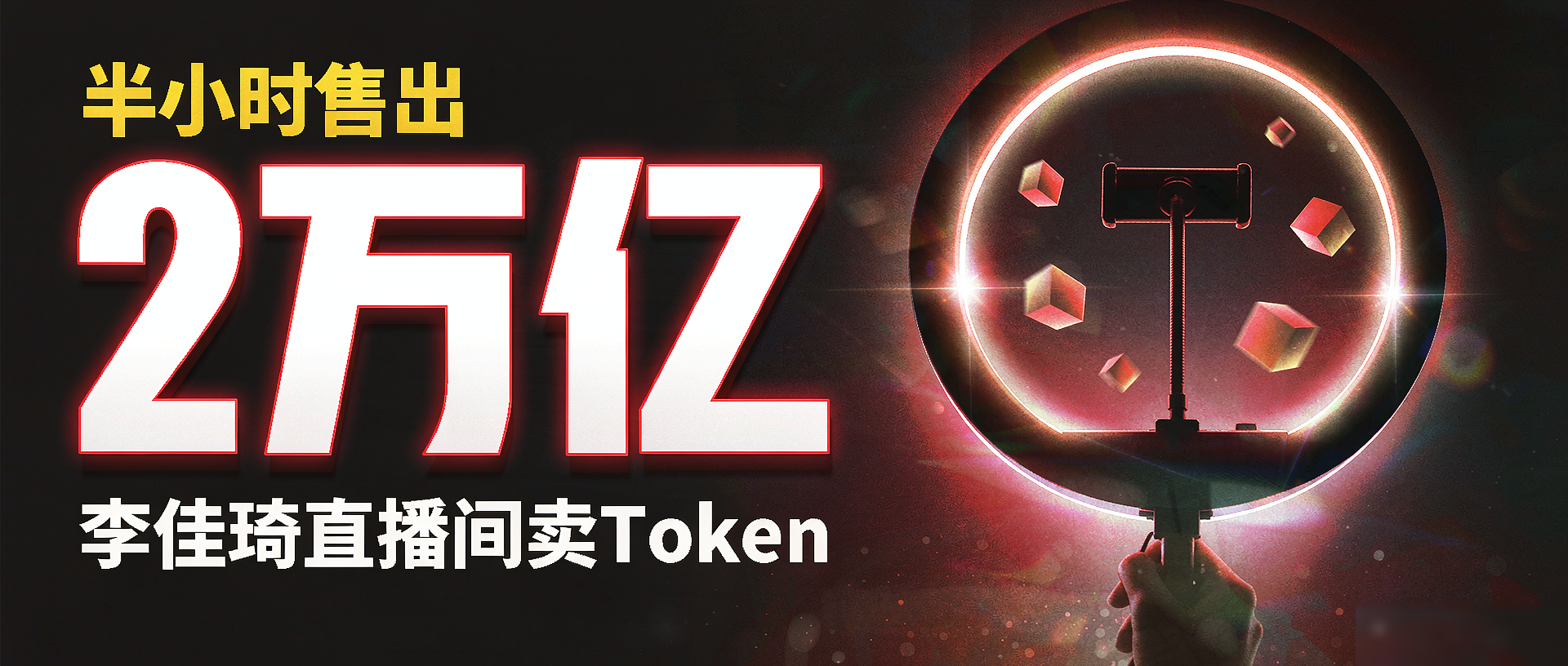
Image: AI generated
100,000 units at 1 cent each amount to 1,000 yuan—and 2 trillion Tokens.
The monthly card normally retails for 28 yuan, slashed to 1 cent in the livestream, on the condition that the user is new and has never activated a membership.
The 2 trillion figure reveals a striking gap once you break it down. Dividing 2 trillion Tokens across 100,000 units yields an average of 20 million Tokens per card. Yet the monthly card benefits clearly state that the basic tier grants 500 points per month, and with bonuses and newcomer perks, eligible users receive only 800 to 900. A single monthly card is worth a few hundred points—not 20 million Tokens.
By common industry standards, one Chinese character is roughly 0.6 Token, so 2 trillion Tokens translates to about 3.3 trillion Chinese characters. Data from the China Academy of Information and Communications Technology shows that in June 2026, domestic daily token consumption stood at 500 trillion. The volume moved in this half-hour livestream equals four-thousandths of the nation's daily consumption.
According to a report by Eastday.com, the 2 trillion figure represents a benefit quota, not the actual computing power consumed. Quota is an accounting unit; consumption is the real cost.
So what this 1,000 yuan actually bought is far more valuable than Tokens: 100,000 new users who completed payment, bound their phone numbers, and entered the membership system—at a unit price of 1 cent.
QuestMobile statistics show that in June this year Qianwen had 167 million MAU, while Doubao had 382 million—more than double the gap. In the first quarter, the activity rate was 17.1% for Qianwen versus 33.5% for Doubao; monthly per-capita usage was 19.8 times versus 54.8 times. Between those who have installed an app and those who actually use it, there is a gap. Qianwen Office wants the latter. The product only began public beta in August this year, positioned for office and internal enterprise collaboration.
Chen Yusen standing next to Li Jiaqi may well be the most intriguing arrangement in this livestream.
Born in 1992, the same age as Li Jiaqi, he graduated from Zhejiang University's Chu Kochen Honors College and founded Chaitin Tech in 2014 to do enterprise security, which was wholly acquired by Alibaba Cloud in 2019, after which he joined Alibaba. On June 11 this year, he took over as CEO of DingTalk, becoming the youngest business unit CEO in Alibaba's history. In July, Alibaba integrated three Agent product lines—QoderWork, Wukong, and MuleRun—into the Qianwen Office business unit, and he also serves as its CEO. On September 22 at the Yunqi Conference, the title Vice President of Alibaba Group was added before his name, rank P11.
More than a month ago, the product he unveiled at the Yunqi Conference was called "Enterprise Context," discussing how Agents can be embedded into enterprise inquiries, quotations, and contract approvals. The customers present were Yihai Kerry Arawana, FAW Toyota, China Unicom Data, and Fangda Partners. More than a month later, he sat in Li Jiaqi's livestream, selling 1-cent monthly cards and answering whether an AI avatar could be made to chat with fans.
Enterprise-level business has a long cycle, while C-end visibility comes quickly. For a business unit just four months old, accounts must be kept on both sides. But looking at these two things in the same quarter, where the money for AI office comes from is not so clear.
The other half of the goods in the livestream is actually hardware. Tmall said that this Double 11, 70 computer models equipped with Qianwen Office will debut, with up to three months of membership included. Tmall 3C Digital General Manager Si Dengyu calls this combination the second growth curve: hardware no longer earns only the purchase-sale price difference, and computing power services continue to charge afterward.
Hardware is the entrance, and subscription is the long business behind it. Exchanging 1 cent for a user installed on a phone is cheaper than advertising in the subway.
A China News Service reporter looked through the Double 11 Token products. Most are priced the same as on the official website, with no major promotional discounts, and store sales remain around a hundred units. For the same type of monthly card, the 28-yuan tier on the official website cannot sell outside Li Jiaqi's livestream.
In other words, the figure of 100,000 units was bought with 1 cent, not grown from demand itself.
-
![]()
Beijing Computing Power Chip Company Initiates IPO Coaching; National AI Industry Fund Participates
-
![]()
Li Jiaqi Sells 2 Trillion Tokens in Half an Hour
-
![]()
AI Agents Enter the Oilfield Decision Chain: The Threshold for Industrial Intelligence Has Changed
-
![]()
Tank Sales Fall 30% Year-on-Year: Has the Hardcore Off-Road Dividend Peaked?
-
Does the China-Market iPhone Duo Cut Corners? Compared to the US Version, Is 1,000 Yuan in Cost Stripped Out?
-
![]()
Apple: The Storage Backlash Finally Arrives — Is the "Safe Haven" Facing AI About to Spring a Leak?
-
![]()
SpaceXSI Opens Global Ambassador Recruitment: Why Is Musk's AI Ecosystem Paying Increasing Attention to Developer Communities?
-
![]()
An Open-Source Model That Lets You Chat About DNA: 14B Parameters, Runs on a Laptop