An Open-Source Model That Lets You Chat About DNA: 14B Parameters, Runs on a Laptop
 11/03 2026
 333
Hugging Face has open-sourced Carbon-X, a 14B-parameter "DNA chat" model that runs on a laptop. Jointly trained by China's Zhongguancun Academy and an Italian team, it turns genomic sequences into natural-language Q&A.
On October 22, the AI platform Hugging Face released a new open-source model called Carbon-X, and what it does sounds like science fiction: you paste a DNA sequence directly into the chat box and ask it in plain language whether "this mutation is benign or pathogenic," and it answers you in natural language. Unlike genomic tools that only crunch numbers in the background and require specialized software to interpret the results, Carbon-X puts DNA and biological descriptions into the same conversation flow, so ordinary people can use it too. More importantly, it has only 14.8B parameters and can run locally on your own laptop, so sensitive data never needs to be uploaded to any cloud.
Behind this is a not-so-complex engineering approach. The team used Qwen3-14B as the base model, added 5,515 tokens specialized for reading DNA to the vocabulary—every 6 bases are encoded as one token, exactly covering 6 base pairs—and then continued training on 300 billion tokens of DNA sequences, English text, and examples of "how DNA corresponds to biological descriptions." It therefore masters two languages at once: the language of the genome and human natural language. Hugging Face research scientist Lewis Tunstall said they deliberately kept the model small so that laboratories and hospitals can run it on their own hardware rather than handing patient data to frontier big tech companies.
What exactly can it do, and where is it strong?
Carbon-X was trained to perform several types of tasks: determine whether a mutation is benign or pathogenic, identify regions that regulate gene activity, classify sequences by biological group, predict the next base of a sequence, and explain its own reasoning. On the average score across five DNA benchmarks, it achieved 66.7%, 27 points higher than the starting point Qwen3-14B, and less than 1 point away from GPT-6.1 Sol's 67.5%—while the inference cost per question is only about 1/1800 of the latter. One frequently cited figure: using Carbon-X to screen all 2.4 million "variants of uncertain significance" in the ClinVar database costs about $300, while the frontier models they tested were quoted at between $32,000 and $4 million.
But the developers themselves are quite restrained in their claims. They have so far not conducted wet-lab validation, the model can miscount bases and confuse coordinates in precise sequence operations, and it is clearly weak on issues such as splice sites and histone marks (only 29.8% and 34.6%, respectively). In other words, its contribution lies mainly in the front end and deployment form, rather than in a proven leap in accuracy. A misjudgment could cause a targeted drug to hit the wrong target and thus be harmful—so Tunstall emphasizes that it should be an aid in researchers' hands, not a tool for directly drawing clinical conclusions.
Why it must run on a laptop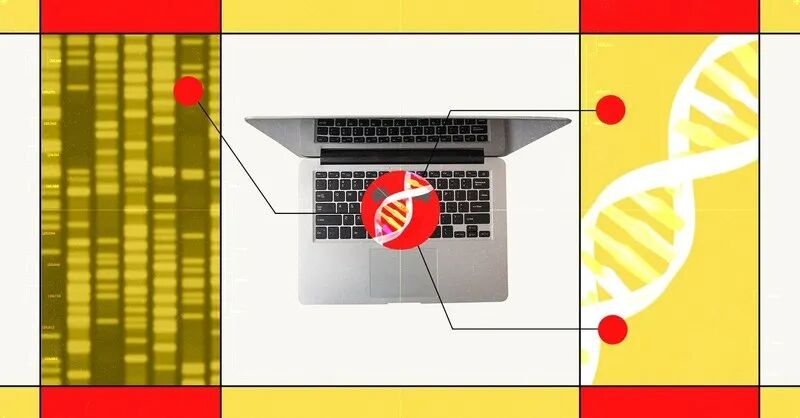
Image source: Wired
Carbon-X compresses the model to 14B, able to fit on a GPU with 80GB of memory, and one of the core considerations is data sovereignty. There are already compliance restrictions on researchers uploading identifiable patient genomic data to frontier closed-source models; local execution means sensitive sequences stay on one's own machine and do not enter any company's cloud. The team also proactively removed viral sequences during training, explicitly saying they did not want the model to be used for dangerous purposes—but this also narrowed the range of organisms it has seen. Another hard constraint is input length: it was trained only on fragments of about 50,000 base pairs, while the human genome has 6 billion letters, so for now it can only perform targeted queries, not whole-genome analysis. The model is open-sourced under the Apache 2.0 license, and the weights have already been made public.
China perspective: open-source models and autonomy in genomic data
One of the joint training parties this time is China's "Zhongguancun Academy," which participated in the research and development of Carbon-X together with the University of Naples Federico II in Italy. At the same time, Nvidia is acquiring Hugging Face for nearly $13 billion; once this "GitHub of AI models" is folded into a computing-power giant, the diffusion path of the open-source ecosystem will also be redefined. For China and the United States, this happens to be a contested intersection: on one side is the US-led frontier closed-source models tied to computing power, and on the other is China's rapid catch-up in open-source weights, genomic data, and biological computing. A paradigm like Carbon-X that "runs locally and keeps data off the cloud" is especially meaningful for genomic data sovereignty—it takes the power of interpretation from the cloud back to the endpoint. But one must also be clear-headed: before wet-lab validation and independent benchmark reproduction are completed, its predictions can only be treated as clues, and clinical and drug decisions must not be blindly trusted.
Today's quote
"Carbon-X turns genomic sequences into natural-language Q&A, but its real value is not in the 'chat'—it is in ensuring that sensitive genomic data does not have to leave your machine—and this precisely hits the nerve of the contest between China and the United States over open-source AI and biological data sovereignty."
Follow [Degao Xing Zhixinglang] for three hardcore technology interpretations every day, and understand the industry and national fortunes behind technology.
-
![]()
Beijing Computing Power Chip Company Initiates IPO Coaching; National AI Industry Fund Participates
-
![]()
Li Jiaqi Sells 2 Trillion Tokens in Half an Hour
-
![]()
AI Agents Enter the Oilfield Decision Chain: The Threshold for Industrial Intelligence Has Changed
-
![]()
Tank Sales Fall 30% Year-on-Year: Has the Hardcore Off-Road Dividend Peaked?
-
Does the China-Market iPhone Duo Cut Corners? Compared to the US Version, Is 1,000 Yuan in Cost Stripped Out?
-
![]()
Apple: The Storage Backlash Finally Arrives — Is the "Safe Haven" Facing AI About to Spring a Leak?
-
![]()
SpaceXSI Opens Global Ambassador Recruitment: Why Is Musk's AI Ecosystem Paying Increasing Attention to Developer Communities?
-
![]()
An Open-Source Model That Lets You Chat About DNA: 14B Parameters, Runs on a Laptop