Domestic Computing Power Firms Favoring Private Placements: The New Capital Market Favorites
 09/14 2026
 412
412
Don't Treat Shareholders as If They Were Portable Chargers
Inspur Information's stock price has recently been haunted by market 'whispers'.
On September 4th, Inspur Information's stock opened and promptly tumbled, hitting the daily limit down in the afternoon, with a total trading volume surpassing 13.7 billion yuan for the day.
At that time, the market speculated about the reasons. Guolian Minsheng Computer quickly issued a bullish statement, suggesting that the adjustment was primarily due to the shift from traditional AI server models to super nodes, with concerns about the third quarter being a transitional period for supply chain and customer product changes. However, this short-term disruption was seen as paving the way for larger-scale demand later, with expectations for sustained high growth in performance from the fourth quarter to the following year.
Yet, the stock price continued to decline despite this explanation. Over the five trading days of the week, Inspur Information's stock kept falling, closing in the red from Monday to Thursday, and only managing a slight increase of 0.16% on Friday.
The market kept speculating about Inspur Information's situation until the answer finally emerged after the market closed on Friday.
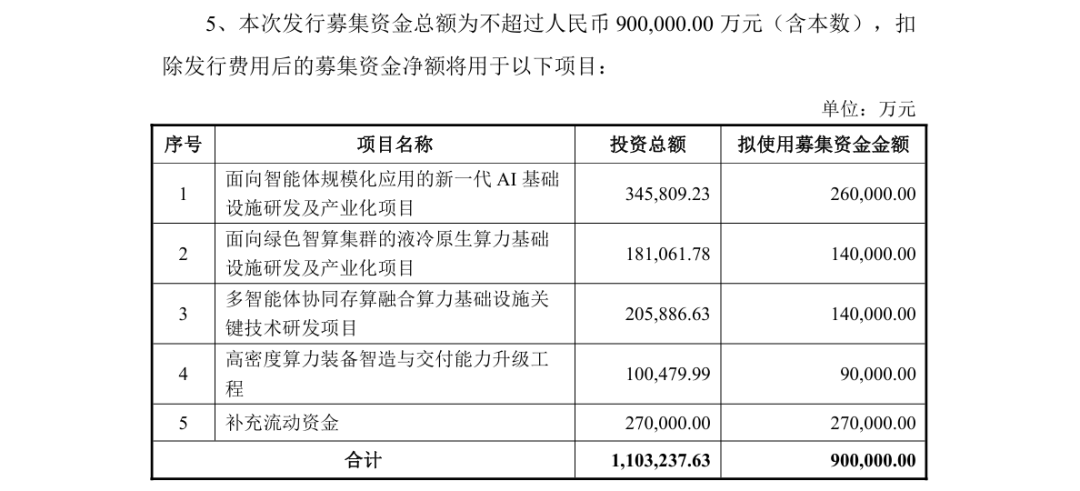
On the evening of September 11th, Inspur Information announced a private placement plan, proposing to issue shares to no more than 35 specific investors, raising no more than 9 billion yuan for projects such as next-generation AI infrastructure, liquid-cooled computing power, integrated storage and computing, and high-density computing equipment, with 2.7 billion yuan allocated to supplement working capital. This 9 billion yuan private placement also marked the largest equity financing in Inspur Information's history since its listing.
However, Inspur Information is not an isolated case but rather a microcosm of the 'private placement boom' in domestic computing power.
01 Domestic Computing Power: Dipping into Shareholders' Wallets
Inspur Information's 9 billion yuan is just a fraction of this year's financing frenzy in domestic computing power. Expanding the scope from servers to upstream and downstream sectors reveals that almost the entire domestic computing power industry chain, from advanced packaging, PCBs, and IC substrates to servers and smart computing centers, is tapping into the capital market.
Moreover, compared to borrowing through bonds, these companies seem to prefer a method that doesn't require repayment of principal or interest—private placements.
According to incomplete statistics by Super Focus, as of now, at least 13 companies in the domestic computing power industry chain have disclosed private placement plans this year, planning to raise a total of approximately 50.7 billion yuan.
Inspur Information alone plans to raise 9 billion yuan; Xiechuang Data plans to raise 8 billion yuan; Changdian Technology 6.5 billion yuan; Unisplendour 5.41 billion yuan; Litong Electronics 5 billion yuan; Shennan Circuits 4.367 billion yuan; and Fastprint Technology also plans to raise 3.9 billion yuan from the market.
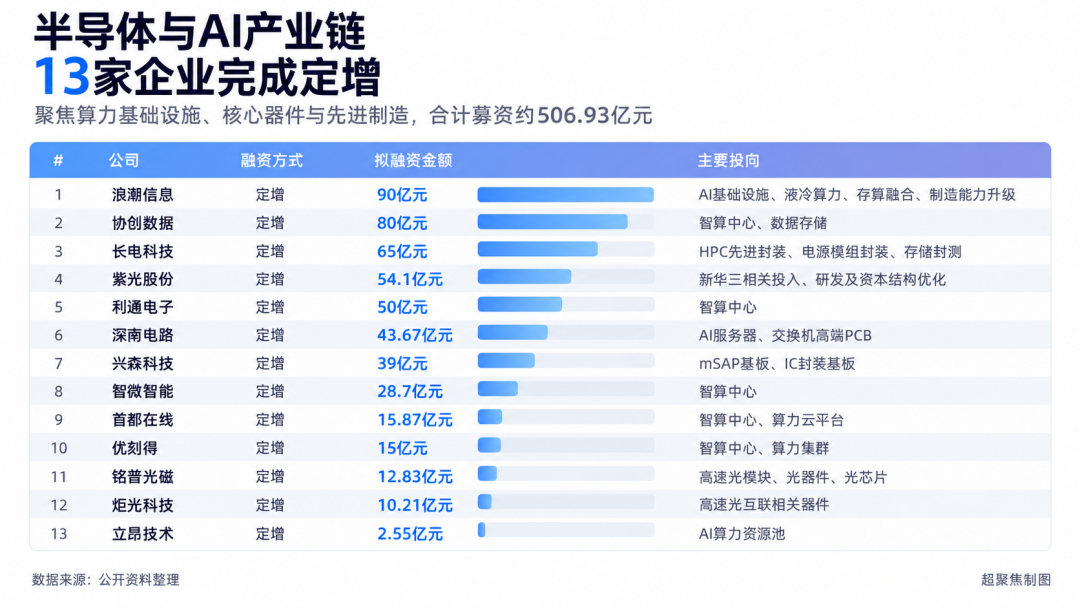
The destinations for these funds are also remarkably similar. Inspur aims to build AI infrastructure, liquid-cooled computing power, and integrated storage and computing products; Changdian bets on HPC advanced packaging; Shennan expands AI server and switch PCBs; while Fastprint continues to invest in high-end mSAP substrates and IC packaging substrates.
On one hand, there is high growth in AI demand; on the other hand, there is collective expansion across the industry chain, with the capital market becoming the most direct source of funds.
Of course, not all domestic computing power companies are insatiable; some are willing to invest through debt.
This year, Dawning Information Industry issued 8 billion yuan in convertible bonds for advanced AI computing clusters, next-generation AI training and inference all-in-one machines, and domestic advanced storage; Richinfo plans to raise 1.27 billion yuan through convertible bonds; while Mingyang Circuit plans to raise 1.2 billion yuan through convertible bonds to build high-end AI HDI computing power products.
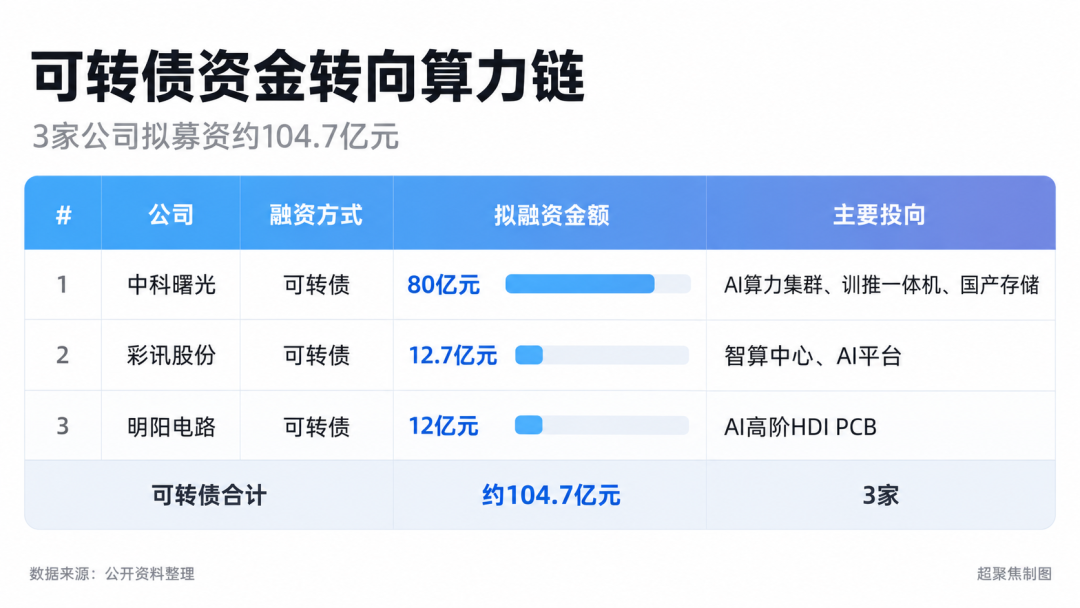
But when comparing the two, the disparity becomes evident.
According to the above figures, domestic computing power-related companies plan to raise approximately 50.7 billion yuan through private placements this year, while convertible bond financing is only about 10.5 billion yuan, with the former nearly five times the latter.
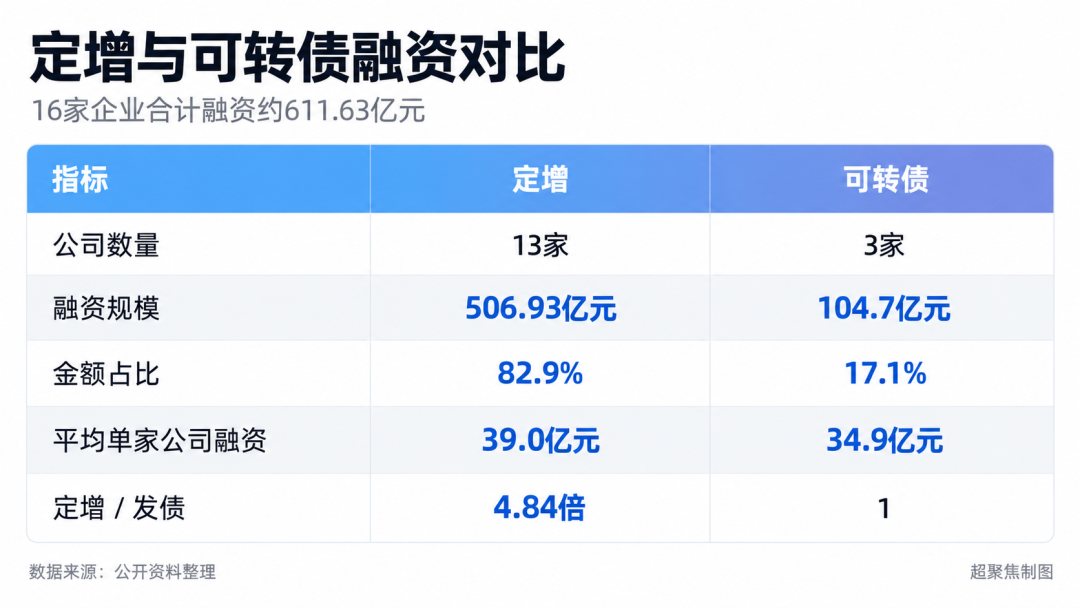
More notably, debt financing is highly concentrated among a few companies. Dawning Information Industry's 8 billion yuan in convertible bonds alone accounts for the majority of this financing; in contrast, private placements range from Inspur Information, Changdian Technology, and Unisplendour to Shennan Circuits, Fastprint Technology, and a number of smart computing center companies, covering almost every link in the domestic computing power industry chain.
In other words, bond issuance seems to be the choice of a few industry leaders, while private placements have become a collective move across the entire domestic computing power industry chain.
But why are companies so fond of private placements? The answer is not complicated—for companies, the biggest difference between bond issuance and private placements is not where the money comes from but whether it needs to be repaid later.
Bond issuance essentially uses future cash flows as collateral for today's expansion. Whether the project is profitable or not, interest must still be paid, and the principal must be repaid upon maturity. Especially for heavy asset investments like computing power, which often involve billions of yuan, once demand falls short of expectations, the debt does not disappear with the orders.
Private placements are much more lenient.
Once shares are issued and cash is received, the company has no fixed interest payments or principal repayment pressure. Even if the expansion pace is misjudged, product iterations are missed, or new capacity fails to deliver profits, the cost of trial and error ultimately manifests more in the stock price and equity value.
In other words, bond issuance means the company bears the project's risks, while private placements shift the project risks to shareholders. This 'risk-free' financing method is particularly appealing for today's domestic computing power companies, as the diluted equity of existing shareholders seems insignificant under the allure of 'no risk'.
Moreover, after AI concepts drive up valuations, the higher a company's market capitalization, the lower the proportion of newly issued shares needed to raise the same 5 billion yuan. For listed companies, rising stock prices themselves become an asset that can be used for financing.
Thus, a very smooth cycle emerges: AI-driven prosperity leads to rising company valuations; higher valuations reduce equity financing costs; listed companies obtain more funds through private placements; they then continue to expand production, using even greater capacity to meet market expectations for AI growth.
02 The Capital Market Is Not an ATM for Listed Companies
If we look beyond companies' claims of 'strengthening capital strength' and 'seizing AI opportunities' and stand on the investor's side, the secondary market's understanding of private placements is often much simpler—more shares mean a smaller piece of the pie for existing shareholders.
Jin Fei, an individual investor with over a decade of A-share investment experience, told Super Focus that he now has a nearly mechanical rule when selecting stocks: avoid companies currently or planning to conduct private placements.
In his view, judging a company's industrial prospects is already difficult enough; there's no need to add another variable of equity financing.
"Of course, companies will say the financing is for development, but from a shareholder's perspective, I don't know the issue price, the timing, or when the funded projects will become profitable. Since I don't know these things, why should I wait with them?"
Another investor who entered the computing power sector this year due to the AI boom has a more direct impression. Over the past few months, several companies he favors have successively disclosed private placement plans, but after the financing expectations emerged, their stock prices did not follow the industrial prosperity upward.
His summary is simple: "The industry is one thing, and the stock is another. The company may be doing better, but after the private placement, the stock just languishes."
This complaint is not entirely unfounded. Private placements first bring a very real supply issue. New shares mean potential equity dilution; before the issuance is complete, the issue price, investors, discount margins, and final dilution level remain uncertain for a long time. For secondary market funds, even if the company's long-term logic remains unchanged, short-term calculations of earnings per share and fund supply and demand must be redone.
Moreover, cases of deliberately suppressing stock prices for private placements are not uncommon.
Additionally, an institutional investor told Super Focus that from an industrial perspective, this round of capital expenditures will not change the long-term upward trend of domestic computing power, as advanced packaging, PCBs, servers, and smart computing infrastructure all require significant investment.
But he also raised another more practical issue: "Just because the long-term logic holds doesn't mean holding the stock long-term will necessarily be profitable."
A few years from now, the billions invested today may indeed turn into production capacity, and the company's revenue and industrial capabilities may have risen to a new level; but by then, whether the market will still value AI computing power as highly as it does today is anyone's guess.
When expansion comes to fruition, the industry may have moved from scarcity to maturity, and market hot spots may have shifted elsewhere. Even if the company earns more profits, investors may not see higher stock prices.
If short-term stock price pressure is the market's one-time digestion of the issuance price, dilution level, and fund supply, then looking longer term, the question investors really care about is simpler: how much money has a company taken from the capital market over the years, and how much has it returned to shareholders?
Taking Inspur Information as an example, according to public data, since its listing in 2000, Inspur Information has raised a total of approximately 7.462 billion yuan and paid approximately 1.548 billion yuan in cash dividends, giving it a dividend-to-financing ratio of only about 21%. In other words, over the past two decades, for every 1 yuan the company raised from the capital market, only about 0.21 yuan has returned to shareholders in the form of cash dividends.
If we add the recently disclosed 9 billion yuan private placement, Inspur Information's cumulative financing since listing will directly reach approximately 16.462 billion yuan. Compared to the 1.548 billion yuan in cumulative cash dividends, the former will be more than ten times the latter.
Other computing power companies follow a similar path: Changdian Technology, since its listing in 2003, has also raised significantly more through financing than it has paid in cash dividends. Public data shows the company has paid approximately 1.712 billion yuan in cumulative cash dividends, while its historical net proceeds from equity issuances alone have exceeded 16 billion yuan, with plans to raise another 6.5 billion yuan this year.
Fastprint Technology has paid approximately 1.180 billion yuan in cumulative cash dividends since listing, with plans to raise 3.9 billion yuan through private placement this year—alone, this round of planned financing is more than three times its cumulative dividends since listing.
Corporate financing is not wrong; AI infrastructure, advanced packaging, PCBs, and servers are all capital-intensive businesses, and industrial upgrading cannot rely solely on the cash on hand.
The problem is that financing should be the starting point for growth, not growth itself.
If a company needs to repeatedly reach into the capital market every time an industry upcycle occurs; if financing scales keep growing but dividends, free cash flow, and return on capital employed improvements never keep pace, then what is called 'seizing industrial opportunities' can easily become another form of capital dependence.
For investors, the fear is not companies financing. It's that money is raised round after round, stories are told round after round, but what truly remains for shareholders never increases proportionally.
Today, domestic computing power stands at its peak in terms of prosperity and valuation premiums, with the capital market willing to foot the bill for their expansion plans, believing that these over 50 billion yuan in private placements will eventually turn into orders, revenue, and profits.
But the capital market's patience is not infinite. A few years from now, if investors see larger production capacity, higher depreciation, and heavier assets but no stronger cash flows or higher shareholder returns, then what is today packaged as 'industrial upgrading' financing will inevitably be repriced into something else.
Are they using capital to grow the industry, or using industrial stories to continuously digest capital?
That may be the real question this 'private placement boom' in domestic computing power needs to answer.
- END -
-
![]()
Rumors Abound: Is BYD Set to Halt Profit-Sharing Bonuses? Cash Reserves Reach 164.7 Billion Yuan Despite 20.5% Profit Drop in First Half
-
![]()
Shining in Pengcheng, Pursuing Light with Ingenuity | Zolix's Successful Participation in CIOE2026 Shenzhen, Paving the Way for a New Journey in Optoelectronics
-
![]()
Domestic Computing Power Firms Favoring Private Placements: The New Capital Market Favorites
-
![]()
Blockbuster! Can NIO Auto ‘Rise Like a Phoenix’? Netizens Say: Only Taiyi Can Resurrect Nezha!
-
![]()
Latest Developments on Huawei’s ‘MaJie’ Collaboration? Maserati Announces Official Launch of December Brand Strategy
-
AI Office: The Race Intensifies
-
[Data Microscope] 100 Million Foldable Phones Split the Smartphone Market in Half
-
Every "Hello" to AI Comes with a Price Tag