Kingwee Faces Ongoing Losses and Declining Customer Loyalty: Negative Cash Flow from Operations and Substantial Redemption Liabilities Pose Significant Challenges
 09/14 2026
 377
377
Harbor Business Insight, Xiao Xiuni
On August 21, 2026, Zhuhai Kingwee Artificial Intelligence Co., Ltd. (hereinafter referred to as Kingwee) filed its prospectus with the Hong Kong Stock Exchange, with Guotai Junan International and BOC International serving as joint sponsors. This marks Kingwee's second attempt to list in the technology sector of the Hong Kong stock market, following the expiration of its initial application in December 2025.
According to the prospectus and data from Tianyancha, Kingwee was founded in 2016. The company is a leading domestic AI enterprise, specializing in AI digital employee solutions and enterprise-level intelligent agent solutions. Utilizing its proprietary technology, Kingwee integrates AI algorithms, large language models, and RPA robotic process automation to deliver products to government and enterprise clients. Through human-machine interaction, it assists enterprises in achieving digital and intelligent transformations. According to an industry report by Frost & Sullivan, Kingwee ranked first in the Chinese AI digital employee solutions market for three consecutive years from 2023 to 2025, based on revenue.
1. Persistent Losses and Declining Customer Retention
From a financial standpoint, during the reporting period from 2023 to 2025 and January-June 2026, Kingwee reported revenues of RMB 217 million, RMB 243 million, RMB 256 million, and RMB 65.129 million, respectively. Net losses for the same periods were RMB 62.573 million, RMB 122 million, RMB 346 million, and RMB 109 million, respectively. Adjusted net losses were RMB 49.065 million, RMB 2.953 million, RMB 27.134 million, and RMB 56.824 million, respectively. The overall gross profit margins were 41.5%, 53.4%, 51.6%, and 51.1%, respectively.
Government subsidies make up a significant portion of the company's other income. During the reporting period, government subsidies amounted to RMB 6.907 million, RMB 11.781 million, RMB 6.247 million, and RMB 4.168 million, representing nearly half of other net income. However, government subsidies and tax incentives for high-tech enterprises are subject to uncertainty. If the company fails to maintain its high-tech status, its corporate income tax rate will rise to the statutory 25%, further increasing its tax burden. Additionally, there is a risk of subsidy reductions, delays, or even demands for repayment.
Furthermore, to incentivize and retain key personnel, the company implemented an equity incentive plan. Share-based payment expenses for 2023, 2025, and the first half of 2026 were RMB 8.31 million, RMB 25.121 million, and RMB 37.951 million, respectively. These non-cash expenses also affect reported profits.
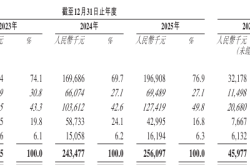
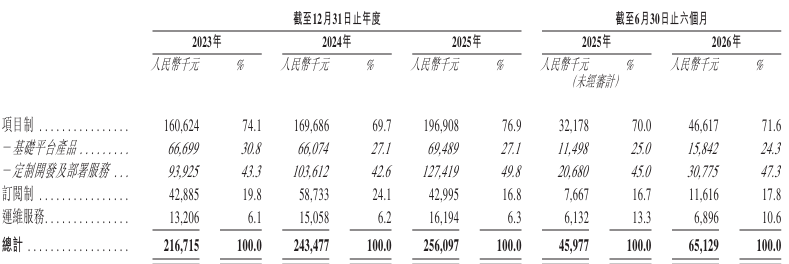
At the business level, Kingwee's revenue is primarily categorized into three segments: project-based, subscription-based, and maintenance services. Customized project-based services have consistently been the mainstay of the company's revenue. During the reporting period, project-based revenues were RMB 161 million, RMB 170 million, RMB 197 million, and RMB 46.617 million, accounting for 74.1%, 69.7%, 76.9%, and 71.6% of total revenue, respectively. Within project-based services, revenues from custom development and deployment services were RMB 93.925 million, RMB 104 million, RMB 127 million, and RMB 30.775 million, accounting for 43.3%, 42.6%, 49.8%, and 47.3%, respectively. Subscription-based and maintenance services accounted for only 17.8% and 10.6% of revenue in the first half of 2026, respectively, indicating that standardized services remain supplementary.
In terms of revenue structure, Kingwee's business is heavily concentrated in the financial services sector. During the reporting period, revenues from financial services end-users were RMB 186 million, RMB 190 million, RMB 178 million, and RMB 50.021 million, representing 85.8%, 78.1%, 69.5%, and 76.8% of total revenue, respectively. Although the proportion of non-financial sector revenue has increased, nearly 80% of revenue still depends on the financial industry.
From a product perspective, the company's two main offerings are K-APA and Ki-Agent. K-APA, as a mature main product, generated revenues of RMB 212 million, RMB 232 million, RMB 240 million, and RMB 46.138 million during the reporting period, maintaining a revenue share of around 90%. The Ki-Agent solution officially began commercialization in 2025 and achieved revenue of RMB 18.991 million in the six months ending June 30, 2026, accounting for 29.2% of revenue during that period, indicating initial success in commercializing new business.
In terms of sales model, the company primarily relies on direct sales, with direct sales revenue accounting for 83.9%, 80.6%, 77.2%, and 74.8% of total revenue during the reporting period. The revenue share from the top five customers ranged from 24.0% to 33.2%, indicating that customer concentration is not extreme. However, the prospectus also reveals that Kingwee has overlapping transactions where some entities serve as both customers and suppliers.
According to the prospectus, A-share listed company Kingdom Technology (600446.SH) is a significant shareholder of Kingwee, currently holding a 12.14% stake and appointing a non-executive director. Kingdom Technology plays multiple roles as a shareholder, customer, channel partner, and supplier, making it the primary related party during the reporting period.
During the reporting period, Kingwee's sales revenue from Kingdom Technology was RMB 19.2 million, RMB 15.989 million, RMB 16.225 million, and RMB 4.969 million, accounting for 8.9%, 6.6%, 6.3%, and 7.6% of revenue in each period, respectively. Notably, the proportion of related sales revenue from Kingwee to Kingdom Technology has generally been declining.
Regarding accounts receivable terms, Kingdom Technology is granted a credit period of 10 to 60 days, longer than the 10 to 30 days typically extended to ordinary customers. Historically, the two parties have also engaged in patent transfers. In 2022, Kingdom Technology transferred an invention patent to Kingwee for RMB 144,000.
In addition to related-party transactions, the prospectus also highlights a notable industry phenomenon. During the reporting period, some trading counterparts served as both customers and suppliers. Some of the top five customers also supplied goods to Kingwee, while some major suppliers purchased AI solutions from Kingwee.
These entities do not fall under the definition of related parties in listing rules. Revenue from such overlapping entities during the reporting period was RMB 22.555 million, RMB 17.409 million, RMB 16.356 million, and RMB 5.939 million, respectively. Purchases from overlapping entities were RMB 10.226 million, RMB 5.613 million, RMB 5.975 million, and RMB 2.174 million, respectively.
Several core operational metrics also indicate pressure. During the reporting period, the number of customers contributing revenue to Kingwee was 564, 686, 781, and 439, respectively. The average revenue per customer gradually declined from RMB 380,000 to RMB 150,000. The customer retention rate fell from 74% in 2023 to 66% in 2025 and further to 60% in the first half of 2026. Although the company's bid success rate remained around 70% and customer acquisition costs stayed around RMB 200,000, the declining retention rates and average revenue per customer reflect a weakening willingness among existing customers to pay, renew, and purchase additional services.
In response, industry experts commented that, based on the disclosed operational metrics, the company's bid success rate remains around 70%, and customer acquisition costs are relatively stable, indicating a certain level of front-end order acquisition capability. However, the periodic declines in average revenue per customer, customer retention rates, and net revenue retention rates require an objective assessment of multiple underlying factors. On the one hand, the company is expanding into emerging industries beyond finance, and new customers often start with small-scale pilot projects, which objectively lower the overall average revenue per customer. However, the consecutive declines in retention metrics also reflect a weakening motivation among existing customers to renew and purchase additional services. The B-end project-based model inherently involves characteristics where, after pilot projects are implemented, whether customers continue to expand procurement is influenced by multiple external factors such as IT budgets, actual business implementation results, and industry competition.
2. Persistently Negative Cash Flow from Operations and Redemption Liabilities of RMB 2.126 Billion
The relatively high gross profit margin has not offset various fixed expenses. High R&D investment, sales and distribution expenses driven by market expansion, and changes in the book value of redeemable preferred shares are the main sources of the company's sustained large losses.
During the reporting period, Kingwee's R&D expenses were RMB 55.38 million, RMB 55.73 million, RMB 78.773 million, and RMB 42.527 million, accounting for 25.6%, 22.9%, 30.8%, and 65.3% of total revenue in each period, respectively. Sales and distribution expenses were RMB 63.05 million, RMB 68.13 million, RMB 74.44 million, and RMB 59.96 million, accounting for 29.1%, 28.0%, 29.1%, and 92.1% of total revenue, respectively. Due to seasonal business fluctuations, the first half of the year is a low-revenue season, causing both R&D and sales expense ratios to exceed 60% in the semi-annual period. The limited revenue scale makes it difficult to cover the continuously rising fixed expenses.
Meanwhile, the company's collection efficiency has significantly deteriorated. During the reporting period, the scale of trade receivables and bills receivable continued to grow, reaching RMB 118 million, RMB 126 million, RMB 161 million, and RMB 100 million, respectively. Trade receivables were RMB 141 million, RMB 151 million, RMB 192 million, and RMB 148 million, respectively, with loss provisions of RMB 23.857 million, RMB 25.097 million, RMB 31.667 million, and RMB 39.276 million, respectively. The collection period lengthened from 182 days in 2023 to 373 days in the first half of 2026. Lengthy approval chains and extended payment cycles among financial customers have resulted in a significant amount of working capital being tied up by downstream customers.
Simultaneously, risks associated with inventory and contract fulfillment costs cannot be overlooked. During the reporting period, the company's inventory and other contract costs surged from RMB 15.132 million to RMB 53.762 million, and inventory turnover days skyrocketed from 44 days to 240 days. Project delays and acceptance extensions have also exerted considerable inventory impairment pressure.
The cash flow situation is even more challenging. During the reporting period, the net cash outflow from the company's operating activities was RMB 56.67 million, RMB 26.49 million, RMB 59.16 million, and RMB 65.21 million, respectively. The core business still lacks self-sufficiency, and the company's survival heavily relies on external equity financing.
During the reporting period, the company's cash and cash equivalents continued to deplete, ending at RMB 204 million, RMB 93.33 million, RMB 141 million, and RMB 71.891 million, respectively. The prospectus explicitly warns that if IPO fundraising falls short of expectations, the company will face significant liquidity pressure.
In terms of equity structure, founder Liao Wanli holds a combined 40.65% voting rights through multiple employee stock ownership platforms, making him the actual controller of Kingwee. After multiple rounds of financing, institutional investors such as Qiming Venture Partners, Hillhouse Capital, and China Development Financial entered the picture. Historical financing issued a large number of convertible redeemable preferred shares with liquidation preferences and redemption rights, which are classified as financial liabilities at the accounting level.
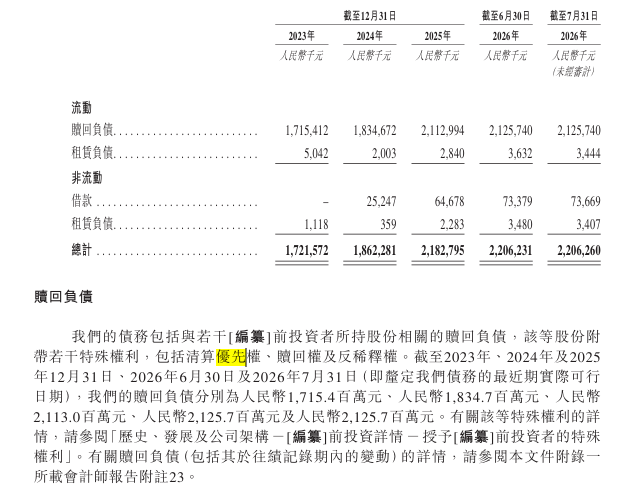
As of June 30, 2026, the total book value of redemption liabilities corresponding to the company's convertible redeemable preferred shares was RMB 2.126 billion. The prospectus discloses that upon submission of the application to the Hong Kong Stock Exchange, the investors' special rights were temporarily terminated but with an automatic reinstatement clause. If the company voluntarily withdraws its listing application, the Hong Kong Stock Exchange rejects the application, the application fails to pass the hearing within 18 months of submission, or the company fails to list within six months of passing the hearing, the investors' redemption rights and liquidation preferences will automatically be reinstated.
This means that if the current IPO attempt fails, the massive redemption obligations will immediately take effect, directly impacting the company's cash flow and even threatening the actual controller's control. Only by successfully completing the H-share listing can these preferred shares be reclassified as equity, eliminating the enormous liability pressure.
The prospectus also reveals a compliance issue. During the reporting period, Kingwee failed to fully pay social insurance and housing provident fund contributions for some employees. The outstanding social insurance and housing provident fund payments during the reporting period were RMB 13.2 million, RMB 16.2 million, RMB 19.3 million, and RMB 9.3 million, respectively.
The directors of the company have made it clear that, during the reporting period, they neither received any notifications from regulatory bodies demanding supplementary payments, nor had any records of administrative penalties, nor were they on the receiving end of any related grievances from their employees. According to the legal counsel's assessment, the likelihood of incurring penalties is minimal, provided that any supplementary payments are promptly made once a rectification notice is received. Consequently, no provisions have been allocated for these outstanding sums. Nevertheless, the company cannot offer any assurances that such circumstances will not arise in the future. Should the competent authorities mandate supplementary payments and the company fails to settle them in a timely manner, it may be subject to fines or even enforcement measures, which could have a detrimental impact on its business operations and financial standing. (Produced by Harbor Finance)
-
Why Is the 'Last Mile' of Large-Scale AI Models So Challenging?
-
![]()
Kingwee Faces Ongoing Losses and Declining Customer Loyalty: Negative Cash Flow from Operations and Substantial Redemption Liabilities Pose Significant Challenges
-
![]()
GAC Group’s A-Shares Halted: Major Announcement on the Horizon!
-
![]()
Cross-border Entry of Tech Companies: Partners or Disruptors? | Cover Story: 70 Years of Striving (Part Nine)
-
![]()
From Supporting Roles to Innovation Ecosystem: 70 Years of China's Auto Supply Chain | Cover Story: Seven Decades of Progress (X)
-
![]()
Apple Finally Releases Foldable iPhone: iPhone Duo Hits Market at $1,999, Seven Years Post Samsung and Huawei
-
![]()
Refusing Orders Worth 500 Million? Component Suppliers Seek to Escape the Automotive Black Hole
-
![]()
Is There Still a Need for Gasoline Vehicles When Everyone is Switching to Pure Electric Ones?