Refusing Orders Worth 500 Million? Component Suppliers Seek to Escape the Automotive Black Hole
 09/14 2026
 550
550
Lead
Introduction
The automotive industry cannot thrive solely on internal competition and price wars.
“From January to July 2026, the automotive industry generated RMB 6,078 billion in revenue, up 2.7% year-on-year; costs reached RMB 5,405.8 billion, up 3.8%; profits stood at RMB 216.2 billion, down 20% year-on-year; the profit margin in the automotive industry was 3.6%.”
This year, the Chinese automotive industry has faced significant challenges. In addition to declining sales, the income of industry professionals has also started to shrink.
Cui Dongshu, Secretary-General of the China Passenger Car Association, stated that in the first seven months of 2026, while automotive industry revenue saw a slight increase, profits plummeted by 20%, with a sales profit margin of only 3.6%. By July, the monthly profit margin further dropped to 2.4%.
The knock-on effect of difficulties in selling cars has translated into challenges in making profits. Behind these figures lies an often-overlooked issue: when automakers face profit pressures, these pressures inevitably trickle up to the supply chain.
In recent years, the automotive supply chain has prioritized scale, with securing major clients, large projects, and substantial orders seen as key to survival.
Especially driven by the trend of the new energy vehicle (NEV) era, suppliers of new and traditional components such as power batteries, chips, LiDAR, and interior and exterior parts have even chosen to “lose money” to acquire clients to keep pace with the market.
However, now, an increasing number of new and established component companies are reassessing their priorities: Is survival more important than fulfilling orders?
01 Tightening Budgets at Automakers Force Suppliers to Adapt
Automotive component companies in the Yangtze River Delta have clearly felt these changes.
In August this year, Zhejiang media surveyed the local NEV supply chain and found that the average profit margin of over 2,500 above-scale automotive component companies in the province was generally below 5%. Some companies faced shrinking orders, idle production capacity, and even the dilemma of “the more orders, the greater the losses.”
Ningbo Ninghai’s Kabel, a typical case, exemplifies this trend.
“We just voluntarily gave up an order worth RMB 500 million,” said Jiang Xiaojun, Deputy General Manager of Kabel. “We’re better off not taking low-price clients’ orders.”
As a key supplier in the NEV cable sector, Kabel saw growth in NEV orders in the first half of the year. However, faced with a RMB 500 million order, the company ultimately chose to decline it. The reason was simple: the order’s profit margin was in the single digits, while the company’s calculated break-even profit rate was around 10%.
Turning down a RMB 500 million order may seem like “counterintuitive” business practice. In reality, it reflects a broader shift among component companies from “chasing orders” to “calculating profits.”
For automotive component companies, the order amount does not equate to revenue, let alone profit. Securing a large project often entails purchasing raw materials in advance, expanding equipment, hiring personnel, building production lines, and bearing costs for R&D, tooling, and quality management.
If the final product price is too low, combined with payment terms, quality claims, and idle capacity due to lower-than-expected sales of related models, large orders can turn into significant cash flow black holes.
The situation is similar in Taizhou, Zhejiang, where numerous automotive component companies supply Vehicle companies (automakers). In the first half of the year, many companies maintained output levels similar to the previous year, but their overall profit margins nearly halved.
A local industry official stated bluntly that after automotive prices declined, the pressure ultimately fell on suppliers—this is the truly thorny issue in today’s automotive supply chain.
While automakers reduce prices in the end market, suppliers struggle to raise prices proportionally despite rising upstream costs for raw materials, labor, and energy.
Price reductions can be quickly passed on, but cost increases are difficult to shift downstream, leaving component companies caught in the middle as sacrifices to industry-wide transformations.
02 Deep-Seated Issues: Intense Competition, Annual Price Cuts, Payment Terms…
The predicament of the automotive component supply chain did not arise suddenly but is the result of years of accumulation.
The first layer of pressure stems from inherent and “passive” intense competition. Early on, many component suppliers, to secure orders from automakers, would undercut prices to gain visibility. Subsequently, automakers would further negotiate and compare prices.
An industry insider revealed details: “After bidding, automakers would rank your price publicly and then ask if you’d lower it. They’d keep pushing until no one would cut further, then privately negotiate to finalize the bid… How do you compete in that?”
The second layer of pressure comes from annual price reductions. The automotive industry has long had a mechanism for suppliers to reduce prices annually. In the current domestic price war environment, the mainstream negotiation target for ordinary components is 5%-10%, low-threshold components face reductions of over 10%, while core monopolized components rarely see annual cuts.
Under normal circumstances, technological advancements, economies of scale, and improved production efficiency can offset some price reductions. However, when price wars become extreme, reductions surpass companies’ ability to optimize costs, forcing suppliers to absorb losses with reduced profits.
More troublingly, costs for raw materials, labor, and energy do not decrease simply because automakers lower prices.
The third layer of pressure arises from payment terms. The automotive supply chain is inherently capital-intensive, requiring suppliers to purchase raw materials, organize production, and deliver products to automakers before receiving payment, which often takes considerable time.
For large suppliers, this may only strain financial metrics. However, for small and medium-sized enterprises (SMEs), it directly determines survival. A company’s demise often stems not from a lack of orders but from depleted cash reserves.
The fourth layer of pressure involves the significant gap between order forecasts and actual sales.
When launching a new model, automakers typically release procurement plans to suppliers based on expected sales volumes. To meet capacity requirements, suppliers purchase equipment, expand factories, increase personnel, and even build dedicated production lines in advance.
However, if actual sales fall far short of expectations after the new model’s launch, orders rapidly shrink. A production line initially prepared for 20,000 units per month might end up producing only 10,000 or even 5,000 units.
While orders decline, factory rent, equipment depreciation, and personnel costs remain unchanged. For capital-intensive suppliers, this means lower capacity utilization drives up unit costs. Thus, the notion of “the more orders, the greater the losses” is not exaggerated.
03 Exit Is Not the Goal—Survival Is
In the past, the automotive supply chain operated on a model where automakers sold cars, and suppliers expanded production in advance. If cars sold well, suppliers profited; if not, suppliers were left with sunk costs in capacity, inventory, and equipment.
This model functioned during the automotive industry’s high-growth phase but is now unraveling as the industry enters a period of stock competition (market saturation), with problems intensifying.
Consequently, component suppliers are actively seeking a second growth curve outside the automotive sector.
The first approach is gradual divestment.
Companies like Kabel have not entirely left the automotive industry but have begun screening orders, allocating limited capacity and R&D resources toward higher-value products.
Kabel has already invested in building R&D capabilities and is exploring applications of automotive cable technology in AI data centers, commercial aerospace, and other fields. This model may become increasingly common.
While the automotive industry remains a vast market, “entering the automotive supply chain” no longer guarantees high-quality growth.
The second approach is cross-industry transformation.
For some small and medium-sized suppliers, if their product technology barriers are limited and they are trapped in low-price competition, continuing to endure in the automotive supply chain may not be optimal.
Some companies are redirecting their existing manufacturing capabilities in machining, injection molding, cabling, and sealing to sectors like energy storage, industrial equipment, AI computing hardware, and home appliances. This does not mean abandoning manufacturing but rediscovering value in their capabilities.
The third approach is relocating production.
Chenyuan Seals, a leading domestic rubber seal manufacturer, serves as a notable example. Faced with rising domestic raw material costs and persistent price pressure from automakers, the company decisively shifted production to Malaysia. Zhang Lingmin, the person in charge, stated, “The Malaysian automotive industry is still in a rapid growth phase, where we can maintain profits of around 20%.”
This reflects another facet of China’s automotive supply chain globalization. Previously, Chinese component companies ventured abroad primarily alongside Chinese automakers. Now, some companies’ motivations for going global are more pragmatic: seeking cost advantages, new customers, and profit margins beyond the domestic market.
The fourth approach involves “tail-cutting” by industry giants.
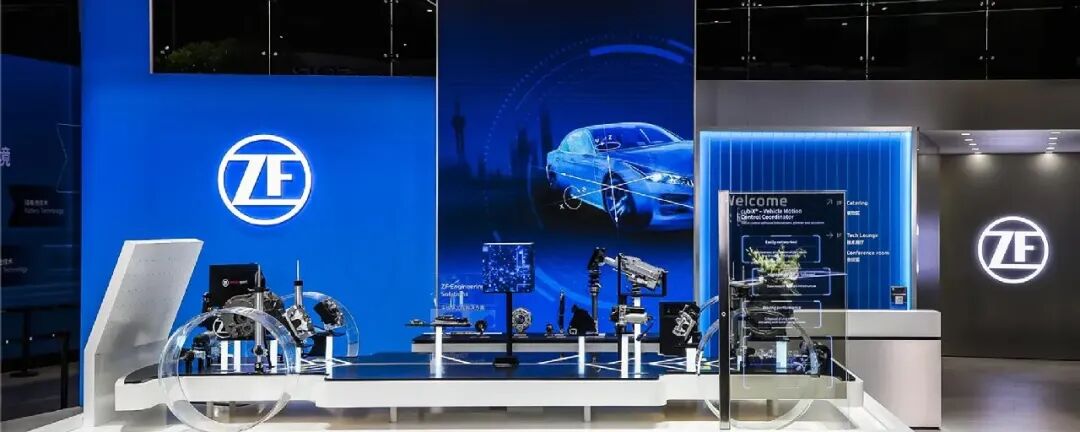
This trend is more pronounced among multinational component giants. ZF Friedrichshafen has continuously restructured its business in recent years, including selling its ADAS business, adjusting its electric drive transmission operations, and improving profitability through layoffs and business optimization.
Continental AG has pursued even more thorough restructuring, spinning off its automotive subsidiary (Vitesco Technologies), selling its ContiTech rubber business, and ultimately concentrating resources in its tire business.
Thus, the so-called “exit from the automotive sector” does not mean abandoning the industry but escaping low-margin, capital-intensive, and highly price-pressured business models.
04 The Automotive Industry Cannot Sustain Only Price Wars
Notably, suppliers’ proactive “exit” has drawn regulatory attention.
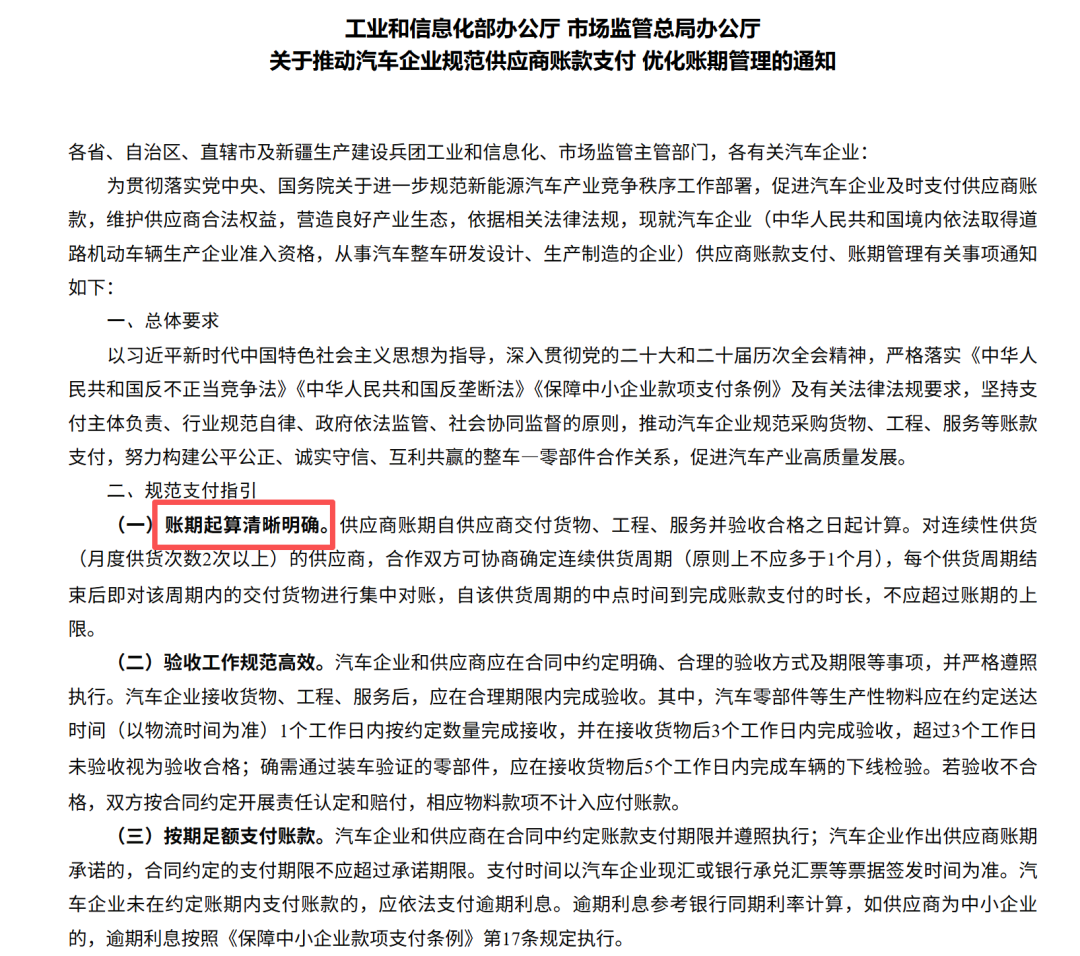
On September 2, the Ministry of Industry and Information Technology and the State Administration for Market Regulation jointly issued the “Notice on Promoting Standardized Supplier Payment Practices and Optimizing Payment Terms in the Automotive Industry.”
The notice explicitly requires automakers to standardize the calculation, acceptance, and payment of payment terms, encouraging SME suppliers to complete payments within 30 days of acceptance, with a maximum principle of no more than 60 days. It also prohibits coercing or covertly coercing suppliers into accepting non-cash payment methods such as commercial acceptance bills or supply chain financing.
This sends a clear signal: “De-intensification” in the automotive industry is no longer focused solely on end-product pricing.
If automakers pass cost-reduction pressures to suppliers, who then shift them further upstream to material companies, the entire supply chain becomes trapped in a cost-cutting race with no winners.
For automakers, lower supplier prices may temporarily improve financial statements. However, if suppliers operate on thin margins or incur losses, the consequences include quality risks, delivery delays, reduced R&D investment, and increasing numbers of companies exiting the market.
For suppliers, the era of “surviving on orders alone” is unlikely to return.
The automotive supply chain is shifting from incremental to efficiency-driven competition. Companies with core technologies, cost control capabilities, overseas markets, and the ability to replicate manufacturing capabilities across industries will hold true bargaining power.
Thus, rejecting a RMB 500 million order is not merely a case of “someone else will take it if you don’t” but reflects a growing realization: Scale is not the endpoint—profit is.
Finally, a quote from Wei Jianjun of Great Wall Motors to inspire automotive professionals:
“Continuous price cuts and squeezing suppliers—can they guarantee quality? I believe we should be a community of shared interests, not view the supply chain as competitive but as cooperative. Protecting and developing the supply chain is not just a responsibility—it’s an obligation.”
Editor-in-Charge: Yang Jing Editor: He Zengrong

THE END
-
![]()
Cross-border Entry of Tech Companies: Partners or Disruptors? | Cover Story: 70 Years of Striving (Part Nine)
-
![]()
From Supporting Roles to Innovation Ecosystem: 70 Years of China's Auto Supply Chain | Cover Story: Seven Decades of Progress (X)
-
![]()
Apple Finally Releases Foldable iPhone: iPhone Duo Hits Market at $1,999, Seven Years Post Samsung and Huawei
-
![]()
Refusing Orders Worth 500 Million? Component Suppliers Seek to Escape the Automotive Black Hole
-
![]()
Is There Still a Need for Gasoline Vehicles When Everyone is Switching to Pure Electric Ones?
-
![]()
It's Official! Achieving These Will Make China a Global Automotive Powerhouse by 2030
-
![]()
Conventional Hybrid Cars: A Resurgence on the Horizon
-
![]()
Stellantis' Global Strategy Divided into Two Halves: Half North American Independence, Half Alliance with Leapmotor and Dongfeng