Internet Giants Are Competing for AI Talent
 09/14 2026
 507
507
Major Companies Have Started Cultivating AI Talent in Advance
Image Source | Internet (Please contact for deletion if infringement occurs)
In September 2026, AI scholarship programs from major internet companies landed almost simultaneously. Baidu Scholarship opened applications for global Chinese students in universities, offering 10 spots with RMB 200,000 in research funding each, along with a fast track for campus recruitment.
ByteDance Scholarship opened global applications for the first time, with over 20 spots available, offering RMB 200,000 in research funding plus RMB 100,000 in mentor bonuses per recipient.
Tencent awarded its inaugural "Qingyun Scholarship" earlier in the year, with 15 recipients each receiving total incentives worth RMB 500,000, including RMB 200,000 in cash and RMB 300,000 in cloud heterogeneous computing resources.
On the surface, this appears to be a philanthropic initiative supporting scientific research. However, a closer look at the rules reveals a harsher logic: nearly all scholarships target students graduating in 2027 or later, and all include internships, fast tracks for campus recruitment, or priority recommendations for top talent programs.
Normal campus recruitment begins six months before graduation, but these scholarships allow applications during study, effectively shifting recruitment two to three years earlier to secure talent before they enter the job market.
This resembles less charity and more an early job offer.

How Intense Is the Talent Grab?
Scholarships are just the tip of the iceberg. Beneath the surface lies an AI talent market undergoing revaluation.
In a media interview, the CEO of Maimai made a staggering claim: “Next year, tech companies will only hire AI talent, not non-AI talent.” He revealed that AI job postings surged 7.9x in 2026, with 30-40% of all open positions now AI-related.
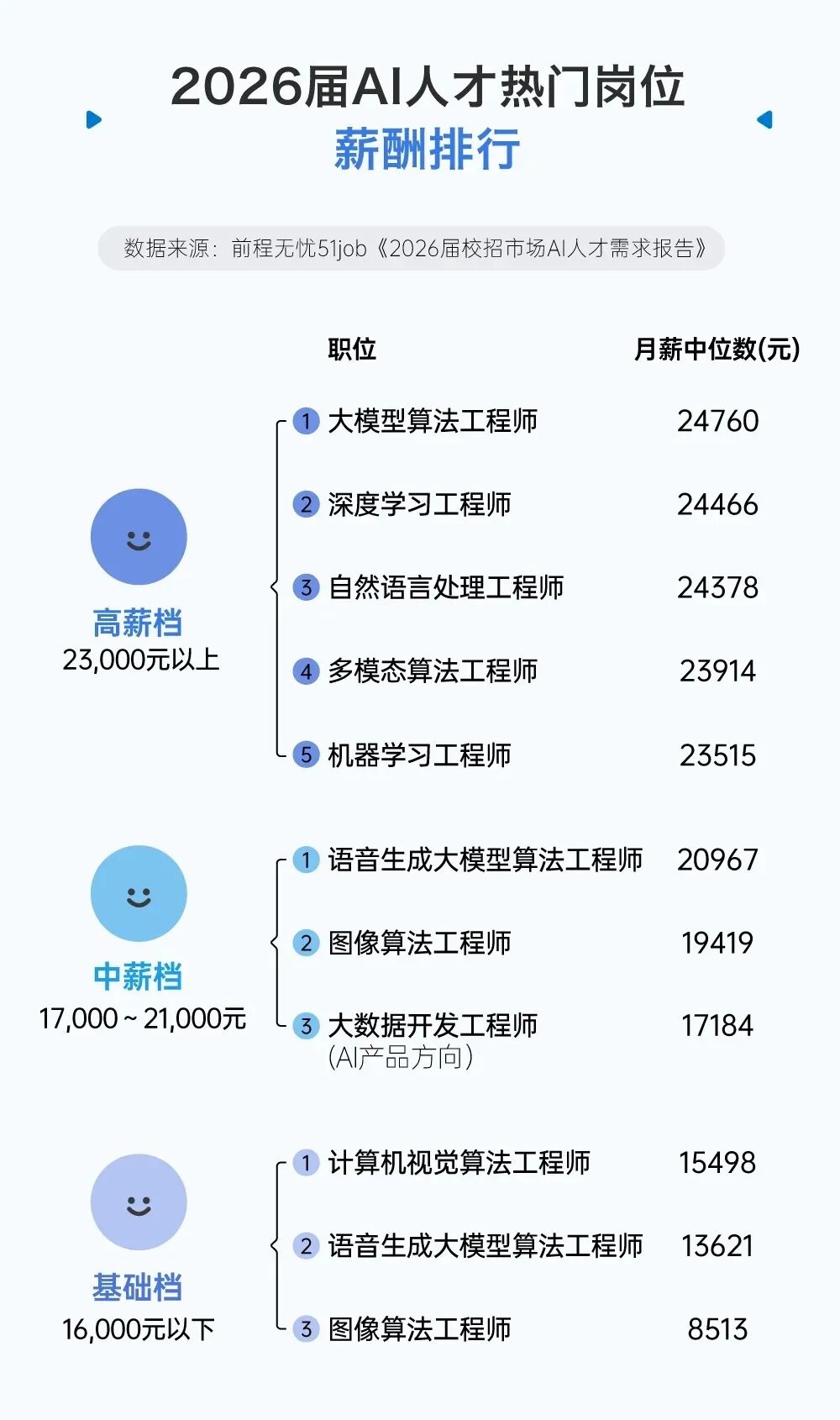
Salary data is even more striking. From January to April 2026, AI scientists/leaders averaged RMB 132,796 in monthly salary, far outpacing second-place algorithm researchers (RMB 74,441) and the only role exceeding RMB 100,000.
High-performance computing engineers face a “4 roles competing for 1 person” shortage. In the highest-end talent market, some fresh AI graduates command annual salaries in the millions or even tens of millions.
Supporting these valuations is a demand gap of absurd proportions. China’s AI core industry exceeds RMB 1.2 trillion in scale, with a talent shortage exceeding 5 million.
At the 2026 China Big Data Expo, a Chinese Academy of Engineering academician stated bluntly that top talent and research teams are “severely scarce,” making independent cultivation “urgent.”
But more intriguing is another set of figures. Since Q4 2025, demand for NLP algorithm roles dropped 62%, speech synthesis 43%, backend development 41%, and frontend development, data product managers, and test development all fell over 20%.
Major companies aren’t expanding—they’re restructuring. Traditional tech roles are collapsing rapidly, while AI positions explode.
Corporate HR budgets aren’t inflating infinitely; resources are shifting massively from traditional roles to AI. As the Maimai CEO put it: “AI users might be 2-3x more productive than non-users. For the same salary, or even a 30% premium, the choice is obvious.”

Four Giants, Four Approaches
Facing the same battlefield, strategies among major companies diverge far more than they appear. Understanding these differences is key to grasping the war.
ByteDance: Pricing AI Business Separately
ByteDance’s weapon is the most aggressive: a virtual stock mechanism for its Doubao large model business.
In Q4 2025, ByteDance piloted the “Doubao Long-Term Incentive Plan.” Unlike company-wide options, this asset is priced independently for specific AI business lines.
During its first repurchase in April 2026, shares were priced at $13.08, rising to $14.85 in June and $17.02 in August—a 14.6% increase over two months and ~70% above the initial grant price of $10.
Critically, ByteDance allows employees to receive part of their annual bonuses in Doubao shares and adjust the cash-to-stock ratio in their total compensation.
Doubao share pricing is tied to metrics like Doubao model invocation volume, monthly active users, ToB revenue, and base model iteration progress.
The intent is clear: without an overall IPO, ByteDance created a reward channel for AI core talent directly linked to business growth.
Grow Doubao, and your virtual shares gain value. No middlemen—the reward path is as short as possible.
Tencent: Computing Power as Hard Currency
The standout feature of Tencent’s “Qingyun Scholarship” isn’t the RMB 200,000 cash but the RMB 300,000 in cloud heterogeneous computing resources.
For young AI researchers, computing power can be scarcer than money. Tencent’s package of cloud capabilities directly addresses researchers’ core pain point.
Once winners grow accustomed to Tencent’s computing ecosystem, joining Tencent’s tech stack becomes a natural choice.
More telling is the award ceremony: Tencent’s Chief AI Scientist, a post-1995 native, presented the awards.
Having AI experts select AI talent signals a shift: at Tencent, AI talent evaluation is now in the hands of AI talent themselves.
Alibaba: Integrating AI into Every Business Gap
Alibaba’s path differs. For its 2027 campus recruitment, 80% of roles are AI-related, with a clear emphasis on “AI+X” composite capabilities—combining AI with specific scenarios.
Alibaba prefers internal cultivation for talent. Key members of the Tongyi Qianwen team were groomed in-house, a result of Alibaba’s 2017 Damo Academy investment.
This “long-term investment” model is slow to yield results but, once mature, creates significantly more stable organizational echelon than teams reliant on external hires.
Since 2026, Alibaba has established the ATH Business Group, Group Technology Committee, and Token Foundry, all led directly by the CEO, elevating AI from a tech department initiative to a group-wide strategic priority.
Meituan: AI Talent Grown from Business Needs
Meituan’s strategy may be the most pragmatic. Its 2027 campus recruitment added over ten AI-native roles, including AI full-stack engineers, AI product managers, and intelligent business analysts, with over 80% of job descriptions explicitly requiring AI capabilities.
However, Meituan’s recruitment head emphasizes not technical skills but “AI Native” thinking: “We want candidates who proactively consider how AI can solve problems, enhance collaboration, and improve services in daily work while diving into business operations to identify and resolve real issues.”
In simpler terms: Meituan seeks not “model writers” but “problem-solvers using AI to tackle delivery efficiency, merchant operations, and user growth.”
This business-driven tech talent logic brings Meituan closest to “AI implementation” among the four. 
What Lies Behind the Talent War?
If you see only “high salaries,” you’re missing half the story. The other half unfolds at the organizational level—and is far more disruptive.
In July 2026, Tencent merged its Hunyuan large language model and multimodal model departments into a Foundation Model Department, placed under its Chief AI Scientist.
An AI scientist simultaneously overseeing foundation models and AI infrastructure—such cross-departmental authority would have been unthinkable in the traditional internet era. Tencent also dissolved its decade-old AI Lab, integrating personnel into the Hunyuan system.
Alibaba’s restructuring was even more dramatic. In March 2026, the Tongyi Qianwen core lead departed, followed by the establishment of the ATH Business Group, consolidating Tongyi Lab, MaaS, Qianwen, Wukong, and other businesses under one group led by the CEO. Alibaba summarized ATH’s mission with three verbs: create Tokens, deliver Tokens, apply Tokens.
The logic: in the large model era, the linear process of product managers defining needs, tech teams implementing them, and business units generating revenue is breaking down.
Model capabilities emerge first; products then find uses. Sometimes, even product forms remain undefined until model capabilities materialize.
Who manages model teams, controls computing power, and decides which products integrate models first—these answers are redefining corporate power structures.
Reporting lines are thin threads on org charts, but what flows through them are GPUs, top talent, high-quality data, and product access. Giants are reorganizing to answer: In the AI era, what production relations match explosive productivity gains?
Nearly three years have passed since ChatGPT ignited China’s large model race in 2023. By 2026, the AI talent war is entering a new phase.
From “quantity expansion” to “structural optimization.” Early talent grabs were crude: anyone capable of pre-training saw their value double. Now, corporate needs are far more nuanced.
In H1 2026, the fastest-growing AI roles weren’t algorithm engineers (+12.84%) but architects (+76.74%), mechanical structure engineers (+57.20%), and hardware engineers (+40.80%).
AI is shifting from “coding” to “product-building,” from pure software to hardware integration, with talent demands evolving from single algorithm skills to composite capabilities.
From “external poaching” to “internal cultivation.” The dense launch of scholarship programs signals a shift. When all giants poach talent with high salaries, compensation ceases to be a differentiator.
Baidu Scholarship, established in 2013, has supported 116 global students over 12 years, with some recipients’ research aligning closely with Baidu’s core businesses.
ByteDance Scholarship, launched in 2021, has identified 67 young researchers in five years, including 2023 winners who became key contributors to Sora2 and DeepSeek GRPO.
These numbers prove one thing: only companies that cultivate AI talent aligned with their business needs can build sustainable competitive barriers.
From “tech elite” to “AI for all.” Future AI talent need not be computer science graduates. Liepin data shows liberal arts graduates in prompt engineering and human-machine training roles average RMB 343,100 in annual salary.
In June 2026, DeepSeek opened a unique role: “AI Cross-Disciplinary Technical Talent,” with no professional background restrictions, targeting candidates “with exceptional abilities seeking to create and build AGI.”
The AI talent pool is expanding from “engineers writing models” to “anyone solving problems with models.”
The war’s conclusion won’t be a single giant “winning” the talent race but the internet industry’s talent composition being entirely rewritten by AI.
When 80-90% of tech campus recruitment requires AI application experience, little space remains for traditional roles.
For everyone in this industry, the question is no longer “Should I learn AI?” but “How will I participate in this rewriting?”
-
![]()
Internet Giants Are Competing for AI Talent
-
![]()
Tech Titans Clash in AI Race, with Workers Shouldering the Burden
-
![]()
Which would you choose: an iPhone costing 10,000 yuan or a domestic smartphone?
-
![]()
User Time Spent No Longer the Ultimate Currency
-
![]()
The US Accuses China of 'Distillation.' Mathematicians Echo the Question Back at OpenAI in the Same Week
-
![]()
Apple, Huawei, and Xiaomi Vie for Dominance in the 10,000-Yuan Smartphone Segment: Has the Smartphone Market Embraced the Luxury Era?
-
![]()
Chinese Air Conditioners Gain Momentum in Europe: Can Indian Companies Follow Suit on the Global Stage?
-
![]()
Xingyu Shares Cancels Contracts of 107 New Graduates—Not for Listing, but for a Far Grimmer Reason