User Time Spent No Longer the Ultimate Currency
 09/14 2026
 543
543

ByteDance Claims the Time Crown, but the Market is Revaluing Every Minute
Author|Dingshan
Editor|Xiaobai
Produced by|Qiangdiao Next
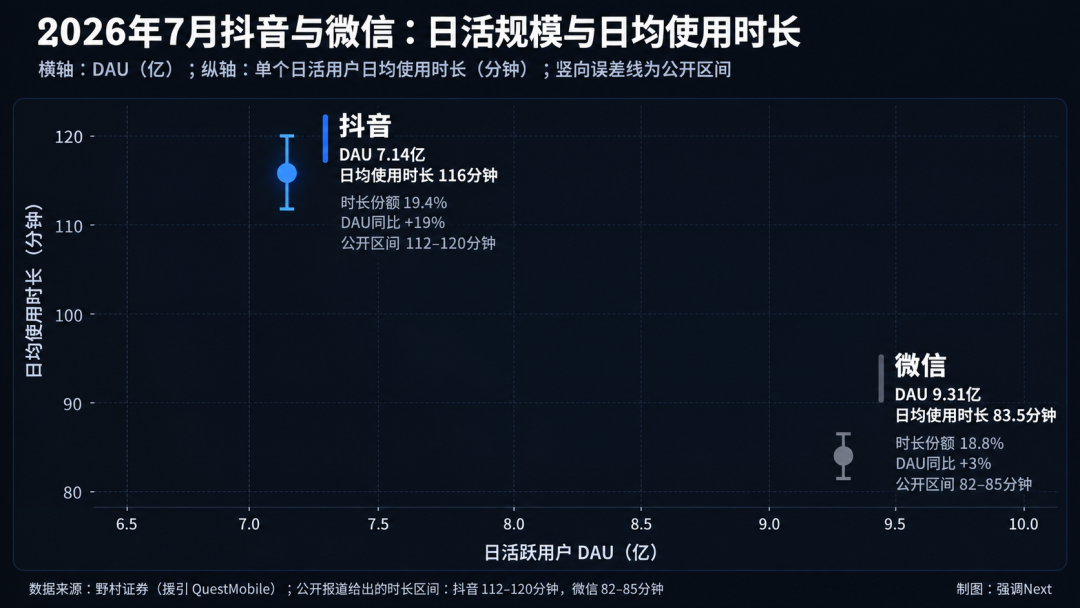
In July 2026, Douyin finally surpassed WeChat in terms of user time spent.
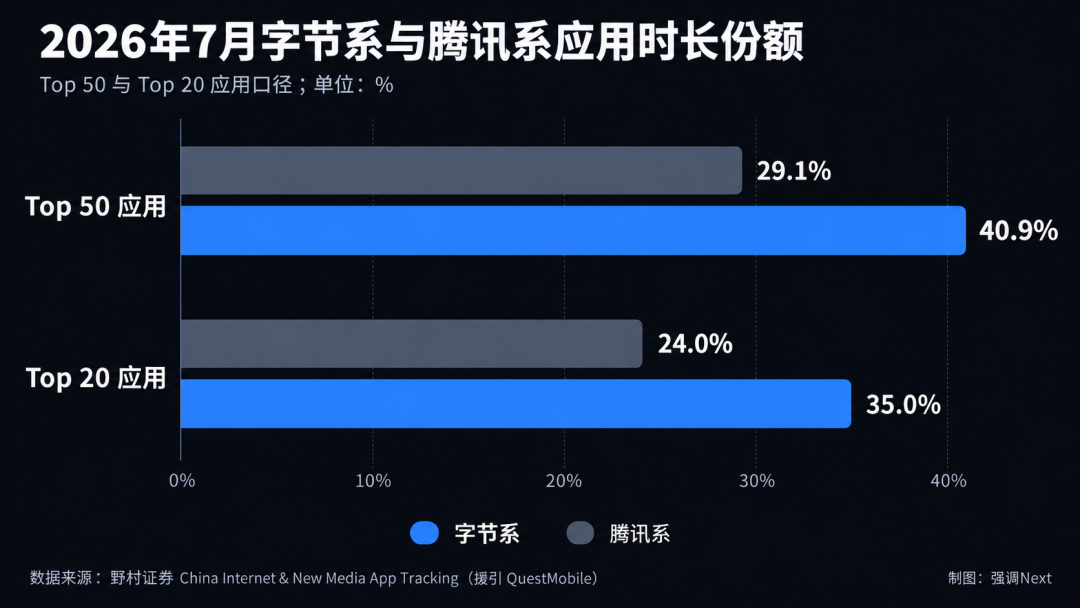
Nomura, citing QuestMobile data, stated that Douyin's total monthly user time spent grew 29% year-on-year, accounting for 19.4% of the total time spent across China's top 50 mobile apps, surpassing WeChat's 18.8% for the first time. ByteDance's five apps combined captured 40.9% of the time share, while Tencent's apps held 29.1%.
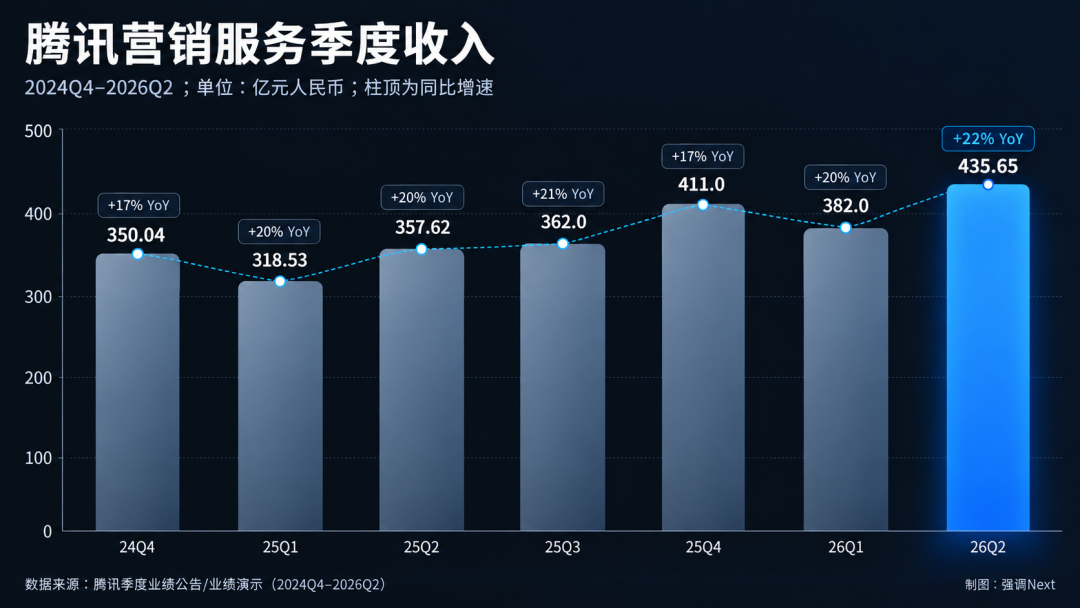
Based on a decade of internet experience, money should follow time spent. Yet, that summer, Tencent's Q2 marketing services revenue surged 22% to RMB 43.6 billion, becoming the company's fastest-growing major business. ByteDance, meanwhile, reportedly adjusted GMV and ad revenue expectations for Douyin E-commerce, reducing info-feed ad loads for e-commerce and local services. A Douyin E-commerce executive denied some GMV figures but did not disclose alternative metrics.
Today, time share can no longer reliably predict a company's ad revenue growth. Time must undergo multiple conversions—ad load rate, click-through rate, conversion rate, average order value, and platform commission—before becoming profit. During the era of rapid traffic growth, these differences were masked by sheer volume. Now, with user growth capped and ad inventory nearing its limit, the quality of each minute determines a company's growth potential.
The internet hasn't lost time spent. It's accumulating more unsold or discounted time.
Douyin Hits the Ad Wall First
According to reports, Douyin's 29% time growth in July was driven by a 19% increase in DAU and an 8% rise in average daily time per user. Hongguo Short Drama performed even stronger, reaching 168 million DAU with monthly time spent up 157%. ByteDance remains China's most powerful attention machine.
The problem is that this machine is nearing its physical ad capacity limit.
Public brokerage estimates suggest Douyin's info-feed ad load rate is around 15%, and even higher when factoring in native commercial content. In contrast, WeChat Video Account's ad load rate remains at 3-5%. Douyin's ad slots are already crowded, while Video Account is still releasing inventory.
Every percentage point increase in ad load rate doesn't come cost-free. Ads displace content, degrade user experience, and reduce click-through and conversion rates for subsequent ads, especially for e-commerce merchants. Thus, even if Douyin gains another minute of user time, it may not sell at past prices. Tencent's Video Account doesn't need to win total time spent—just monetizing more of its previously non-commercial traffic can drive growth.
Tencent's Q2 marketing services revenue grew 22%, primarily due to AI-driven ad recommendations, smart ad placement products, and WeChat's ecosystem-closed transactions. Tencent's incremental revenue comes from improved efficiency per exposure and selling off old inventory. However, this isn't unlimited—it just hasn't hit its limit yet.
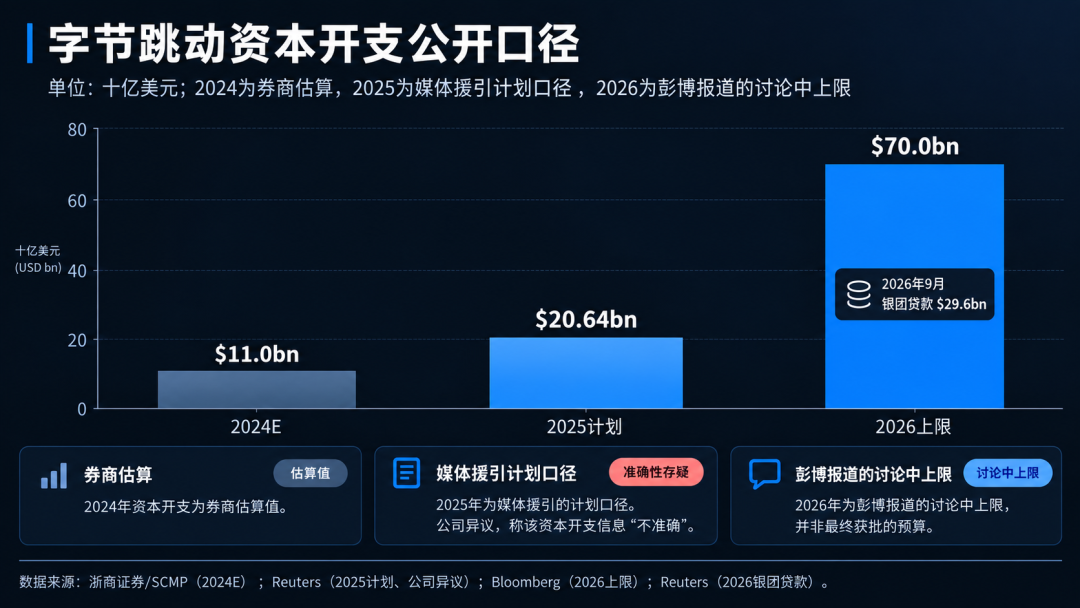
ByteDance's choice is straightforward. Reuters reported on September 4 that ByteDance secured a $29.6 billion syndicated loan from nearly 30 banks, ostensibly for general corporate purposes, but insiders say it primarily supports AI initiatives.
Bloomberg previously revealed that ByteDance discussed raising 2026 capital expenditures to $59-70 billion, mainly for data centers and AI infrastructure.
ByteDance hasn't abandoned the traffic business. It's using cash and credit from its mature cash cow to bet on the next machine. Douyin E-commerce and local services are now focused on profitability, while AI absorbs new capital. The resource allocation is clear: content time can still generate revenue but can no longer carry the group's highest growth expectations.
Qishui Music Wins Traffic but Not Pricing Power
The disconnect between time spent and revenue is even more pronounced in online music.
Nomura's July report showed Qishui Music's DAU up 70% year-on-year, while Tomato Music grew 37%. QuestMobile data indicates Qishui Music reached 156 million MAU in March, surpassing NetEase Cloud Music. Meanwhile, QQ Music's DAU fell 5% in July, while Kugou and Kuwo both dropped 15%.
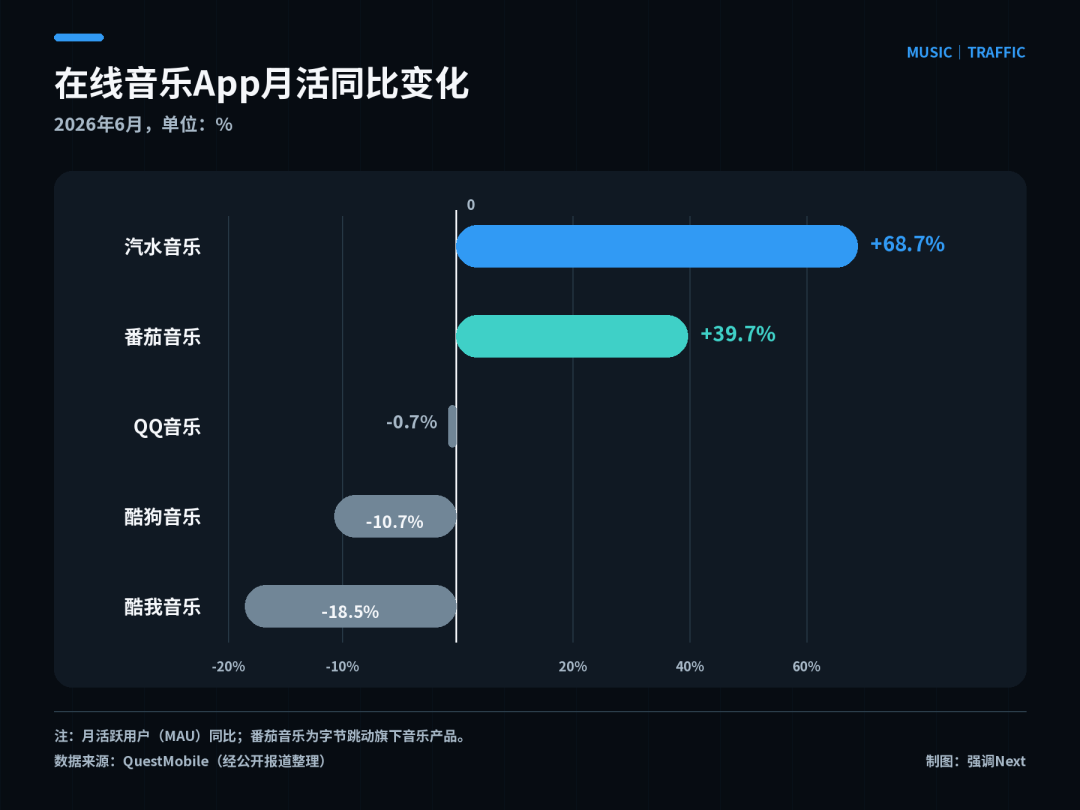
ByteDance has won users but not the music industry's profit pool.
Qishui Music's standard membership costs RMB 8/month for auto-renewal, but its key selling point remains ad-supported free listening. It hasn't disclosed paid user numbers or revenue. Market rumors suggest 7-9 million paid users, with ad revenue accounting for 70% (based on brokerage expert research). What's certain is that Qishui Music relies on Douyin referrals and free content for scale, with ads as its primary monetization tool.
Tencent Music, meanwhile, holds a different asset portfolio. By late 2025, it had 125 million paying online music users (22.9% pay rate). In Q2 2026, it generated RMB 8.93 billion in revenue and RMB 2.69 billion in adjusted net profit. Even as QQ Music, Kugou, and Kuwo lose active users, their established copyright libraries, membership habits, and paywalls continue generating cash.
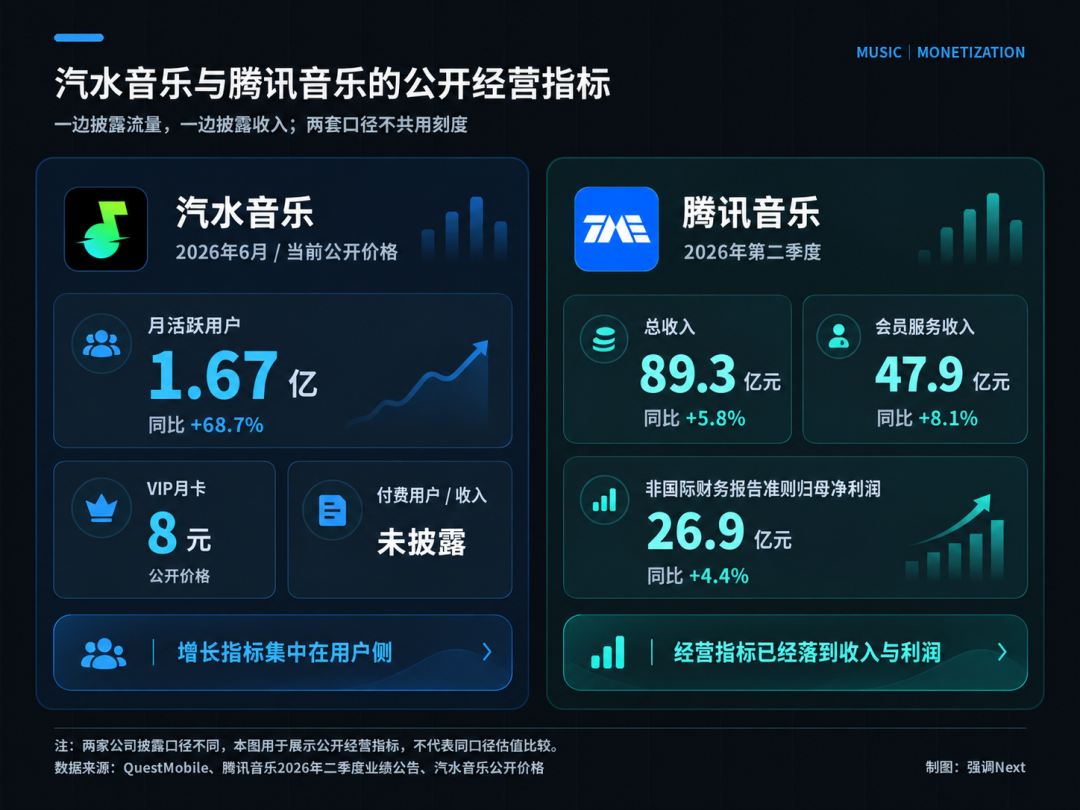
Tencent Music stopped disclosing quarterly online music MAU, paid users, and ARPPU starting this year, only announcing paid user numbers annually. This weakens external oversight but reflects that MAU is no longer a favorable metric. TME now prices itself on membership revenue, ARPPU, and profits. Whether it can maintain profits after integrating Ximalaya matters more than DAU declines.
Qishui Music has won the free user battle, pulling the industry back from "pay-to-listen" to "ad-supported listening" and forcing incumbents to expand free offerings. This benefits users but not necessarily industry revenue: new time spent is monetized at lower prices, with winners gaining traffic but collectively lowering the market's revenue ceiling.
Low-Time Businesses Regain Value
Another group of internet companies never excelled at consuming time but can charge more per interaction.
Meituan's Q2 core local commerce revenue hit RMB 71.5 billion, with operating profit recovering to about RMB 5.7 billion (7.9% margin). A year earlier, subsidy wars had turned the segment from RMB 52.4 billion in annual profit to a RMB 6.9 billion loss. As competition cooled, profits returned quickly.
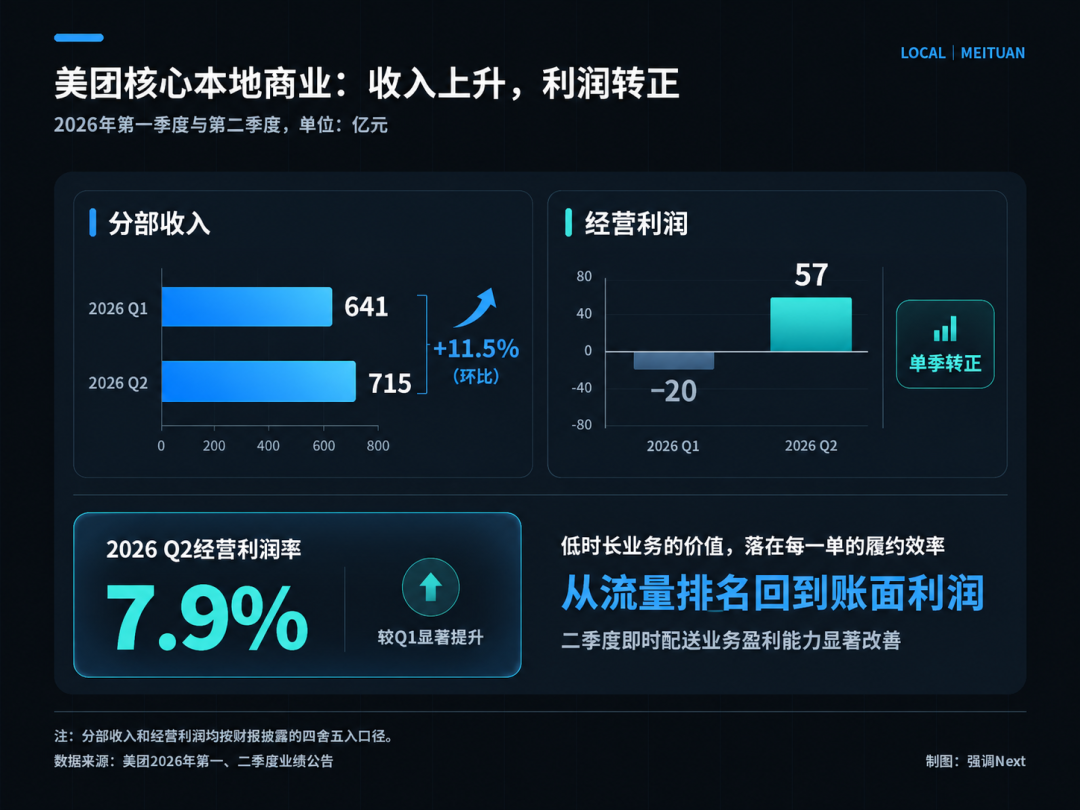
This is because riders, merchants, payment systems, dispatch networks, and after-sales services weren't destroyed during price wars. A 10-minute Meituan session might result in a RMB 50 food delivery order or a RMB 1,000+ hotel booking. The goal is transaction completion, not keeping users engaged for hours.
Gaode's experiment is even more intriguing. Maps are inherently "use-and-go" tools. Gaode reached 996 million MAU but only achieved quarterly profitability in Alibaba's Q3 2025 fiscal year. In September 2025, Gaode launched the "Street Scan Rankings," attempting to enter local services via navigation, visits, and repeat visits. After one year, it claimed to have served over 880 million users, with users navigating to ranked merchants for a cumulative 366 billion kilometers.
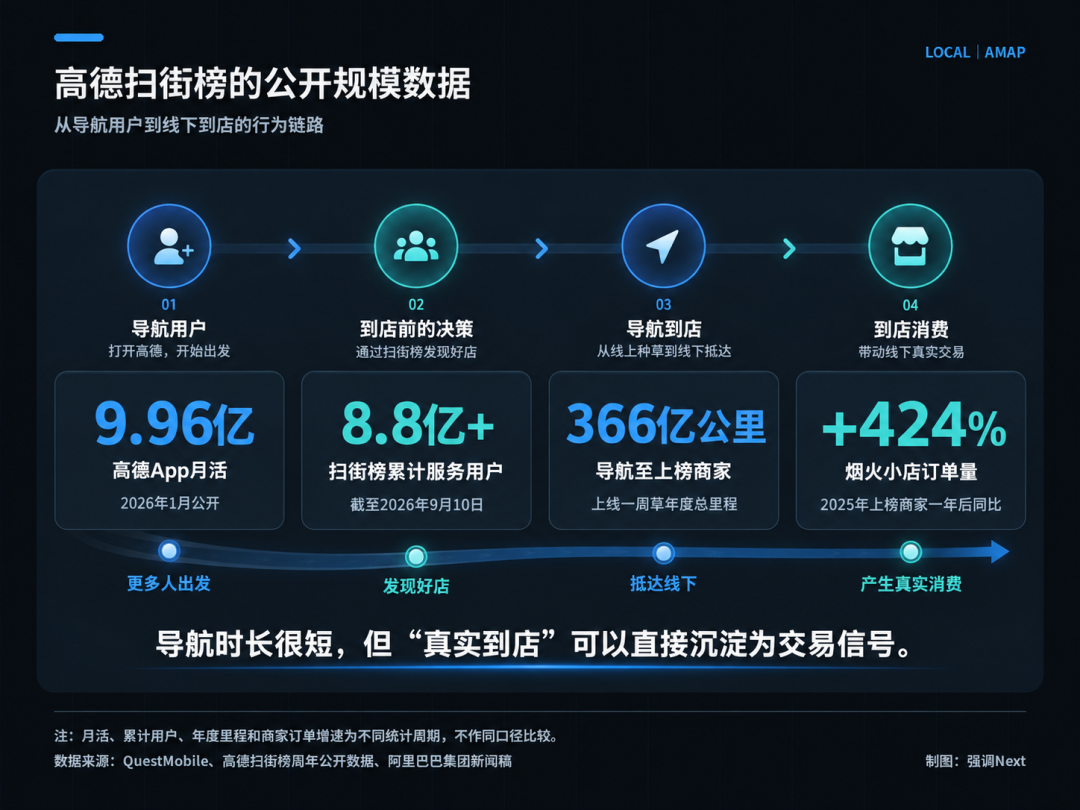
Navigation behavior reflects real consumption intent more than mass-produced reviews, but it doesn't automatically translate to revenue. After users arrive at a store, orders, payments, redemptions, and merchant operations remain controlled by platforms like Meituan, Douyin, and Alipay.
Gaode has proven it can track "where people go" but must now prove it can influence "what people buy." Otherwise, 366 billion kilometers is just a vast free data source.
However, "real behavior data" is often overhyped. While harder to fake than content, it's not unfakeable. It boosts ranking credibility but only generates stable revenue when tied to transactions and fulfillment. Gaode's real challenge isn't keeping users longer but advancing from navigation endpoints to orders.
Tokens Aren't New Currency—They're Pricier Bills
Tokens are increasingly touted as the next internet "hard currency," but this is a misleading metric.
For companies selling APIs and cloud services, token usage directly translates to billing. For free consumer apps like Doubao, tokens first represent inference costs. More user queries and longer model-generated videos mean higher computational bills for the company.
ByteDance's discussion of up to $70 billion in capital expenditures doesn't prove tokens are more valuable than time spent—it shows its willingness to use cash flow from mature businesses to bet on a more expensive gateway.
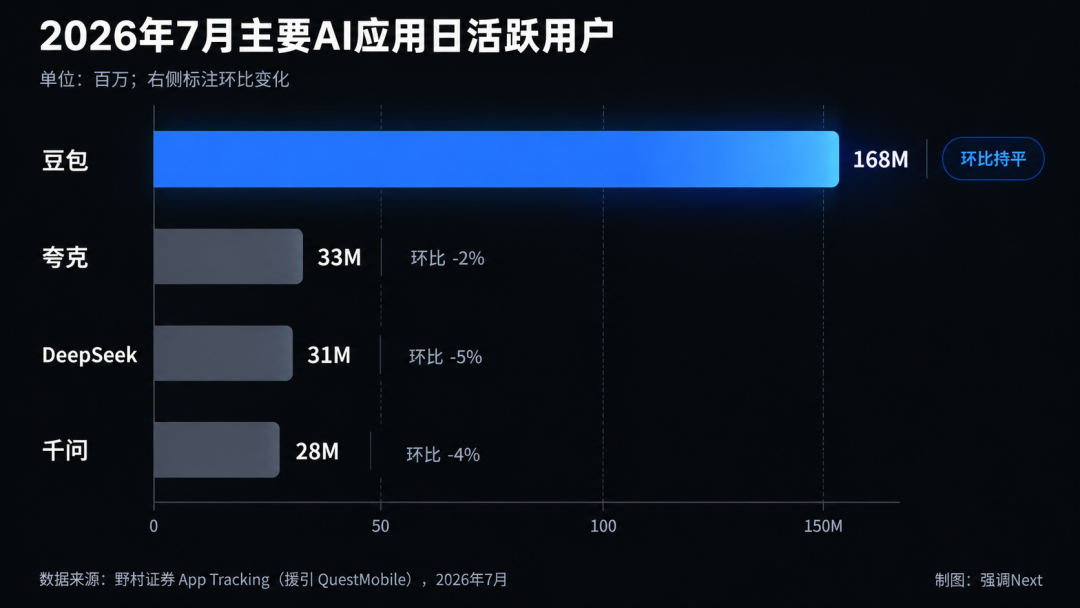
What AI truly changes is the objective function of internet products. Content platforms want users to stay, while agents should resolve tasks quickly. Booking flights, generating reports, finding restaurants, or placing orders—if an AI product increases user time spent, it may indicate poorer performance, not better engagement.
This could turn "time spent" from an imprecise metric into a negative one for some products. What matters isn't how long users stay but what platforms accomplish for them and how much revenue they capture from those completions.
Douyin still commands China's most abundant attention, Tencent retains the deepest social graphs, Meituan controls fulfillment, and Gaode owns location data. No one is out yet. But as content supply explodes, what's scarcer are validated demands and the step that converts demand into revenue.
Time spent hasn't retired—it's reverted from currency to raw material.
Header Image: Ready Player One
Primary Sources:
Nomura Securities citing QuestMobile's July 2026 app tracking data;
Tencent, Meituan, and Tencent Music's Q2 2026 earnings announcements;
Reuters' report on ByteDance's $29.6 billion syndicated loan;
Bloomberg's report on ByteDance's capital expenditure discussions;
Public data from Alibaba and Gaode's Street Scan Rankings.
- END -
-
![]()
Internet Giants Are Competing for AI Talent
-
![]()
Tech Titans Clash in AI Race, with Workers Shouldering the Burden
-
![]()
Which would you choose: an iPhone costing 10,000 yuan or a domestic smartphone?
-
![]()
User Time Spent No Longer the Ultimate Currency
-
![]()
The US Accuses China of 'Distillation.' Mathematicians Echo the Question Back at OpenAI in the Same Week
-
![]()
Apple, Huawei, and Xiaomi Vie for Dominance in the 10,000-Yuan Smartphone Segment: Has the Smartphone Market Embraced the Luxury Era?
-
![]()
Chinese Air Conditioners Gain Momentum in Europe: Can Indian Companies Follow Suit on the Global Stage?
-
![]()
Xingyu Shares Cancels Contracts of 107 New Graduates—Not for Listing, but for a Far Grimmer Reason