Qianwen's Losses Widen Year-on-Year in Q2, Catching Up with Doubao Remains a Long Road
 09/15 2026
 354
354
Produced by Leida Finance | Text by Zhou Hui | Edited by Shen Hai
Recently, Alibaba released its second-quarter earnings report, revealing that its "AI Labs and Applications" division generated RMB 3.338 billion in revenue in the second quarter of 2026, but reported an adjusted EBITA loss of RMB 13.861 billion. In the same period of 2025, the company's adjusted EBITA loss was only RMB 3.224 billion. Alibaba attributed the widening losses primarily to increased investments in AI capabilities and higher inference costs associated with the Qianwen App.
To reduce losses, Qianwen has begun exploring commercialization. On August 7, the Qianwen App received a major update, introducing features such as an office assistant, in-depth research, and scheduled tasks, while also opening access to the Qwen3.8-Max flagship model. Basic functions of Qianwen remain free, but advanced capabilities like the office assistant will have usage limits, with the possibility of paid purchases for additional access in the future. However, given the intense competition in the AI office sector, commercialization is unlikely to improve Qianwen's losses in the short term.
Currently, Qianwen has secured a position in the top tier of domestic large models but still lags significantly behind Doubao. According to Quest Mobile, Qianwen has 167 million monthly active users (MAUs), while Doubao has 382 million MAUs as of June, making Doubao's user base nearly 2.3 times larger than Qianwen's.
Notably, Lin Junyang, known as the "Father of Qianwen," has ventured into entrepreneurship. His company, positioned as a next-generation intelligent agent spanning the digital and physical worlds, secured an angel round of financing co-led by Gaorong Capital and Sequoia China China, with participation from Tencent and the Shanghai Future Industry Fund. The total funding amount is RMB 220 million, with a post-money valuation of $2 billion (approximately RMB 13.5 billion).
Significant Losses in AI Labs and Applications Division
According to Alibaba's interim report, revenue from its AI Labs and Applications division reached RMB 3.338 billion in the second quarter of 2026, up 16% from RMB 2.882 billion in the same period of 2025.
Despite the revenue growth, losses in the AI Labs and Applications division widened significantly. Financial results showed an adjusted EBITA loss of RMB 13.861 billion for the division in the second quarter, a 2.3-fold increase from the RMB 3.224 billion loss in the same period of 2025.
This marks the first time Alibaba has reported figures for its AI Labs and Applications division. In the second quarter of this year, the company restructured its AI model labs, Qianwen 2C division, and Qianwen Office to form the AI Labs and Applications division.
Leida Finance noted that Qianwen represents Alibaba's ambitions in the AI sector.
On November 17, 2025, Alibaba officially announced the "Qianwen" project, fully entering the AI-to-C market.
On March 2 this year, Alibaba announced that it would unify its internal AI (artificial intelligence) branding and core brand under Qianwen. The Qianwen large model (Qwen) encompasses foundational large models and specialized domain models, while the Qianwen App became Alibaba's flagship AI application for consumers (C-end).
This move aimed to avoid confusion caused by multiple names such as Qianwen, Tongyi Qianwen, and Qwen. After unification, Alibaba's large model brand is known as "Qianwen Large Model" in Chinese and "Qwen" in English, with "Tongyi Labs" serving as the organizational name for Alibaba Group's AI institutions.
Some observers point out that Alibaba's unification of its AI branding for B-end and C-end appears understated but actually reflects its ambition to consolidate its efforts and make a significant impact.
Guo Tao, an angel investor and senior AI expert, stated that Alibaba's unified branding helps integrate B-end and C-end data. C-end user behavior data can feed back into large model optimization, while B-end solutions can enhance C-end product functionality, creating a virtuous cycle.
At the same time, Alibaba's centralized approach to AI aligns with the market trend shifting from technological competition to ecological competition. It facilitates the construction of a "multi-form hardware + ecological services" ecosystem, allowing users to perceive brand services in different scenarios and strengthening user-brand connections.
Indeed, Alibaba has recently accelerated its AI hardware Layout (layout). At the MWC exhibition held in March this year, Alibaba launched its first hardware product for the personal AI assistant "Qianwen"—the Qianwen AI Glasses.
Unlike other AI glasses, Alibaba's AI Glasses replicate the "one-sentence task completion" feature of the Qianwen App, achieving a closed loop from "large model Q&A" to "full-link execution."
Some analysts believe that the launch of Qianwen AI Glasses signifies Alibaba's proactive move beyond the confines of screens to capture a broader physical presence. After all, the essence of AI competition lies in whether it can truly integrate into users' daily lives.
Song Gang, head of AI hardware for Alibaba's Qianwen C-end business group, also stated that as a new generation of human-computer interaction and AI entry point, glasses offer more imagination than smartphones.
Alibaba Group CEO Wu Yongming has also emphasized that AI's greatest potential does not lie in creating one or two new super apps on smartphone screens but in taking over the digital world and transforming the physical world.
Qianwen Secures First-Tier Position but Still Lags Behind Doubao
Currently, Qianwen has secured a position in the first tier but still lags significantly behind Doubao.
According to Quest Mobile's ranking of AI-native app user scales for the first half of 2026, Doubao had 382 million MAUs in June.
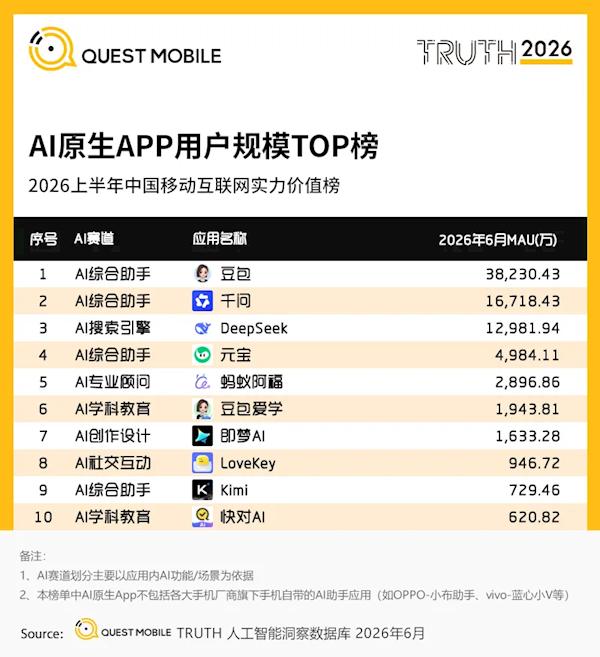
Qianwen had 167 million MAUs, with Doubao's user base nearly 2.3 times larger than Qianwen's.
To promote the Qianwen App, Alibaba has invested heavily.
On February 2 this year, the Qianwen App announced a RMB 3 billion "Spring Festival Hospitality Plan," emphasizing "non-stop freebies for dining, entertainment, and fun."
Quest Mobile data shows that the event attracted 14.75 million users on its first day (February 6), with participation nearing 20 million the next day. Driven by this, Qianwen's DAU (daily active users) surged from 7.07 million on the day before the event (February 5) to 73.52 million on February 7.
In terms of user engagement, Alibaba's Qianwen achieved 14.4 average uses per user on the first day through a combination of "freebies + consumption," directly linking red envelopes to real consumption scenarios. This positioned it at the forefront of the industry, propelling it to become a national-level AI assistant.
However, some analysts point out that for most users, the appeal of the Spring Festival AI competition remained at the "subsidy" stage.
A user interviewed by Yicai stated that due to reduced work scenarios during the Spring Festival, their AI usage frequency dropped significantly.
Quest Mobile data indeed reflects this characteristic. From February 2 to 8, Qianwen's average daily usage time per user was 7 minutes, dropping to 5 minutes from February 9 to 15, and further declining to a historical low of 3 minutes from February 16 to 22.
Clearly, Qianwen's Spring Festival traffic was highly concentrated on transactional behaviors (placing orders and collecting coupons), with extremely short user retention times, exhibiting a typical "transactional, low-duration" usage pattern.
In contrast, Doubao's average daily usage time per user only declined moderately by about 15%, dropping to 8.7 minutes during the week of February 16 to 22 (from a previous average of 10.2 minutes), demonstrating stronger resilience.
Additionally, in terms of absolute scale, Qianwen still has a noticeable gap with Doubao. During the Spring Festival, Doubao's WAU (weekly active users) peaked at 253 million, while Qianwen's WAU peak was 165 million, only about 65% of Doubao's.
Morgan Stanley points out that the Spring Festival competition marks the official start of the battle for China's next "super entry point" in consumer AI, but short-term traffic surges do not equate to long-term victory.
The key to long-term success lies in whether users can be retained through product utility after the event, whether seamless ecological integration can be achieved, and whether real value beyond monetary incentives can be created.
Notably, due to multiple extensions of the consumption coupon validity period (from February 23 to February 28, and then to March 3), Morgan Stanley estimates that actual spending likely exceeded RMB 5 billion (approximately 200 million orders × RMB 25 coupon per order = RMB 5 billion, plus other brand marketing expenses).
The massive marketing investment led to a significant increase in losses for the "AI Labs and Applications" division, where Qianwen is located, in the first half of this year.
Is Qianwen Office the Solution?
To enhance monetization capabilities, Qianwen has chosen to focus on the office market.
In July this year, Alibaba integrated and upgraded three intelligent agent products—QoderWork, Wukong, and MuleRun—into "Qianwen Office" and initiated internal testing.
On August 27, Qianwen Office launched the Qwen3.8-Flash model and introduced a standard mode, allowing all users to experience the model through this mode. Based on Qwen3.8-Flash, the single-task generation speed of Qianwen Office's standard mode improved by approximately 100%, while Token consumption decreased by an average of 75%.
According to media reports, as of September 4, one month after its launch, Alibaba's enterprise-grade general-purpose agent product, Qianwen Office, had surpassed 30 million users, with enterprise users accounting for more than half. Over the past month, Qianwen Office has completed 120 version updates, averaging four iterations per day, with cumulative updates to thousands of features. During this period, Qianwen Office launched an international version, fully entering the global market.
In response, some media commented that the 30 million user figure in the official one-month report is based on registration, with questionable value. The report did not disclose any DAU, retention, or payment data; new users receive 2,000 points upon registration, and the Qianwen Office can be directly activated from the DingTalk workbench, with the top-rated comment in the report's comment section questioning, "DingTalk users are all automatically enrolled, even if they don't use it." This figure proves not demand but channel reach.
The office sector is one of the more suitable areas for agent intervention, receiving widespread attention and investment from domestic internet companies. Qianwen Office faces intense competition in this sector.
On July 20, Tencent announced an internal organizational adjustment, merging the QClaw product center into the Cloud Product Division VI, where WorkBuddy is located. For the first time, CodeBuddy, WorkBuddy, and QClaw—three core agent products—were placed under the same organizational unit.
ByteDance announced on July 30, 2026, a restructuring of its ToB business, integrating the Feishu product team with the Doubao product team to form a new Doubao product team. It also merged the Feishu GTM team with the Volcano Engine team to establish a new ToB GTM organization called the "Creativity Service Platform." Subsequently, the TRAE and Kouzi teams were also incorporated into the Doubao system, with the independent product "Doubao Work" officially launched.
On August 14, Baidu also rebranded GenFlow as Kuku AI, launching the independent brand across four platforms.
According to media calculations, current pricing across all companies is relatively low. If not managed well, Qianwen Office could become a setback for Alibaba's AI ToB ambitions.
"Father of Qianwen" Lin Junyang's Company Valued at $2 Billion
Notably, Lin Junyang, known as the "Father of Qianwen," has recently made headlines, with his startup valued at $2 billion.
Public records show that Lin Junyang was born in 1993. He studied English at the University of International Relations while simultaneously learning Japanese, Russian, German, and French. He pursued a master's degree in Foreign Linguistics and Applied Linguistics at Peking University, shifting his focus to computational linguistics and natural language processing (NLP).
After graduating in 2019, Lin Junyang joined Alibaba's DAMO Academy as a senior algorithm engineer, participating in the development of the ultra-large-scale pre-trained model M6 and the general-purpose unified multimodal pre-trained model OFA.
At the end of 2022, Alibaba merged the DAMO Academy's language and vision AI teams into Alibaba Cloud, establishing Tongyi Labs. Lin Junyang was officially appointed as the technical leader for the Tongyi Qianwen series of large models, becoming Alibaba's youngest P10-level technical leader.
Under Lin Junyang's leadership, Alibaba's Qianwen advanced rapidly: the Tongyi Qianwen large model was released in 2023; the Qwen series model open-source work began in 2024; and in 2025, the flagship model Qwen3-Max, with over a trillion parameters, was launched, surpassing international mainstream models in evaluations like GPQA.
"Me stepping down. Bye my beloved qwen." On the evening of March 4, to the surprise of many, Lin Junyang, the core leader of Alibaba's Qianwen, posted this message on X, bidding farewell to Qianwen with "Goodbye, my beloved Qianwen," marking the end of his tenure at Alibaba's Qianwen.
According to Tianyancha data, Lin Junyang established Yuyong (Shanghai) Technology Co., Ltd. in May this year, with a registered capital of RMB 1.25 million. The company's business scope includes general items such as technical services, technology development, technology consulting, technology exchange, technology transfer, and technology promotion; engineering and technological research and experimental development; software development; and software sales.
In August this year, media reports revealed that Yuyong Technology, founded by Lin Junyang, secured a total of $220 million in angel round financing, co-led by Gaorong Capital and Sequoia China China, with participation from Tencent and the Shanghai Future Industry Fund. The post-money valuation is $2 billion (approximately RMB 13.5 billion).
In the "post-Lin Junyang" era, what direction will Qianwen take? Will Yuyong Technology become a competitor to Qianwen? Leida Finance will continue to monitor developments.
-
![]()
The Roar of the V8 Drowns Out the Hum of Electric Motors: Why European Automakers Are Making a 'Combustion Engine Comeback'
-
![]()
Xiaomi's High-End Strategy Succeeds! Lei Jun Secures Top Spot in Domestic Android Foldable Phone Sales, Stores Overwhelmed
-
![]()
Qianwen's Losses Widen Year-on-Year in Q2, Catching Up with Doubao Remains a Long Road
-
![]()
Taiyi, Which Invested 3 Billion to Revive Nezha, Faces Consumption Restrictions on Its Beneficiary
-
![]()
Domestic Computing Power Reaches a Turning Point: Hardware is No Longer a Bottleneck, Software Ecosystem is the Real Challenge
-
AI Enters the Second Half: Anthropic, DeepSeek, and Zhipu Stockpile Resources for Battle
-
![]()
Graduating Means Unemployment? AI Disrupts Job Market, Driving College Students to Switch Majors, Career Paths, and Industries
-
![]()
AI-Generated Fake Ads: Stealing Faces, Exploiting Influencers, and Undermining Credibility