Chinese Computing Power Expands Its Global Reach in ASEAN
 09/21 2026
 559
559
If ASEAN were considered a single nation, it would rank as the world's third most populous country, boasting a population of up to 700 million, trailing only China and India.
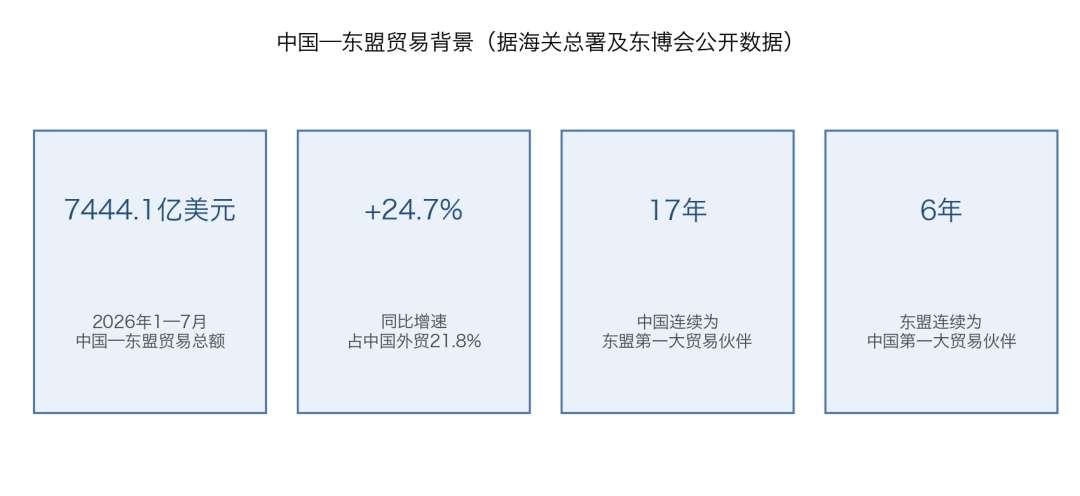
Furthermore, these 700 million people possess relatively strong purchasing power, making ASEAN China's largest trading partner (although a significant portion of this trade is of a 'transit' nature).
As Xingkongjun has often remarked, wealthy nations have limits to their wealth, but poor nations won't remain impoverished indefinitely.
China's years of deep engagement with the Belt and Road Initiative are aimed at gradually helping these nations prosper.
Nowadays, everyone is delving into AI large models, but when you examine the manufacturers, you find that only China and the US are actively involved. So, the question arises: how do nations outside China and the US, such as those in ASEAN, participate?
There's actually a vast market space here. American AI is closed-source; users can only pay for access. Chinese AI, on the other hand, is open-source; it can be deployed privately, but that requires building data centers, purchasing equipment, and handling installation and maintenance—a model that promotes shared prosperity.
Liu Shengyu, the leader of the operations team at DeepSeek, stated that AI could lead humanity to one of two futures: communism or a dystopian world akin to Cyberpunk 2077.
The future might resemble one of these models or a blend of both.
In September this year, Sugon signed a strategic cooperation agreement with the China-ASEAN Artificial Intelligence Application Cooperation Center to establish its ASEAN business headquarters in Nanning.
1. Failed Merger
Nine months ago, Sugon had just experienced a failed merger attempt.
On May 25, 2025, Hygon Information, a leading chip company listed on the STAR Market, announced plans to absorb Sugon through a share swap, valuing the transaction at 115.967 billion yuan. Touted as the first major deal under new restructuring regulations, the merger would have resulted in Sugon's delisting and the disappearance of its A-share code, 603019.
However, after 199 days of planning, this 116 billion yuan 'parent-child' merger was terminated on December 9, 2025. The official explanation cited the large transaction scale, multiple involved parties, and changes in the market environment, making the restructuring conditions immature.
Nine months later, Sugon established its ASEAN business headquarters in Nanning.
Sugon's 2026 semi-annual report reveals: revenue of 7.466 billion yuan, up 27.62% year-on-year; net profit attributable to shareholders of 971 million yuan, up 33.31% year-on-year; and core net profit of 844 million yuan, up 48.45% year-on-year.
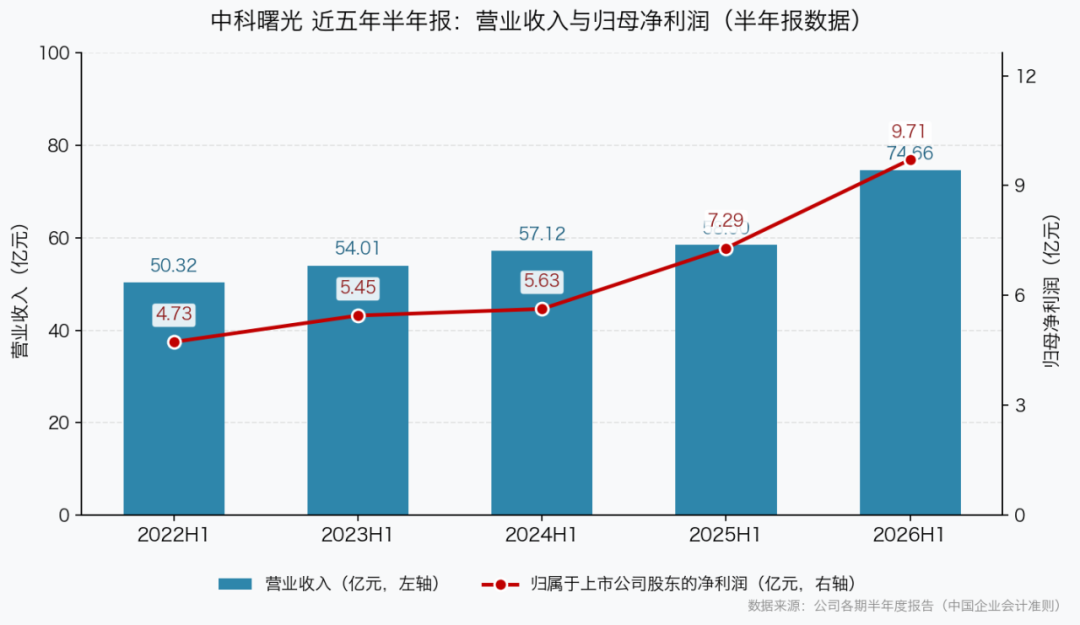
Data Source: ifind
The company attributes this growth to the explosion in demand for AI computing power and the strong performance of its high-end products. Its three main businesses—high-end computers, storage, and liquid-cooled data centers—have all benefited from the AI infrastructure boom.
According to public industry research estimates, the overall procurement scale of domestic computing power cards is expected to rise to 1.44 trillion yuan by 2029, several times the current market size. The demand-side explosion has propelled the entire domestic computing power industry chain onto the fast track.
However, one figure stands out as inconsistent with the others: net cash flow from operating activities, at -187 million yuan.
A company with a net profit of 971 million yuan has negative operating cash flow. Is the profit real or just a paper figure?
The time lag between revenue recognition and payment collection is becoming a common phenomenon in the computing power industry. Government and enterprise clients, as well as smart computing center projects, have long acceptance cycles and slow payment rhythms. Server manufacturers front the costs for chip procurement and assembly, recognizing revenue before cash is received. The income statement surges while the cash flow statement bleeds—this is the most critical contradiction in the current cycle of large-scale domestic computing power expansion.
2. Major Client
To understand Sugon, one cannot overlook Hygon Information. The relationship between these two companies is one of the most unique parent-child dynamics in the A-share market.
It all began with Hygon's origins. Founded in 2014, Hygon Information was established under the leadership of Sugon as a chip company. Early on, it secured x86 architecture authorization through a joint venture with AMD, starting with general-purpose CPUs and later expanding into DCU product lines. In other words, Hygon is a child nurtured by Sugon: Sugon is its largest shareholder, a core supplier for its complete machine matching (supporting products), and even Hygon's current CEO, Sha Chaoqun, previously served as Sugon's technical vice president for many years. The offices of the two companies are just a four-minute drive apart, both originating from the Institute of Computing Technology, Chinese Academy of Sciences.
Looking at Hygon Information's 2025 annual report: the top five clients accounted for 90.28% of total sales, with the largest client contributing 8.149 billion yuan, or 56.68% of the total. The name of this largest client was exempted from disclosure due to trade secrets. Based on equity relationships, business backgrounds, and historical transaction comparisons, this mysterious related major client is the Sugon system.
This proportion is accelerating: in 2024, the largest client accounted for 40.26% of Hygon's sales, jumping to 56.68% in 2025—a 16-percentage-point increase in one year.
In other words, over half of Hygon's DCU and CPU chips are sold to its largest shareholder, Sugon; while Sugon's domestic computing power servers rely on Hygon's chips as their core computing source. Sugon acts as both a shareholder sharing in Hygon's profits and a client absorbing Hygon's production capacity.
Hygon Information's revenue in the first half of 2026 was 9.099 billion yuan, up 66.52% year-on-year; net profit attributable to shareholders was 1.798 billion yuan, up 49.69% year-on-year.
Sugon holds a 27.96% stake in Hygon. Based on Hygon's net profit in the first half of the year, Sugon's corresponding equity share is approximately 500 million yuan, while Sugon's own net profit attributable to shareholders in the first half was 971 million yuan. Half of its profit comes from that stake.
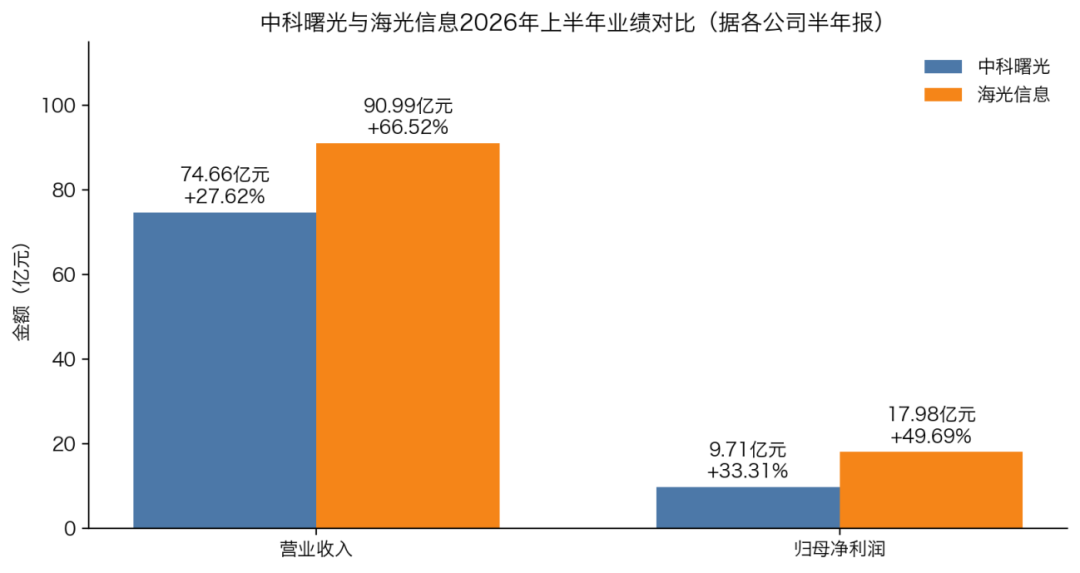
Data Source: ifind
So, the failed 116 billion yuan merger attempt at the end of last year was essentially an effort to tear down the walls: since the two are so intertwined, why not merge into a single company to integrate the complete chain from chip design, server manufacturing, to liquid-cooled data centers?
3. The Confidence to Take Domestic Computing Power Global
Poor nations may lack the capacity to develop AI large models, but they still have AI needs. Once all software and hardware are integrated with AI, AI will become the oil of the future.
The US approach is to export gasoline, maximizing profits alone; the Chinese approach is to export refineries, sharing in humanity's progress.
At the core of Sugon is Hygon Information's dual product lines of CPUs and DCUs. CPUs are general-purpose processors, competing with Intel's x86 architecture; DCUs are deep computing units, or AI acceleration cards, responsible for training and inference in large models. On the main track of import substitution, Hygon represents the rarest spark of x86 architecture domestically, with its products mass-applied in general-purpose servers, high-end computing, AI training, and inference scenarios. Government, finance, telecommunications, research, and smart computing centers in the trustworthy computing market are its main battlefields.
As a leading complete machine manufacturer, Sugon integrates Hygon's chips into its servers, complemented by its core strengths: liquid-cooled data centers and supercomputing engineering capabilities. Its subsidiary, Sugon Data Cooling, is a leading liquid-cooled infrastructure provider listed on the Beijing Stock Exchange and an undervalued asset in the Sugon ecosystem.
In the main lane of domestic computing power, the Sugon-Hygon formation is one of the few domestic players capable of offering a complete solution.
But competition is fierce. At Huawei's Full Connect Conference on September 17, it announced that the Ascend 960 chip was ready ahead of schedule, with performance doubled. The 960DT and 960PR were released three quarters and one quarter ahead of plan, respectively, with a commitment to one new generation per year. The arms race in domestic AI chips is accelerating. Expanding into ASEAN is, to some extent, opening another window amid the increasingly intense domestic competition.
-END-
Disclaimer: This article is based on the public company attributes of listed companies and relies primarily on information disclosed by the companies in accordance with their legal obligations (including but not limited to interim announcements, periodic reports, and official interaction platforms) as the core basis for analysis and research. Shiyu Xingkong strives for fairness in the content and viewpoints presented in the article but does not guarantee its accuracy, completeness, or timeliness. The information or opinions expressed in this article do not constitute any investment advice, and Shiyu Xingkong assumes no responsibility for any actions taken based on this article.
Copyright Notice: The content of this article is original to Shiyu Xingkong and may not be reproduced without authorization.
-
![]()
Why Has OPPO Slowed Down When the Entire Industry is Rushing into AI?
-
![]()
BYD Plans to Construct 20,000 Stations, Sunwoda Aims for 10,000 Stations: The Boom of Flash Charging in China
-
![]()
Chinese Computing Power Expands Its Global Reach in ASEAN
-
![]()
Analysis of Competitive Strategies for Home Appliance Enterprises in the Stock Market: The 'Four Alls and One Diversification' Approach
-
![]()
Gross Margin Dips Below 10%, Li Auto Temporarily Sets Aside Its 'Competitive Edge'
-
YC's Latest Insight: Harness Matters More Than the Model
-
A 1000 Yuan Price Gap: Three Key Differences Between iPhone18 Pro and Max
-
![]()
From Didi Shrimp to Doubao Auto: Why Automakers Are Keen on Integrating AI into Their Vehicles