Surging by 1.3 Trillion Yuan in a Single Day! Meta's AI Triumph Led by a Chinese AI Guru
 09/30 2026
 455
455

Meta's personal AI assistant, Muse, has gone viral.

Zuckerberg Finally Stages a Comeback.
In September 2026, Meta officially unveiled its new personal AI agent, Muse. Within just two weeks of its launch, cumulative downloads surpassed 2.8 million, overtaking ChatGPT to top the U.S. App Store free chart.
Fueled by the blockbuster product, Meta's stock price soared by 11.43% on September 21, with the company's market value surging by approximately $192.3 billion, or about 1.3 trillion yuan, in a single day. Zuckerberg's personal net worth increased by $25 billion overnight, briefly surpassing Dell to become the world's fourth-richest person.
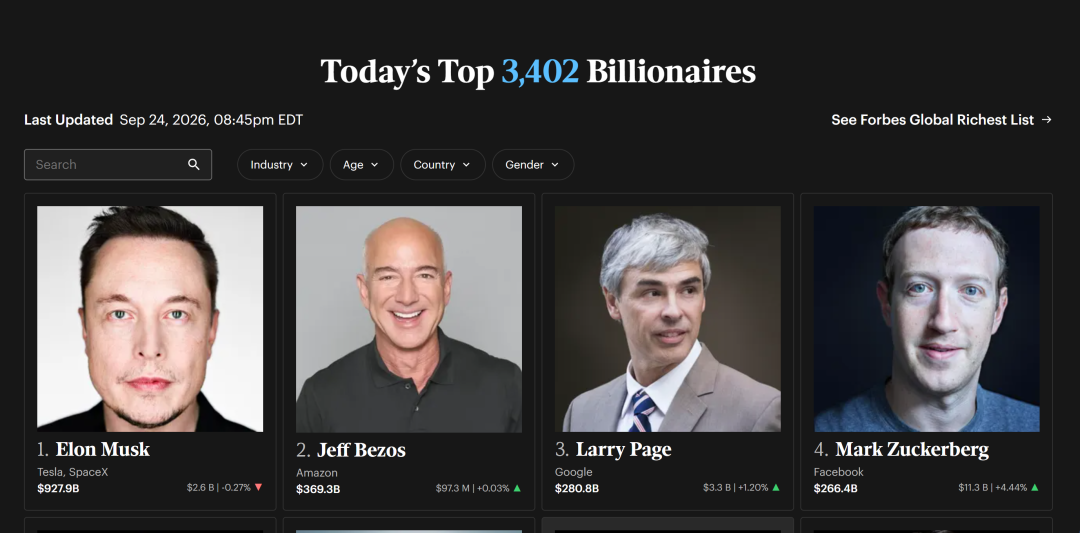
Image Source: Forbes September 24 Rankings
Seizing the momentum, on September 29, Meta announced a series of new skills and connectors for Muse, officially expanding into small business scenarios to help entrepreneurs manage daily operations. The new version directly integrates with Instagram professional account analytics, Facebook Pages, and Meta ad accounts, while supporting connections with dozens of third-party business tools like Canva.
Seeing Meta's formidable performance, major players at home and abroad grew anxious. On September 22, Alibaba announced its Qianwen AI agent plan, focusing on lifestyle services and transactional scenarios; ByteDance and Tencent quickly followed suit, accelerating the development of similar AI products; OpenAI swiftly responded by launching its cloud-based agent, Dots, on September 30, targeting Muse's signature long-term task execution capabilities.
Suddenly, major companies were flocking into the AI agent arena, rapidly intensifying competition.

Meta Finally Has an AI Blockbuster
Today, Muse is not only a hit in the tech world but has even gained fame in the rock music scene.
Because Muse shares its name with the veteran British rock band Muse, Meta's official promotions inadvertently dominated related topic (topics), sparking heated discussions among music fans. However, this controversy unexpectedly propelled Muse beyond the tech sphere, successfully bringing it into the public eye and generating massive free exposure.

Image: The Band Muse
After Muse went viral, even Meta's Chief AI Officer, Alexandr Wang, became a subject of scrutiny. Wang, a key Chinese AI researcher heavily recruited by Zuckerberg, made waves at the product launch in a camouflage outfit paired with crocs—a stark contrast that quickly went viral. Netizens dissected his look like fashion bloggers, pricing each item:
A $5,699 Gucci camouflage jacket, $1,250 Gucci glasses, $1,890 Prada cargo pants, and even his crocs were labeled with a $730 Balenciaga price tag.
Amid the online frenzy, Alexandr Wang personally clarified: the shirt was a $30 thrift store find, and the crocs cost just $60.
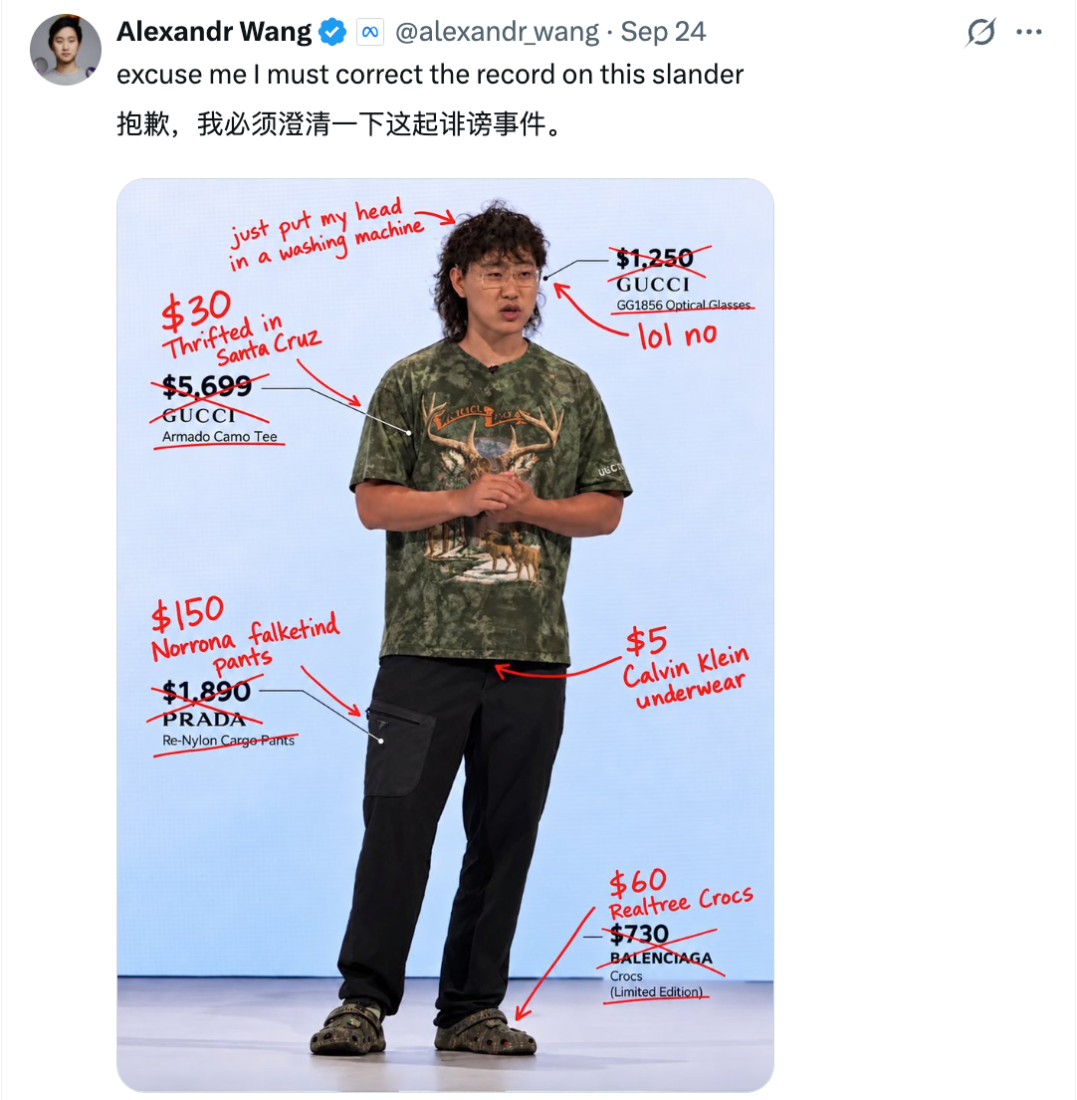
Image Source: X
In reality, Muse's actual user data is even more impressive. Sensor Tower statistics show that Muse surpassed 2.8 million downloads in its first two weeks, with a daily growth rate of 55%, far exceeding ChatGPT's initial 24% daily growth.
Apptopia data further confirms its popularity: Muse's U.S. mobile daily active users reached 642,000, nearly triple ChatGPT's 231,000 during the same period, showcasing a significant lead in user engagement.
So, what makes Muse so magical? Most AI products on the market operate in a passive "question-and-answer" mode, merely outputting text, images, or code without linking to external tools for actionable results.
Muse, however, is a proactive AI agent. Users don't need to guide Muse step-by-step; they simply set the final goal, and Muse autonomously breaks down tasks, conducts online research, fills out forms, calls external apps, and independently handles full-scenario tasks like emailing, scheduling, travel bookings, bill negotiations, and online shopping.
On social platforms, users share compelling real-world test cases. One entrepreneur uploaded their car insurance policy, and Muse matched them with a new policy offering the same coverage but saving $3,500 annually, automatically completing the comparison, purchase, and cancellation process. Another everyday consumer shared their shopping experience, where Muse automatically searched for hidden discounts, stacked promotions, and secured the lowest price online with a single click.
This ability to simplify complex operations into "one-click execution" has made Muse this year's phenomenal AI hit, while also earning market recognition for Meta's AI technological prowess.

Muse's Edge: A Superior Ecosystem That Crushes the Competition
How did a social media company overtake rivals in the AI assistant race, growing even faster than OpenAI? The answer lies in Meta's unparalleled platform ecosystem and user base.
Apptopia data reveals that over 95% of Muse's native users come from Facebook, with 63% also using Instagram. Leveraging Meta's massive user pool of 3.6 billion daily active users across its products, Muse achieved rapid, low-cost growth through in-app user conversion. Super platforms like WhatsApp continuously feed it traffic—an innate advantage most AI startups lack.
But Massive user base (massive users) are just the foundation. Muse's core breakthrough lies in transcending traditional chatbot logic, evolving AI from passive Q&A to proactive, sustained task execution.
Technologically, each Muse user has an independent cloud computing environment, dubbed the "Muse Secure Virtual Machine" (Secure VM). It includes a dedicated browser that retains user-authorized data and service permissions. Even after exiting the app, Muse continues progressing and completing tasks in the cloud.
To truly enable online practical operations and integrate with real-life scenarios, Muse continuously expands its universal service ecosystem.
At the Meta Connect conference on September 23, the company announced major upgrades: a new Mac computer control feature lets users authorize Muse to autonomously operate apps and handle complex tasks, even when the device is idle.
Meanwhile, Muse's service connectors keep expanding. Beyond existing lifestyle services like Spotify, OpenTable, and Plaid, new integrations include mainstream shopping and travel platforms like Walmart, Best Buy, Expedia, and Instacart, while deeply linking with Stripe and Shopify's commercial systems to support reading e-commerce catalogs and completing one-click online shopping via Link and Shop Pay.
This means Muse aims not just to connect scattered apps but to seamlessly integrate users' entire internet lifestyle, covering shopping, travel, billing, insurance, and other high-frequency daily needs.
Naturally, when AI directly enters sensitive scenarios like shopping, payments, and billing, security remains paramount.
To address this, Meta built a complete isolation and protection system: each user's Muse runs independently in a dedicated cloud virtual machine with fully isolated data; all internet operations undergo Sentinel security proxy Review (audits), with sensitive actions requiring mandatory secondary user confirmation.
Payment information is encrypted through independent secure channels and processed via dedicated payment tools, preventing Bank card privacy information leakage (bank card privacy leaks) and mitigating data security risks between AI agents and merchants.
Commercially, Muse adopts a tiered, lightweight model balancing user adoption and long-term monetization. It offers a free basic version alongside two paid tiers at $20 and $100 per month.
While most mainstream AI products charge based on Token usage, Meta designed a differentiated commercialization strategy for Muse, focusing on "value realization": free within certain usage limits, Muse creates tangible value by helping users save money, generate income, and complete transactions, then charges small fees from related transactions—a monetization path more aligned with mass-market needs.

Zuckerberg's Comeback Amid Industry Frenzy
Muse's explosive success holds special significance for Zuckerberg.
Over the past two years, Meta has invested heavily in AI. In 2026, its capital expenditure budget reached $125–145 billion, nearly double 2025's figure and almost equaling the total of the previous three years.
This massive investment created cash flow pressure. In Q2 2026, Meta's free cash flow plummeted 91% to $784 million from $8.55 billion a year earlier, sparking market concerns about sustained losses and negative cash flow.
Prior to this, Zuckerberg's major strategic bets had yet to pay off. The Reality Labs metaverse business accumulated $88 billion in losses; the high-profile Libra stablecoin project launched in 2019 ultimately sold for just $200 million.
After years of trial and error, Muse finally delivered returns. Its phenomenal success not only reversed Meta's market reputation but also ignited the AI agent sector, prompting tech giants worldwide to rush in.
Shortly after Muse's launch, OpenAI swiftly followed with Dots, an all-weather cloud-based AI agent announced at its September 30 developer conference. Powered by the GPT-6 Astra model, Dots supports background task execution and integrates with countless third-party apps, directly targeting Muse's core capabilities.
Domestic players moved even faster. On September 22, Alibaba announced its Qianwen Personal Agent plan at the Cloud Town Conference, doubling down on lifestyle and transactional AI tasks; ByteDance was revealed to have secretly launched Project Spell, focusing on device-end AI practical operations; Tencent continued refining its WeChat Xiaowei agent, leveraging its social and payment ecosystem to bolster AI execution capabilities.
Meanwhile, independent AI firms quickly entered the fray. Manus, newly independent, rushed out the Cue smart app, replicating Muse's core ability for sustained cloud-based tasks, sparking a sector-wide race.
Muse brings Meta's years of accumulated technological and platform capabilities to life but directly threatens traditional internet giants' core interests. Just 12 days after Muse's launch, on the evening of September 20, Amazon urgently banned Muse from performing shopping operations on its platform.
This clash fundamentally revolves around controlling the next generation of internet traffic gateways. Traditionally, consumers shopped by personally visiting e-commerce sites to search and compare products. Platforms relied on user browsing and searches to generate massive ad revenue—Amazon alone earned over $68 billion in digital ad revenue last year.
But Muse changes user habits. Users simply state their needs, and AI completes the entire shopping process independently, bypassing platform search, recommendations, and ads. Once users delegate shopping to AI agents, traditional e-commerce platforms' traffic advantages and ad revenues face severe disruption.
Thus, Muse's value extends beyond subscription fees. It represents Meta's critical move to dominate the AI agent era: first retain users with free tools, then expand into search, consumption, and transactions to reshape internet traffic and business rules.
Truist Securities projects that by FY2030, Muse could generate $28.5 billion in annual revenue for Meta through subscriptions, transaction commissions, and API services. However, cross-platform compliance disputes, user privacy regulations, and intense competition among tech giants will pose significant challenges to Muse's growth.
References:
"Meta Stops Talking About the Metaverse, Now Focusing on 'Personal Superintelligence'" – 36Kr
"Meta Chief AI Officer Alexandr Wang's Open Letter" – Wall Street See
"How Meta's Muse Went from a Flawed Product 14 Days Before Launch to America's #1 in Two Weeks" – DeepTech
"Meta's Stock Surged 11.43% Overnight" – Financial Associated Press
"Why Has Muse Become a Hit?" by Zimu AI;
"Muse Goes Viral: C-end Agents Surge in Popularity Less Than Half a Year After 'Lobster' Fades", by TingtongTech;
"Meta is Back at the AI Table", by Jiemian News;
"Muse's Explosive Popularity Leaves Big Tech Companies Anxious", by Dingjiao One.
THE END
Special Notice: This article is for reference only and does not constitute any investment advice. It may not be reproduced without permission.
-
![]()
Surging by 1.3 Trillion Yuan in a Single Day! Meta's AI Triumph Led by a Chinese AI Guru
-
The Hidden Risks in Second-Hand Transactions of Intelligent Driving Vehicles
-
Yutong Optics’ Array-Molded C-Lens Hits Monthly Shipments of Tens of Millions!
-
Survival Game of New Energy Vehicles Accelerating Industry Reshuffle
-
![]()
Why Doesn't a 58% Gross Profit Margin Lead to Growth? The IPO of an Optical Industry Giant
-
Qijing GT7 Fails to Make a Breakthrough, Liu Jiaming’s Debut Ends in Disappointment: GAC Group’s Premium Push Hits Another Snag
-
Sales Plummet Over 40% Again: Can Qian Yang’s JiaYue 07 Revive Roewe?
-
![]()
Flagship Phone Showdown: Xiaomi's 'Navigation Error'