The Other Side of the 'Great AI Opportunity' for Digital Employees | WAVE
 10/12 2026
 544
544
Editor | Yang Xuran
Recently, a company that has not garnered much attention but represents an important application of AI—Zhuhai KingWise Artificial Intelligence Co., Ltd.—has made a push for the capital market by submitting a new listing application to the Hong Kong Stock Exchange's main board. This marks its second attempt after the initial submission on December 15, 2025, expired six months later.
According to the prospectus, as of the end of June 2026, KingWise had deployed over 2 million AI digital employees based on the number of licenses granted. These employees are 'involved in more than ten industries, including financial services, government affairs, and manufacturing, serving a cumulative total of over 1,600 clients (including more than 120 Fortune Global 500 and Fortune China 500 companies).' The company has 'provided services to over 270 banks (covering China's six largest state-owned banks), over 130 securities firms (covering over 90% of China's securities firms), and over 220 other major financial institutions.'
From a business perspective, this company producing digital employees appears future-oriented with a strong technological edge, suggesting it should have strong financial performance, capital pursuit, and regulatory support. However, financial data tells a different story.
From 2023 to 2025, the company accumulated losses of approximately RMB 531 million over three years. Its cash and cash equivalents on hand amounted to just about RMB 72 million, while liabilities related to redeemable preferred shares reached as high as RMB 2.126 billion.
A company that has produced 2 million digital employees and boasts an impressive client roster ultimately fails to achieve strong financial performance. Behind this lies a story about AI, business models, and operational validation.
This article is an in-depth, value-driven piece from the WAVE content team. Feel free to follow us on multiple platforms.

Attractiveness
The story of digital employees, a niche segment within AI, certainly sounds attractive.
According to a report by iResearch released in July 2026, China's digital employee market is projected to surge from RMB 7.47 billion in 2025 to RMB 209.84 billion in 2030, representing a compound annual growth rate (CAGR) of 94.9%. The underlying logic for this explosive growth is attributed by the institution to the 'qualitative transformation of digital employees from cost-saving tools to a new type of workforce.'
In its prospectus, KingWise defines AI digital employees as 'virtual labor forces integrating RPA and AI technologies (such as OCR, ASR, NLP, and large language models) capable of replacing humans in performing rule-based, repetitive, and cross-system operational tasks within enterprises and government departments.'
When digital employees are redefined as a 'workforce,' their connotation and scope undergo a comprehensive upgrade, raising the ceiling and significantly increasing the necessity for institutions to deploy them.
Traditionally, budgets for information technology would fall under corporate IT informatization (IT informationization) expenditures. However, once information technology takes on 'human resource attributes,' its domain expands from IT information to human resources.
This logic is undoubtedly compelling: if digital employees, as a product, can truly be integrated into corporate staffing like 'humans,' they would not only tap into the software market but the entire labor market.
Within this narrative, KingWise, leveraging years of industrial accumulation, has grown into a leading player in this segment.
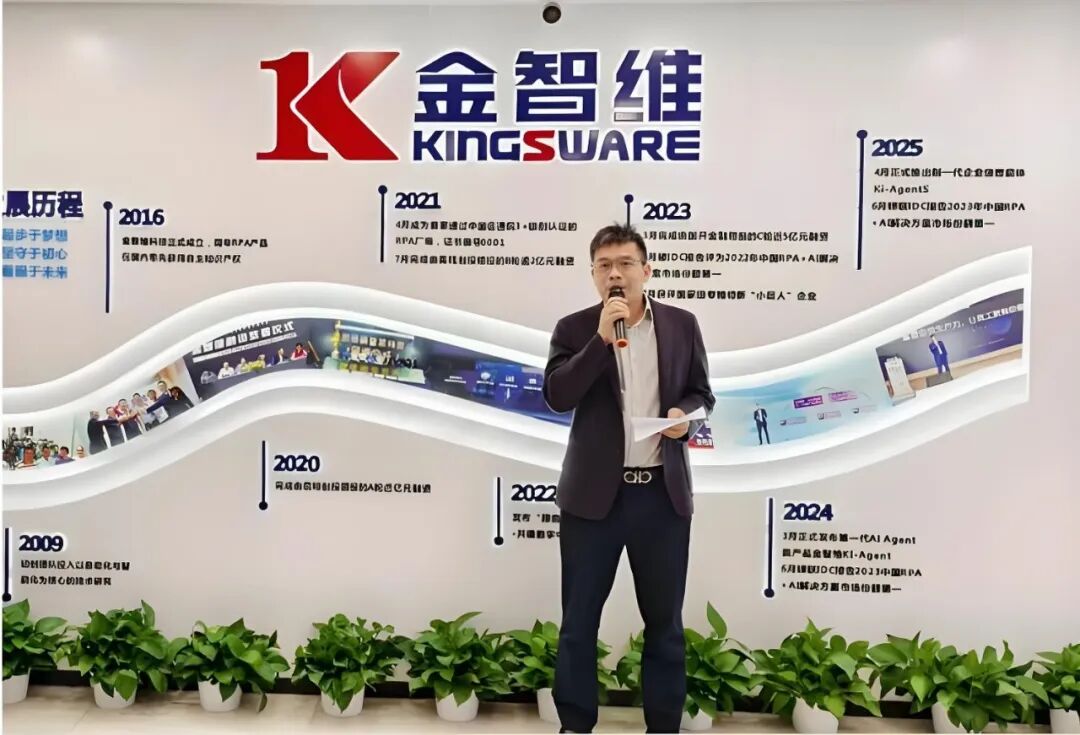
Founder Liao Wanli graduated from Hangzhou Dianzi University's Computer and Application program in 1993 and immediately joined the technology department of the Zhuhai Branch of the Agricultural Bank of China, where he worked as a core technical staff member for nearly eight years. After leaving the bank, he held key positions at financial IT companies such as Yusys Easysoft, Mintai Information, Yusys Hengsheng, and Kingdom Technology.
In March 2016, he founded KingWise in Zhuhai.
KingWise's background in banking core systems is a key defining characteristic.
In the 2019 global tender by China Construction Bank, KingWise competed alongside international peers such as UiPath, Blue Prism, and Automation Anywhere, ultimately winning the bid for K-RPA with the top score. Subsequently, clients such as the Industrial and Commercial Bank of China, the Export-Import Bank of China, multiple provincial branches of the Bank of China, and the Credit Card Center of the Bank of Communications became its customers.
As of the end of June this year, KingWise had provided services to over 270 banks, with revenue from the financial services sector consistently accounting for about 70% of its total revenue.
However, behind this impressive track record lies persistent financial pressure.
In the first half of 2026, KingWise reported revenue of RMB 65.13 million, up 41.7% year-on-year. However, when viewed over a longer timeframe, the company's growth trajectory over the past three years has been nearly flat. From 2023 to 2025, revenue was RMB 217 million, RMB 243 million, and RMB 256 million, respectively, with a two-year compound growth rate of just about 8.7%.
In comparison, the compound growth rate of China's enterprise-level AI solutions market during the same period reached 37.1%—enterprises are allocating more funds to AI products other than digital employees.
Its profit performance lags far behind its revenue growth. From 2023 to 2025, KingWise's net losses widened from RMB 62.57 million to RMB 346 million, accumulating to RMB 530 million over three years. Losses continued in the first half of 2026, reaching RMB 109 million.
Even after excluding factors such as fair value changes in financial instruments like redeemable preferred shares, its adjusted net losses expanded from RMB 2.95 million in 2024 to RMB 27.13 million in 2025, further widening to RMB 56.82 million in the first half of 2026.

Pressure
To understand why KingWise is experiencing revenue growth without profitability, we must first examine its revenue structure.
In 2025, KingWise's project-based revenue was RMB 197 million, accounting for 76.9% of total revenue. Custom development and deployment services contributed nearly half of the total revenue, reaching RMB 127 million.
Additionally, its subscription-based revenue declined from RMB 58.73 million in 2024 to RMB 43 million in 2025, accounting for just 16.8% of total revenue. Project-based revenue had a gross margin of 44.2%, while subscription-based revenue had a gross margin of 75%—less than 60% of the latter.
This represents a critical structural issue.
In the context of this company, project-based work primarily involves customized, 'case-by-case' services. Under this model, each client requires an implementation team to conduct on-site needs assessments, process configurations, scenario debugging, and site acceptance. Revenue expansion relies heavily on personnel expansion, making it extremely difficult to reduce marginal costs.
Data supports this observation. In 2025, KingWise's outsourced deployment costs surged by 139% to RMB 28.58 million. In the first half of 2026, out of 905 employees, 373 were delivery and operations personnel, surpassing the 342 R&D staff.
Such a business model significantly increases cost expenditures.
First, for every new client acquired, the company must allocate corresponding implementation and operations personnel, whose costs are rigid and difficult to amortize with scale growth.
Second, the project-based model also leads to increased pressure on the expense side. In the first half of 2026, sales and distribution expenses rose from approximately RMB 29.21 million in the same period last year to about RMB 59.96 million, a 105.3% increase, far exceeding the 41.7% revenue growth during the same period. The proportion of sales expenses to revenue jumped from about 29% from 2023 to 2025 to 92.1%.
To maintain effective project operations, R&D expenditures also need to increase proportionally. From 2023 to 2025, KingWise's R&D spending rose from RMB 55.38 million to RMB 78.77 million. In the first half of 2026, it continued to grow by 34.5% to RMB 42.53 million, accounting for a high 65.3% of revenue.
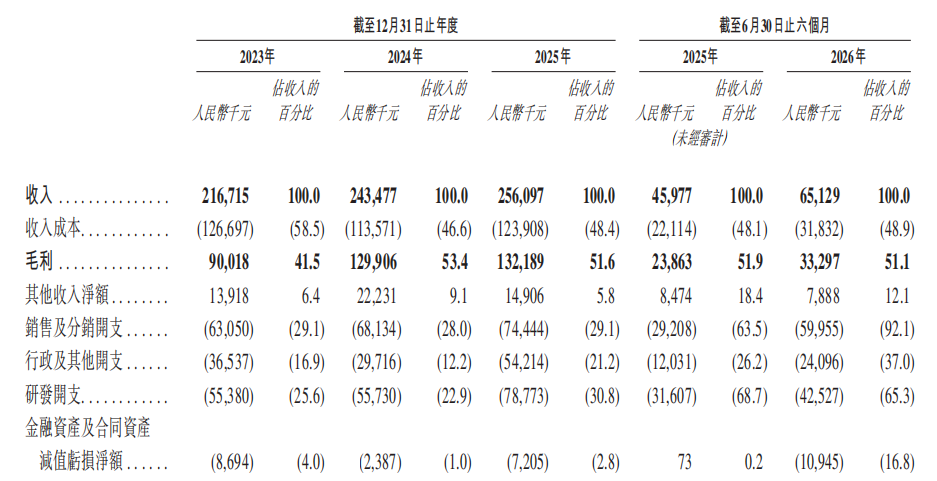
The low gross margins and high expenditures of the core business inevitably result in pressure on the balance sheet.
As of the end of June 2026, KingWise had just about RMB 72 million in cash on hand, while liabilities related to redeemable preferred shares reached as high as RMB 2.126 billion. These liabilities stem from gambling arrangements signed with investors during financing—if the IPO fails to materialize, investors have the right to demand that the company redeem their shares.
This means that if the IPO is blocked again, the company will face even greater liquidity pressure. Going public has become an essential path for KingWise to sustain its operations.
However, even if the company successfully goes public, its growth challenges are unlikely to be resolved in the short term, as they are determined by the current development stage of the digital employee segment.

Testing Ground
While many companies claim that digital employees 'save labor' or 'improve efficiency,' these effects often lack unified standards, and few enterprises can quantify their profit contributions in financial reports.
For example, in financial scenarios, the value of digital employees is expressed in various ways:
Industrial and Commercial Bank of China and China CITIC Bank use 'person-years' as a metric. The former states that 'AI digital employees handle workload equivalent to 55,000 person-years annually,' while the latter claims that intelligent models enhance efficiency by over 17,000 person-years.
Bank of Jiangsu uses the concept of 'work hours,' disclosing in its 2026 interim report that various AI-related applications across the bank have cumulatively replaced 1.2 million work hours.
China Merchants Bank declares in its annual report that 'AI saves labor efficiency by over 15.56 million hours.'
Regardless of the metric used, none of the major banks ultimately translate these cost-saving outcomes into tangible financial figures.
The lack of a unified evaluation framework means that corporate purchasing decisions are more 'driven by the tide of the times,' primarily motivated by a desire not to fall behind in the industry's AI race, rather than being driven by real efficiency validation and value.
This procurement model poses significant challenges for suppliers. In addition to facing greater pricing pressure, if products fail to meet expectations or deliver commercial results, enterprises can easily discontinue their use and adopt a wait-and-see approach for upgrades.
KingWise's client retention rate dropped from 74% in 2023 to 66% in 2025, further declining to 60% in the first half of this year. Average contract value fell from RMB 380,000 to RMB 150,000.
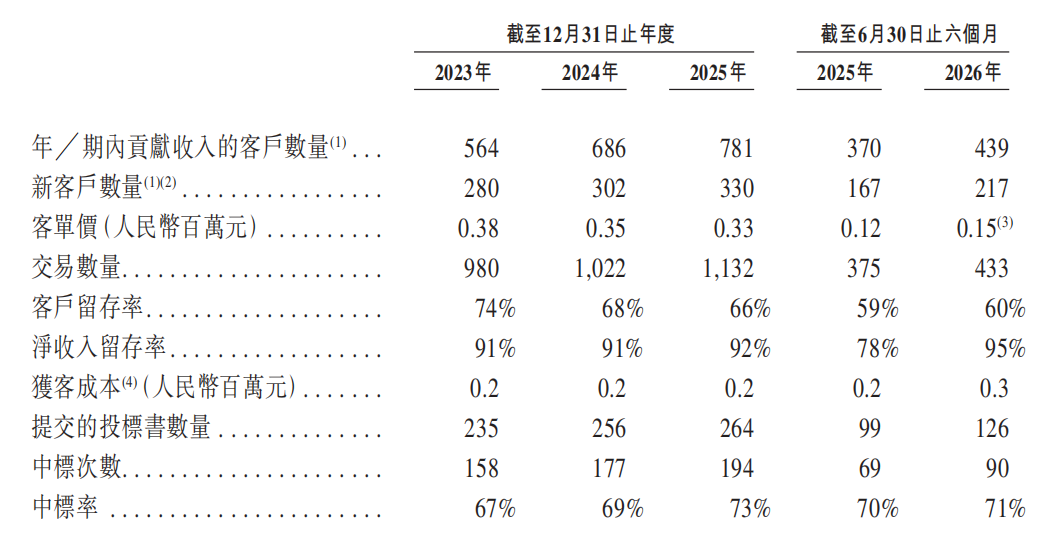
Together, these metrics paint a picture: AI projects have been implemented, but clients have not seen sufficient returns, leading them to choose not to renew contracts or demand lower prices from suppliers.
Moreover, this is not a challenge unique to KingWise.
According to KPMG's Global Technology Report released in June 2026, 88% of surveyed enterprises have begun integrating Agentic AI into their systems, but only 24% can achieve return on investment across multiple AI use cases.
Gartner's 2026 H1 CIO report reveals that 83% of CEOs are increasing AI investments, yet 59% of AI projects fail to reach production environments. Among the 11,000 CIOs surveyed, 71% said it was difficult to identify AI application scenarios that could deliver quantifiable results.
In other words, while everyone believes digital employees are a good thing, few enterprises have truly saved money using them, or even calculated exactly how much they have saved.
While the segment appears to hold infinite potential, virtually all players are navigating uncharted territory. In this environment, clients are unlikely to entrust all their digital employee needs to a single dominant supplier, resulting in a relatively fragmented industry.

According to Frost & Sullivan data, while KingWise ranked first in the AI digital employee solutions market with a 3.3% share in 2025, the second and third players held 2.9% and 2.1%, respectively, with the top five vendors collectively accounting for about 11.3% of the market.
This indicates a highly fragmented, low-barrier-to-entry early-stage market that has yet to form dominant barriers.
Only when the overall industry's intelligence level undergoes significant upgrades will a large number of institutions, including financial firms, take action again. Until then, institutions will maintain a relatively cautious attitude toward suppliers' products, treating digital employee purchases less as immediate cost-saving measures and more as strategic 'future-proofing' investments.
For suppliers like KingWise, this represents both a strategic opportunity in the early stages of industry development and an ongoing ordeal.

Conclusion
The challenges faced by a company like KingWise essentially represent a typical sample of how various segments are transitioning from conceptual hype to real-world commercial validation in the impending AI era.
AI has become a strategically certain direction across industries, but tactical approaches remain far from mature.
Explorers may attract capital attention, list on stock exchanges, and even secure substantial client orders. However, even so, everyone is still in the early stages of industrial development, with digital employees and KingWise serving as prime examples.
For capital and clients alike, the various AI products emerging at this stage share similar traits: they are future-oriented and will undoubtedly present development opportunities. However, time will always remain the ultimate yardstick for measuring all progress and benefits.
-
![]()
September Vehicle Sales Rankings Unveiled: BYD Song Outshines Tesla Model Y to Claim Top Spot
-
![]()
Manus Returns to the Domestic Market with a $4 Billion Valuation: What's Next?
-
![]()
India’s AI Glasses Revolutionize Payment Methods: Seamless Transactions by Conversing with QR Codes
-
![]()
Zhang Yiming’s World Model Can No Longer Remain Unnoticed
-
![]()
Zuckerberg, the Eyewear Seller, Becomes the Fourth Richest Person in the World
-
![]()
Spherical Aberration: Why Even On-Axis Points Fail to Achieve Perfection?
-
![]()
Apple is Finally Adding Touchscreens to MacBooks, Why is This Time Different?
-
![]()
The Other Side of the 'Great AI Opportunity' for Digital Employees | WAVE