Spherical Aberration: Why Even On-Axis Points Fail to Achieve Perfection?
 10/12 2026
 367
367
Abstract: Even when an object is precisely positioned along the ideal optical axis, spherical optical systems are incapable of achieving flawless point imaging, primarily due to spherical aberration. As the sole primary monochromatic aberration that manifests on the optical axis, it induces a discrepancy in the focal positions of light rays traversing the lens's center and periphery. This intrinsic imaging flaw represents a fundamental aberration that necessitates correction in the design of AR optical engines.
A common misconception is that as long as the object point is centered on the optical axis and the optical path is sufficiently regular, the optical system can produce a perfectly focused light spot. However, in practical optical imaging scenarios, even under ideal on-axis conditions free from aberration tilt or field shift, issues such as focal spot dispersion and inadequate light concentration persist. The primary culprit behind this phenomenon is, undoubtedly, spherical aberration.
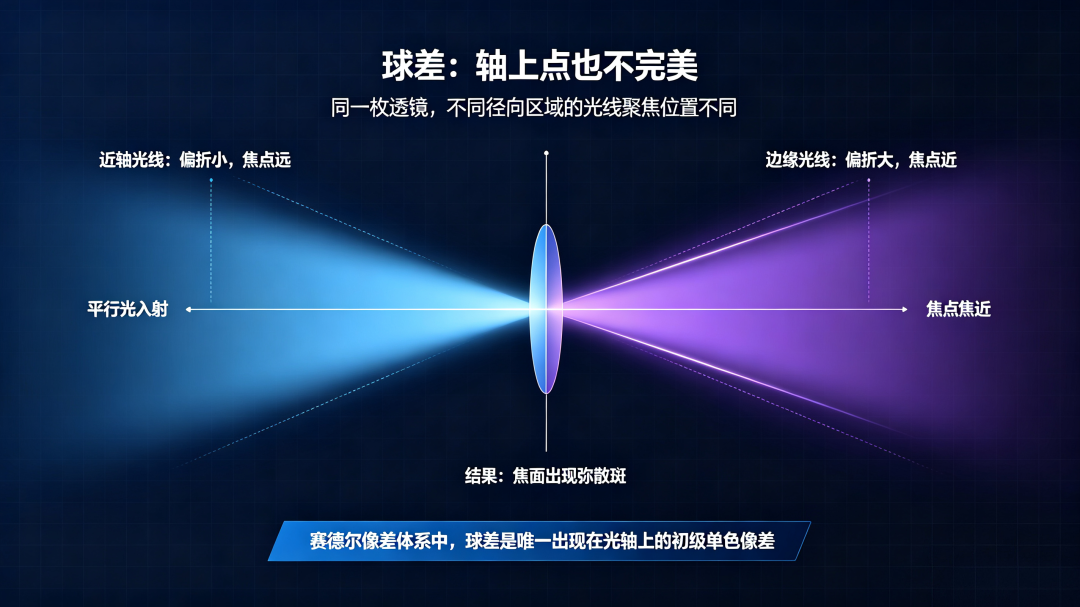
Core Understanding: Within the Seidel aberration framework, spherical aberration stands as the only primary monochromatic aberration that occurs on the optical axis. Even when the object point lies on the optical axis, the refractive power varies across different regions of the lens, causing marginal and paraxial rays to fail to converge at the same point. This fundamental characteristic renders optical systems inherently 'imperfect from the center'.
I. The Physical Essence of Spherical Aberration: Inherent Flaws in Spherical Geometry
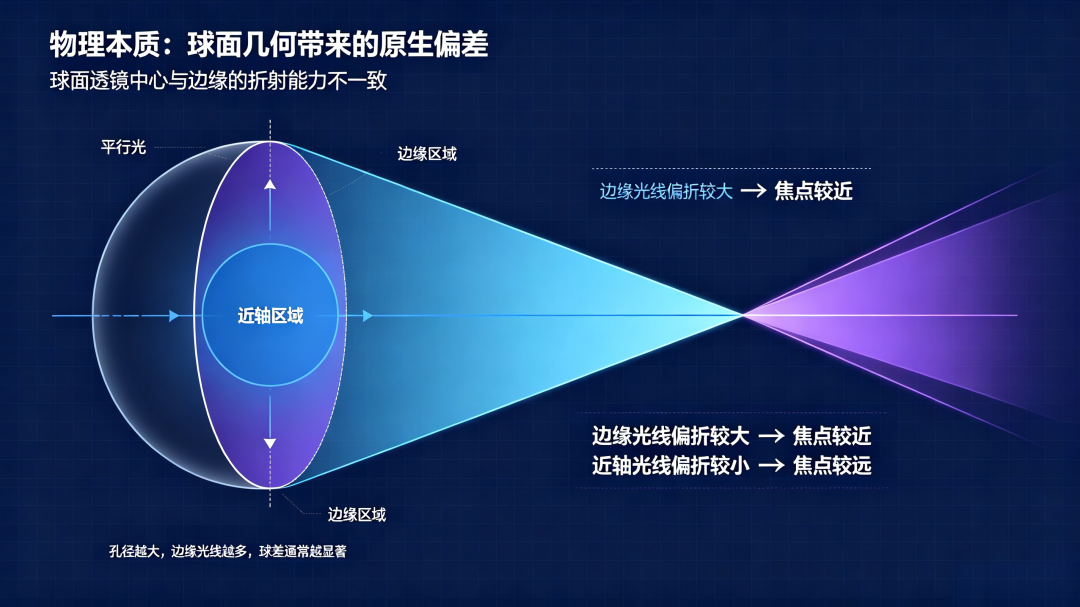
The origin of spherical aberration lies in the inherent geometric properties of spherical lenses, representing a native deviation within optical systems. When parallel incident light passes through a standard spherical lens, the degree of refraction varies significantly for rays at different radial positions. Paraxial rays near the optical axis undergo less refraction and converge at a focal point farther from the lens. Conversely, marginal rays passing through the lens's outer regions experience greater refraction and converge at a point closer to the lens. In essence, the light-gathering capability differs between the central and peripheral regions of the same spherical lens, preventing parallel incident rays from converging at a single focal point.
II. Practical Implications in Optical Systems: From Ideal Light Points to Dispersion
The most conspicuous imaging defect caused by spherical aberration is the inability of an ideal point light source to converge into a perfect light spot, resulting in a blurred, diffuse spot on the focal plane. Within the focal plane region, the optical system lacks a single, distinct focal point, forming instead a series of diffuse circles of varying sizes and brightness, significantly degrading imaging sharpness.
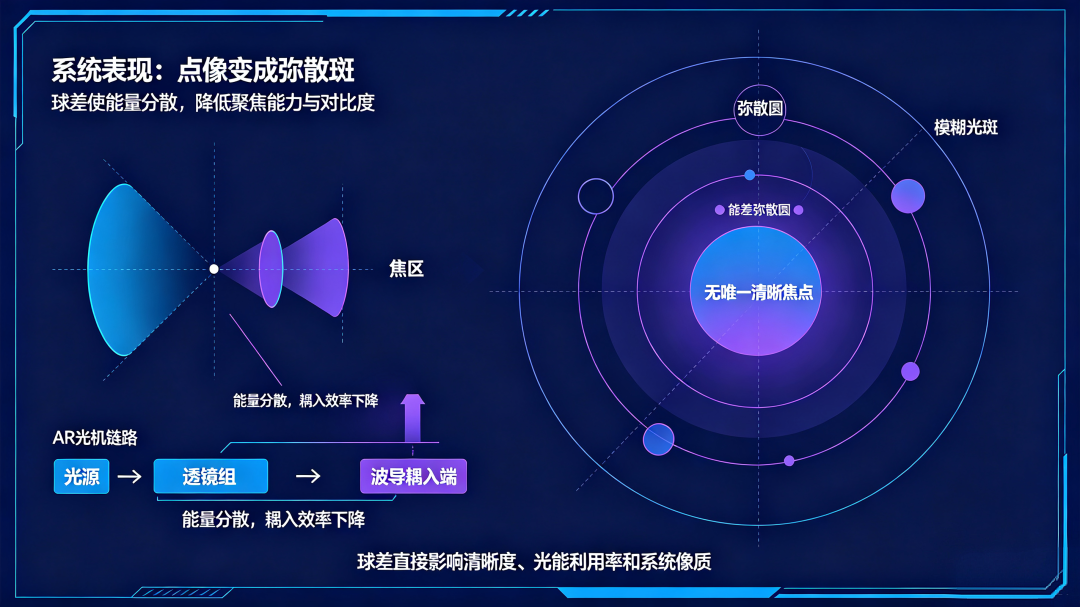
In AR optical engine systems, the detrimental effects of spherical aberration are particularly pronounced. Scattered and displaced rays cannot be accurately focused onto the waveguide's coupling port, leading to substantial losses in effective light energy. This directly diminishes the system's light energy utilization efficiency while compromising the overall clarity and purity of the displayed image.
III. Mainstream Correction Strategies for Spherical Aberration: Fundamental Optimization Logic in Optical Design
The optical industry has devised three mature and widely applicable strategies for correcting spherical aberration, catering to the diverse design needs of various optical systems.
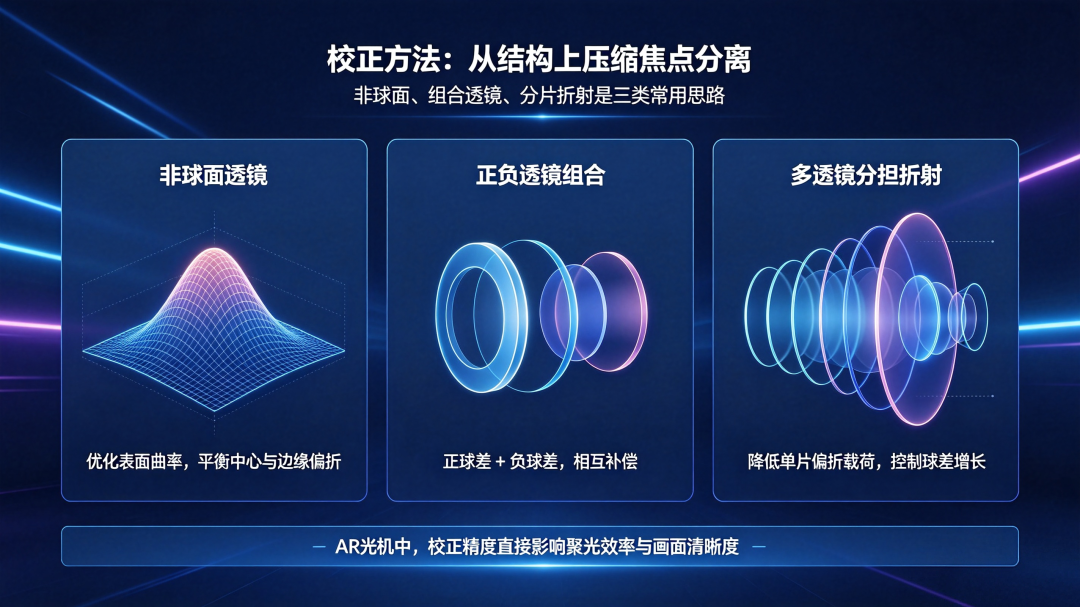
The primary optimization methods can be categorized into three groups:
- Aspheric Lens Substitution: By optimizing the curvature distribution of the lens surface, the refraction differences between central and marginal rays are balanced, thereby structurally suppressing spherical aberration.
- Combined Positive and Negative Lens Structures for Spherical Aberration Cancellation: Leveraging the positive spherical aberration generated by positive lenses and the negative spherical aberration generated by negative lenses to mutually compensate and optimize the optical path.
- Multi-Lens Segmentation to Share Refractive Loads: Avoiding excessive refraction in a single lens by distributing the refractive load across multiple lenses, thereby mitigating the risk of excessive spherical aberration at the source.
In AR optical engine design, the correction accuracy of spherical aberration directly influences core performance metrics such as the light-gathering efficiency and imaging clarity of the optical engine.
Conclusion
Unlike coma or astigmatism, which predominantly affect off-axis fields, spherical aberration is the sole native monochromatic aberration in the central on-axis field, representing a fundamental limitation that prevents optical systems from achieving perfect imaging.
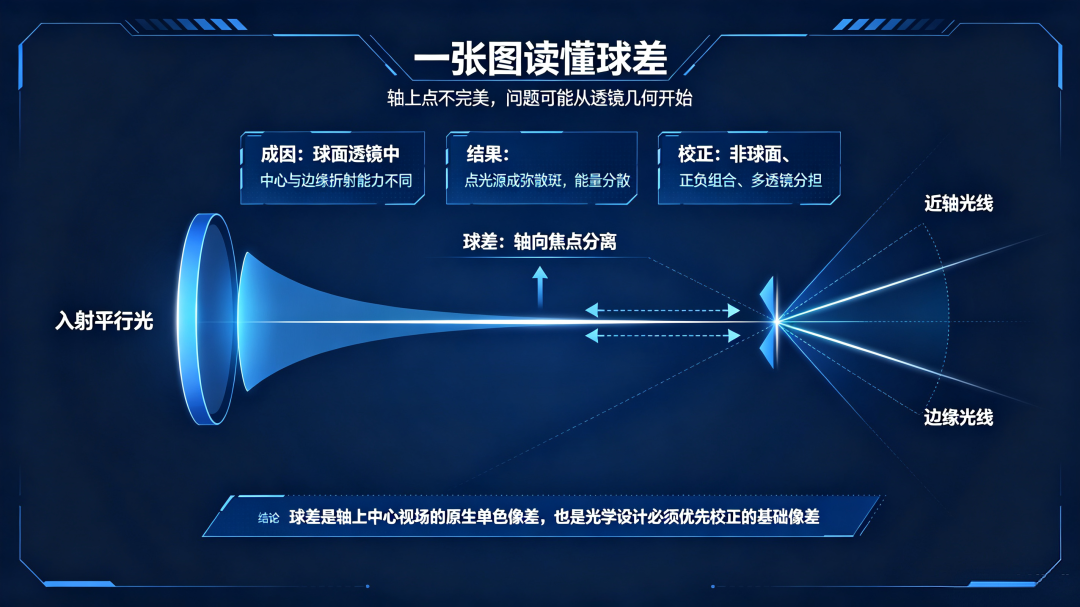
Understanding the underlying logic of spherical aberration provides precise insights into why large-aperture spherical lenses struggle to achieve ultimate focusing, why aspheric lenses have become standard in high-end optical equipment, and serves as a core theoretical foundation for fine-tuning optical paths in AR optical engines.
Interactive Topic: Have you encountered focal point shifts or low light energy utilization caused by spherical aberration during optical simulation or optical engine debugging? Share your debugging experiences in the comments!
— AR Andy | Focused on waveguide and AR microdisplay technologies, deeply dissecting the fundamental logic of the optical industry.
[Risk Disclaimer] This article provides industry-oriented optical science popularization content. The principles, phenomena, and optimization solutions discussed are derived from publicly available optical theories and general optical design experience. They are intended solely for technical learning and industry exchange and do not constitute a basis for product design, process iteration, or mass production selection.
-
![]()
September Vehicle Sales Rankings Unveiled: BYD Song Outshines Tesla Model Y to Claim Top Spot
-
![]()
Manus Returns to the Domestic Market with a $4 Billion Valuation: What's Next?
-
![]()
India’s AI Glasses Revolutionize Payment Methods: Seamless Transactions by Conversing with QR Codes
-
![]()
Zhang Yiming’s World Model Can No Longer Remain Unnoticed
-
![]()
Zuckerberg, the Eyewear Seller, Becomes the Fourth Richest Person in the World
-
![]()
Spherical Aberration: Why Even On-Axis Points Fail to Achieve Perfection?
-
![]()
Apple is Finally Adding Touchscreens to MacBooks, Why is This Time Different?
-
![]()
The Other Side of the 'Great AI Opportunity' for Digital Employees | WAVE