Apple is Finally Adding Touchscreens to MacBooks, Why is This Time Different?
 10/12 2026
 516
516
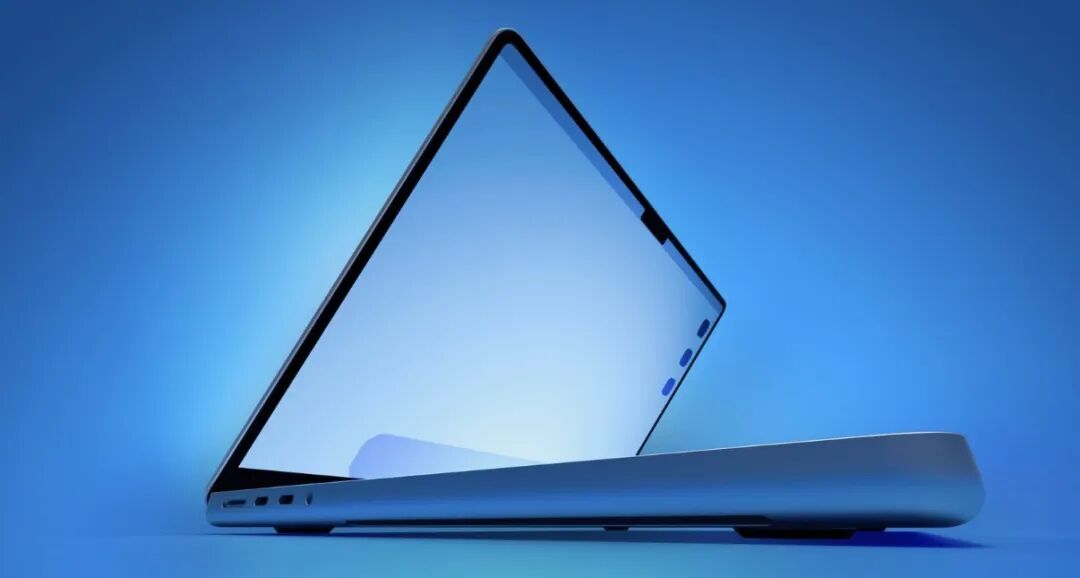
Apple has a widely circulated internal credo: Macs are for keyboards, iPads are for fingers, and neither should encroach on the other's territory.
Tim Cook has publicly compared touchscreen laptops to “a toaster-fridge hybrid.” He has repeated this line for a decade, and Apple's product managers have adhered to it for just as long—until October this year.
According to Bloomberg, Apple is set to release its first touch-enabled MacBook Pro around October 27. Featuring an OLED screen, Dynamic Island, and a thinner body, it represents the most significant redesign of the MacBook Pro since 2021.
Apple Held This Rule for a Decade
Apple's long-standing rejection of touchscreen laptops has little to do with technical limitations.
The company's patent portfolio in touchscreen technology dates back over a decade. The touch interaction expertise gained from iPhones and iPads faces no fundamental technical barriers when applied to Mac screens. The real reason Apple has held off is rooted in product logic: each device type has its own interaction paradigm, which defines product boundaries and justifies separate user payments for different devices.
iPhones are pocket-sized touch devices, iPads are handheld touch devices, and Macs are desktop keyboard-driven machines. These three lines each have growth potential, with sufficiently distinct functionalities that users don’t feel owning one negates the need for another.
This logic has operated effectively for years, helping Apple sustain simultaneous growth across multiple product lines.
But two key changes have occurred.
The first change comes from the user side. Analyst Ming-Chi Kuo offers an intriguing explanation: Apple's consideration of touchscreen Macs at this juncture stems from long-term observations of iPad user behavior. The company found that touch interactions are more efficient than keyboards and trackpads in certain scenarios. Since its own user data now confirms this, persisting with “Macs shouldn’t have touchscreens” shifts from a product principle to a product dogma.
The second change is market-driven. In Q3 FY2026, Mac revenue reached $10.4 billion, up 29% YoY—a record high for the period. In the same quarter, iPad revenue fell 6% YoY to $6.2 billion. Mac is ascending while iPad is declining, with their growth curves now intersecting.
What does this data combination indicate? Mac is currently one of Apple’s hardware segments with the strongest growth momentum. Launching a significantly upgraded MacBook Pro at this juncture aims to capitalize on this success, pushing Mac’s growth even further with a product featuring a notable form factor change.
As for iPad’s decline, the reasons are complex—slower product refresh cycles being one factor—but the overlapping use cases between Mac and iPad cannot be ignored. Cook himself acknowledged years ago that iPads have, to some extent, cannibalized Mac sales. The reverse is also true: as Macs become more powerful, some users may find iPads less essential.
The introduction of a touchscreen MacBook Pro will make this cannibalization more direct. But Apple likely has a plan to manage it.
What Touch Can and Cannot Do
Before discussing how Apple might handle this, let’s examine its approach to the touchscreen.
According to Bloomberg, the new MacBook Pro’s macOS will introduce a “dynamic” interaction mechanism: when fingers touch the screen, contextual menus pop up around the fingertip for quick selection; when switching back to the trackpad, the interface returns to traditional precision control mode. Touch adds a layer of interaction on top of the keyboard and trackpad without removing any existing functionality.
This design reveals Apple’s true intent: it doesn’t want to turn the MacBook Pro into a large iPad with a keyboard. Touch is meant to serve as an auxiliary tool within professional workflows—nothing more.
Is this positioning tenable? It depends on the scenario.
Dragging timelines in video editing, selecting regions in photo editing, or adjusting mixing faders in music production are all more intuitive with direct finger input than navigating via trackpad. Apple’s event theme explicitly targets creative work like video production, photo editing, and music creation, indicating that the company itself sees touch’s primary value in these contexts.
However, the boundaries of touch are equally clear. Coding, spreadsheet work, long-document typesetting, and precise vector path adjustments remain highly dependent on keyboard and cursor control. A video editor might find 20% of daily operations more convenient with touch, but for the remaining 80%, keyboard shortcuts and trackpad gestures remain indispensable.
In other words, the touchscreen MacBook Pro enhances operational smoothness rather than raising the ceiling on productivity. This distinction matters—it determines whether touch is a “must-have” upgrade or a “nice-to-have” addition.
The answer likely lies somewhere in between. Apple needs enough professional users to perceive this difference as worth paying for.
The Boundaries Between Mac and iPad Are Crumbling
This is the most noteworthy aspect of the entire situation.
A touch-enabled MacBook Pro already covers most use cases of an iPad Pro. It offers touch input, superior processing power, a full desktop OS, and retains a physical keyboard and trackpad. For creative professionals who previously carried both a MacBook Pro and an iPad Pro, the question becomes: Do I still need an iPad?
Apple cannot have overlooked this issue. Based on currently available information, it appears to have prepared a tiered strategy to manage internal competition.
For Macs, the product lineup has been clearly stratified. At the bottom is the MacBook Neo, powered by an iPhone processor, priced lowest, and targeting casual users. Above it is the MacBook Air, emphasizing portability and battery life. Next is the entry-level MacBook Pro, featuring the M6 chip, maintaining the current design language, and lacking touch and OLED. At the top is the new OLED touch-enabled MacBook Pro, equipped with M5 Pro and M5 Max chips, priced significantly higher than the current MacBook Pro.
Notably, the latest M6 chip goes to the entry-level model, while the previous-generation M5 Pro/Max powers the high-end touch variant. Apple is using both chip generations and screen technologies to create sufficient differentiation across price tiers. The entry-level model sells on “latest chip, adequate performance,” while the high-end model sells on “new form factor, exclusive experience.”
On the iPad side, Apple is also taking action. The newly released iPad mini features an OLED screen for the first time, while the iPad Pro maintains its premium positioning. Apple intends for iPads to continue emphasizing portability and the Apple Pencil’s handwriting experience—features a touch-enabled MacBook Pro cannot replicate.
But honestly, whether this differentiation holds depends on user calculations. A fully equipped iPad Pro, paired with a Magic Keyboard and Apple Pencil, costs nearly as much as—or even more than—a MacBook Pro. If the MacBook Pro itself offers touch functionality, why would users spend similar money on a device with more limited capabilities?
Apple’s ability to manage internal product line competition is widely recognized in the industry, but touchscreen Macs do create a crack between the two lines. Over the next one to two years, changes in Mac and iPad revenue will serve as the most direct indicators of this strategy’s success. If Mac continues growing while iPad keeps declining, it suggests touchscreen Macs are accelerating iPad replacement—the pie isn’t growing, just being redistributed.
The Supply Chain Game Behind 2.5 Million Panels
Currently, Samsung Display is the sole supplier of OLED touch panels for the MacBook Pro, expected to ship 2.5 million units this year. LG Display isn’t technically ready and may only enter the market by 2029 at the earliest. BOE lags further behind, likely competing for MacBook Air panel orders only after 2028.
This pattern (landscape) isn’t ideal for Apple. Exclusive supply means limited room for price negotiation in the short term, with OLED panel costs directly eating into MacBook Pro profits. However, Apple is clearly betting on a scenario: once LG and BOE catch up, tripartite competition will drive panel prices down. Until then, OLED will remain exclusive to the most expensive MacBook Pro, with MacBook Air adopting it only after 2028—not because Apple doesn’t want to, but because it can’t afford to yet.
This “premium first, mainstream later” rhythm mirrors Apple’s past strategy of expanding OLED from iPhone Pro to the entire iPhone lineup. Apple uses the profit margins of high-end products to absorb the initial costs of new technologies while pressuring suppliers to expand production and reduce prices, paving the way for future widespread adoption.
From a broader industry perspective, Apple’s entry is reshaping capacity allocation in the notebook OLED market. Counterpoint predicts that MacBook Pro’s shift to OLED will drive a 33% YoY increase in global OLED notebook shipments in 2026. Omdia expects the global OLED screen market for notebooks to reach $4 billion this year. Samsung Display has exclusively activated its 8.6-generation OLED production line for Apple’s orders. If this capacity is later released to PC vendors like Dell, HP, and Lenovo, it means the entire Windows camp (ecosystem) will also accelerate its OLED upgrades.
Apple’s procurement decisions have never been just about solving its own supply issues. It redefines where the supply chain invests.
But all these benefits take time to materialize. Limited by panel capacity, the first OLED MacBook Pros are unlikely to trigger a leap in Mac revenue shortly. True volume growth will come only after multiple suppliers enter the market, panel costs decline, and OLED spreads to more product lines.
What Is Apple Betting On?
Apple’s decision rests on two pillars: First, its accumulated user behavior data has reached a tipping point, proving touch’s value in specific scenarios. Second, the Mac product line is in an upward growth phase, making it far easier to double down during success than to pivot during decline.
Whether the touchscreen MacBook Pro succeeds depends on whether professional users are truly willing to pay a premium for touch capabilities—and whether Apple can maintain a balance between Mac and iPad that allows both product lines to thrive.
The October 27 event will partially answer the first question. The answer to the second may take another two years to emerge.
-
![]()
September Vehicle Sales Rankings Unveiled: BYD Song Outshines Tesla Model Y to Claim Top Spot
-
![]()
Manus Returns to the Domestic Market with a $4 Billion Valuation: What's Next?
-
![]()
India’s AI Glasses Revolutionize Payment Methods: Seamless Transactions by Conversing with QR Codes
-
![]()
Zhang Yiming’s World Model Can No Longer Remain Unnoticed
-
![]()
Zuckerberg, the Eyewear Seller, Becomes the Fourth Richest Person in the World
-
![]()
Spherical Aberration: Why Even On-Axis Points Fail to Achieve Perfection?
-
![]()
Apple is Finally Adding Touchscreens to MacBooks, Why is This Time Different?
-
![]()
The Other Side of the 'Great AI Opportunity' for Digital Employees | WAVE