Feishu’s Strategic Shift: Is Doubling Down on Entry Points for China’s AI-Powered Office Tools the Right Call?
 10/13 2026
 552
552

In just ten days, tech giants Alibaba, Tencent, and ByteDance have all streamlined their AI-driven office product portfolios. The consensus is clear: the window of opportunity for AI office solutions is closing fast.
On July 30, ByteDance announced two key organizational changes via an internal email: The Feishu and Doubao product teams were merged into a single Doubao team, led by Doubao’s head Zhao Qi, with Feishu’s leader Xie Xin reporting to Zhao. Meanwhile, Feishu’s market, sales, and customer service teams joined the Volcano Engine team to form a new ToB unit called the “Creativity Service Platform,” headed by Volcano Engine’s Tan Dai. Post-restructuring, Feishu’s brand and services remain unchanged.
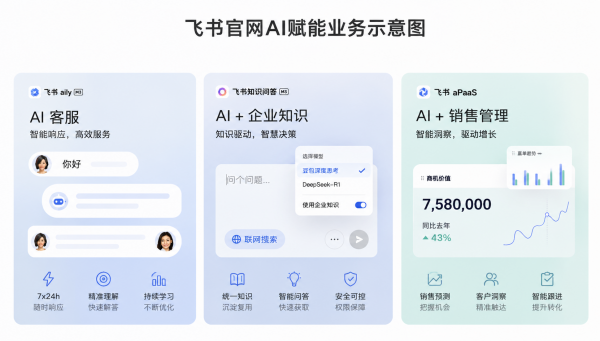
Feishu, which has operated independently for nearly a decade, has now split its product development and commercialization capabilities into two distinct business units.
A Shared Strategic Shift
Alibaba and Tencent had already made similar moves ten days earlier.
On July 20, Tencent transferred QClaw’s business and some teams to Cloud Product Division VI, which oversees WorkBuddy, placing both under the same management. On July 23, Tencent merged its Hunyuan multimodal model and large language model departments into a new Foundation Model Department, led by Chief AI Scientist Yao Shunyu. On July 27, Alibaba unified its three AI agent products—QoderWork, Wukong, and MuleRun—under the “Qianwen Office” brand, launching Windows and macOS versions with web and DingTalk-embedded versions to follow. DingTalk’s new CEO, Chen Yusen, took full charge. Just 46 days after Chen’s appointment, Qianwen Office debuted. On July 30, Feishu completed its spin-off. Thus, all three companies overhauled their AI office strategies within a single week.
It’s rare for Tencent, Alibaba, and ByteDance to converge on the same strategic focus. A data report titled the “2026 Q2 China Office Agent Platform Market Insights Report” sheds light on their motivations.
According to the report, 17 mainstream desktop-based AI-native office agents saw visits surge from 20 million in March to over 60 million in June this year—a near-tripling in three months.
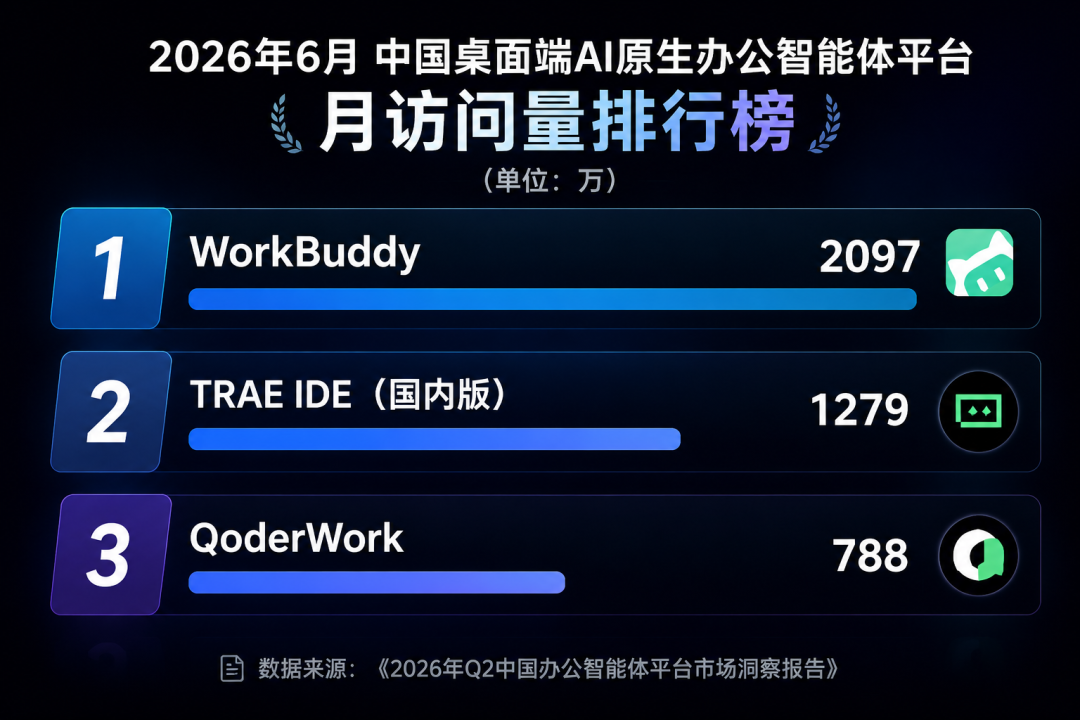
The report also ranked products by monthly visits: Tencent’s WorkBuddy led with 20.97 million, followed by ByteDance’s domestic Trae at 12.79 million, and Alibaba’s QoderWork at 7.88 million.
User growth is even more striking. Take Tencent’s WorkBuddy: a source close to Tencent Cloud confirmed daily active users exceeded 13 million by July, just four months after its March launch.
The data points to an undeniable trend: AI office agents are rapidly evolving into a standalone market, not just a feature of traditional office software. Their growth has outpaced expectations, with core use cases—document generation, data analysis, and information organization—overlapping heavily with legacy tools. If this trajectory continues, substitution will become inevitable in the coming quarters.
The market is already luring investors. Gartner predicted in a 2026 report that by 2030, $234 billion in enterprise software spending could shift from traditional tools to AI agents.
This explains the urgency among Tencent, Alibaba, and ByteDance. Once the AI office agent landscape is dominated, latecomers will struggle to catch up.
However, securing market share requires deeper strategic planning. A key backdrop: After OpenClaw’s “Longxia” gained traction in early 2026, many large firms adopted a multi-team approach to explore Agent products.
Alibaba simultaneously ran QoderWork, Wukong, and MuleRun. QoderWork, from an Alibaba Cloud startup team, focused on desktop AI agents; Wukong, incubated by DingTalk, positioned itself as an enterprise-grade AI platform; and MuleRun, led by Chen Yusen during his internal entrepreneurship at Alibaba Cloud, targeted cross-platform automation.
Tencent advanced four products: WorkBuddy, CodeBuddy, QClaw, and Yuanbao. ByteDance operated three parallel lines: Trae, Doubao, and Feishu.
While decentralization fosters innovation, desktop tools naturally gravitate toward centralization. Users are unlikely to juggle multiple similar products requiring plugin installations, account bindings, and workflow integrations.
This means large firms must act fast to consolidate their positions in the booming AI office agent sector.
Divergent Paths to Consolidation
Though the three companies acted in unison, their integration strategies differ significantly.
Alibaba pursued vertical integration. By absorbing Wukong’s enterprise permissions and MuleRun’s cross-platform capabilities into QoderWork, Alibaba aims to build an Agent architecture spanning desktop interaction, enterprise security, and process automation. The rebranded “Qianwen Office” ties directly to Tongyi Qianwen’s model strengths, rather than leveraging DingTalk’s brand.
Tencent’s adjustments were more tactical. Merging QClaw into WorkBuddy’s division aligned management but left product strategies intact. Tencent retained separate brands, reflecting WorkBuddy’s strong market position. With no “product line confusion” to address, Tencent focused on streamlining capabilities across departments rather than rebuilding architectures.
At the organizational level, Tencent went further. On July 23, it unified its Hunyuan multimodal and large language model teams under Chief AI Scientist Yao Shunyu, aiming to reduce redundant R&D efforts.
ByteDance’s overhaul was the most radical. Feishu’s product development and commercialization teams were split: the former joined Doubao, and the latter moved to Volcano Engine. This positions large models (Doubao) as ByteDance’s core enterprise offering, while Feishu’s collaboration tools are integrated into the AI ecosystem. For ByteDance, AI is no longer a business unit—it’s the organizing principle for other operations.
ByteDance’s aggressive approach stems from cost pressures. Public data shows its 2025 net profit fell over 70% YoY, largely due to AI computing expenses. Its 2026 AI infrastructure budget exceeds 200 billion yuan. With investments mounting, monetization is urgent.
Feishu offers the clearest path to revenue. Its annual recurring revenue topped 3 billion yuan in 2025, with Q2 2026 growth exceeding 100%. Over 90% of Feishu’s new customers also bought AI products, per Caixin. Integrating Feishu’s client base with Doubao and Volcano Engine is a logical step to accelerate revenue during ByteDance’s AI investment phase.
Thus, the three companies’ divergent strategies reflect their answers to a common question: What form should AI office solutions take?
From Entry Points to Habits: The Real Challenge Post-Integration
Consolidating product lines and unifying brands address “entry point”布局 (strategic positioning). However, a global benchmark reveals a deeper hurdle.
By Q4 2026, Microsoft 365 Copilot had over 30 million paid enterprise seats, with 10 million added in a single quarter. Yet, third-party tracking of 150,000+ U.S. users shows only 35.8% of Copilot buyers remain weekly active users.
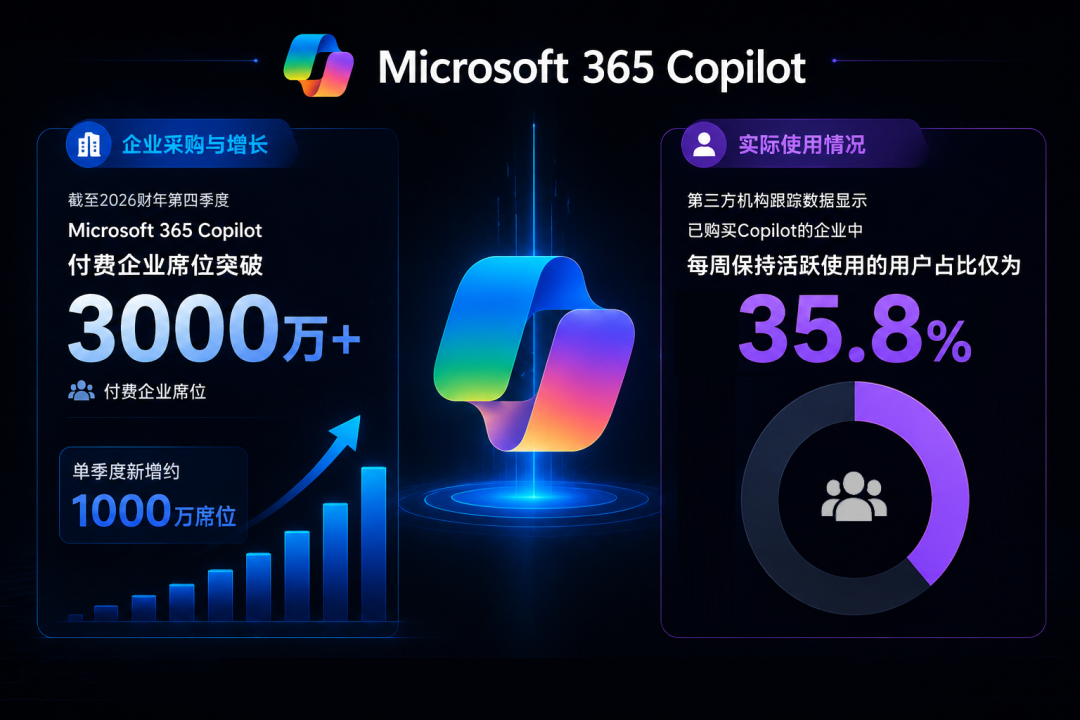
This cautionary tale matters for China. While visit metrics show adoption, true integration into workflows hinges on active usage and retention—the hallmarks of user habits.
User behavior is also diversifying. OpenAI reports Codex’s weekly active users grew from under 1 million in February to 8 million+ in July, with 20% from non-technical roles (analysts, marketers, legal, project managers). Non-developer usage is growing three times faster than programmer adoption. Anthropic’s Claude Code dominates the programming Agent market, with enterprise clients (34%) averaging 20 weekly usage hours.
These trends signal a shift: AI Agents are expanding beyond developers to all knowledge workers, becoming indispensable production tools.
Tencent, Alibaba, and ByteDance are vying for AI office dominance. The real race is to transform entry points into habits.
From this lens, Feishu’s spin-off isn’t about a single product’s fate. Its brand, customers, and services remain intact. What’s changed is its role in ByteDance’s ecosystem—from an independent unit to an AI-driven component. This organizational sacrifice reflects a broader truth: When AI office opportunities are shrinking by the month, structure is a variable worth reshaping.
-
![]()
Global Market Share of Pure Gasoline Vehicles Dips Below 50%: Is the Gasoline Car Era Nearing Its End?
-
![]()
The Whole Story of the 2026 'Rushed Vehicle' Controversy: From a Live Stream Joke to a Public Naming by People's Daily
-
![]()
V4 Flash Scores Impressively, But DeepSeek Hasn't Revealed All Its Cards Yet
-
![]()
MiniMax is set to tell a new story
-
![]()
Feishu’s Strategic Shift: Is Doubling Down on Entry Points for China’s AI-Powered Office Tools the Right Call?
-
Toyota’s North and South China Operations Merge, GAC Toyota Appoints New Chinese Executive
-
![]()
Zunjie V800 Brake Pedal Third-Party Test Results Unveiled: Withstands 3000N Longitudinal Force Without Damage
-
Domestic Mobile Phone Brands in Disarray as Market Slides 20%: Samsung and Apple Surge Amidst Domestic Decline!