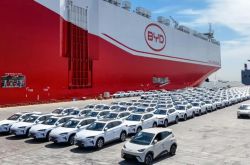
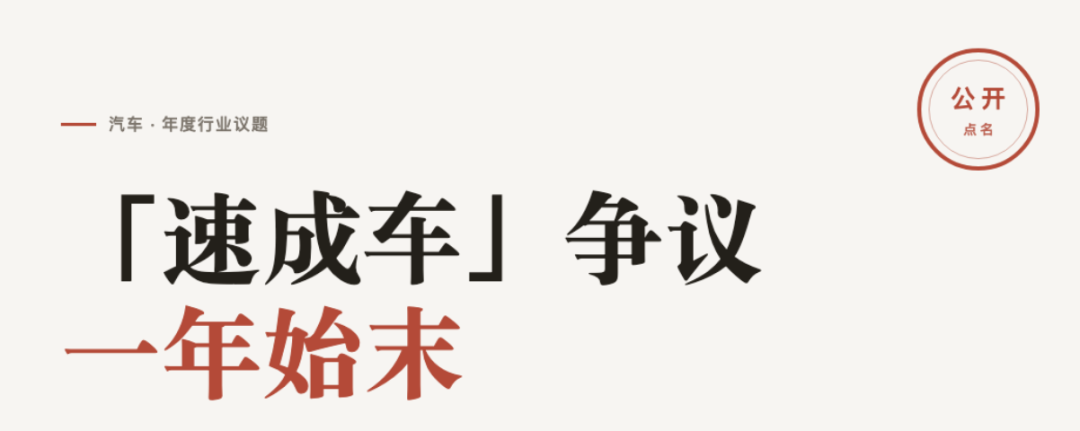
The Whole Story of the 2026 'Rushed Vehicle' Controversy: From a Live Stream Joke to a Public Naming by People's Daily
 10/13 2026
 483
483
In 2026, a stark contrast emerged in China's auto market: the development cycle for new vehicles was compressed to unprecedented lengths, with launch timelines accelerating, yet most new vehicles ended up in the so-called 'valley of death.' More and more automakers began publicly emphasizing their commitment to 'never building rushed vehicles,' with their slogans growing louder by the day.
The controversy began with a provocative remark in a forum, escalated into a public debate between traditional automakers and new energy players, and eventually fermented into an industry-wide discussion on R&D efficiency, testing and validation, and product safety. On October 11, the situation reached a new turning point.
On that day, the People's Daily client published an article titled 'Four Departments Join Hands to Say No to 'Rushed Vehicles!',' naming the controversial Zunjie V800 brake pedal bracket fracture incident. The article stressed that while an authoritative investigation was still pending, safety in automotive brake pedals could not be taken lightly.
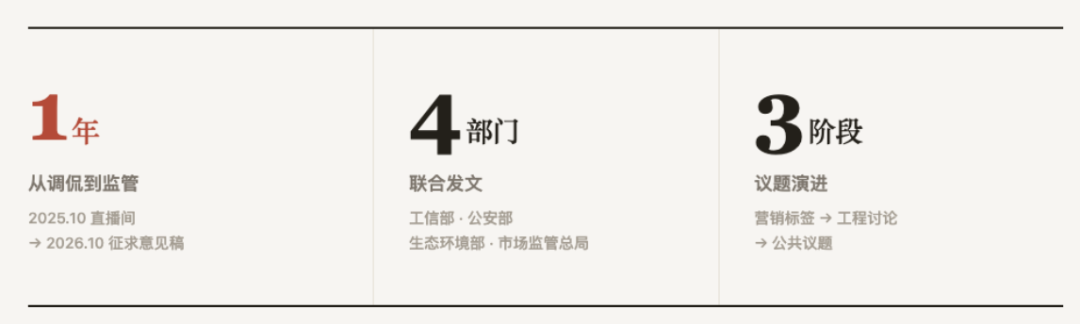
The day before, on October 10, the Ministry of Industry and Information Technology (MIIT), along with the Ministry of Public Security, the Ministry of Ecology and Environment, and the State Administration for Market Regulation, released a draft for public comment, proposing clearer requirements for new vehicle reliability, environmental adaptability, and safety assessments for innovative designs.
The controversy over 'rushed vehicles' boils down to a fundamental question: when new vehicle development is compressed from three to four years to just one or two, how much efficiency have automakers truly gained, and how much of the verification risk—which should rightfully be their responsibility—have they quietly shifted onto consumers?
01
How a Joke Became a Public Issue
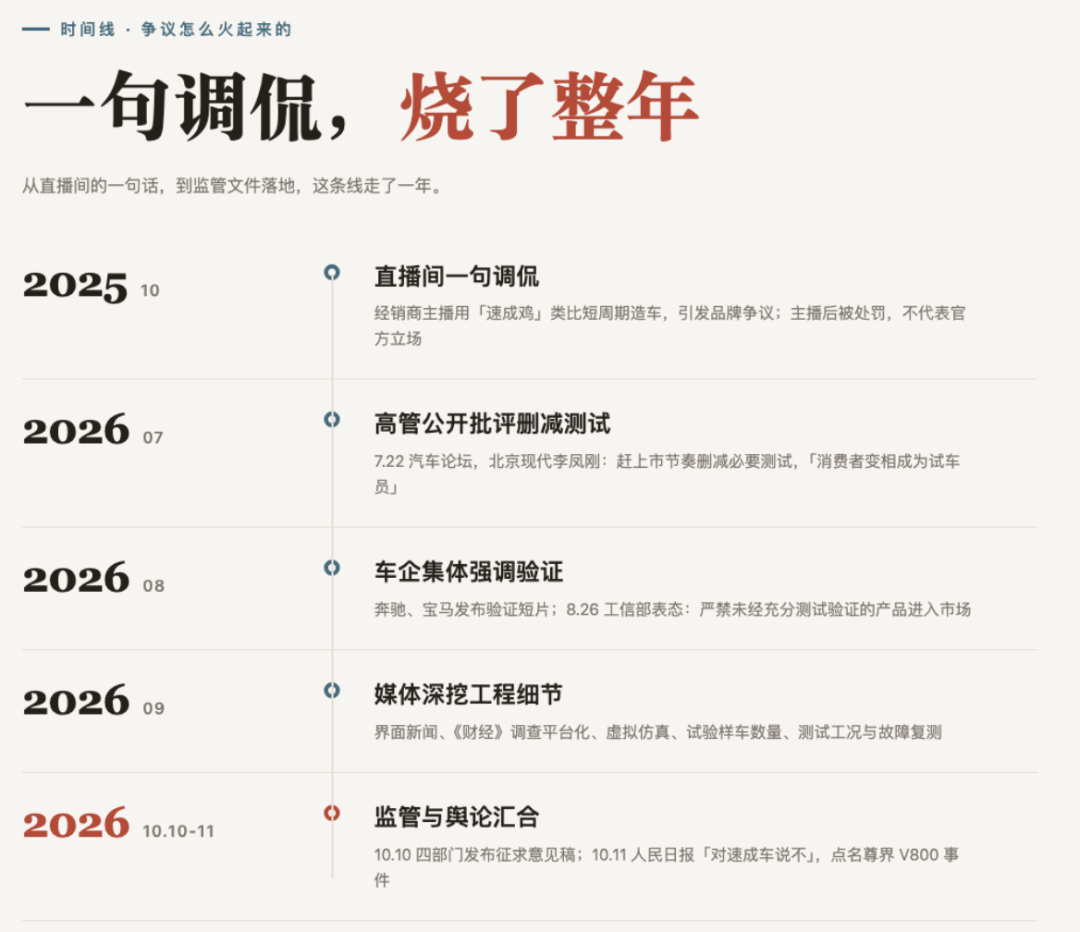
◎ The term 'rushed vehicle' first entered the spotlight in October 2025.
A BMW dealer's livestream host in Shanghai compared short-cycle vehicle manufacturing to 'rushed chickens,' a remark seen as implying criticism of domestic new energy brands. At the time, it was merely a marketing label used in mutual attacks. The dealer involved was later penalized for the livestream remarks, and the comments could not be equated with BMW's official stance.
◎ On July 22, 2026, at the China Auto Forum, Beijing Hyundai's General Manager Li Fenggang publicly criticized some companies for cutting necessary tests to meet launch deadlines, effectively turning consumers into test drivers. For the first time, the debate shifted from marketing rhetoric to engineering development.
◎ In August, Mercedes-Benz and BMW released promotional videos emphasizing real-world testing and validation. SAIC Volkswagen, Chery, WEY, and other companies or executives also brought reliability development to the forefront. On August 26, the MIIT publicly stated that products without sufficient testing and validation would be strictly prohibited from entering the market.
◎ In September, media outlets such as Jiemian News and Caijing began investigating the specific methods used to compress development cycles, focusing on engineering aspects like platformization, virtual simulation, the number of test vehicles, testing conditions, and fault retesting. The discussion gained technical depth.
◎ From October 10 to 11, regulatory action and public opinion formally converged.
The four departments' draft for public comment was released, and the People's Daily client directly used the headline 'Saying No to Rushed Vehicles,' linking the Zunjie V800 brake pedal incident to product safety. At this point, 'rushed vehicles' had transformed from a marketing topic into a public issue of automotive quality management.
The initial question (questioning) of 'rushed vehicles' carried clear undertones of market competition. By the second half of the year, more and more companies began showcasing their complete development processes, using test mileage, the number of prototype vehicles, and winter/summer testing frequencies as selling points.
However, the industry has yet to provide a unified technical definition of 'rushed vehicles.'
A short development cycle does not necessarily mean testing has been cut; a long development cycle does not guarantee a defect-free product. What matters is which verifications an automaker has completed, how they address discovered issues, and whether they conduct thorough re-validation afterward.
02
How Development Cycles Shrank from Four to Five Years to Just 18 Months
To understand 'rushed vehicles,' one must first examine the changes in automotive development methods in recent years.
In the past, a completely new model—from market analysis, product definition, and engineering design to prototype manufacturing, design validation, production validation, and final mass production—often took 36 to 60 months. Electrification and intelligentization have rewritten this entire process.
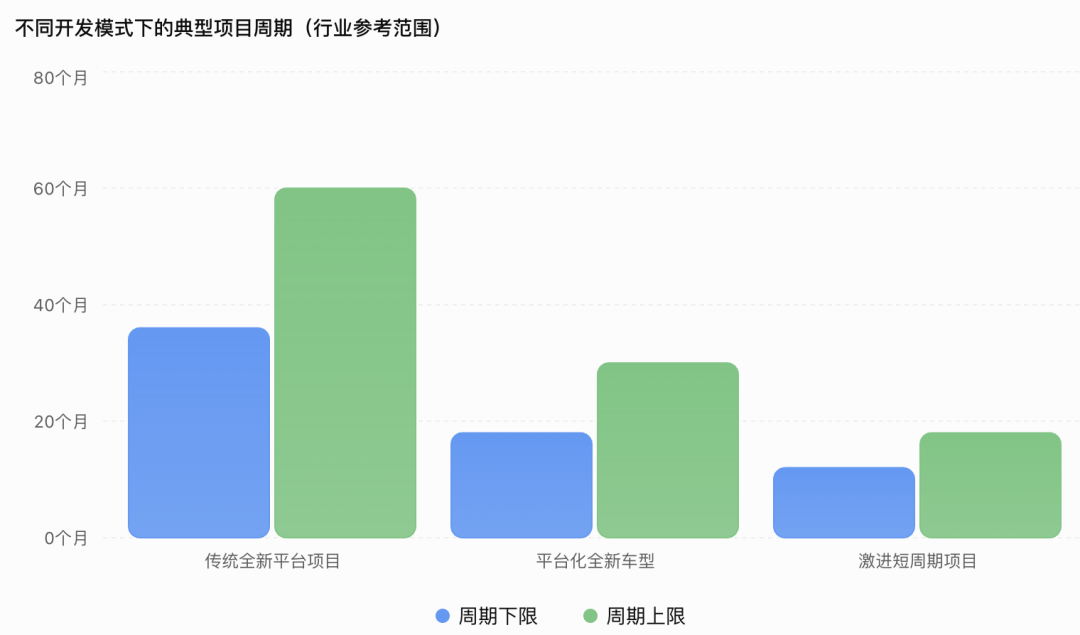
Three forces have compressed development cycles:
◎ Platformization: In the past, nearly every new vehicle required designing the chassis, powertrain, electrical and electronic architecture, and manufacturing processes from scratch. Now, mature pure electric platforms can directly reuse battery, electric drive, thermal management, chassis modules, and electrical architectures. Models with high component commonality can save significant engineering time.
◎ Simulation proliferation: Structural finite element analysis, vehicle dynamics, thermal management, and crash simulations can identify issues that previously only emerged during physical prototyping, allowing problems to be addressed during the digital design phase.
◎ Concurrent engineering: Styling, structure, supplier selection, software development, and manufacturing preparation no longer proceed strictly in sequence but are largely advanced in parallel.
Thus, the significant shortening of R&D cycles is backed by solid technical logic.
The risk lies in companies often conflating 'time saved through technological progress' with 'time saved by cutting necessary validations.'
This step is the easiest to bypass. Two companies might both claim an 18-month development cycle, but their realities could differ vastly:
◎ One uses a mature platform, reuses thoroughly validated components, and only conducts systematic differential validation;
◎ The other introduces a new body, new materials, new suppliers, a new battery, and a new chassis simultaneously but compresses testing to meet deadlines.
Focusing solely on the 18-month figure reveals nothing about the maturity of the two vehicles. What differentiates them is the extent of technological change, validation coverage, and the quality of issue resolution.
03
Where Are the Hidden Risks?
Automotive engineering faces a hard constraint: while design can rapidly iterate through computational tools, material aging, mechanical fatigue, environmental adaptability, and long-term reliability always require real-world engineering evidence. The following areas are most susceptible to compression:
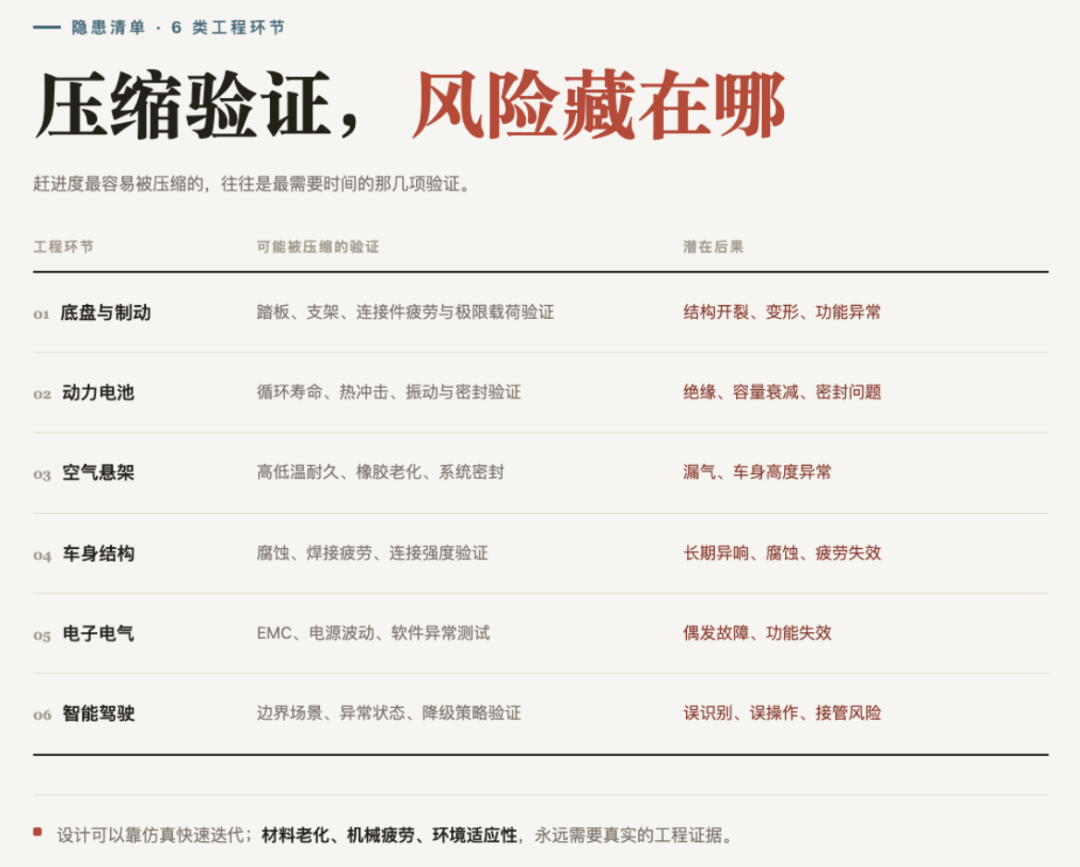
In automotive development, Design Verification Plan and Report (DVP&R), Design Failure Mode and Effects Analysis (DFMEA), and Production Failure Mode and Effects Analysis (PFMEA) are not about merely filling out forms. The challenge lies in identifying root causes and thoroughly validating solutions after issues are discovered.
For example: during a high-temperature durability test, an air suspension seal leaks. Engineers must first determine whether the failure resulted from the material, interface, assembly, or thermal cycling, then redesign, build new prototypes, and retest related components.
If this occurs when the launch date is already fixed, the company faces a stark choice: delay the launch or implement partial rectifications within limited time.
At this juncture, project management capabilities, the independence of the quality system, and the company's risk tolerance all determine the final outcome.
The dangers of 'rushing' often emerge not at project initiation but at the critical juncture when the launch date is set yet validation issues remain unresolved.
04
Why the Zunjie V800 Incident Brought Fundamental Safety to the Forefront
On October 8, DCD Auto released a test video claiming that during a 100 km/h-to-0 emergency braking test in a closed venue , the brake pedal brackets of three Zunjie V800 vehicles fractured, sparking widespread controversy.
Zunjie Auto responded by stating that the braking system had completed development and validation to standards exceeding relevant requirements, describing the test as a non-standard extreme condition. The company announced it would optimize the design of the relevant components, offer free upgrades to delivered users, and conduct a systematic review.
Whether the test conditions were reasonable depends on verifying the actual pedal load, kicking direction, test frequency, force application method, and equipment. It cannot be judged solely based on a video segment as representative of normal driving conditions.
Whether a pedal bracket fracture constitutes a design defect depends on structural design, collision protection requirements, material properties, manufacturing quality, and load boundaries.
The pedal system may include intentional deformation or disconnection mechanisms for collision protection, but normal braking, extreme pedal application, and collision intrusion correspond to entirely different design conditions and cannot be conflated.
A single fracture during a test does not prove the entire vehicle is a 'rushed vehicle,' nor can it directly infer that the company failed to conduct sufficient validation.
A video segment does not tell the whole story. However, since the braking system is the most fundamental safety system, such incidents warrant thorough, independent, and transparent technical investigations to determine the cause.
The People's Daily client's linkage of this incident to the 'rushed vehicle' topic on October 11 reflected the public's heightened concern for fundamental safety. The report also clarified that an authoritative conclusion was still pending.
For the engineering industry, what holds greater value is the disclosure of test boundaries, failure causes, rectification plans, and retest results that can explain the issues.
The significance of the four departments' draft for public comment lies in shifting regulatory oversight from 'whether marketed products meet standards' to the innovation design safety assessments and R&D testing and validation processes themselves.
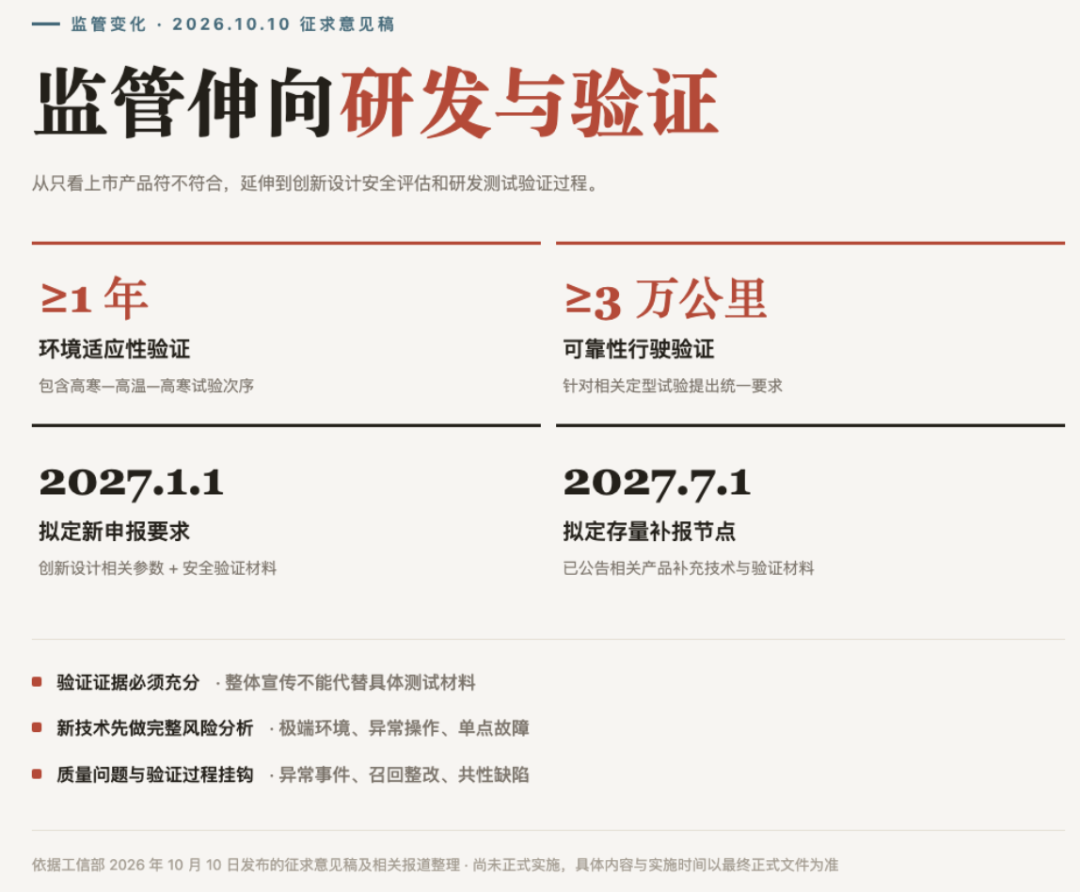
Key points of the draft for public comment (subject to the final official document, not yet implemented): Regulatory focus is on process.
◎ Environmental adaptability validation: No less than 1 year, including test sequences for extreme cold, extreme heat, and extreme cold again.
◎ Reliability driving validation: No less than 30,000 kilometers, with unified requirements for relevant approval tests.
◎ January 1, 2027: Newly declared vehicle models must submit innovative design parameters and safety validation materials.
◎ July 1, 2027: Already announced vehicle models must supplement technical and validation materials.
Regulators are also targeting usage safety and validation requirements for new designs such as fully concealed door handles, virtual controls, emergency operations, zero-gravity seats, rotating seats, and large-area displays.
For automakers, the most substantive changes include:
◎ Development cycles can be short, but validation evidence must be robust. Companies can no longer replace project-specific test materials with general claims like 'billions of simulated kilometers' or 'the platform has been thoroughly validated.'
◎ New technologies must be accompanied by more complete risk analyses, especially for new structures, materials, and human-machine interactions. Extreme environments, abnormal operations, single-point failures, and post-accident safety operability must all be considered.
◎ Product quality after launch will be more tightly linked to design validation and production consistency. Regulators will not only assess whether a batch of vehicles meets factory standards but also examine abnormal incidents, recall rectifications, and systemic defects in R&D processes.
Slower development does not necessarily mean better quality, nor does every derivative model require a full validation cycle as if it were a brand-new platform.
Platformization, reuse of validated components, and differential validation for design changes can still achieve high efficiency. What automakers need to improve is their ability to identify, resolve, and validate issues within a given development timeline.
Summary
Looking back over the past year, the debate has unfolded in three waves. Initially, 'rushed vehicles' was a ridicule (mocking) remark amid fierce competition, with traditional automakers using it to question (question) the speed of new players, who in turn emphasized the efficiency gains from platformization, electrification, and software capabilities.
By the summer of 2026, the discussion shifted to testing mileage, durability trials, R&D processes, project management, and supplier quality. In October, with the release of the four departments' draft for public comment and the People's Daily client explicitly discussing safety, regulators and the public began demanding more thorough product validation evidence from automakers.
China's automotive industry has managed to compress development cycles from four to five years to two years or even shorter, a result of technological progress and improved industrial organization capabilities. Platform-based design, battery and electric drive integration, electronic and electrical architecture upgrades, and digital R&D tools have provided immense efficiency advantages in the past decade—advantages that must be preserved.
However, as vehicles grow increasingly complex, integrating high-voltage batteries, brake-by-wire systems, intelligent chassis, advanced driver-assistance systems, and massive amounts of software, failure in any single area can trigger a cascade of systemic issues.
When consumers buy a car, they expect not only advanced technology, good design, and cost-effectiveness but also the assurance that necessary safety and reliability validations have been completed before delivery.
-
![]()
From January to September, Chinese EV Brands Shine in Europe: One in Five Cars Sold, Some Brands See 20-Fold Increase | Mirror Pro
-
Transsion Holdings' Hong Kong IPO: What Makes the Business in Africa's Mobile Phone Market So Challenging?
-
![]()
Global Market Share of Pure Gasoline Vehicles Dips Below 50%: Is the Gasoline Car Era Nearing Its End?
-
![]()
The Whole Story of the 2026 'Rushed Vehicle' Controversy: From a Live Stream Joke to a Public Naming by People's Daily
-
![]()
V4 Flash Scores Impressively, But DeepSeek Hasn't Revealed All Its Cards Yet
-
![]()
MiniMax is set to tell a new story
-
![]()
Feishu’s Strategic Shift: Is Doubling Down on Entry Points for China’s AI-Powered Office Tools the Right Call?
-
Toyota’s North and South China Operations Merge, GAC Toyota Appoints New Chinese Executive