Unitree and DeepSeek, Moving Towards Each Other
 10/14 2026
 523
523
Wang Xingxing has moved up his timeline.
Two months ago, he predicted that embodied AI would see breakthroughs in two to three years on the fast track, or five to ten on the slow. Then Unitree’s recent performance was dismal.
At the recent Industrial Expo, he revised the fast-track estimate to one to two years. What changed his mind was GPT-6: the Unitree team tested it on different robots and were impressed with the results. He also reflected that his biggest mistake over the past decade was not believing enough in AI.
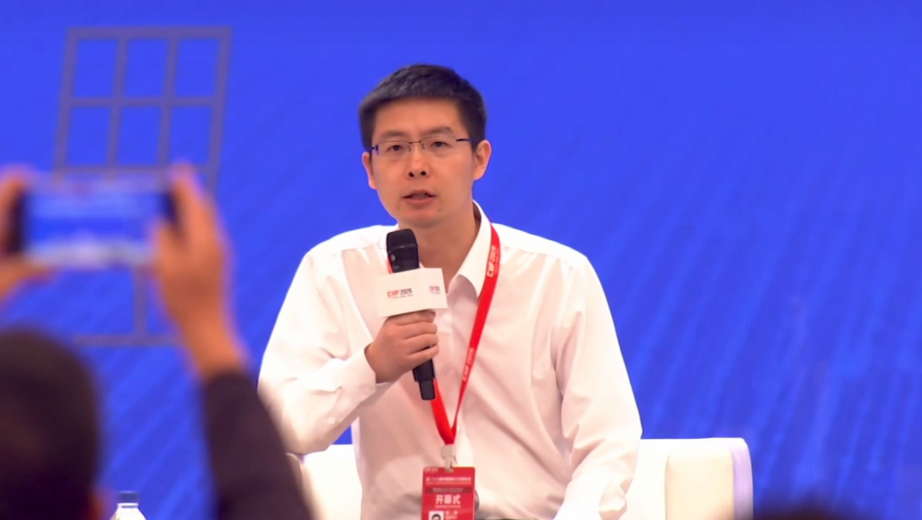
Speaking at the Industrial Expo, Wang Xingxing mentioned that Unitree has already started testing robot tasks with the new model.
In “What Did Unitree Do Wrong?”, we discussed Unitree’s challenges: while machines are selling, the intelligence to make them work effectively still needs improvement. Now, upstream large models are beginning to help robots understand tasks and plan steps, while specialized embodied models demonstrate methods for learning new tasks from a single demonstration and applying existing capabilities to new environments.
Some capabilities that once required robotics companies to develop item by item can now be sourced from foundational models. As a result, Wang Xingxing can recalculate how much more time and money Unitree needs to make their existing machines truly useful.
DeepSeek is also moving closer to embodied AI. It has taken a stake in Unitree, with both sides agreeing to prioritize each other for model and robotics business. Recent reports also suggest that Liang Wenfeng is engaging with embodied AI startups, evaluating whether to build a team in-house or enter the field through investment.
Unitree wants to turn model advancements into practical machine applications, while DeepSeek aims to make its models capable of action. The two companies are moving towards each other, but their next goal is more than just a collaboration: once robots become more capable, how will the revenue from this business be distributed?
01 Large Models Begin to Take Over Embodied Tasks
Google demonstrated a scenario where a user makes a natural language request, and a Spot robot fetches popcorn. The one responsible for understanding and organizing this task is Gemini Robotics ER 2. It calls on the robot’s navigation and robotic arm interfaces to translate the human request into a series of actions.
The model is based on Gemini 3.5 Flash, with additional embodied reasoning training. In Google’s robotic system, it can also observe the environment, plan steps, track task progress, and then hand over execution to an action model. The understanding capabilities accumulated by general-purpose multimodal models now have a practical path into robotic workflows.
Skild AI, which develops general-purpose robot models, demonstrated how robots can learn new tasks from a single demonstration. Staff recorded an operation video and gave it to the pre-trained S1, which then attempted to replicate the task. In a potted plant test, from recording the demonstration to the robot executing it autonomously, the team took 11 minutes without retraining the model for the new task.
It also adjusts its approach based on what’s in front of it. If the demonstrator uses a watering can, but the robot only has a cup of water, it switches to the cup. The model must understand the goal from the demonstration and then use its pre-learned capabilities to achieve it.
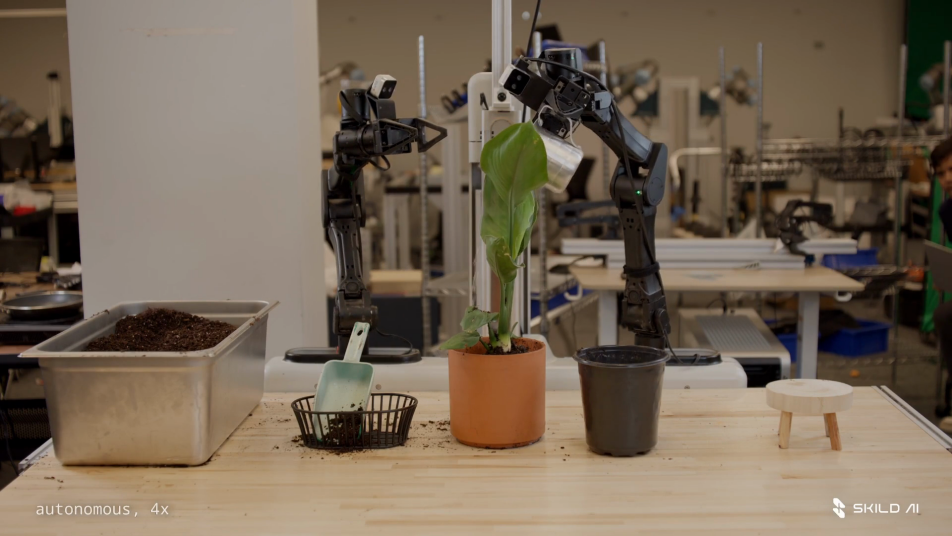
In Skild’s test, the robot used a cup to water the plant.
In the past, teaching a robot a new task often required data collection and specialized training. S1 shows a different product form: after purchasing the machine, users may have the opportunity to expand its capabilities through demonstrations. When new demands arise, the R&D team may not need to start a new project every time.
The more familiar Figure company went a step further, directly placing robots in 30 homes without any prior training data collection, having them pick up toys, make beds, and fold towels. With changed room layouts, furniture, and objects, the robots had to locate items, move their bodies, and then manipulate them.
All one can say is, large models are just too comprehensive.
In Figure’s controlled test, Helix 2.5, pre-trained on human behavior data, achieved a 56% success rate for complete tasks; another model, trained under the same conditions but without this pre-training step, achieved only 9%. For a toy pickup task to be considered complete, 13 to 15 toys had to be placed in the basket, and any safety personnel intervention counted as a failure.
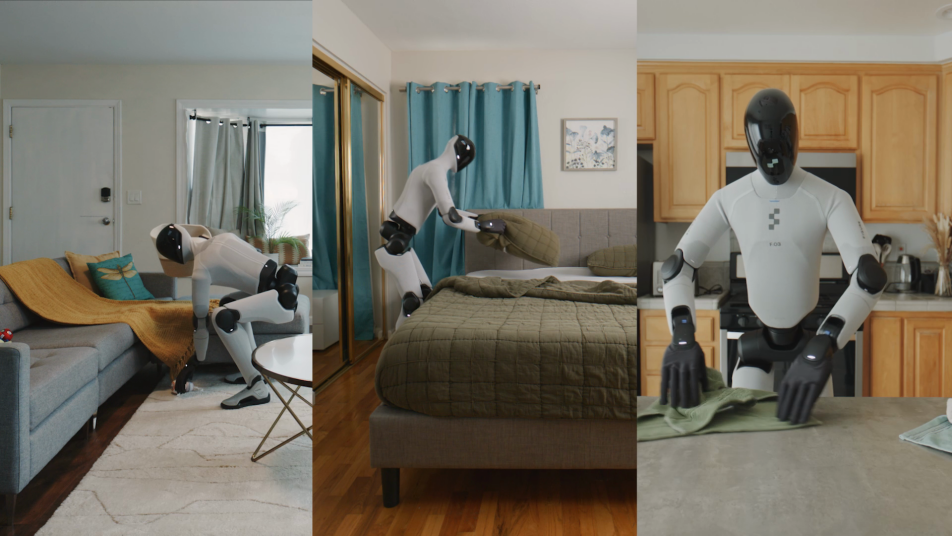
Figure’s official test demonstrated three household tasks: picking up toys, making beds, and folding towels.
While there’s still a gap before embodied AI enters ordinary households, this showcase proves that pre-training can reduce the cost for new customers to retrain machines.
From understanding instructions to learning new tasks and adapting to unfamiliar environments, these experiments reduce repetitive work in robot development. After embodied training, general-purpose models begin to handle task understanding and planning; embodied foundational models continue to advance reusable capabilities into operational actions. What robotics companies need to develop themselves is changing accordingly.
Unitree is already doing this. Its embodied model is based on Qwen3-VL, with added interaction prediction and action learning. Wang Xingxing still works on models but indeed doesn’t need to reinvent the wheel.
This benefits Unitree and also changes the competition it faces. While Unitree can use upstream models to expand machine capabilities, other OEMs can also try to integrate them. Product managers will next compare more specific scenarios: for the same task, which machine performs longer and with fewer errors, and when the customer switches tasks, how many engineers are needed.
02 DeepSeek Begins to Explore the Next Topic
DeepSeek has further integrated visual capabilities into Flash’s Agent workflow. First, V4-Flash-Vision-Exp allowed image input, and the subsequently released V4.1-Flash explicitly added native visual understanding. Developers can now give the model both images and text and let it call on tools to complete tasks.
Flash’s product direction is clearly outlined in the release notes. When introducing V4.1-Flash, DeepSeek specifically explained the operational cost of an Agent: as the model repeatedly processes task records, it uses caching; compressing the cache reduces this expense. According to official disclosures, the new model’s KV cache memory usage has dropped to a quarter of the previous generation. It also emphasizes faster inference, higher throughput, and has accordingly lowered API prices.
This also explains why model vendors increasingly value products like Flash. Once an Agent starts working, it may repeatedly read information, call tools, and check results. Each step takes time and money, and errors require starting over. When application developers choose a model, they ultimately calculate how much time and cost are needed to complete an entire task. If a single answer is cheap but the task repeatedly fails, it doesn’t save money.
Google’s positioning for the Flash series is equally clear: improve efficiency, shorten wait times, and enable Agents to operate at scale in production environments. The robotic reasoning model Gemini Robotics ER 2, mentioned earlier, is based on Gemini 3.5 Flash and includes embodied reasoning training. The efficiency improvements model companies make for applications now have a concrete path into robotics.
This gives DeepSeek a step-by-step route. First, apply its existing visual and reasoning capabilities to understand tasks and plan steps; action execution can be left to partners. If it continues to develop action models, it must learn what happens when a machine touches something: if a cup slips, how should the robotic arm adjust; if an object moves, how should the next judgment change.
These experiences must be accumulated through operation. Unitree’s embodied model, besides Qwen3-VL, also uses about 2,500 hours of real robot data for training, covering different devices and operational scenarios. For DeepSeek, buying robots is just the beginning; it also needs partners for experiments, recording actions, results, and failures.
Training methods must also be rethought. Physical Intelligence, a researcher of robotic foundational models, found that certain approaches—directly jointly training visual-language models with action modules—can make robots more likely to ignore language instructions and harder to apply existing knowledge to operations. If DeepSeek continues with action models, it must preserve its accumulated understanding and reasoning capabilities while learning operations.
Its collaboration with Unitree fits into this path. When DeepSeek participated in Unitree’s IPO strategic placement with approximately 141 million yuan, both sides agreed: in the future, when DeepSeek explores embodied AI, it will prioritize purchasing Unitree’s robots and technical solutions under equal conditions; when Unitree conducts model adaptation, calling, and integration, it will also prioritize DeepSeek’s model training services and solutions under equal conditions.
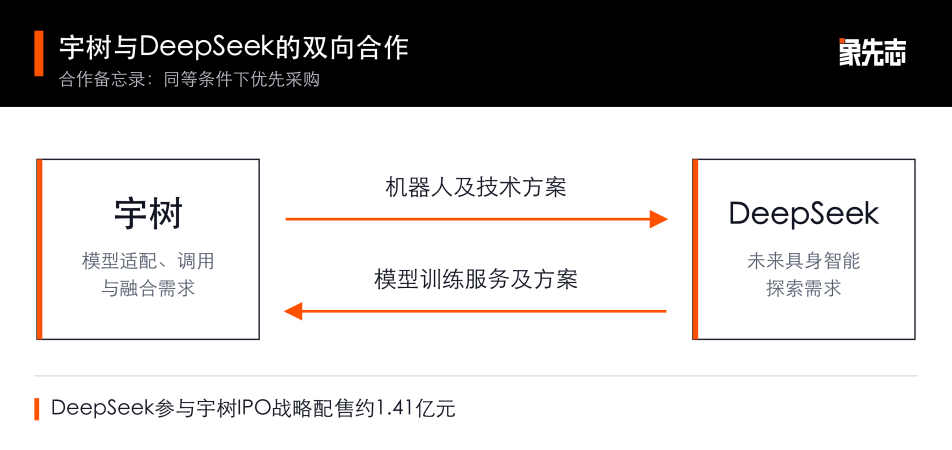
Both sides agreed to prioritize purchasing each other’s products and services under equal conditions.
According to foreign media reports, DeepSeek has also agreed to lead the seed round financing of Winverse AI, though the deal was not yet finalized at the time. Founder Hu Han previously led visual-language and embodied foundational model teams at Tencent. The contacts Liang Wenfeng has made include both companies that can provide machines and researchers specializing in robotic intelligence.
Unitree hopes to leverage upstream models to reduce its repetitive development work; by moving closer to robotics companies, DeepSeek has the opportunity to gain operational experience that screen-based tasks cannot provide. However, who ultimately uses this experience must be negotiated in their collaboration. Whether on-site data can be used for training and whether improved models can be provided to other OEMs will affect how much both sides are willing to invest.
After all, for DeepSeek to build a model business for the industry, it must apply what it learns from Unitree’s machines to more devices and environments. Google has already demonstrated the ability to control different robot bodies with the same action model. The deeper model companies go, the more R&D and delivery responsibilities they will need to negotiate with OEMs.
03 Commercial Prospects for Model Companies
At this point, news of DeepSeek’s new financing round takes on more concrete meaning. Media reports suggest the company’s second funding round aims to raise about 100 billion yuan, with a pre-investment valuation of around 500 billion yuan. Liang Wenfeng prefers industrial investors who can bring upstream and downstream resources. Potential investors include Geely, and CATL also plans to continue increasing its investment.
This is financing for the entire company, with embodied AI being one of the directions under evaluation. If DeepSeek continues toward robotics, the research conditions that automotive and battery companies can provide become valuable: machines can be purchased, but production lines require companies to be willing to open them up, and permission is needed to use the data accumulated from daily operations.
In the same Industrial Expo dialogue, Wang Jian mentioned that industrial data remains scattered within companies, making it difficult for robotics and AI researchers to use directly. Accepting industrial capital investment can increase opportunities to access on-site data. At specific factories, which data can be used and who is responsible if testing affects production still need to be negotiated case by case.
Models used in robotics already have paying customers. Skild disclosed that in the ten months since its first commercial deployment, it has acquired over 60 paying customers and confirmed 50 million USD in revenue, with about 90% coming from operational tasks. The company did not separately disclose pure model licensing fees; this revenue came from previous commercial deployments.
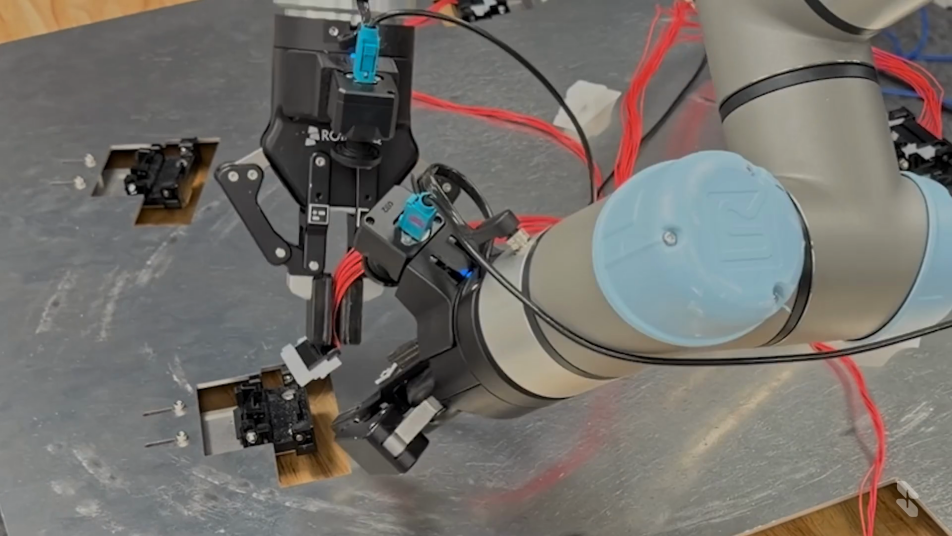
Skild
An official video shows robotic arm operations.
Investors will continue to observe the “marginal delivery cost”: for each additional customer, the extra costs for adaptation R&D, deployment debugging, and on-site support.
Figure tested household tasks in 30 homes without any prior training data collection, while Skild demonstrated learning new tasks from a single demonstration. These experiments show that existing capabilities can reduce repetitive development when serving new customers.
Flash enables models to use fewer resources and complete tasks faster. The reuse of embodied capabilities can reduce on-site development. For model companies that also handle deployment, both inference costs and delivery costs must be considered: if engineers still need to repeatedly debug on-site, the money saved on inference may be offset by delivery expenses.
Price cuts will also change DeepSeek’s revenue requirements. For the same usage volume, lower prices mean less ARR. It needs more usage or to find services customers are willing to pay for continuously. Robots can indeed expand model applications, but selling a machine doesn’t naturally bring long-term revenue to the model company.
Unitree has already included robot models in its IPO fundraising for R&D projects, with budgets covering equipment, personnel, and implementation. External model companies have the opportunity to compete for training and technical service needs within this. However, although DeepSeek holds a stake in Unitree, Wang Xingxing recently publicly praised GPT-6, and Unitree’s own model is also based on Qwen. Although the two are moving closer, they still haven’t fully come together.
For Unitree, model advancements allow the same machine to do more tasks and reduce development costs for customers. What DeepSeek needs to achieve is to use training, updates, and deployment services to reduce on-site development for the next batch of customers and make them willing to continue paying for model improvements.
-
![]()
Unitree and DeepSeek, Moving Towards Each Other
-
![]()
In Compliance: Zunjie Releases V800 Third-Party Report, Authoritative and Insightful
-
![]()
Is Software Vulnerable to Being Cracked by Altering Just One Byte? The Reality of AI Reverse Engineering is Less Sensational Than Trending Searches Suggest
-
![]()
DeepSeek Makes Another Move: Why is Liang Wenfeng Betting on Tencent's Former Scientist?
-
![]()
Why Does Jingneng Look Abroad for Chips After Installing 300,000 Modules in Vehicles?
-
![]()
Hello World: Key Highlights of Hello's Revolutionary Generative Driving World Model
-
![]()
Final Verdict: 'Golden September' Falters, 'Silver October' Loses Luster as Domestic Auto Market Remains Under Pressure
-
6G on the Brink of Commercialization: The Interplay of Policy, Technology, and Market Forces