In Compliance: Zunjie Releases V800 Third-Party Report, Authoritative and Insightful
 10/14 2026
 564
564
By | Guanchejun
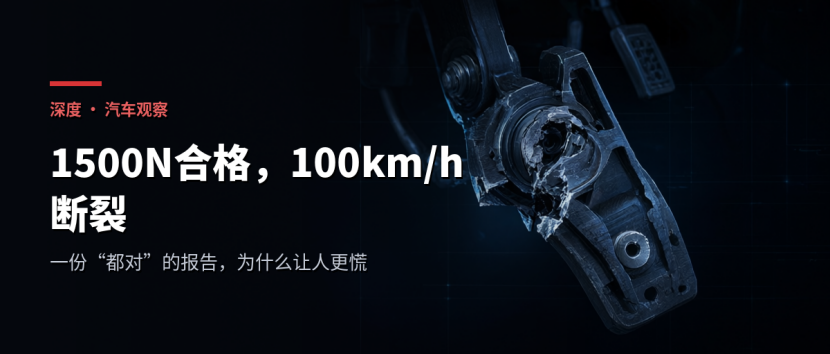
The Zunjie incident has taken a new turn.
On October 13, Zunjie issued the "Explanation of Brake Pedal Inspection for Zunjie V800". According to the report, on October 11, the testing center of the China Automotive Engineering Research Institute Co., Ltd. conducted tests in accordance with the industry standard QC/T 788-2018. Under a longitudinal force of 1500N, the average pedal displacement was 2.61mm, significantly below the 5mm threshold. When the force was increased to 3000N, with 14 pedal assemblies, a loading rate of 20mm/min, a holding time of 5 seconds, and 5 cycles, no cracks or damage were detected upon visual inspection.
In essence, two words sum it up: compliant.
However, public opinion did not uniformly shift to trusting Zunjie; instead, it sparked renewed controversy. From Guanchejun's perspective, the primary reason lies in a cognitive disconnect. The report addresses compliance, whereas the public is primarily concerned with "safety."
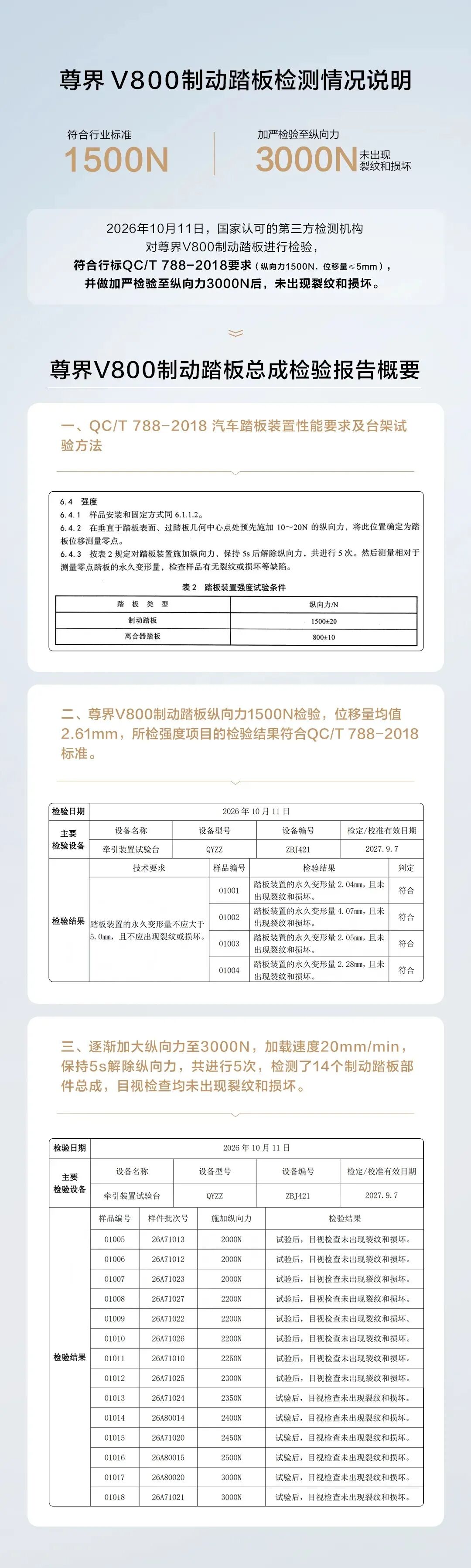
As confirmed by the China Automotive Research and Testing Center to the media, the report is solely responsible for the samples or prototype vehicles submitted by the enterprise and does not provide any assurances for the products subsequently mass-produced by the enterprise.
This implies that the report does not encompass the three mass-produced vehicles in Dongchedi's possession, which were directly transported from a 4S store to the test site.
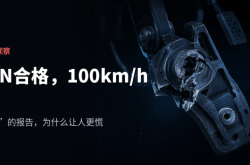
Secondly, the loading speed specified in the report is 20mm/min, equivalent to two centimeters per minute. In contrast, Dongchedi's test conditions involved full braking from 100km/h, with the load applied instantaneously.
Nevertheless, the report still substantiates, through a third-party authoritative institution, that the brake pedal of the Zunjie V800 is compliant, at least for the vehicle submitted for inspection.
Zunjie has further responded by pledging free upgrades for the entire V800, S800, and even V680 series starting from November.
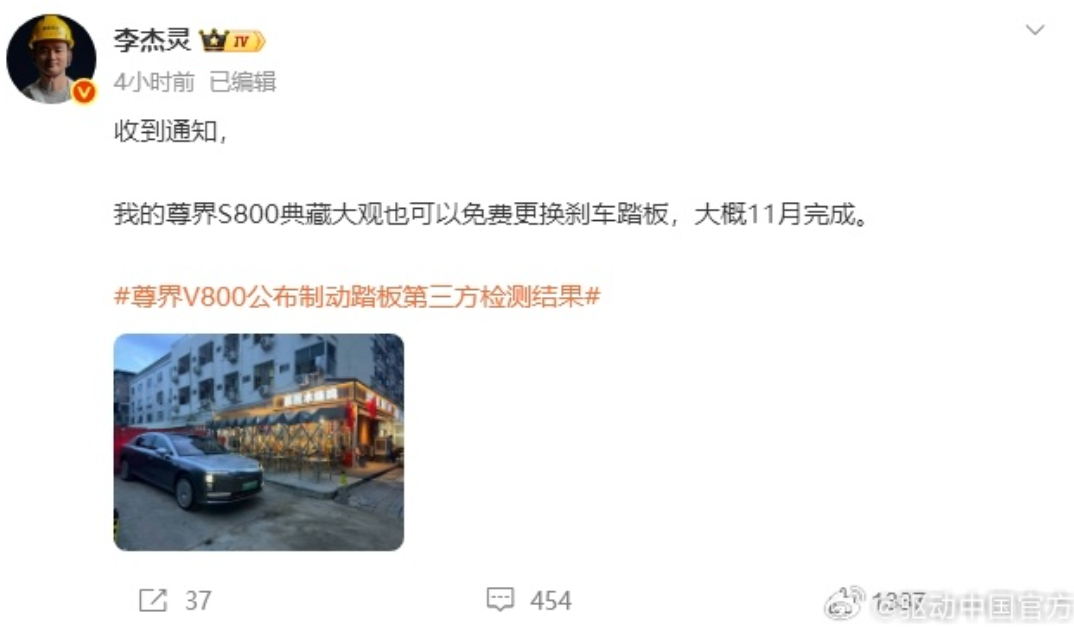
Guanchejun believes that Zunjie must take several steps to address public concerns.
Firstly, randomly select a mass-produced vehicle and publicly replicate Dongchedi's test conditions. Given that the enterprise possesses the necessary venue, vehicles, equipment, and personnel, conducting six 100km/h braking tests within 10 minutes should not pose a significant challenge.
Secondly, fully disclose the original report, complete with the official seal, sample batch numbers, sample photos, and pre- and post-test comparisons. Visual evidence is more compelling.
Thirdly, the distinction between free upgrades and recalls must be clearly maintained. Upgrades constitute a service, whereas recalls entail a responsibility.
Finally, Guanchejun wishes to discuss the 1500N threshold.
It is a recommended industry standard, not a mandatory national standard. The text explicitly states that it is "applicable to mechanically hinged metal brake pedals, and other types may refer to it for implementation."
However, the Zunjie V800 employs a PP+GF40 plastic bracket. Applying a standard formulated for metal parts to plastic components indicates that the standard itself is outdated relative to the technology.
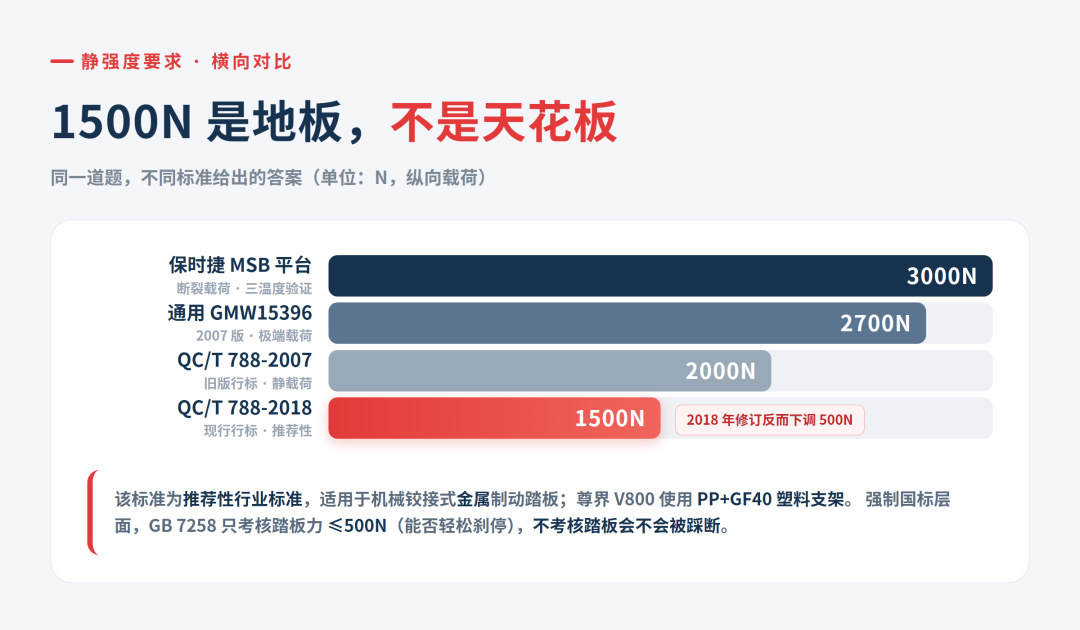
The static load requirement in the 2007 version of QC/T788 was 2000N±50N, but the 2018 revised version reduced it to 1500N±20N.
The 2007 version of General Motors' GMW15396 sets the extreme load at 2700N; Porsche's MSB platform mandates a fracture load of 3000N, verified at three temperatures: -35°C, room temperature, and 80°C.
The China Association of Automobile Manufacturers' 2025 draft group standard for "Passenger Car Electronic Brake Pedal Assemblies" plans to increase the strength test from 1500N to 2000N.
As for mandatory national standards, they are virtually nonexistent. GB 7258 merely stipulates that the pedal force required to generate maximum braking efficiency should not exceed 500N, assessing whether the vehicle can brake easily, not whether the pedal will fracture under pressure.
The mandatory national standard GB 21670-2025 does not specify a numerical value for the brake pedal's load-bearing capacity but only requires that components possess sufficient strength, with certification relying on design document reviews rather than mandatory separate pedal strength destructive testing.
In conclusion, for a luxury car valued in the millions, "meeting standards" should not be considered the ultimate defense for safety.
Because luxury cars worth millions are not merely selling refrigerators, TVs, and sofas but also redundancy. Porsche includes 3000N in its specifications, even though German regulations do not mandate it. It sells the weight of the word "luxury."
Therefore, having only a report responsible for the samples is far from sufficient. We anticipate Zunjie disclosing more reproducible, verifiable, and accountable data in the future.
The charts in this article, unless attributed, are all publicly disclosed through various channels. We express our gratitude for this!
The views expressed in this article are for reference only and do not constitute investment advice.
This article is original content from Leverage Auto Observations and is prohibited from being reproduced without authorization. If reproduction is necessary, please obtain authorization. Additionally, when authorized for reproduction, please indicate the source and author at the beginning of the article. Thank you!
-
![]()
Unitree and DeepSeek, Moving Towards Each Other
-
![]()
In Compliance: Zunjie Releases V800 Third-Party Report, Authoritative and Insightful
-
![]()
Is Software Vulnerable to Being Cracked by Altering Just One Byte? The Reality of AI Reverse Engineering is Less Sensational Than Trending Searches Suggest
-
![]()
DeepSeek Makes Another Move: Why is Liang Wenfeng Betting on Tencent's Former Scientist?
-
![]()
Why Does Jingneng Look Abroad for Chips After Installing 300,000 Modules in Vehicles?
-
![]()
Hello World: Key Highlights of Hello's Revolutionary Generative Driving World Model
-
![]()
Final Verdict: 'Golden September' Falters, 'Silver October' Loses Luster as Domestic Auto Market Remains Under Pressure
-
6G on the Brink of Commercialization: The Interplay of Policy, Technology, and Market Forces