ByteDance, The Super APP Factory
 10/14 2026
 529
529


Its Super APP Model is Being Replicated
Image Source | Internet (Please contact us for deletion if infringement occurs) Partially generated by AI
An unassuming milestone is being dissected repeatedly by the industry.
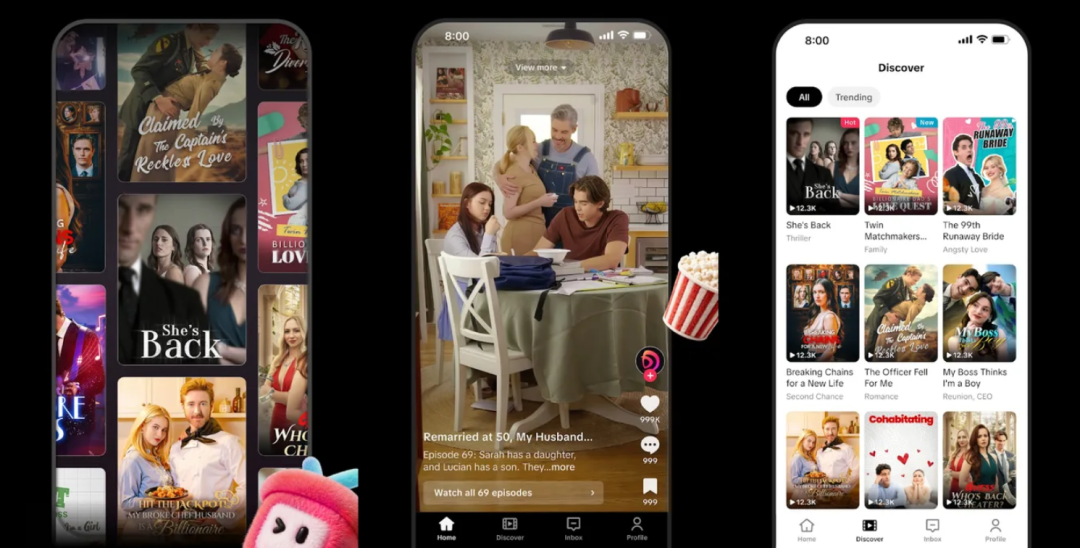
In October 2026, third-party data agencies revealed a set of figures: PineDrama, an independent short drama app under ByteDance, surpassed 100 million cumulative global downloads approximately nine months after its launch, with around 7 million daily active users and over 12 million downloads in September alone.
Among the seven independent short drama apps with over 100 million cumulative downloads globally, PineDrama is the only newcomer launched within the past year.
This prompts the question: Why does ByteDance, having already created multiple super apps domestically, continue to aggressively expand its overseas APP portfolio?
Shifting our gaze from the product itself to the behemoth behind it reveals that PineDrama's significance extends far beyond being a mere overseas hit.
It serves as a key, unlocking a hidden understanding of ByteDance's past decade and its trajectory for the next.

PineDrama: Not 'Just Another One,' but 'The Same Kind'
To understand PineDrama, one must first recognize what it does not do.
In the overseas short drama market, ReelShort and DramaBox were the first to establish a viable business model. Their approach was straightforward: Users encounter a Several tens of seconds (several dozen-second) short drama clip on TikTok, become hooked by the plot, click to download the app, watch the first few episodes for free, only to be abruptly cut off at a critical plot twist and prompted to pay for unlocking subsequent content.
Priced at a few cents to several dollars per episode, with monthly subscriptions often exceeding $20, ReelShort alone is projected to generate approximately $1.05 billion in annual revenue for 2026. This is a proven, highly profitable business.
PineDrama, however, took a diametrically opposite approach: full episodes are free, with no locked plots or paywalls. Users can unlock subsequent content by watching ads, complemented by light incentives like earning coins for watching dramas.
This is seen as almost 'disruptive' by overseas peers, but it is not new to ByteDance.
Because ByteDance has been honing this strategy in the Chinese market for over two years. Hongguo Short Drama, launched in 2023, rapidly grew into ByteDance's fifth app with over 100 million daily active users and over 200 million monthly active users using the same 'free viewing, ad monetization' model.
Essentially, PineDrama systematically transplanted Hongguo's underlying logic overseas.
And the core of this logic has never been 'free' itself.
Indonesia and Brazil collectively contributed 82% of PineDrama's downloads. These markets share common characteristics: a large mobile internet user base but highly price-sensitive users with limited willingness to pay.
For ReelShort's paywall model tailored to the North American market, these users represent 'low-value traffic' unworthy of acquisition costs.
But ByteDance sees another side: Users who don't spend money still hold commercial value, as long as the cost of acquiring them is low enough.
PineDrama supports one-click login via TikTok accounts. Users who encounter short drama clips on TikTok can directly jump to the app to watch the full series.
This directly reduces customer acquisition costs to zero, significantly saving on promotion expenses. After all, TikTok itself is the world's largest traffic portal, and TikTok users are natural consumers of fragmented content, with short dramas perfectly filling their desire for more complete narratives after minutes of scrolling.
This forms a closed loop. TikTok handles outreach and interest generation, PineDrama manages retention and in-depth consumption, and ad monetization completes the commercial cycle.
On the content front, PineDrama did not simply export Chinese short dramas with translations but built a local production network. The Nigerian local story 'The 1 Billion Naira Bride' surpassed 40 million views within a week of launch, while local titles in Indonesia and Brazil exceeded 200 million views each.
The freemium model, local content, in-ecosystem acquisition, and ad monetization—none of these elements are novel individually. However, weaving them into a tightly interconnected system represents ByteDance's true capability.


A Precision-Engineered System
If PineDrama represents a slice of ByteDance's product logic, viewing it within ByteDance's broader product matrix clarifies the picture.
In late February 2026, ByteDance products occupied half of the top ten spots on the App Store China's free chart: Doubao (AI assistant), Hongguo Short Drama, Qishui Music, Doushengsheng (local services), and Douyin Mall collectively ranked.
These five products span five entirely distinct sectors: AI assistance, short dramas, music, local services, and e-commerce.
They are not functional modules within Douyin but independent apps, each acquiring users and operating autonomously.
The underlying logic of this 'APP Factory' system can be dissected into three hierarchical layers.
At the base lies shared middleware capabilities. ByteDance's algorithmic recommendation, growth systems, commercialization tools, and data middleware serve as infrastructure shared across all product lines.
When launching a new product, there's no need to build recommendation systems or ad placement capabilities from scratch—it directly plugs into the middleware to operate. This means ByteDance's marginal cost for each new product is far lower than that of a startup building from zero.
The middle layer consists of internal racing mechanisms. ByteDance rarely deploys just one team per track (sector). In 2016, three short video projects—Huoshan, Xigua, and Douyin—launched simultaneously, with Douyin emerging victorious. In the social sector, products like Duoshan, Feiliao, and Paofu underwent repeated trial and error.
The logic here is not 'finding the right person for the right job' but 'letting market data decide.'
Winning products receive more resources, while losing teams can transfer or disband, preventing prolonged allocation of human and financial resources to unpromising directions.
The top layer features traffic ecosystem synergy. This became particularly evident in the 'APP Factory 2.0' phase. Early ByteDance products mostly 'fought their own battles,' but by 2026, ByteDance tend to (tended to) extract functions with strong internal demand from super apps to operate as independent apps while maintaining data and account system integration with the parent app.
Doushengsheng exemplifies this: Douyin serves as the interest generation engine, while Doushengsheng acts as the transaction harvester. Users log in via Douyin accounts, view orders in Douyin Wallet, and redeem offers without switching apps. This proves far more efficient than cramming functions into the main Douyin app.
These three layers combine to form a positive feedback loop: Middleware reduces development costs → racing increases trial volume → traffic ecosystem boosts success probability → successful products feed back into middleware capabilities and traffic pools.
This explains how ByteDance can advance across multiple sectors simultaneously and continuously produce hits despite most projects 'dying.'

From 'APP Factory' to 'AI Factory'
Around 2022, ByteDance's 'APP Factory' experienced a noticeable downturn. Products like grassroots community 'Kesong,' real-time interactive community 'Party Island,' reading tool 'Shiqu,' and social product 'Feiliao'—all initially highly anticipated—were mostly withdrawn within a month of launch.
Hardware products like Dali and Pico also underperformed. During this period, whispers of the 'APP Factory malfunctioning' abounded.
This phase starkly revealed the true limitations of the 'APP Factory' model: Middleware and racing can reduce trial costs but not the difficulty of 'finding the right direction.'
When ByteDance enters sectors where it lacks core advantages and faces strong incumbents—such as social competing against WeChat or grassroots competing against Xiaohongshu—this racing mechanism may accelerate resource wastage.
More recent challenges arise from monetization. Despite PineDrama's 100 million downloads, its users primarily come from emerging markets like Indonesia and Brazil, where ad monetization value lags far behind North America.
How much ad revenue substantial watch time generates depends on local ad market maturity.
Some analysts point out that freemium models face physical ARPU ceilings. Once users acclimate to 'free meaning ads,' any attempt to shift toward paid models risks massive churn.
ReelShort and DramaBox, the two paid platforms, still account for roughly half of short drama revenue outside China.
In 2026, ByteDance is undergoing a transformation more profound than mere product matrix expansion.
The company's revenue reached $120 billion in H1 2026, up ~30% YoY, with overseas revenue exceeding 30%—a record high.
Yet profitability plummeted: Net profit fell to $20 billion, with net margin declining from over 20% to ~16.7%.
The culprit: ByteDance's AI investments are surging. Bloomberg reports that ByteDance considered investing up to $70 billion in data centers and AI infrastructure in 2026—double that of 2025.
ByteDance is now applying its 'APP Factory' methodology to build an 'AI Factory.'
Doubao has surpassed 100 million DAU, with daily token calls exceeding 180 trillion; Jimeng, as an AI video generation tool, embodies ambitions of becoming the 'Douyin of AI'; while the Seedance video model ranks among global leaders.
Organizationally, ByteDance initiated AI-focused restructuring in July 2026, merging the Feishu product team with Doubao to form a new Doubao product team.
Simultaneously, the Seed department established a dedicated Model Safety and Alignment team to oversee AI safety and frontier risks.
The racing mechanism has been replicated in the AI sector. Doubao, Jimeng, and Jianying compete in the C-end space, while Feishu, Volcano Engine, and Doubao Enterprise Version race in the B-end arena.
However, unlike the mobile internet era, trial costs in AI are an order of magnitude higher. Training and inference costs for large models, R&D for inference chips, and heavy asset investments in data centers far exceed 'launching a lightweight app to test data.'
ByteDance's 'APP Factory' logic is shifting from 'creating the most products at the lowest cost and letting data pick winners' to 'betting big on one direction and covering all possible entry points with a product matrix.'
This represents an iteration of underlying logic. Racing continues, but the entry tickets to the track (sector) have become far more expensive.

PineDrama surpassing 100 million downloads within a year is indeed impressive. However, viewing it as just another 'ByteDance hit' misses the more valuable information.
What truly warrants attention about PineDrama is not merely the product itself but the timing and approach of its market entry into a validated sector.
It did not build a short drama content ecosystem from scratch but transplanted Hongguo's proven domestic model overseas. It did not compete head-on with ReelShort in the paid short drama arena but chose a freemium model to serve markets paid players ignore.
This reflects a systematic product capability: It's not just about inventing something entirely new but identifying a validated model, finding a neglected market gap, and leveraging ecosystem resources to achieve scaling (scale) at minimal cost.
ByteDance has repeatedly demonstrated this capability over the past decade.
Jinri Toutiao wasn't the first news feed product, Douyin wasn't the first short video app, Hongguo wasn't the first short drama platform, and PineDrama wasn't the first overseas short drama app.
Yet within ByteDance's ecosystem, they all surged ahead as 'latecomers but faster.'
However, this system is not without vulnerabilities. As traffic dividends peak, AI investments erode profits, and overseas regulatory environments complicate, ByteDance must answer not 'whether it can create another hit' but 'whether the factory logic itself needs redesigning.'
Thus, PineDrama represents a good interim answer—but not the finale.
-
![]()
September Sales Analysis: Top Five Independent Chinese Automakers Excel, with BYD Leading and All Expanding Overseas
-
AI with a Defined Trajectory is Energizing the Entire Industry Ecosystem
-
【Daily Science and Technology Innovation】ArcSoft: Why is Half of Its Revenue Invested in R&D? What is the Invisible Champion of Mobile Algorithm Betting On?
-
![]()
The Paris Motor Show is Set to Disrupt the European Luxury Car Market Again
-
![]()
When Plug-in Hybrid and Extended-Range Vehicles Flood the Fully Electric Era: Are You Prepared to Be the "Cannon Fodder"?
-
![]()
Unitree Admits Mistake, DeepSeek Steps In
-
![]()
ByteDance, The Super APP Factory
-
![]()
“The three-way cooperation among FAW, Toyota, and GAC was nearly called off!”