As Internet Enters the Byte-Time Era, AI Revolutionizes E-Commerce's Future
 10/16 2026
 523
523
By 2026, AI-generated content will seamlessly integrate into daily life, sparking a transformative chain reaction.
On one hand, AI technology will be omnipresent in business operations. Film and television stars will license their youthful likenesses and voice assets to AI producers. A growing number of professional actors will establish lifestyle accounts and venture into live-streaming, sharing daily essentials in their spare time. This will lead to an unprecedented surge in video and live-stream content.
On the other hand, platform ecosystems will undergo refined segmentation. Douyin E-commerce's 'shelf scenarios,' centered around search and shopping malls, will significantly boost transaction volumes. Meanwhile, the independent, high-intensity content consumption platform Hongguo Short Drama will explode in popularity, with AI content dominating user time.
As AI drastically lowers content production and live-streaming barriers, is it merely amplifying traditional live-stream commerce, or is it driving a new industrial evolution?
From a conventional tool-based perspective, AI provides cost-effective operational capabilities for live-stream rooms and a richer drama supply for content creators, seemingly accelerating progress along the established path. However, beneath the surface, AI is not merely repeating the old 'entertainment-sales blend.' Instead, by unlocking digital asset potential on the supply side and reshaping attention granularity on the demand side, AI is propelling mobile internet from the early 'content-commerce crude convergence' stage to a new era of specialized 'entertainment-commerce purification.'
This contrast arises because when the industry views AI through a tool-based lens, it overlooks a holistic commercial evolution. The rapid rise of live-stream commerce over the past five years has relied on impulse purchases driven by algorithms matching 'fragmented roaming attention' with the 'premium of scarce acquaintance companionship.'
Today, AI's widespread adoption does not replicate this old formula but drives content and e-commerce toward a new division of labor from both supply and demand perspectives.
I. Shift in Scarcity on the Supply Side
According to the 2026 First Half AI Drama and Animation Data Report by DataEye Research Institute and Xinhuanet reports, in the first quarter of 2026, approximately 128,000 micro-short dramas were launched industry-wide, with AI micro-short dramas accounting for over 95%. Newly launched AI animated dramas exceeded 14,600 monthly, averaging over 470 daily algorithm-served dramas.
AI has exponentially boosted visual spectacle and narrative pleasure production efficiency, necessitating time allocation changes in traditional film, television, and live-action production chains. Many actors have freed up schedules and begun seeking new mass-reach avenues.
Abundant content production capacity has extended along traffic pipelines to live-stream e-commerce, the transactional epicenter. Two new trends emerge on our screens:
The first is professional actors' lifestyle connections. More familiar and even veteran actors are frequently updating 'lifestyle accounts' featuring mundane family matters, showcasing down-to-earth activities like grocery shopping and cooking, and conveniently launching live-stream commerce by linking to products.
The second is commercial licensing of likenesses and voice assets. Some celebrity artists, through agencies, license their images to AI teams for new drama development. On the e-commerce service side, more artists, influencers, and professional models license their images and voices to technology providers via formal agreements, synthesizing them into 24/7 brand virtual anchors.
From a single-point view, businesses see significant operational barrier reductions. Previously unaffordable for celebrities to stay on-site for extended periods, now budget-friendly AI avatars or collaborations with actors who have opened lifestyle accounts can complete specialized promotions.
However, within the entire e-commerce ecosystem, supply abundance directly leads to the 'dilution of familiar face premiums.'
Initially, live-stream commerce priced 'human touch' and 'physical time.' Whether early top anchors or the first batch of celebrity joiners, consumers forwent price comparison software searches and followed live-stream countdowns to place orders, assuming the on-screen person was dedicating real time to make a reputation-backed recommendation.

Back then, 'familiar faces' were scarce, and 'real-time companionship' was exclusive.
However, when AI significantly lowers audio-visual synthesis and live-streaming barriers, enabling thousands of brand stores to equip with fluent, lifelike AI avatars while information feeds constantly showcase actors sharing daily essentials, 'face-to-face companionship' and 'standardized selling point announcements' transform from scarce resources into ubiquitous infrastructure overnight.
Economic fundamentals hold true. When an element's supply becomes abundant and low-cost, its original excess premium naturally dissipates, and market pricing power shifts toward higher-dimensional scarce capabilities.
Actors operating lifestyle accounts and licensing AI avatars signify content supply's industrialized abundance stage. When standardized screen explanations and familiar face interactions become standard, the era of impulse purchases driven solely by 'mixing in' ends. Live-stream rooms must shift from superficial volume and duration competitions to hardcore product selection aesthetics and supply chain depth contests.
II. Purification of Attention on the Demand Side
Supply-side abundance reshapes live-stream room entry barriers, while demand-side attention migration rewrites the traffic-to-transaction path.
The internet industry has long held a consensus: Holding massive user time naturally leads to monetization, with live-stream commerce, closest to money, being the natural endpoint. The early rise of comprehensive short-video platforms seemed to validate this rule perfectly.
However, viewing the 2026 internet landscape with old eyes reveals traffic behavior changes.
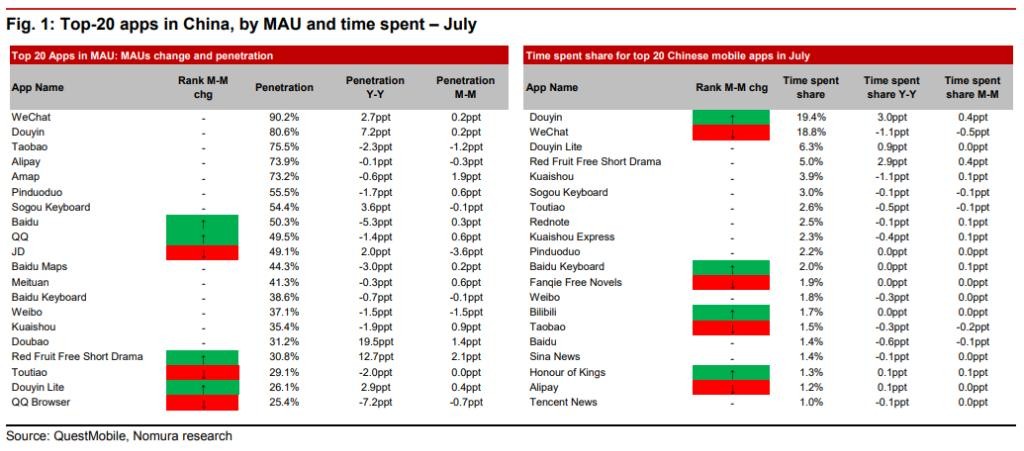
According to QuestMobile statistics, ByteDance's Hongguo Short Drama monthly active users surpassed 250 million by late 2025 and grew to 356 million, approaching traditional long-form video platforms. More notably, its user engagement—Hongguo Short Drama's average daily usage time per user reached 125 minutes, ranking among top mainstream apps.
On another AI-fueled track, according to industry monitoring data, the 'Hongguo Free Animated Drama' app, launched in November 2025, pushed its average daily usage time per user to over 90 minutes within four months, with a next-month retention rate exceeding 52%.
An ordinary netizen spending four to five hours daily on their phone allocates two hours to Hongguo Short Drama and another one and a half hours to AI animated dramas, leaving significantly less time for traditional information feeds and various live-stream commerce rooms.
Time has not left the internet or even the same major company's ecosystem. So, what changes occur from e-commerce and advertising perspectives when 120 minutes shift from comprehensive information feeds to short dramas and AI animated dramas?
Platforms have explored various ways to connect usage time with transactions. Hongguo Short Drama not only configures shopping mall and order entrances in the bottom bar and personal center but also attempts to hang links to the same products at the bottom of drama playback pages to guide purchases. However, actual conversion characteristics differ significantly from comprehensive short-video information feeds.
Behind this lies a fundamental rule easily overlooked by traffic operators: Attention is not equally interchangeable; their natures are entirely different.
Initially, browsing short videos paired with live-stream commerce followed offline commerce's 'pedestrian street logic.'
When users browse fragmented videos ranging from 15 seconds to 1 minute, their brains are in a low-dopamine, purposeless, and easily interruptible 'strolling state.' One moment, they're watching funny pet videos; the next, they slide into a cookware live-stream room where the anchor demonstrates stir-frying in an iron wok, aptly filling leisure time.
On this 'pedestrian street,' users' attention is divergent and relaxed. Anchors can easily attract passersby into the store with enthusiastic introductions and limited-time offers, completing unplanned purchases.
Today, Hongguo Short Drama and AI animated dramas follow the highly immersive 'private cinema logic.'
After AI technology intervenes in script assistance and storyboard rendering, the content industry achieves something extremely sophisticated: It polishes public narrative expectations for 'reversals, comebacks, cultivation, and suspense' to second-by-second responsiveness with extremely high iteration efficiency. A two-minute AI animated drama or high-quality short drama establishes conflict in the first 3 seconds, provides a twist at the 15-second mark, leaves a cliffhanger at the 50-second mark, and seamlessly auto-plays the next episode.
When a user is immersed in a tightly knit strong narrative, their attention is in a highly focused closed loop. In this state of full concentration while chasing a drama, any pop-ups and live-stream entrances attempting to interrupt the plot and make them stop to study tissue or laundry detergent parameters will clash with the current mental mode.
It's like a person strolling on a pedestrian street who might impulsively buy daily necessities upon seeing a store promotion; but when sitting in a cinema fully engrossed in a movie's climax, if someone pushes the door open to promote shampoo, they'll most likely just want to continue watching the movie.
AI's most powerful content-side improvement is elevating pure entertainment content production efficiency to the extreme, creating high-purity, low-cost 'mental sugar.'
In the past, due to long production cycles and slow updates of high-quality long-form videos, users always had one or two hours of 'drama shortage' leisure time daily, which live-stream commerce conveniently catered to. Now, with over 470 newly launched AI animated dramas daily and a massive amount of free short dramas, they precisely cater to public entertainment needs, refining and encapsulating the 'pure entertainment time' previously mixed in information feeds.
When 'strolling time' and 'drama-watching time' each find their place, content-driven commerce based on roaming encounters faces a historical shift.
III. Secondary Separation of Entertainment and Commerce
Examining 'familiar face standardization' on the supply side and 'attention purification' on the demand side together answers an important question: As AI becomes increasingly deeply integrated into content and commercial ecosystems, is it gaining a larger share in live-stream and e-commerce?
The answer is: AI is capturing a massive content production and user time share while replacing the vague intermediate state of 'selling goods incidentally through content,' driving entertainment and commerce to re-separate into specialized fields after five years of convergence.
Looking back at the past five years' content e-commerce boom, its success in propelling many emerging brands and live-stream commerce agencies was due to the internet being in a special transitional period: Recommendation algorithms were mature, but the industrialized supply of high-intensity narrative content had not yet fully rolled out, and product price comparisons and parameter screenings still required manual labor.
Back then, a simple plot setup and a charismatic anchor could intercept a large amount of roaming attention in information feeds and convert it into product sales. The traffic acquisition fees and commissions merchants paid were essentially buying the scenario premium of 'making users stop and place orders during entertainment.'
However, AI's popularization is returning entertainment and commerce to purity:
On the pure content side, AI is pushing spiritual consumption toward an efficient closed loop. Hongguo Short Drama and AI animated dramas have proven that when generative technology can stably and massively supply strong narrative content, entertainment itself can achieve efficient commercial operation through models like free drama viewing plus brand advertising (IAA).
On the pure transaction side, after consumers satisfy their entertainment needs in short-drama apps, shopping returns to being a rational decision-making process emphasizing quality, price, and efficiency. This is why the proportion of search and shopping mall shelves within Douyin E-commerce continues to climb to nearly half. Users no longer rely solely on 'encountering' products in live-stream rooms but actively seek the most certain low prices and fulfillment guarantees once they have a clear need.
Following this underlying logic, e-commerce in the AI era is likely to differentiate:
First, attempts to simply replicate the 'live-stream commerce miracle' in AI animated dramas and short dramas are likely to hit a wall.
Provided that the immersive model characterized by compelling narratives and high information density remains intact, short dramas and animated series are better suited for facilitating seamless brand integrations or promoting derivative merchandise and cultural tourism experiences that are closely tied to intellectual properties (IPs), rather than acting as high-volume sales channels for everyday consumer goods. By honoring the sanctity of 'theater time' and substituting abrupt jump links with native advertising and subtle brand messaging, more sustainable commercial returns can be achieved.
Secondly, live-stream anchors in the mid-to-lower tier and those engaging in 'dramatic live-stream commerce' are set to undergo genuine segmentation and reshuffling.
Accounts that persist in relying on outdated strategies and contrived, trivial plotlines to drive sales will find these tactics increasingly ineffective. When it comes to story rhythm and suspense, skits produced by ordinary teams over a week cannot hold a candle to the high-density, high-quality serialized content churned out by AI-powered animated drama studios. In terms of the endurance and cost-efficiency of explaining standardized products, human live-stream shifts pale in comparison to AI virtual anchors, which cost only a few dozen yuan in electricity per day.
The ambiguous middle ground of 'half-entertainment, half-sales' is rapidly shrinking. For human anchors and actor-lifestyle accounts to carve out a niche, they must delve deeper—offering authentic, on-site physical experiences (such as tracing product origins deep into production areas, conducting complex on-body try-ons, and providing instant feedback), consistently curating aesthetically pleasing selections (the buyer's ability to narrow down options amidst a vast supply), and fostering emotional resonance and a sense of community belonging.

Thirdly, the true core share that AI can capture in e-commerce lies not in the 'performance positions' in front of the camera but in the 'shopping guide, product selection, and supply chain positions' behind the scenes.
As consumer shopping behavior becomes increasingly rational, AI-driven services will ultimately evolve into 'dynamic product manuals' in stores—akin to a 24/7 intelligent customer service embedded in the product details page, instantly responding to consumers' size and parameter inquiries at 3 a.m. What truly dictates the allocation of transaction shares is the backend AI curation and shopping guide infrastructure that major e-commerce platforms are heavily investing in.
A glance at the latest action ledgers of major platforms reveals a unified direction:
At JD.com, during the 618 shopping festival, the platform introduced a 'low-price bestsellers' label that garnered positive consumer feedback. By Double 11, this mechanism had been upgraded to an AI-driven cost-effectiveness curation model, supplemented with manual verification by JD.com's procurement and sales personnel, sifting through hundreds of millions of products to help consumers complete the complex price comparison process in advance.
According to 36Kr, JD.com has also deeply integrated AI into logistics superbrain path planning and the 'Jingxiaotong' merchant operation tools, channeling the saved operational costs back into enhancing product price competitiveness and fulfillment certainty.
At Alibaba and Douyin, similar backend upgrades are in full swing. According to consulting firm Gartner, traditional search engine traffic is projected to decline by 25% by 2026, with AI dialogues and intelligent shopping guides emerging as new decision-making entrances.
To this end, Alibaba fully integrated Qianwen with Taobao during the 618 shopping festival, launching the 'Qianwen AI Shopping Assistant' at the bottom of Taobao, bundling AI try-ons, AI discount calculations, AI low-price sniping, and cross-store horizontal comparisons into a single dialog box. Douyin E-commerce introduced the 'Ask Doubao Before Buying' feature and rolled out official self-operated flagship stores in key cities like Beijing, Shanghai, Guangzhou, and Shenzhen, leveraging AI algorithms to handle backend operations such as self-operated product bestseller predictions, inventory selection, and quality risk control.

A decade ago, smartphones brought offline shopping malls onto screens; five years ago, short-video platforms ignited a trillion-dollar super furnace through live-stream commerce. Today, guided by a group of visionaries, AI is restoring the once intertwined elements of 'storytelling for leisure,' 'human connection,' and 'product comparison' to their rightful places.
Farewell to the clamor of 'buying on a whim.' Both content and commerce, propelled by AI, are ushering in a more enduring era of professionalism.
Source: Songguo Finance
-
Big Tech Firms Struggle with Security Concerns in AI Race
-
![]()
Apple AI is Finally Coming to China, But Siri is Not in the First Batch of Features
-
![]()
Unbelievable! TikTok Sellers Lodge Collective Complaint: AI-Generated Sales Videos Distort Product Info, Deceiving Shoppers
-
![]()
New China-EU Automobile Trade Consensus: What Do BMW and Volkswagen's Differing Positions Signal?
-
![]()
Three Departments Launch Investigation into Zunjie; DCD Seals Three Vehicles—Who Will Oversee the Retest?
-
![]()
Development Isn't Just 'Washing Away the Exposed Area': How Do Photoresist Sidewalls Take Shape?
-
![]()
Young Wartime CEO: How to Win Meta's AI Turnaround Battle
-
![]()
7 Million DAU! ByteDance's Free CEO Romance Short Dramas Are Driving Foreigners Wild