Three Departments Launch Investigation into Zunjie; DCD Seals Three Vehicles—Who Will Oversee the Retest?
 10/16 2026
 440
440
The investigation team comprising three departments has arrived on the scene, but it's not Zunjie that should be feeling the real heat.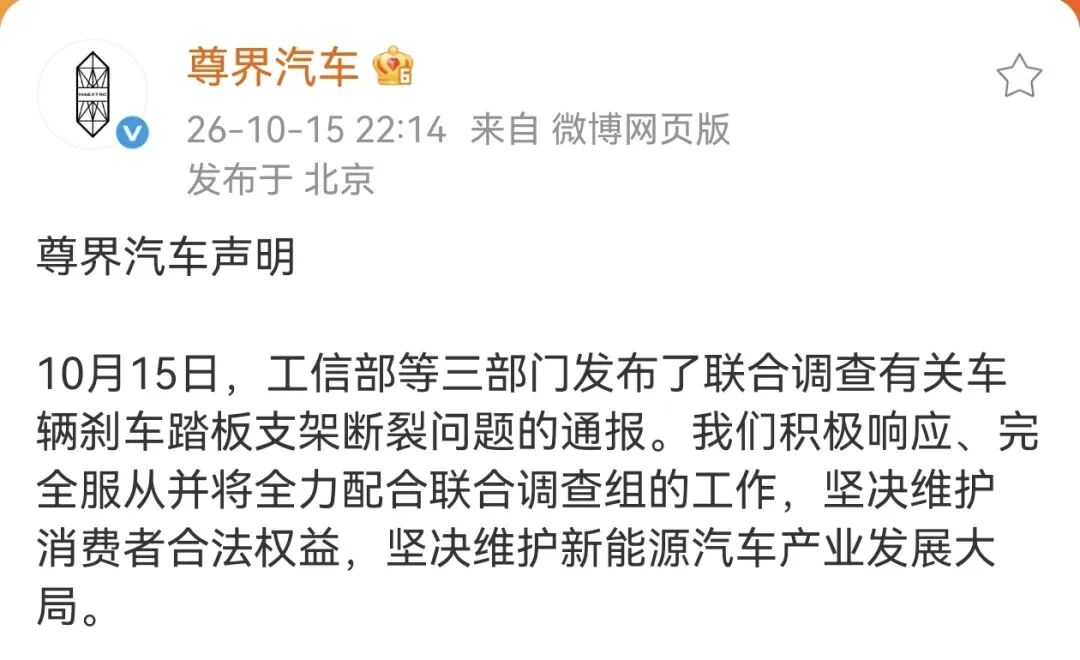
Following the testing and subsequent failure of three Zunjie V800 vehicles, DCD has placed the remaining three brand-new cars under seal, intact and under notary supervision. During emergency braking from 100 km/h to a complete stop, the brake pedal brackets of all three vehicles snapped at remarkably similar points. DCD independently procured six vehicles, tested and broke three, and now has the remaining three securely stored, ready for a public retest at a moment's notice.
The onus now lies with the investigation team.
Firstly, the investigation team has opened the door for a retest.
The previous deadlock revolved around the nature of the test conditions. DCD contends that emergency braking from 100 km/h is a basic driving maneuver, with the pedal breaking under approximately 1,612N of force—a figure below national standards. Zunjie, on the other hand, released a third-party static bench report indicating no cracks even under a reinforced 3,000N longitudinal force, thus meeting industry benchmarks.
However, static and dynamic testing are not equivalent. Zunjie's test loading speed was a sluggish 20mm/min, applying pressure gradually. New energy vehicle expert Yang Weibin drew a precise parallel: "The former bench test involves a slow, quasi-static application of force, whereas the latter is a high-speed dynamic impact resulting from hard braking. The gradients of force increase differ significantly, leading to vastly different effects on the tested object—much like in boxing, where the same force delivered at different speeds yields markedly different outcomes."
One netizen succinctly commented: "Who brakes at a rate of 20 millimeters per minute?"
The three vehicles sealed by DCD constitute the sole physical evidence capable of resolving this dispute. Should the investigation team deem DCD's testing method flawed, it can request a revalidation following standard procedures. If the method is deemed reasonable, the discrepancy between the static report and dynamic testing must be elucidated. Retesting is not about taking sides; it's about allowing the data to speak for itself.
Secondly, the legality of online reviews will come under retrospective examination.
In June 2026, the Cyberspace Administration of China and the State Administration for Market Regulation jointly issued the Network Review Activity Norms, stipulating that online reviews involving product functionality or performance testing must be conducted by legally certified testing institutions, with raw data retained to ensure result traceability.
Whether DCD's test complies with these norms is an inevitable inquiry for the investigation team. Investors of JAC Motors have already raised direct questions on interactive platforms: If DCD failed to meet certification obligations as mandated, why does the company remain passively explanatory?
This is not about absolving automakers of responsibility. The norm's original intent is to transition the review industry from a "might makes right" mentality to one where "qualifications speak the loudest." If the investigation deems DCD's test non-compliant, public opinion will swiftly shift; if deemed compliant, the questions Zunjie must address become significantly more daunting. Both sides must navigate this test successfully.
Thirdly, the true ramifications of this incident lie in the gaps within industry standards.
A static test of 3,000N passed, yet a dynamic test of 1,612N failed. These figures collectively expose not an isolated issue with a single company but whether the entire verification system adequately covers real-world driving scenarios.
QC/T 788-2018, a recommended industry standard, specifies a brake pedal strength test with a 1,500N longitudinal force held for 5 seconds and repeated 5 times. Yang Weibin noted that the standard fails to specify force increase gradients or pedal speed, yet emergency braking pedal speeds exceed 300mm/s—far surpassing test speeds.
If the investigation team's conclusion merely addresses whether "Zunjie meets current industry standards" without considering "whether current standards are stringent enough," then this investigation will have been futile.
The involvement of the three departments signifies this incident's transition from a public opinion battle to institutional accountability. However, whether the investigation team can deliver a conclusion that convinces all remains the true litmus test. Whether through retesting or standard revisions, the public seeks not a winner or loser but an answer that withstands rigorous scrutiny.
Do you believe the three vehicles sealed by DCD should undergo a publicly live-streamed retest? If the retest results align with the static report, whom would you trust? Share your thoughts in the comments.
#Mao Qiying AI Circle #Zunjie V800 #Three-Department Investigation #DCD #Static vs. Dynamic Dispute
---
Data and image sources: Xinhua News Agency, CCTV News, National Business Daily, Phoenix News, Cyberspace Administration of China, DCD, etc.
-
Big Tech Firms Struggle with Security Concerns in AI Race
-
![]()
Apple AI is Finally Coming to China, But Siri is Not in the First Batch of Features
-
![]()
Unbelievable! TikTok Sellers Lodge Collective Complaint: AI-Generated Sales Videos Distort Product Info, Deceiving Shoppers
-
![]()
New China-EU Automobile Trade Consensus: What Do BMW and Volkswagen's Differing Positions Signal?
-
![]()
Three Departments Launch Investigation into Zunjie; DCD Seals Three Vehicles—Who Will Oversee the Retest?
-
![]()
Development Isn't Just 'Washing Away the Exposed Area': How Do Photoresist Sidewalls Take Shape?
-
![]()
Young Wartime CEO: How to Win Meta's AI Turnaround Battle
-
![]()
7 Million DAU! ByteDance's Free CEO Romance Short Dramas Are Driving Foreigners Wild