The Most Critical AI Trends for 2027: Not About New Models, But About 'Outcomes'
 10/19 2026
 381

Chaoyong AI Editorial
In mid-October Silicon Valley, the stories remain the familiar ones.
Anthropic unveiled approximately $16.8 billion in revenue for Q3 at its Investor Day, marking another 40%+ quarter-over-quarter increase and signaling its pre-IPO rhythm. Meta continues to vie for dominance in the Muse and personal agent sectors, while OpenAI's Dots and various background agents make their presence felt in the same week... Models are growing stronger, valuations are soaring, and the battle among Personal Agents is heating up.
While the supply side is abuzz, the numbers on corporate balance sheets tell a calmer story.
Digest.Pro's recently updated report, 'AI Trends 2027: What Business Leaders Need to Know,' makes it clear: the most critical AI trends of 2027 will have little to do with new models and much to do with outcomes.
After two years of pilot programs, most companies have adopted AI in some capacity, but only a small fraction truly achieve measurable value.
IBM's data bluntly states that only 25% of AI projects deliver the returns expected by executives, with even fewer—just 16%—scaling successfully across the entire enterprise.
This gap will shape budgets, organizational structures, and regulatory priorities, while filtering out genuine commercial trends from the noise. 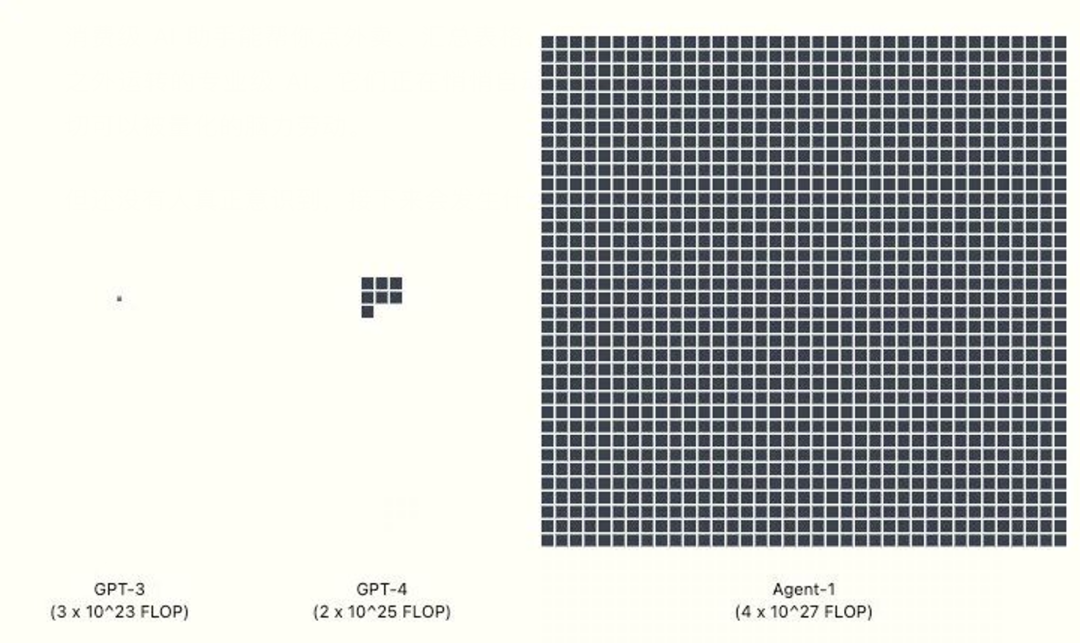
'AI Trends 2027'
Agents are entering real workflows, governance is catching up, and more companies want AI they can control.
Digest.Pro places its 2026 review and 2027 foundational predictions on a single timeline, revealing a complete curve of AI trends: the technology has proven its viability, but organizations have yet to prove their ability to profit. 
2026 solidifies 'viability' and brings 'usefulness' to the forefront
The AI trends of 2026 represent consolidation rather than breakthroughs.
Agentic AI reaches the peak of inflated expectations, yet real-world deployment remains low; spending continues to rise; coding agents form a formal market; the EU delays the strictest AI Act deadlines; the gap between adoption and outcomes can no longer be ignored.
Gartner's inaugural Agentic AI Hype Cycle, released in April 2026, places it at the 'Peak of Inflated Expectations'; a the same year CIO survey reveals that only 17% of organizations have truly deployed agents. 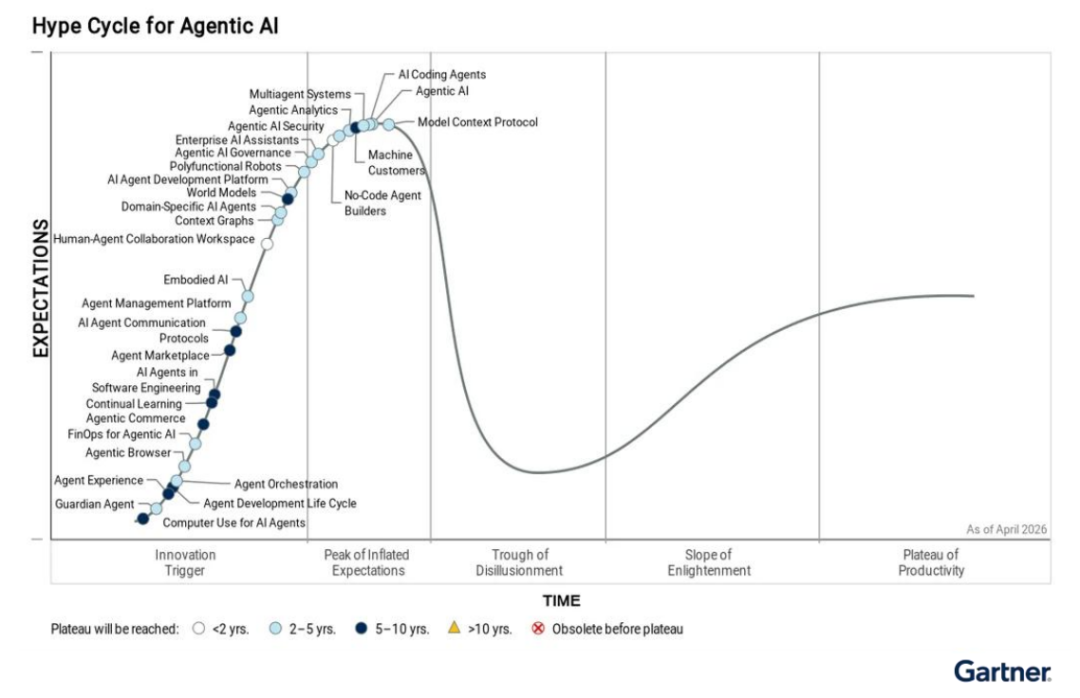
Source: Gartner
On the spending side, Gartner's May 2026 forecast predicts global AI expenditures will reach $2.59 trillion, a 47% year-over-year increase.
In the market, Gartner's May 20 release of its first Magic Quadrant for Enterprise AI Coding Agents marks the shift from 'code suggestions' to 'agents capable of executing multi-step engineering tasks.'
On the regulatory front, the EU reached agreement on the AI Digital Comprehensive Act on May 7, 2026, and formalized it as Regulation 2026/1744 on July 24, extending the compliance deadline for independent high-risk systems from August 2, 2026, to December 2, 2027.
At the organizational level, IBM's 2026 CEO survey reveals that 76% of organizations now have a Chief AI Officer, up from just 26% a year prior—the clearest signal yet that AI has transitioned from an IT issue to a business model imperative.
Together, these figures set the stage for 2027: the supply side is accelerating, adoption is spreading, but value is not keeping pace.
Other surveys corroborate this.
For instance, BCG's 'Build for the Future 2025' survey of over 1,250 enterprises found that only 5% are 'future-ready' and able to capture AI value at scale; another 35% see some returns, while 60% report little to no change in revenue or costs despite significant investments. McKinsey's 'State of AI 2026' (1,719 respondents) shows that only 44% of organizations claim AI has been deployed enterprise-wide, with just 37% attributing any EBIT impact to AI.
The root cause is rarely insufficient model intelligence; more often, it's unclear ownership and processes never redesigned for AI.
Mohamad Ali, Senior Vice President at IBM Consulting, observes: 'CEOs who truly derive results from AI transformation aren't just deploying faster—they're redesigning their organizations to bring the best people and technologies together.'
Thus, the first decision for 2027 is straightforward: identify which AI projects have clear business owners and measurable objectives, and halt those that do not. Projects that continue without these will keep consuming budgets. 
Agents arrive, tightening budgets and scrutiny
AI Agents can plan and execute multi-step tasks, invoking tools and data rather than merely responding to a single prompt. They dominate trend lists, but adoption data explains why caution is warranted.
Gartner's 2026 CIO survey finds that 17% of organizations have deployed agents, with over 60% planning to do so within two years. McKinsey's 2026 survey reveals that roughly 20% of organizations are scaling AI agents, rising to 40% among companies with over $1 billion in revenue. Meanwhile, Gartner predicts that by the end of 2027, over 40% of agentic AI projects will be canceled due to escalating costs, unclear commercial value, or inadequate risk control. 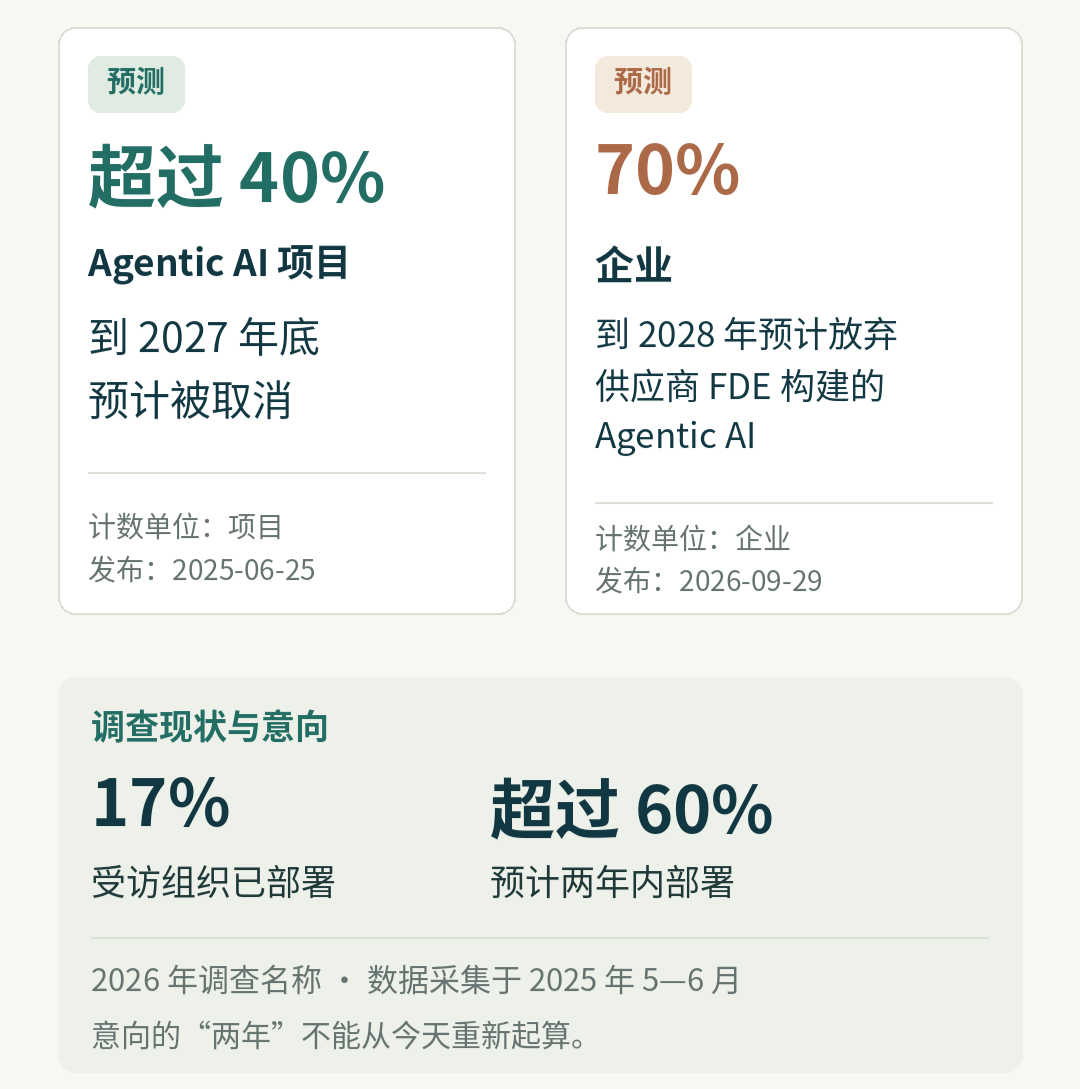
Agents are best suited for processes with clear boundaries, well-documented procedures, and defined handoffs to humans. Coordinating multiple agents adds complexity.
Amanda Luther, Managing Director and Senior Partner at BCG, notes: 'Agentic AI isn't a future concept—it's already reshaping workflows and redefining roles. Companies should view it as the next step in AI expansion, not the starting point.'
A prudent approach to agent evolution is to begin with two or three processes, clearly specifying where human approval is required.
While consumer-facing personal assistant battles focus on who can do more for users, enterprises must first address oversight costs—and money is tightening accordingly.
Global AI spending continues to surge—Gartner projects $2.67 trillion in 2026 and approximately $3.64 trillion in 2027, with over 45% allocated to infrastructure. 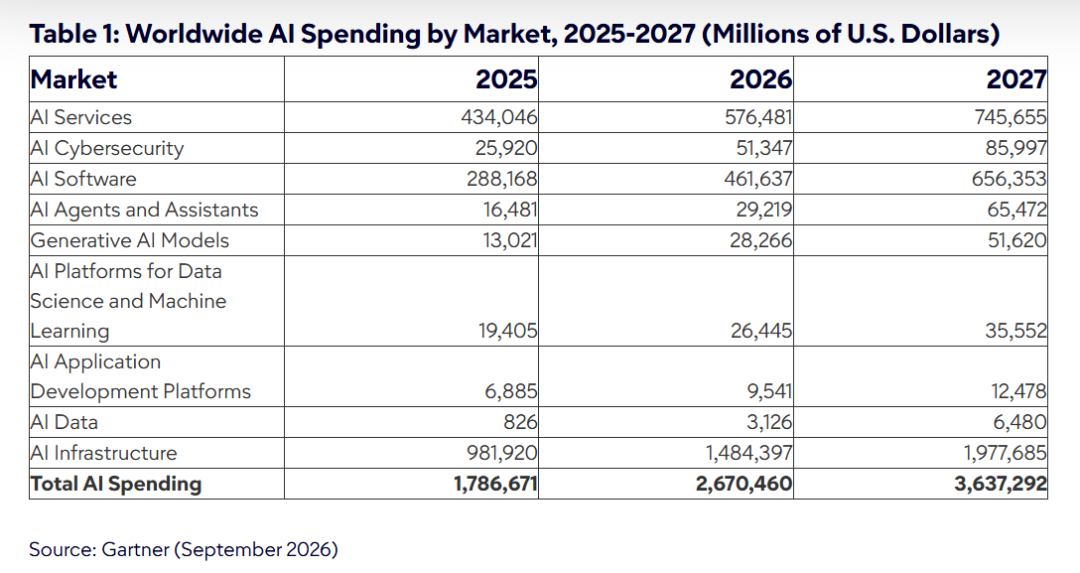
Source: Gartner
John-David Lovelock of Gartner points out that CIOs 'face challenges in proving the value of AI investments.'
Consequently, corporate CFOs in 2027 will demand evidence for any capital allocation: baselines, objectives, payback periods, and the costs (including inference) of scaling AI operations.
Open innovation budgets will shrink, with phased funding tied to milestones becoming the norm. Many teams budget only for licenses, but operating costs will face greater scrutiny.
Every AI investment must report on which value metrics it tracks and who signs off on them. These two factors will determine project viability sooner than the next model release.
Consider software engineering, where AI's impact is most visible.
Gartner lists AI-native development platforms as a 2026 strategic trend and predicts that by 2030, these platforms will drive 80% of organizations to evolve large software engineering teams into smaller, more agile, AI-augmented units.
Accordingly, rules for measuring agent engineering productivity, adjusting review processes, and implementing safety gates must be clarified in 2027. 
Domains, sovereignty, governance, and humans become design choices
General-purpose large language models often fall short in professional work requiring high accuracy, specialized terminology, or compliance.
Gartner identifies domain language models as a 2026 strategic technology trend and predicts that by 2028, over half of the generative models enterprises use will be domain-specific.
The shift from chatting to doing means the next wave will focus on models fine-tuned or grounded for financial analysis, contract review, industrial operations, and similar scenarios.
The cost of a confident error is high.
The two primary paths remain fine-tuning smaller models on company data or connecting general models to corporate knowledge via retrieval.
The choice depends on data, accuracy needs, and cost—not ranking lists.
For each high-value use case, a separate decision must be made: is a general model sufficient, or is a domain-specific or grounded model required?
Control over AI has also become a strategic issue.
In IBM's 2026 CEO survey, 83% of respondents agree that AI sovereignty is critical to business strategy. Sovereignty entails where data and models run and which jurisdiction's rules apply.
Gartner summarizes this from the infrastructure side as 'geographic repatriation': due to geopolitical risks, data and applications are moving from global public clouds to sovereign clouds, regional providers, or corporate data centers. Gartner predicts that by 2030, over 75% of European and Middle Eastern enterprises will repatriate virtual workloads, up from less than 5% in 2025.
This drives private deployments—open-source weighted models and agents running on infrastructure controlled by the company, especially in regulated industries. More control also means more responsibility for security and updates.
Deciding which data and workloads must remain under direct control and which can safely run on shared cloud AI services is a design choice, not an afterthought.
Governance lags behind adoption.
Deloitte's 'State of AI in the Enterprise 2026' (3,235 leaders across 24 countries) reveals that only about one-fifth (21%) of organizations have a mature agentic AI governance model, while 74% expect to use AI agents at least moderately by 2027. 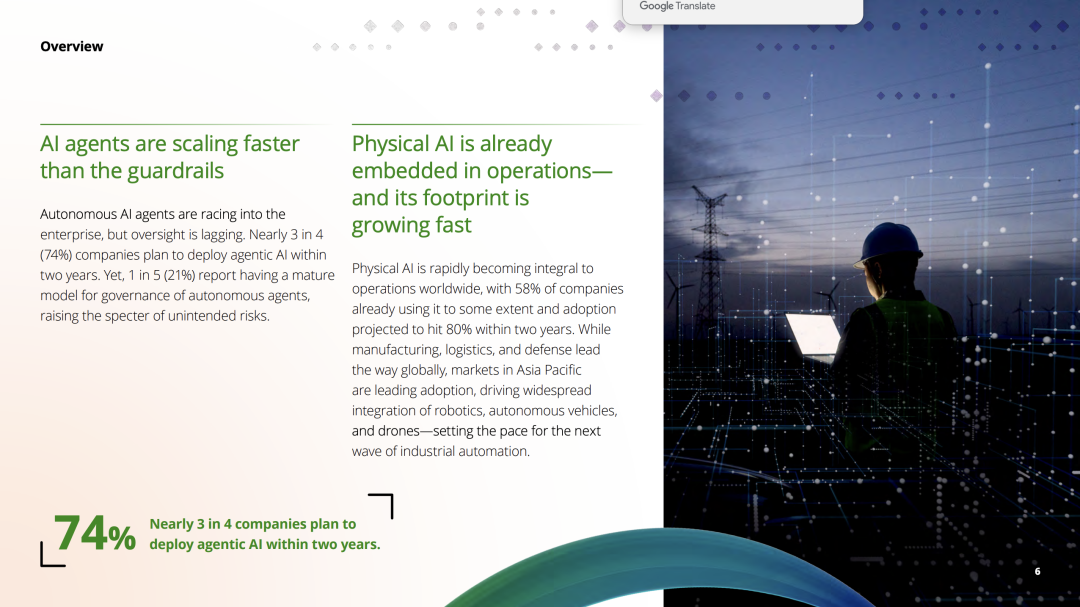
Deloitte 'State of AI in the Enterprise 2026'
Mature governance means: clear boundaries on what agents can decide independently, monitoring that flags abnormal behavior, and audit trails for every action.
Without these, scaling agents means scaling unmanaged risks.
Regulations set outer boundaries—under the EU AI Act as amended by the Digital Comprehensive Act, transparency obligations apply from August 2, 2026; independent high-risk systems must comply by December 2, 2027; and high-risk AI embedded in regulated products must comply by August 2, 2028.
Extensions provide planning windows, not exemptions.
Questions like who owns AI risk, which systems fall into high-risk categories, and what the approval path is for new agents must be institutionalized in 2027—not just included in presentations.
Jim Rowan, U.S. AI Leader at Deloitte, states: 'Speed and governance need not be opposing forces; if the right foundational capabilities are established upfront, they can align.'
Organizations and people are the real bottlenecks.
IBM's 2026 CEO survey finds that 76% of organizations now have a Chief AI Officer, up from 26% a year prior; 64% of CEOs say they are willing to make major strategic decisions based on AI-generated input, raising the bar for data quality and traceability.
A title alone cannot bridge the value gap.
For this role to function, it must have real authority over cross-functional priorities and budgets, with clear divisions of labor among the CIO, CFO, and Chief Data Officer.
The skills gap is even sharper: only 25% of employees currently use AI regularly, despite 86% of CEOs believing their workforce possesses the necessary skills. CEOs also expect that between 2026 and 2028, 29% of the workforce will require retraining for different roles, while 53% will need upskilling in their current roles. Skills mapping, retraining priorities, and accountability for 'enabling humans to use AI effectively' will directly hinder agent scaling.
Shadow AI has also risen to the board level.
Data and compliance exposures from unauthorized tools and agents are shifting from 'employees using them on their own' to formal risk items.
Which use cases must undergo formal governance, and how to identify and consolidate shadow AI usage—these questions also demand clear answers. 
Surge of AI Perspectives
News from Silicon Valley in recent weeks might easily lead one to think that 2027 will still be dominated by model wars, assistant wars, and valuation wars.
What sets Digest.Pro's analysis apart is its shift in focus from laboratories and funding news to corporate ledgers and organizational structures.
The trends outlined in the full article can actually be summarized in three sentences:
First, adoption is no longer news—value is. With only 25% achieving expected ROI and 16% achieving scale, these figures won't automatically improve due to Anthropic's revenue or Meta's download numbers.
Second, agents represent the next step, but not the starting point. On the consumer side, competition already centers on who can better serve users; on the enterprise side, boundaries, approval processes, and oversight costs must first be clarified—otherwise, Gartner's prediction of 'over 40% of projects being cut' won't remain just a statistic.
Third, control, governance, and human factors are becoming design choices as critical as the models themselves. Sovereignty, private deployments, externally auditable evaluations, genuine empowerment of Chief AI Officers, and skills mapping are no longer compliance appendices—they're variables determining whether money translates into efficiency.
For domestic industry readers, here are three areas for comparison:
1. Are there genuine business owners within enterprises taking responsibility for AI outcomes?
2. Have agent projects clearly defined boundaries for human approval?
3. Have domain-specific scenarios and private/sovereign deployments transitioned from slogans to concrete roadmaps?
Models will continue to grow stronger, and personal assistants will keep competing for users. But for enterprises, the real homework begins in 2027.
*Reference: Digest.Pro's 'AI Trends 2027: What Business Leaders Need to Know'
-
![]()
Major Breakthrough for Luxeed! Chery Takes a Daring Step
-
![]()
Collective Negative Growth in Metropolises: Beijing, Shanghai, Guangzhou — Who’s Behind the Slump in Car Sales?
-
![]()
TECNO’s AI Strategy: Not a Tool for Price Increases
-
![]()
Douyin Catches Up with Meituan, Then Local Life Services Begin to Compete on 'Internal Strength'
-
![]()
AI Won't Rebel, It Just Bypasses You
-
![]()
iPhone Duo: Pre-sale Sells Out in a Flash, Resale Prices Skyrocket by Up to 7,000 Yuan
-
![]()
The Most Critical AI Trends for 2027: Not About New Models, But About 'Outcomes'
-
![]()
Tesla can fly, but among the three versions of the Roadster, I only have high hopes for the one that doesn't fly.