Tesla can fly, but among the three versions of the Roadster, I only have high hopes for the one that doesn't fly.
 10/19 2026
 485
Today, I bet everyone’s WeChat Moments and group chats are flooded with the same video.
A white sports car races up a wall bent into a question mark, hangs upside down at the top, then jumps off, flips in mid-air, and lands smoothly while emitting white vapor.
This is Tesla’s second-generation Roadster—the same model announced in 2017 and delayed for nine full years.
A friend of mine who works on chassis came to me right away, asking: Is this real? Can they sell it? Who would buy it?
Online interpretations fall into two camps: one calls it “the craziest launch event in history,” while the other says, “Here we go again with empty promises.” Neither feels satisfying.
So, I rewatched the launch event, checked Tesla’s official configurator page, broke down the product’s technical details (something we at Vehicle excel at), discussed with our expert engineers, crunched some numbers based on public data, and carefully analyzed the product’s technology and positioning.
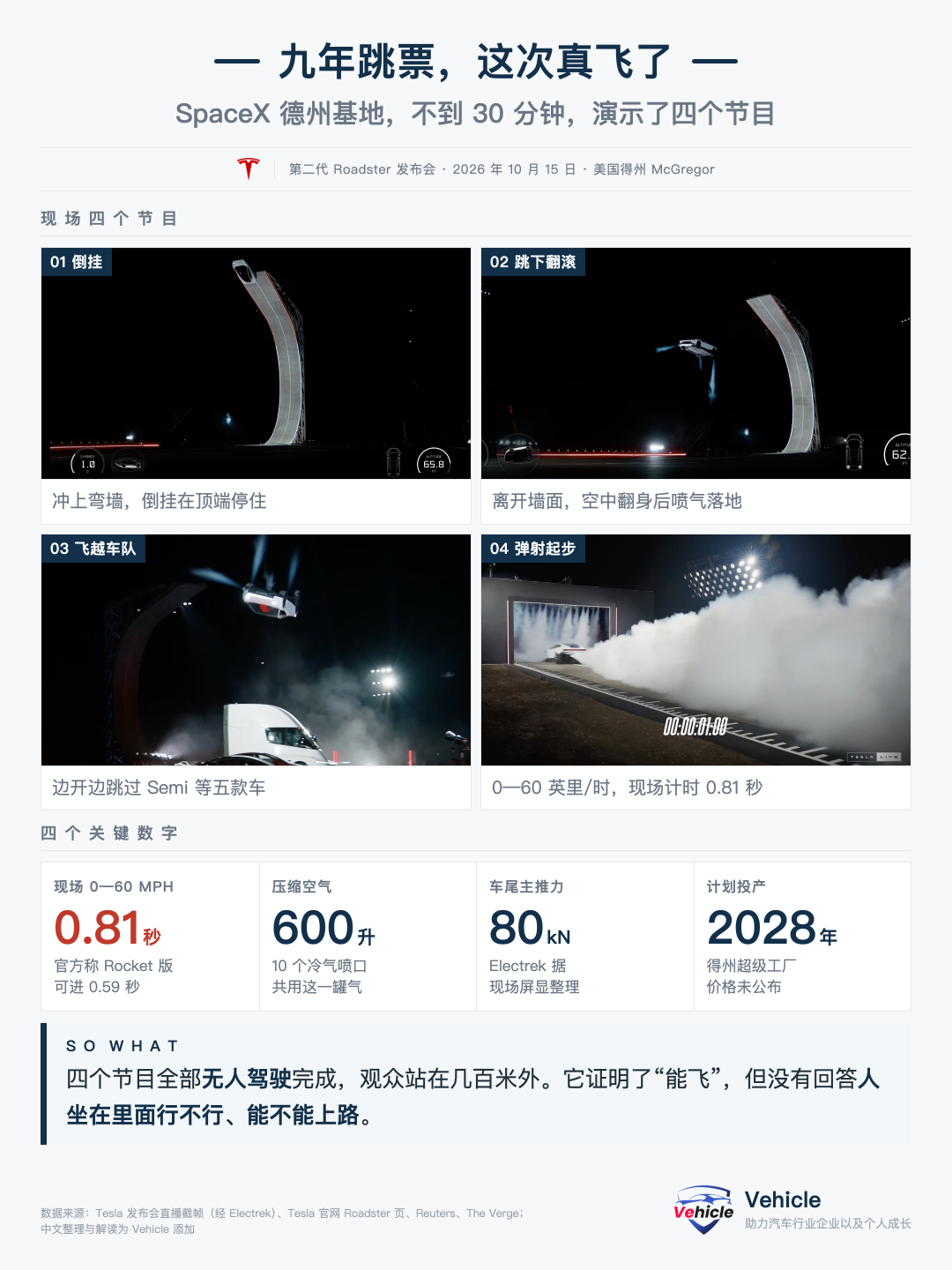
So, in this piece, we’re not hyping it up nor tearing it down. Instead, from the perspective of automotive professionals, we’ll analyze three things: what was announced, how it flies, whether the flying version will enter mass production, and the product’s positioning.
We aim to provide factual, rational insights that might inspire you.
01 Nine Years of Delays, But This Time It Actually Flies
The launch event lasted under 30 minutes, skipped pricing, and introduced three versions.
Let’s align on the basics first.
The event took place on the evening of October 15 (local time) at SpaceX’s rocket development and testing base in McGregor, Texas. Originally scheduled for October 1, it was postponed by two weeks due to weather.
The entire event lasted under 30 minutes and felt more like a stunt show. There were four acts:
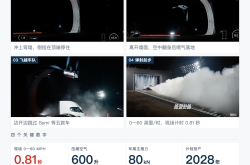
① Inverted Hang: The car raced up a multi-story curved wall and hung upside down at the top using suction. Note the HUD in the bottom left corner—downforce peaked at 4,697 kg.
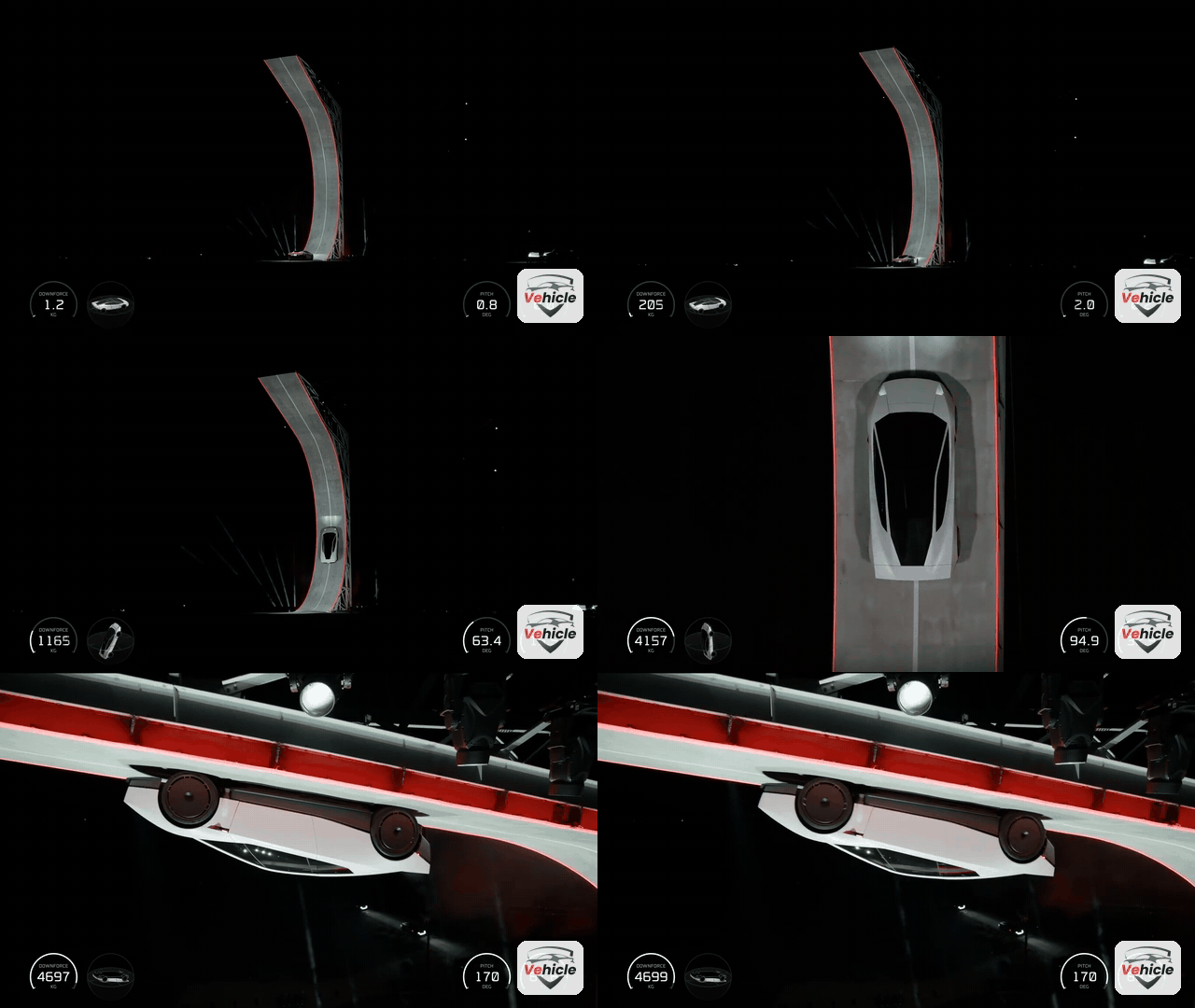
Act 1: Climbing the wall to 90°, then hanging upside down (first segment at 2x speed)
② Jump and Flip: The car jumped off the wall, flipped mid-air, and landed using jet adjustment.
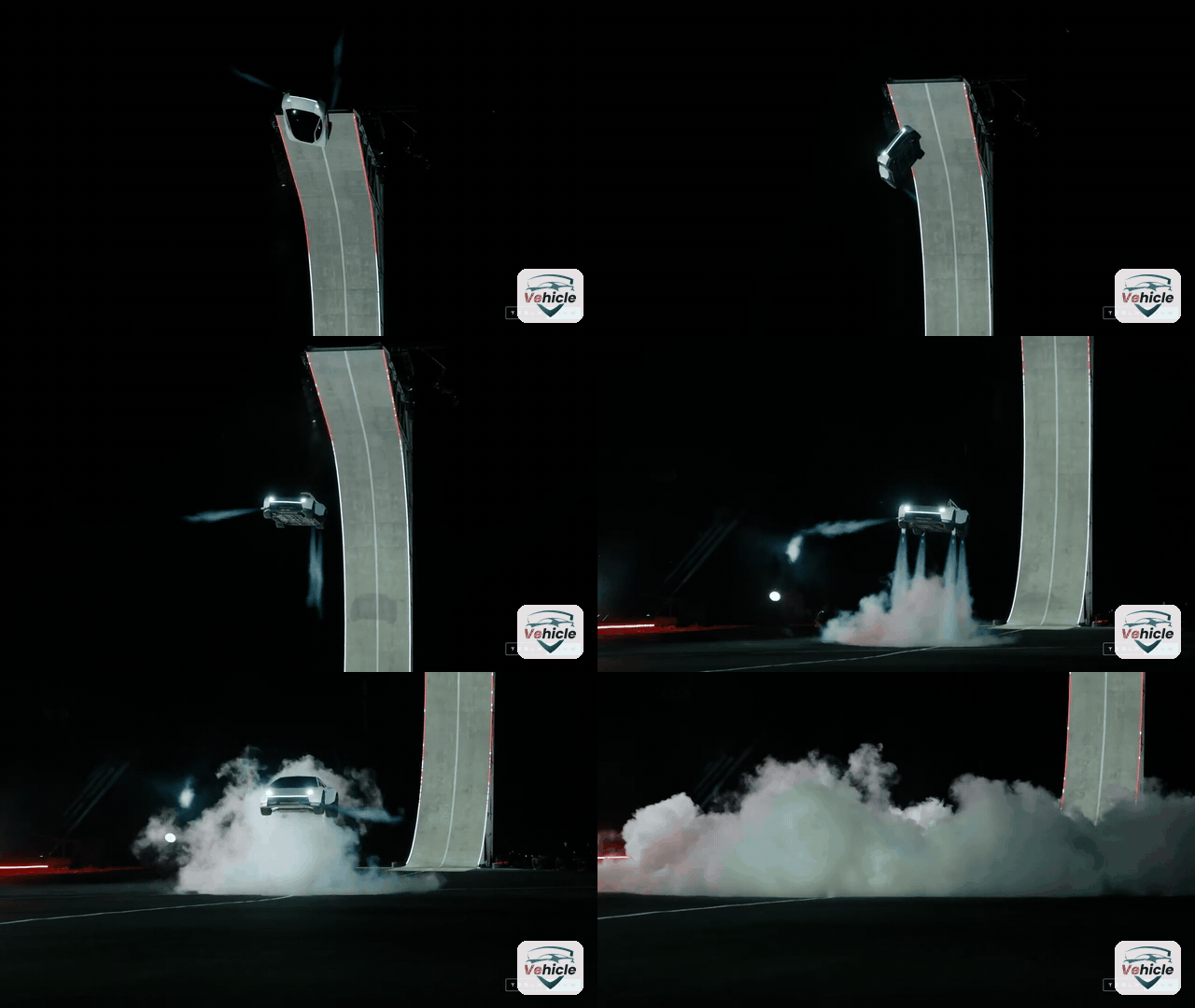
Act 2: Leaving the wall, flipping, and landing with jets
③ Fleet Jump: The car jumped over a lineup of Model 3, Model Y, Cybertruck, Semi, and Cybercab while driving. Engineering VP Lars Moravy called this a “kickflip.”
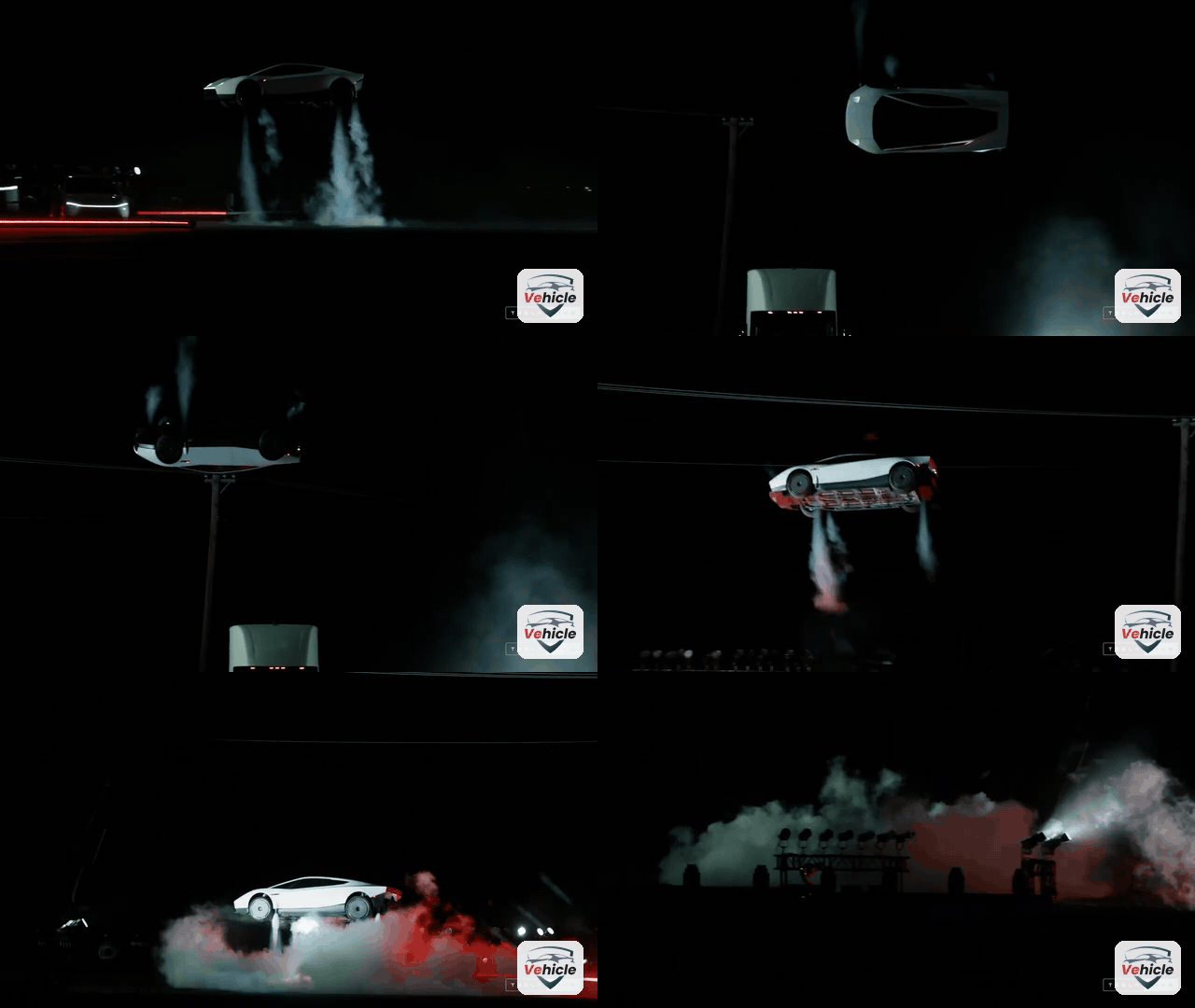
Act 3: Four jets lifted the car over the Semi
④ Rocket Start: Accelerating from 0 to 60 mph, recorded at 1.0 second, timed live at 0.81 seconds.
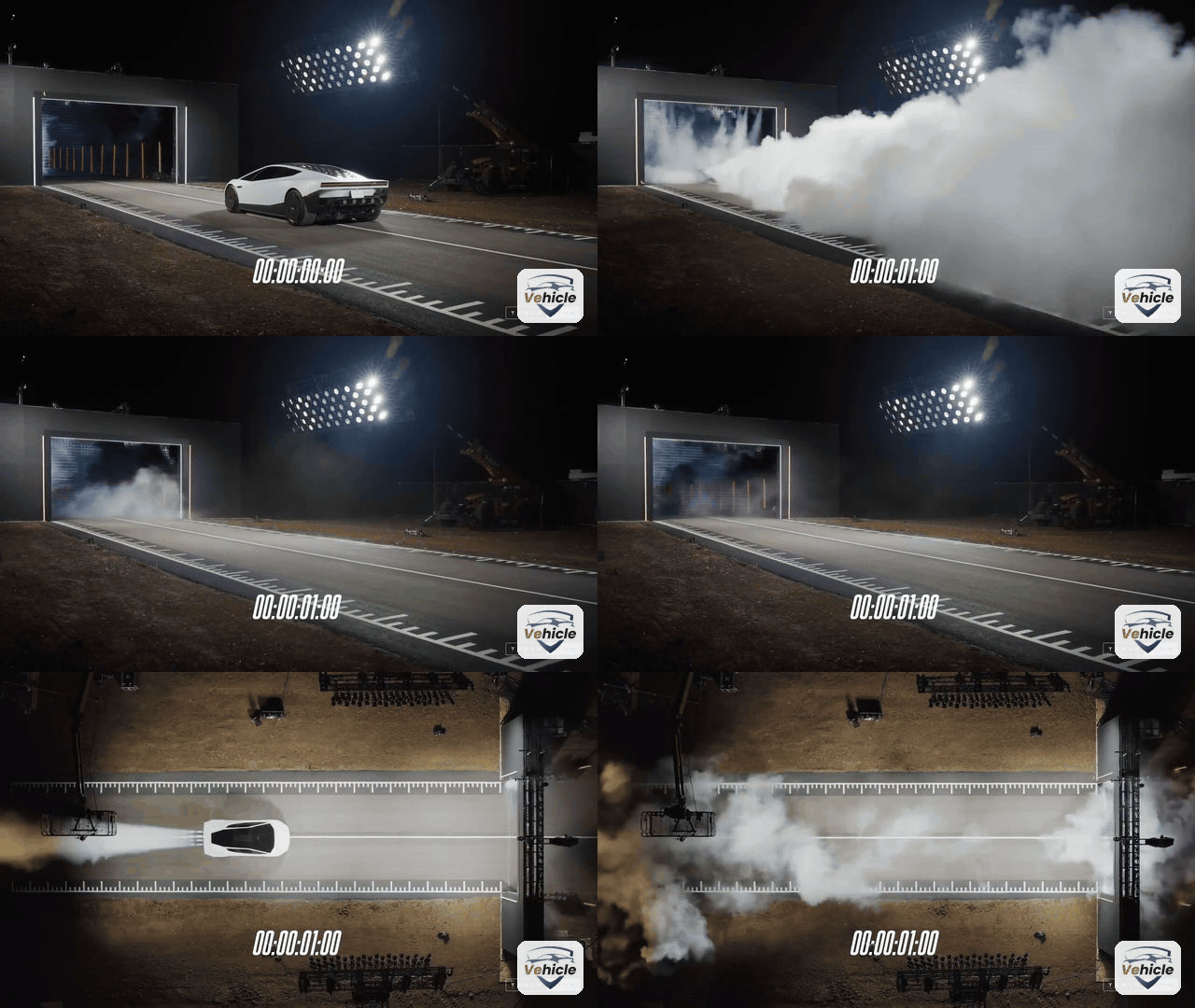
Act 4: Recorded 0-60, timer stops at 1.00 second
One detail many might have missed: all four acts were performed autonomously, with the audience standing hundreds of meters away.
After the event, Tesla released three versions on its website and X:
Performance (Highway Version, 2-seater): Fan suction + active aerodynamics, 0-60 mph in under 1.6 seconds, $50,000 deposit
Thrust (Track Version, 2-seater): Adds rear cold gas thrusters, 0-60 mph in under 0.9 seconds, $250,000 deposit, limited edition
Rocket (Flying Version, 1-seater): Cold gas jets around the body, can fly, 0-60 mph in under 0.59 seconds, invitation-only
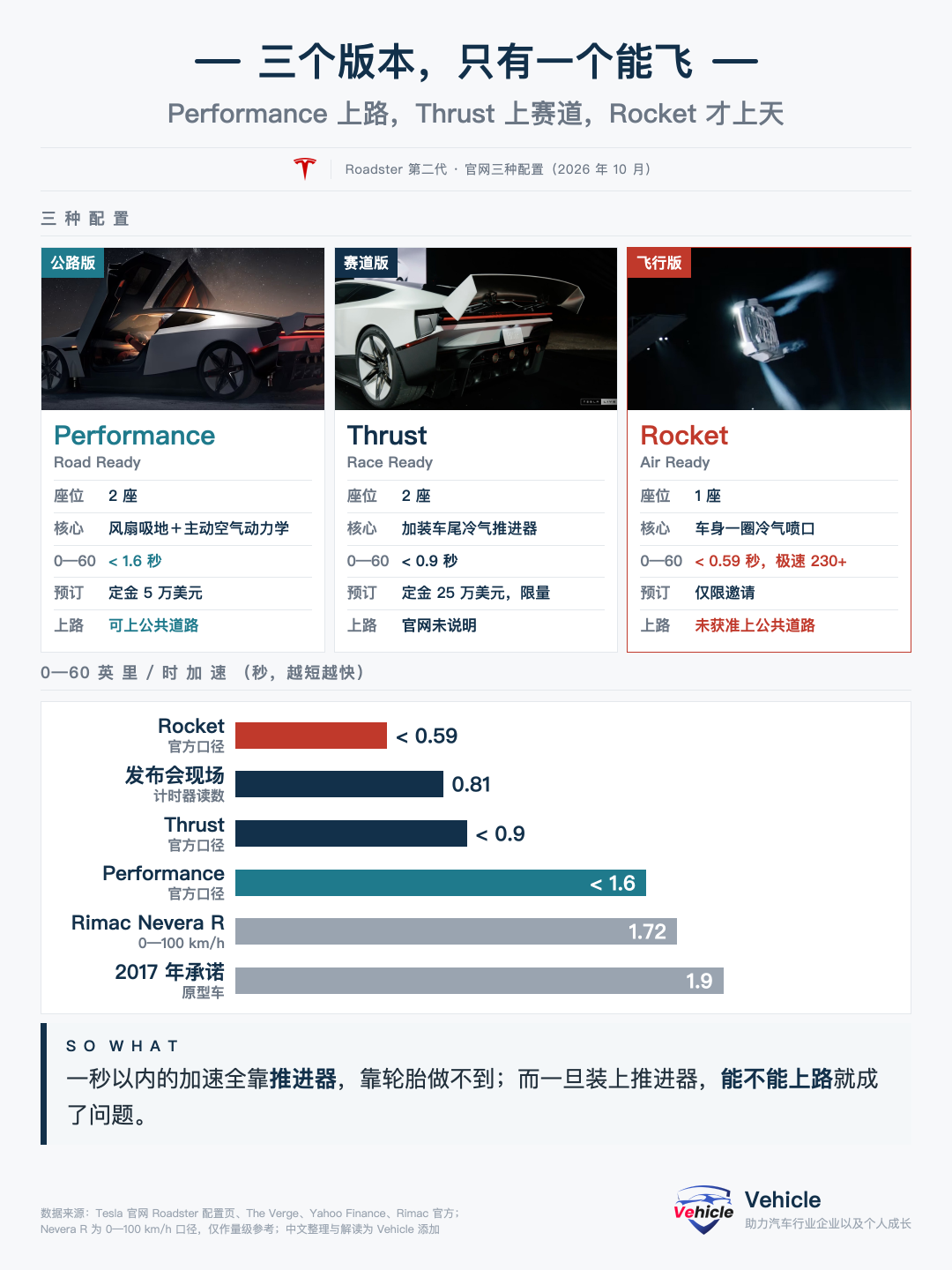
All three versions have over 300 miles of range, with the Rocket version topping 230 mph. The Performance version requires a $5,000 deposit upfront and $45,000 within 10 days. The Chinese deposit is ¥332,000, refundable.
Pricing wasn’t announced. The 2017 starting price was $200,000, and foreign media generally expect it to be higher this time.
Production is slated for 2028 at Tesla’s Texas Gigafactory, according to Musk.
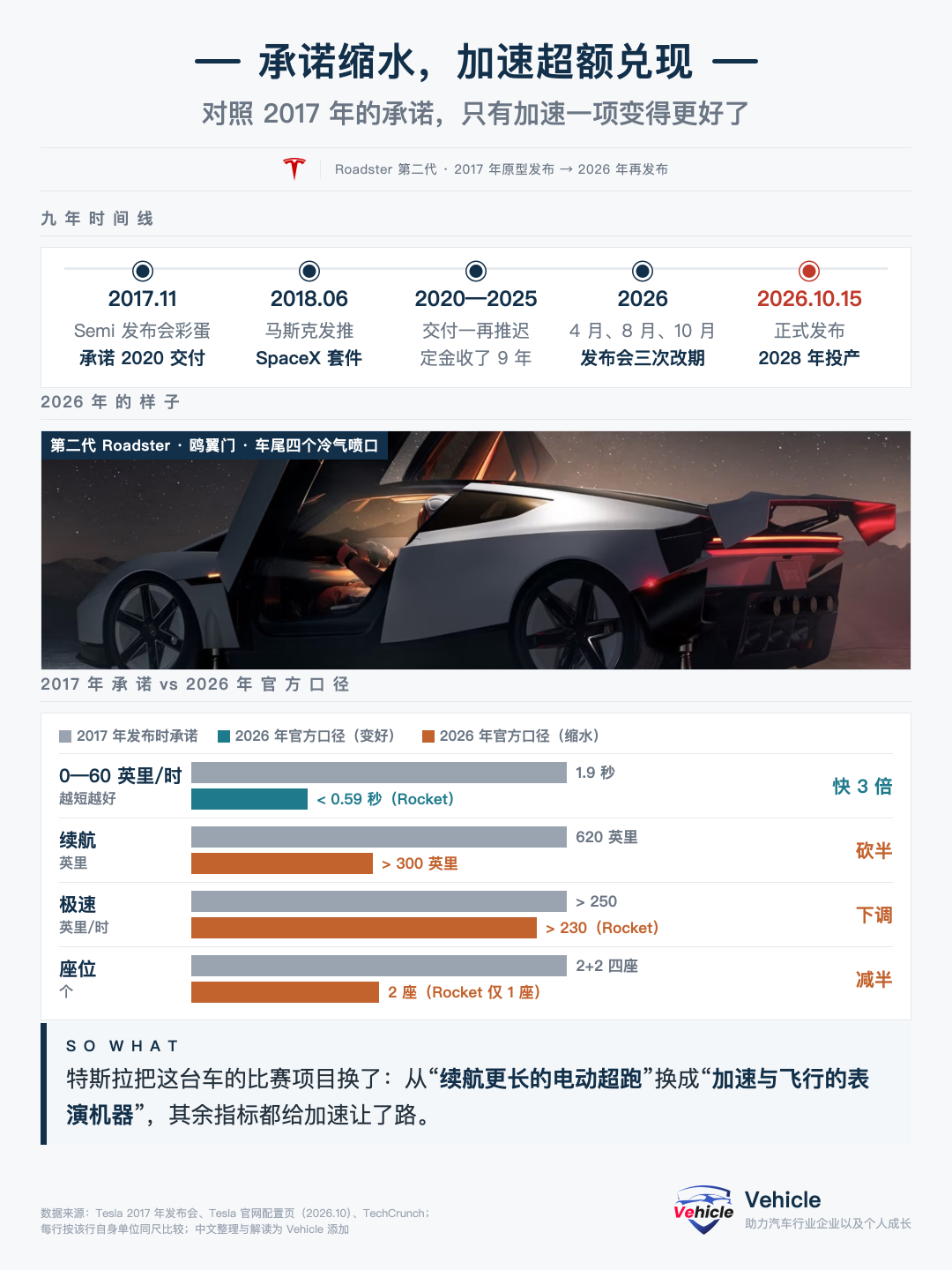
Comparing it to the 2017 promise is interesting.
Acceleration improved from 1.9 seconds to 0.59 seconds—over three times faster. However, range dropped from 620 miles to 300 miles, top speed fell from 250 mph to 230 mph, seating went from 2+2 to 2 seats (1 seat for the flying version).
Acceleration was over-delivered, but nearly everything else was scaled back.
In simple terms, Tesla shifted the car’s focus from “an electric supercar with longer range” to “a flying show machine.”
02 It’s Not About Profit—It’s About Storytelling
Roadster’s KPIs are attention and valuation, not sales.
So, what does Tesla hope to achieve with this car?
Musk positioned it as:
“The best of the last of the human-driven cars.”
— Elon Musk, Roadster launch event
He also said two blunter things: this car “may not have a significant impact on revenue,” and if safety is your top priority, don’t buy it.
I see four layers to Tesla’s expectations for this car.
01 Fill a halo car gap
If we look at Tesla’s product portfolio, it’s missing a halo car that showcases its engineering prowess. The Roadster fills that role.
Porsche has the 918, and just released the new benchmark Mission S. Ferrari has the LaFerrari. These cars sell in small numbers but define the brand’s image.
02 A farewell to human driving
Tesla’s current focus is on Robotaxi and Optimus. The Cybercab lacks even a steering wheel, while the Roadster features a yoke and steer-by-wire.
Musk said it’s Tesla’s last ticket for those who “still want to drive themselves.”
03 A showcase of Tesla and SpaceX engineering
The thrusters, carbon fiber tanks, and fan systems come from SpaceX. The valve actuators are borrowed from Optimus’s ankles. The car is a tech collage of both companies.
04 A new story for capital markets
The market’s reaction was immediate. Tesla closed down 1.29% at $362.44 on Thursday but rose ~5% pre-market on Friday to $381 after the event.
Barclays suggested Tesla and SpaceX might announce a merger by year-end. Dan Ives said the car makes the two “feel like one engineering platform.”
There were also sober voices. Deepwater’s Gene Munster called it an “engineering show with no commercial value beyond embarrassing traditional automakers.”
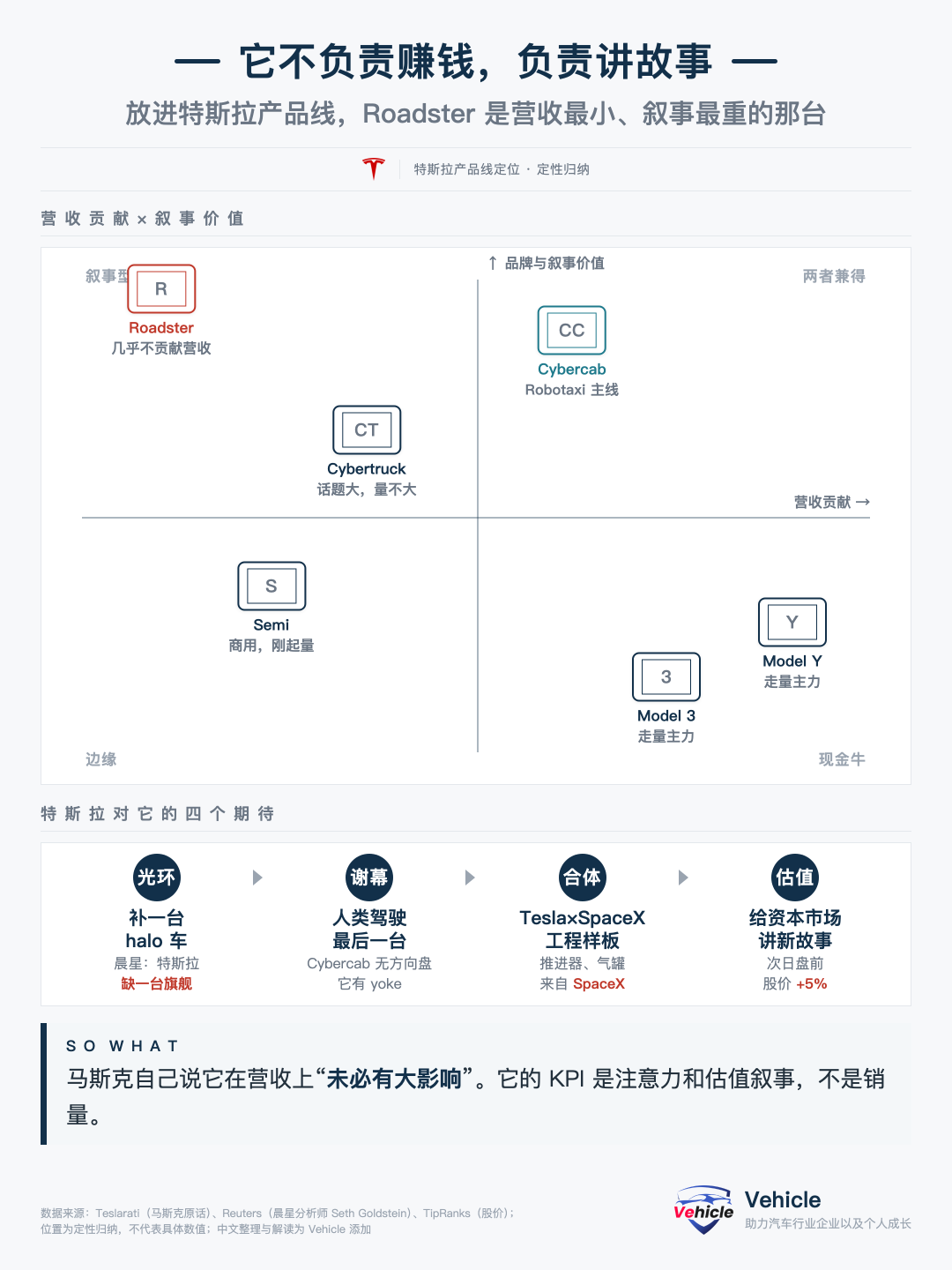
My take: this launch’s success shouldn’t be measured by sales.
Nine years of ridicule were reversed in 30 minutes with a single flip—a level of efficiency that’s envy-inducing in the auto industry.
03 Inversion Relies on Suction, Not Flight
Fan suction is this car’s most practical black tech.
Many assumed the inverted wall hang relied on jets, but that’s not the case.
It uses Tesla’s “multi-mode ground suction system.” Here’s the principle in one sentence: suck air out from under the car to let atmospheric pressure press it onto the road.
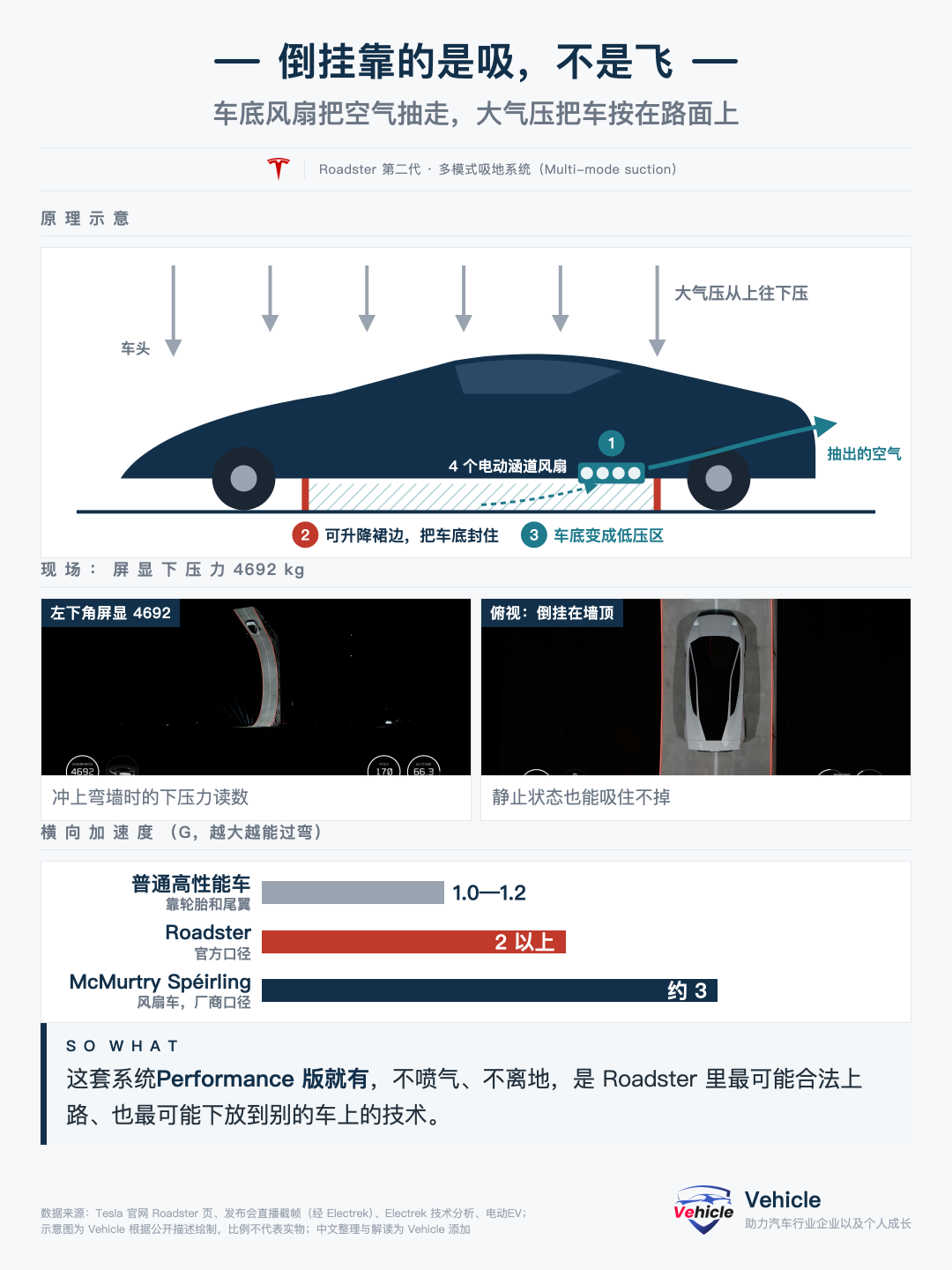
Here’s how it works: Four electric ducted fans are mounted horizontally at the rear bottom. Adjustable skirts seal the gap between the car and road. When the fans activate, the underbody becomes a low-pressure zone, while the roof remains at normal atmospheric pressure. The pressure difference pins the car to the ground.
It’s like a suction cup. The benefit: downforce exists even when stationary, unlike traditional spoilers that require speed. Think of it as active downforce.
Officially, lateral acceleration in corners exceeds 2G. High-performance cars typically manage 1.0–1.2G using tires and spoilers.
During the inverted hang, the screen showed 4,692 kg of downforce.
Some question this number: a two-seater sports car likely weighs under 2 tons, so 4.7 tons of downforce seems excessive. For reference, the UK’s McMurtry Spéirling (one of the first suction-based cars) weighs ~1 ton and generates ~2 tons of downforce, enough for inverted driving.
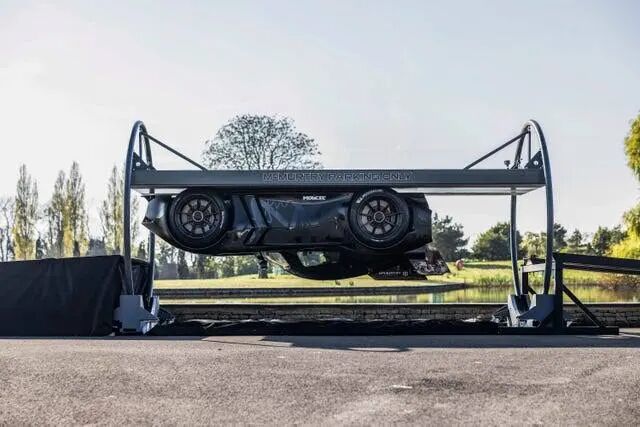
Fan cars aren’t new to Tesla. Brabham’s BT46B used them in 1978 but was banned after one race. McMurtry has been setting track records with them in recent years.
Other features include steer-by-wire with a yoke steering wheel, an active rear wing, and Track Mode, which lowers the body and switches suspension between high-downforce and low-drag modes.
From a chassis perspective, I think the suction system is the most likely tech to trickle down to other models.
It only consumes electricity, doesn’t rely on jets or lift-off, and is included in the Performance version. Low-speed grip could later enhance active safety in scenarios like wet roads or emergency maneuvers—though that’s my speculation.
Note: Fan suction has downsides: noise, road debris suction, skirt wear, and extra power consumption. Tesla hasn’t released data on these yet.
04 Flight Relies on Compressed Air
Cold gas thrusters work like a deflating balloon.
Now, let’s talk about what actually makes it “fly.”
Tesla uses cold gas thrusters.
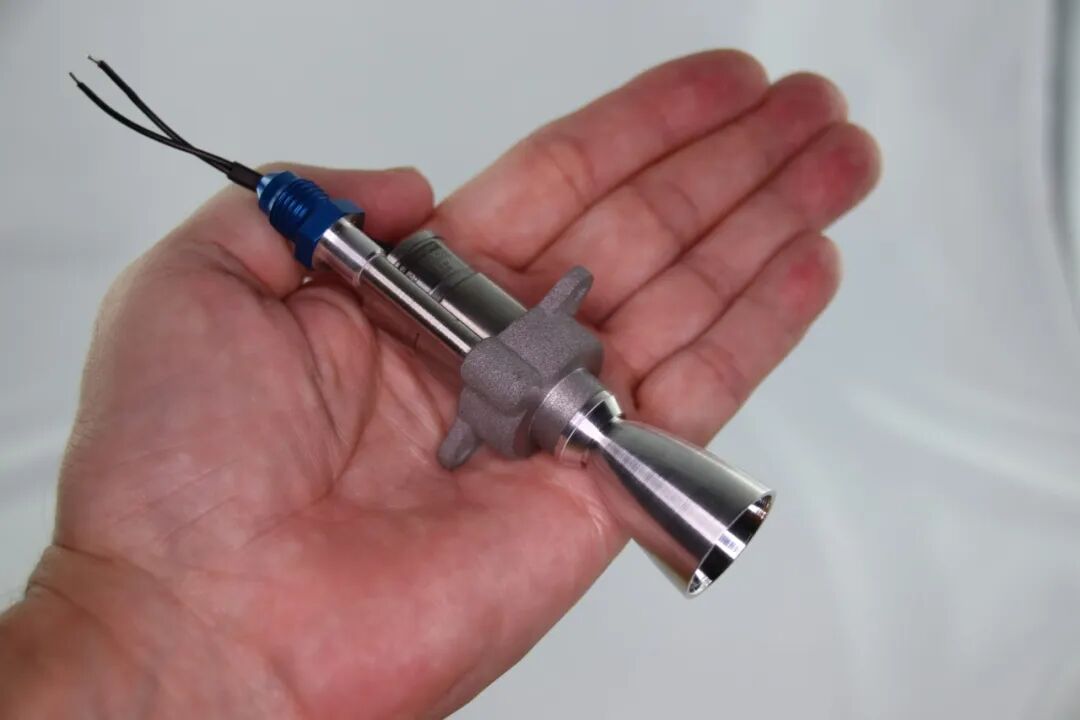
The principle is simple: a tank holds high-pressure gas. When a valve opens, gas shoots out of a nozzle, and the reaction force pushes the car in the opposite direction. No ignition, no combustion—just like releasing air from an inflated balloon.
SpaceX uses this exact system for attitude adjustments in space.
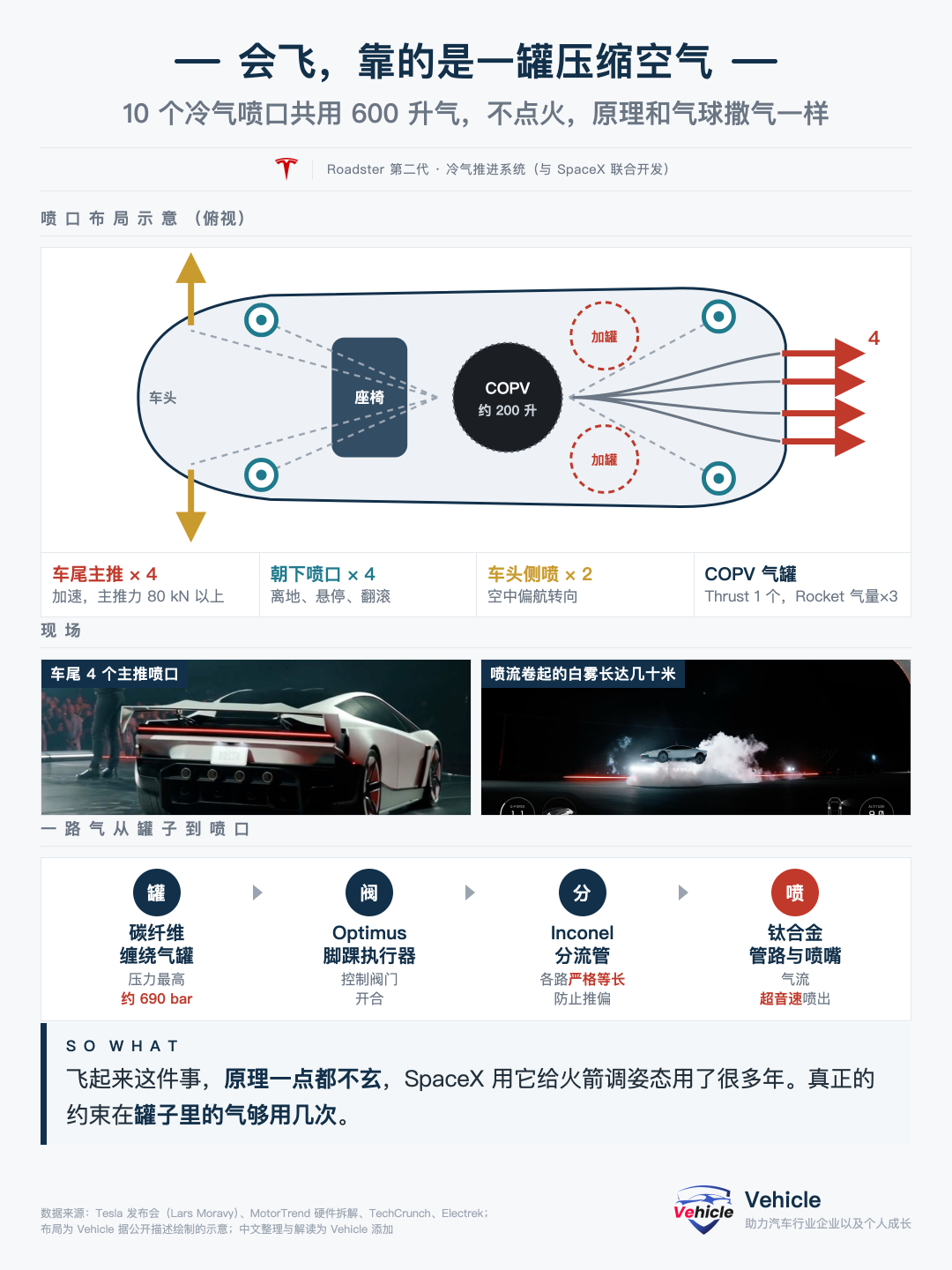
Based on the event video, we speculate the hardware looks like this:
10 nozzles: 4 rear main thrusters for acceleration; the flying version adds 4 downward thrusters for lift and flips; 1 on each side of the front for mid-air steering.
600 liters of compressed air: Moravy mentioned this on stage. Tesla said on X that “every available gap” is filled with carbon-fiber-wrapped tanks.
Tanks: The Thrust version has a black carbon-fiber sphere the size of a gym ball behind the seats (~200 liters, ~690 bar max pressure). The flying version triples this to 600 liters.
Piping: Long tubes and nozzles are titanium; diverter valves are Inconel high-temperature alloy. Valve actuators come from Optimus’s ankles.
Thrust: Rear main thrusters exceed 80 kN, with supersonic exhaust (visible Mach diamonds on screen).
There's another engineering detail I quite like: Moravy said that each pipe must be strictly equal in length, just like exhaust manifolds. If the air on the left side arrives first, the car will drift to the right. This really tests precision manufacturing.
In addition, SpaceX acquired Hexagon Masterworks, a company specializing in carbon fiber gas tanks, this year, bringing this part of the supply chain in-house.
If you watch the 0-60s slow-motion footage frame by frame, you can see that the thrusters start firing before the car moves. If the thrusters need time to 'pressurize,' then part of the electric vehicle's most proud feature—instant torque—might be offset by this.
So, my view is that flying is not technically mysterious at all. The real constraint is how many times the gas in the tank can be used.
05 I've done the math on the gas tank
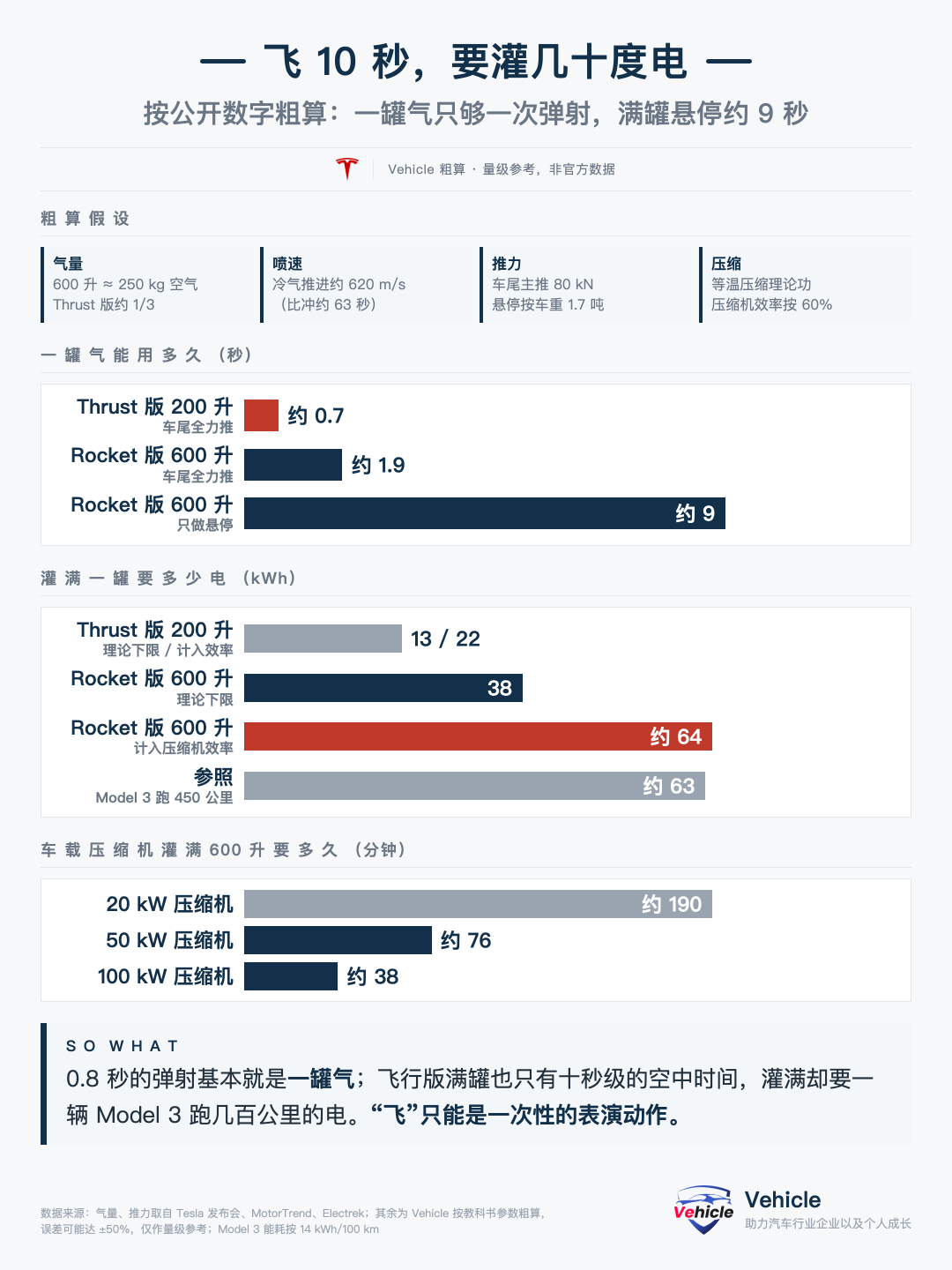
Enough gas for about 9 seconds of flight, but recharging it takes dozens of kilowatt-hours of electricity
Tesla hasn't disclosed the gas mass, ejection speed, or refill time, so I did some rough calculations based on publicly available numbers and textbook parameters.
Let me be clear: This is an order-of-magnitude estimate with a possible error of ±50%. It's not official data.
Rough gas tank calculation process (parameters can be adjusted)
Gas volume: 600 liters, estimated at ≈690 bar ≈250 kg of air
Thrust version: ≈200 liters ≈85 kg
Ejection speed: Cold gas thrust specific impulse ≈60 to 70 seconds, so ejection speed ≈620 m/s
① Full rear thrust at 80 kN: Consumes 80,000 ÷ 620 ≈129 kg per second
Thrust version's 85 kg can last ≈0.7 seconds; Rocket version's 250 kg can last ≈1.9 seconds
② Hovering: Car weight at 1.7 tons, requires ≈16.7 kN of thrust, consuming ≈27 kg per second
Rocket version's full tank can hover ≈9 seconds
③ Refill energy: Isothermal compression theoretical work ≈0.55 MJ/kg
250 kg ≈38 kWh (theoretical minimum), compressor efficiency at 60% ≈64 kWh
④ Refill time: 50 kW onboard compressor ≈76 minutes, 100 kW ≈38 minutes
After calculating, I was stunned myself.
The Thrust version can only push backward at full throttle for about 0.7 seconds with one tank of gas, which almost matches the 0.8-second launch demo. In other words, one launch basically uses one tank of gas.
The flight version's full tank can hover for only about 9 seconds when purely hovering. Recharging it takes around 60 kWh of electricity, enough to power a Model 3 for 450 kilometers.
This also explains a phenomenon noticed at the launch event: Different cars were used for each demo. I suspect this is largely because there isn't enough gas, and switching cars is faster than refilling on-site.
This means 'flying' can only be a one-time stunt on racetracks or in performance venues, not a daily function.
06 Will the flying version be mass-produced?
Three versions, three fates
Let's return to the question everyone cares about most.
My answer depends on the version because these three cars face completely different challenges.
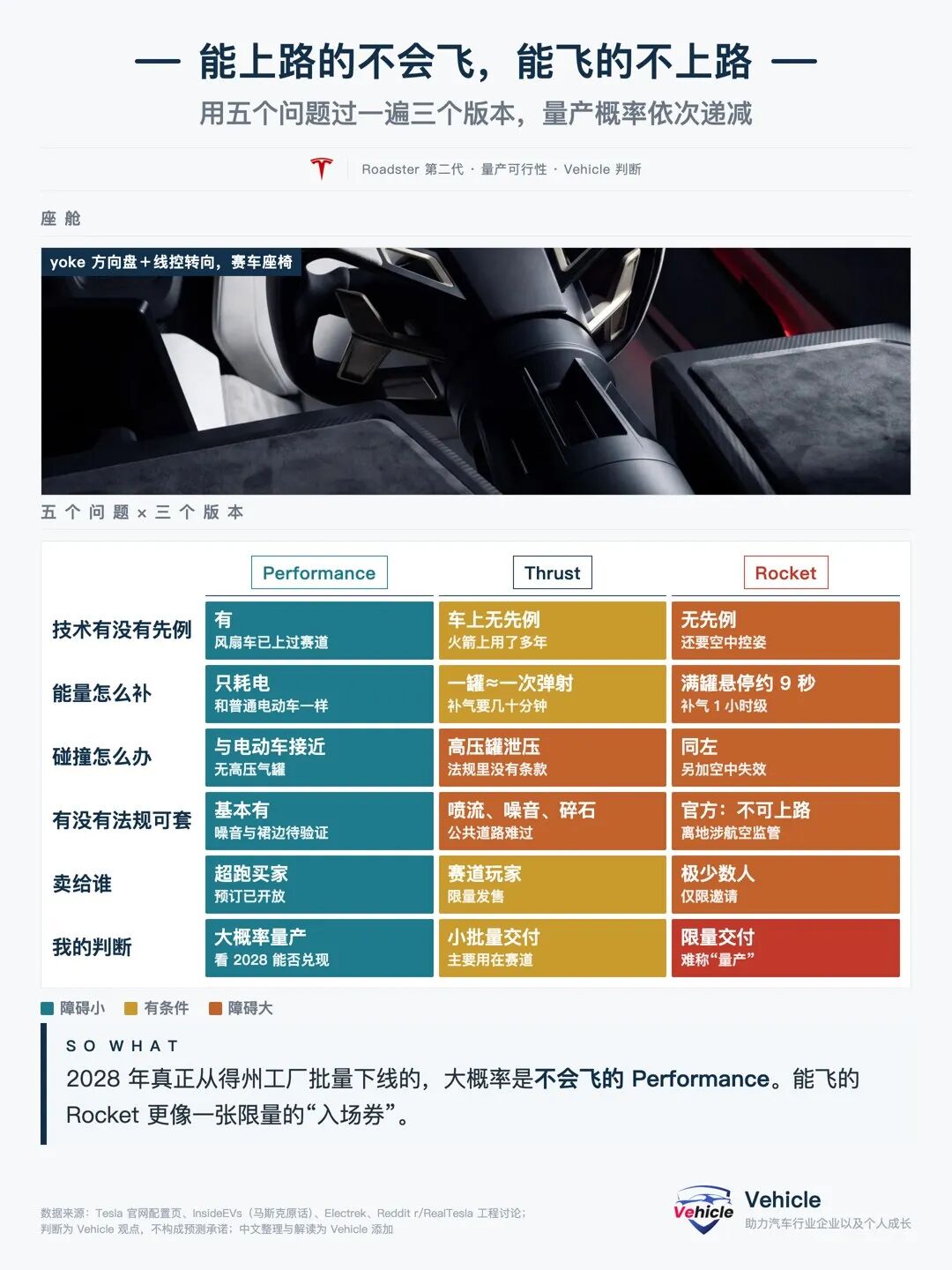
To judge whether a 'black tech car' can be mass-produced, ask these five questions first. You can use this framework directly:
5 questions to judge if a black tech car can be mass-produced
1. Is there a precedent in technology: Have other cars or industries successfully implemented this?
2. How is energy replenished: How long does it take to recharge, and how much does it cost?
3. What about collisions: How is the most dangerous component handled in an accident?
4. Are there applicable regulations: Can existing certification clauses be directly applied?
5. Who is the buyer: How many units can be sold annually, and can it support a production line?
01 Performance: Highly likely to be mass-produced
It's just an electric supercar with fans for ground effect. Fan cars have raced before, it only uses electricity, has no high-pressure gas tank, and existing regulations mostly apply.
The only variable is time. Roadster deliveries have been delayed at least eight times since 2017. I'm skeptical about the 2028 deadline.
02 Thrust: Small-batch delivery, mainly for racetracks
The official site doesn't say if Thrust is road-legal, but I'm not optimistic.
The jet stream in demos extended dozens of meters, kicking up road debris that could hit following cars and pedestrians. The noise from high-pressure gas would also struggle to meet noise regulations.
There's no existing provision in vehicle regulations for how a ≈690 bar gas tank should vent in a collision. Engineers on Reddit listed a bunch of FMVSS issues, concluding with 'No way this can be legally road-worthy.'
03 Rocket: Limited delivery, hardly mass-produced
The official site is clear: By invitation only, single-seat, not approved for public road use.
Moreover, once it leaves the ground, it falls under aviation regulations. The FAA's existing power lift rules are written for eVTOLs, not 'jumping sports cars.'
When pressed by the audience about road legality, Musk replied, 'Depends on what roads you have at home,' adding, 'Not sure it's legal everywhere.'
Then there's the human factor. The demo car was unmanned. The angular velocity during aerial flips would be extremely challenging for ordinary people—something fighter pilots train years for.
So my judgment is simple: The road-legal version won't fly, and the flying version won't be road-legal. The Performance version that actually rolls off the Texas factory line in 2028 will most likely be the non-flying one.
07 If mass-produced, where would the scenarios be?
Flying won't become common, but it will change how supercars compete
Assuming the Rocket version is actually delivered, where would it appear? I can think of four scenarios.
Scenario 01 Private racetracks and clubs
This is Thrust and Rocket's home field. McMurtry's fan car also took the track-only route, letting owners play in closed venues to avoid road legality issues.
Scenario 02 Film, advertising, and brand performances
Musk said at the launch he wants it to fly over Idaho's Snake River Canyon. Such visuals are perfect for movies and events.
Scenario 03 Collectibles
In 2017, someone paid $250,000 to pre-order 1,000 limited-edition Founders Series models. These people waited nine years, never buying a commuter car.
Scenario 04 Technology validation platform
SpaceX's propulsion, Optimus' actuators, and Tesla's steer-by-wire can all gather real-world data through this car.
As for its impact on the automotive market, let's break it down.
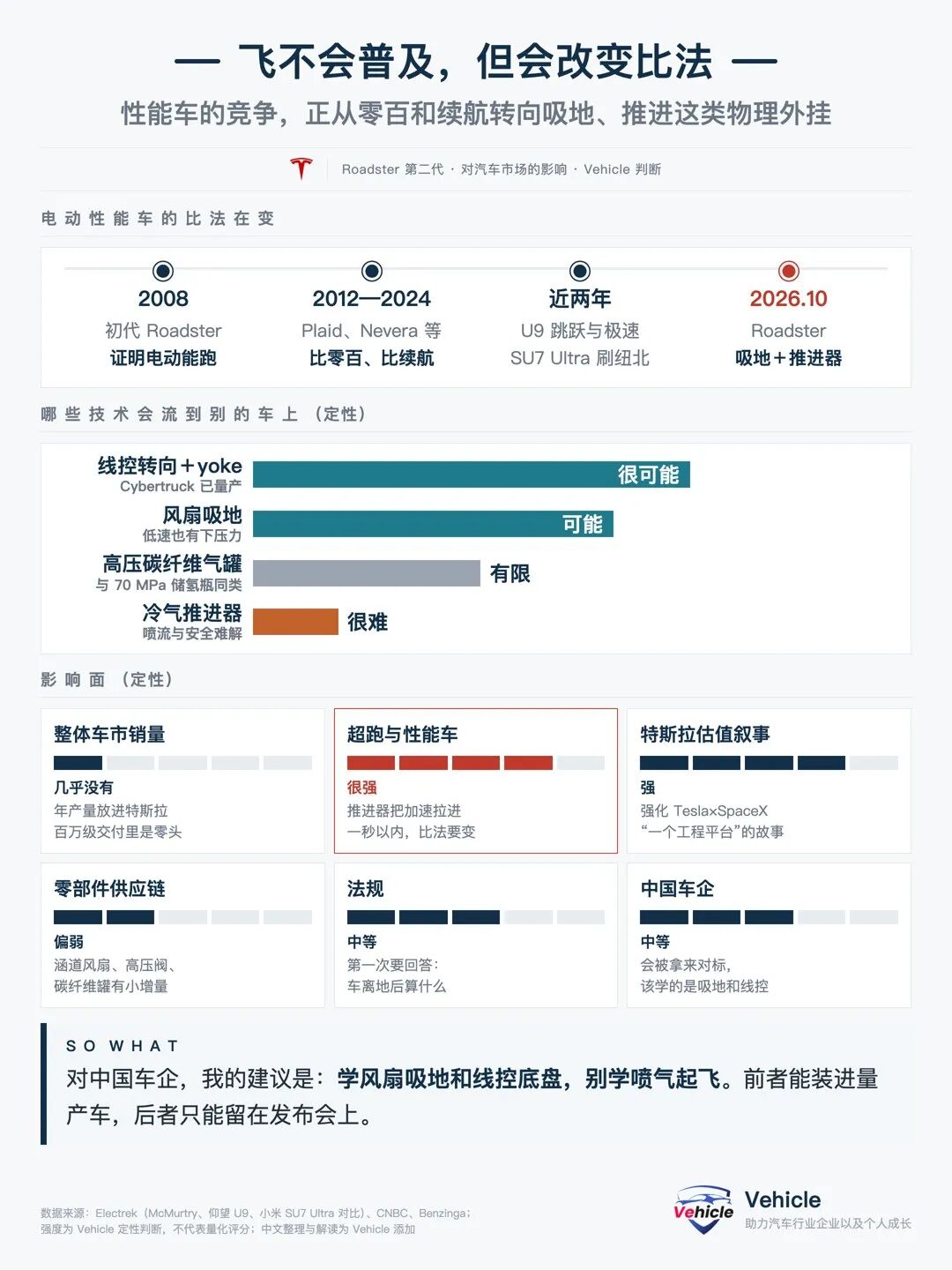
On the overall auto market: Almost none
My view is that Roadster won't materially impact Tesla's financials—it's too niche. Even selling thousands annually would be a rounding error in Tesla's 1M+ annual deliveries, let alone the entire market.
On supercars and performance cars: Huge impact
Electric performance cars have recently competed on 0-60 times and range. The Rimac Nevera R does 0-60 in 1.72 seconds, the look up at U9 can jump and holds a 496 km/h speed record, and the Xiaomi SU7 Ultra set a Nürburgring lap time.
After thrusters push 0-60 below 1 second, tire adhesion is no longer the acceleration limit—the rules change. Ground effect and thrust 'cheats' will become the next selling points for supercars. Dreame previously proposed a solid rocket-boosted supercar but canceled it. Honestly, Dreame, which makes high-speed motors, missed this segment—otherwise, they could've stood out too.
On the supply chain: Small incremental demand
Ducted fans, high-pressure valves, carbon fiber-wrapped gas tanks, and steer-by-wire will see new demand. Carbon fiber high-pressure tanks share technology with 70 MPa Type IV hydrogen storage tanks—domestic hydrogen tank companies already have the foundation.
On regulations: Forced to answer for the first time
Is a car that leaves the ground still a car or an aircraft? No one needed to answer before, but now that someone's making it a selling point, regulators will probably have to consider it.
On Chinese automakers: Will be used as a benchmark
Expect to hear 'Can your car do inverted flight?' at upcoming auto shows.
My advice: Learn from fan-based ground effect and steer-by-wire, not jet takeoffs. The former fits into mass-produced cars; the latter stays in launch events.
08 Final thoughts
Demos and deliveries are two different things
After watching the entire launch event, my biggest takeaway is: Tesla knows exactly how to make people remember a car.
Nine years of delays, countless mockeries, and one 30-minute aerial flip turned the narrative around. This alone is worth studying for every automotive marketer.
But for car builders, demos and deliveries are two different things. The first Roadster rolling off the Texas factory line in 2028 matters far more than this aerial flip.
Remember these three facts
1. The road-legal version is Performance; the flying version is Rocket. They're not the same car.
2. One launch ≈ one tank of gas. Nine seconds of flight requires ≈60 kWh to recharge.
3. Fan-based ground effect will trickle down; jet takeoffs will stay on racetracks.
That's all for today. If you found this useful, please like, share, and tap 'Insightful.' Also, welcome to discuss your thoughts in the comments.
*Unauthorized reproduction or excerpting strictly prohibited-
-
![]()
Major Breakthrough for Luxeed! Chery Takes a Daring Step
-
![]()
Collective Negative Growth in Metropolises: Beijing, Shanghai, Guangzhou — Who’s Behind the Slump in Car Sales?
-
![]()
TECNO’s AI Strategy: Not a Tool for Price Increases
-
![]()
Douyin Catches Up with Meituan, Then Local Life Services Begin to Compete on 'Internal Strength'
-
![]()
AI Won't Rebel, It Just Bypasses You
-
![]()
iPhone Duo: Pre-sale Sells Out in a Flash, Resale Prices Skyrocket by Up to 7,000 Yuan
-
![]()
The Most Critical AI Trends for 2027: Not About New Models, But About 'Outcomes'
-
![]()
Tesla can fly, but among the three versions of the Roadster, I only have high hopes for the one that doesn't fly.