TECNO’s AI Strategy: Not a Tool for Price Increases
 10/19 2026
 349
Produced by | RoboIsland
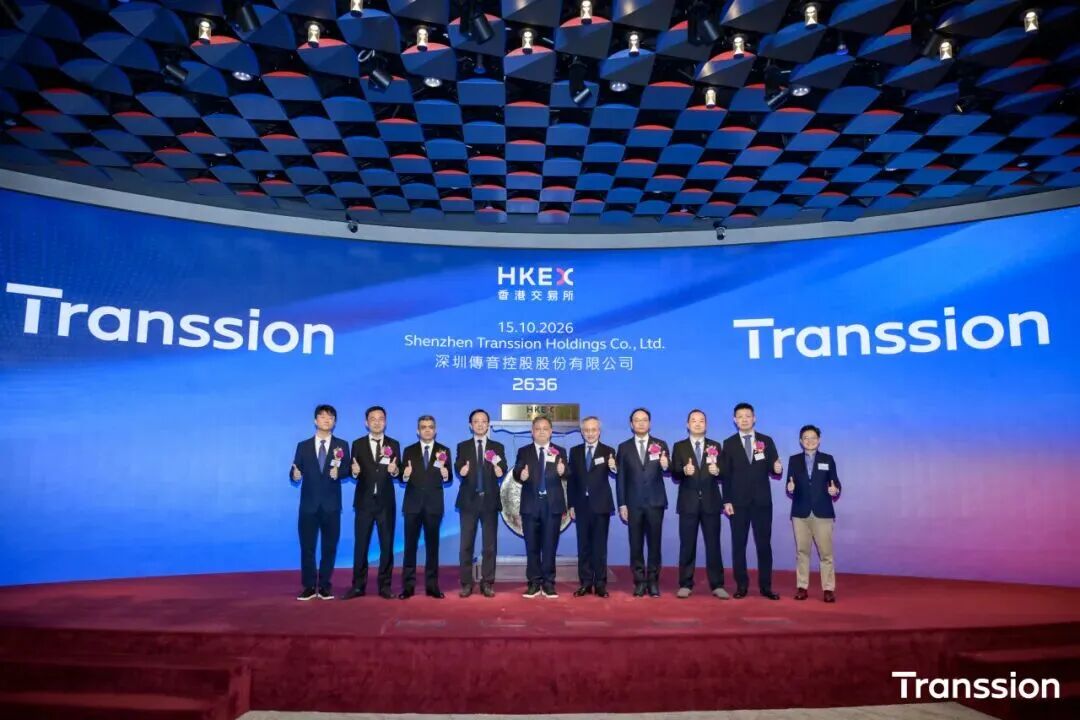
On October 15, TECNO made its debut on the Hong Kong Stock Exchange. The issue price was positioned at the lower end of the indicative range, and the stock fell below its issue price on the first trading day, closing 5.72% lower.
A company that commands a 50% market share in Africa’s mobile phone sector witnessed capital markets react with a downward trend.
Several factors have been cited to explain the stock’s underperformance: escalating memory chip prices, reliance on low-cost inventory timing for profitability, a shrinking African market base, and the limited immediate impact of AI.
However, it’s crucial to shift our focus from “what TECNO did wrong” to a more fundamental issue: TECNO’s position in the supply chain restricts its ability to transfer upstream cost increases downstream.
TECNO sells 20% of smartphones in emerging markets but captures only 4.7% of the revenue. Its slim per-unit profit margins leave little room to absorb upstream volatility. When AI-driven demand for storage reallocates scarce upstream resources, TECNO’s “low-price, high-volume” business model faces an unsustainable cost structure.
This highlights a disconnect between AI’s actual economic role at TECNO and the narrative assigned to it—a gap that warrants serious attention.
1. Squeezed at Both Ends of Cost Pass-Through
Rising memory costs are not unique to TECNO.
In the first four months of 2026, memory chips accounted for 48.4% of TECNO’s sold inventory costs, up from 20.9% in 2023, surpassing SoCs and screens as the most expensive component.
Yet the same cost pressures affect manufacturers differently: Apple raised flagship phone prices by 1,000 yuan without deterring buyers, Samsung offset part of the increase through its in-house memory production, while TECNO’s mainstream models rely on LPDDR4X—a previous-generation memory type that manufacturers began phasing out due to strong demand from AI data centers and premium smartphones.
In a seller’s market for memory, TECNO lacks pricing power and must accept procurement costs dictated by upstream capacity allocation. Negotiating better terms is unlikely.
TECNO’s options were limited: raise prices, reduce entry-level models, or accept near-breakeven margins on low-end devices.
It chose the first two strategies, resulting in a 14% year-over-year decline in African shipments and a drop in market share from 51% to 47%. A company that dominates its core market was forced to retreat from its strongest price segment due to cost pressures.

Source: TECNO Official Website
However, focusing solely on memory overlooks faster-moving variables like patent licensing costs, which are harder to avoid.
As TECNO expanded from a regional African vendor to the world’s third-largest phone maker, entering South Asia, Southeast Asia, the Middle East, and Latin America, pressure for standard essential patent (SEP) licensing negotiations increased across multiple markets.
TECNO has secured licensing agreements with major rights holders like Qualcomm, Philips, and Nokia, and resolved disputes with Ericsson in 2026 through cross-licensing.
While this ensures compliance, each license introduces new, ongoing fixed costs tied to shipment volumes—unavoidable like memory costs but unaffected by product mix adjustments or memory cycle fluctuations. Memory impacts quarterly gross margins; patent fees erode the already thin profit per phone.
Unable to pass upstream costs downstream or avoid downstream regulatory costs, price increases become the only option. However, raising prices requires brand premium, which demands product differentiation—hence, TECNO’s narrative pins differentiation on AI.
2. Trapped in Premium Dilemma
Viewing AI within Africa’s unique constraints reveals a disconnect from funding narratives.
Omdia’s March 2026 African AI roadmap highlights a fact systematically overlooked in global AI discourse: emerging market AI is not a scaled-down version of mature market AI.
Global AI assumes cloud-first infrastructure, infinite connectivity, and flagship-level computing power; Africa faces unstable networks, high data costs, and a dominance of entry-level devices.
Omdia identifies three engineering bottlenecks: (1) cloud-dependent AI fails offline, requiring offline-first architectures; (2) models with over 7 billion parameters struggle on low-RAM chips, demanding extreme model quantization and SoC co-optimization; (3) global models “hallucinate” on African languages and dark-skinned scenarios, necessitating proprietary African datasets.
TECNO’s allocation of 40% of proceeds to on-device small models, offline speech recognition, and minority language support aligns technically with these constraints.
Source: TECNO Official Website
Precisely because this is Africa’s universal tech path, it hardly serves as a differentiated premium source—any vendor selling phones in Africa must eventually follow suit. Thus, on-device AI resembles a market entry requirement more than a proprietary edge.
TECNO’s tech stack reflects this: the Ella assistant integrates Gemini for multimodality, Tongyi Qianwen for on-device offline processing, and Azure Speech for multilingual support, with TECNO’s team handling local adaptation.
In 2025, TECNO processed over 500 million AI requests, over half in non-English interactions, with Hausa support leading the industry. This “global model + local adaptation” architecture accumulates minority language voice data, improves African accent recognition accuracy, and gains low-compute deployment experience—what Omdia calls the “African data moat.”
In a world of converging models, ownership of locally relevant data and lowest-cost deployment grants bargaining power.
Yet this barrier’s commercial ceiling is visible: it enables better experiences at the same hardware cost but struggles to persuade price-sensitive users to pay significantly more for “better experiences.”
The prepaid, price-sensitive African market clashes with subscription monetization models. Mainstream smartphone prices typically stay below $200, creating tension with per capita income levels and making AI hard to sell as a premium feature.
3. AI: Cost or Investment?
If AI cannot help sell phones at higher prices, does allocating 40% of proceeds to it lack commercial logic?
Not necessarily. TECNO’s mobile internet services—a “high-margin, low-ARPU, limited-scale” business—generated 942 million yuan in 2025 (1.4% of revenue, ~80% margin), primarily from ad distribution and pre-installs.
This is fundamentally a traffic distribution business, not transaction-based or subscription-driven. Here, AI’s direct role is clear: sharper ad targeting, higher pre-install conversion, and offline voice assistant availability in unstable networks—all enhancing the value of over 300 million MAU ad inventory and retaining paying users.
A more honest metric than ARPU supports this: retention rates. TECNO’s paying customer retention rose from 46% in 2023 to 53% in 2025.
Lower customer service costs, reduced churn, and precise content distribution—AI’s efficiency gains ultimately reflect in this indicator.
Thus, TECNO need not prove AI can boost a ~3 yuan annual ARPU user to 5 yuan (nearly impossible in Africa’s user structure). It must show that when hardware sales falter, AI can prevent the 300 million MAU base from shrinking alongside hardware—making the 40% AI allocation commercially justifiable.

Source: TECNO Official Website
Moreover, AI could upgrade TECNO OS from “pre-installs and ad distribution” to a “transaction gateway.” At MWC 2026, TECNO demonstrated AI-driven direct purchases of data plans, ride-hailing, and food ordering—logically sound: if AI assistants understand intent and complete transactions, TECNO shifts from “selling traffic” to “facilitating transactions and taking cuts,” a monetization efficiency leap.
Yet this path depends on local service ecosystem density and digital payment infrastructure maturity—areas where TECNO’s public progress remains insufficient to prove it has crossed the “gateway” threshold.
This brings us back to the stock’s underperformance. The market’s true uncertainty lies not in “whether TECNO should pursue AI” but in whether this spending represents a cost or an investment.
If AI merely maintains distribution efficiency and retention in a ~3% paid-rate, ultra-low-ARPU pool, it resembles maintenance capex—delaying existing business decline and offsetting hardware-driven user churn without altering TECNO’s valuation framework. Only if AI unlocks transaction gateways does it become true growth investment.
4. Conclusion
AI is narratively tasked with “helping TECNO navigate cost impacts.”
TECNO need not force a “mid-to-high-end + AI premium” narrative to override fundamental constraints of a business with an extremely low price ceiling. Nor must it abandon AI—just demonstrate quantifiable efficiency gains, e.g., marginal retention improvements, MAU resilience amid hardware declines, and stable internet service margins.
The stock’s underperformance corrects the misalignment between narrative and structure. When a company’s cost pass-through space is severely constrained in the supply chain, capital markets demand narratives align with structural realities.
Cover Source: Parasite
Header Image Source: TECNO
Disclaimer: This article is for reference only and does not constitute investment advice. Investors act at their own risk.
© RoboIsland. All rights reserved. Unauthorized reproduction prohibited.
-
![]()
Major Breakthrough for Luxeed! Chery Takes a Daring Step
-
![]()
Collective Negative Growth in Metropolises: Beijing, Shanghai, Guangzhou — Who’s Behind the Slump in Car Sales?
-
![]()
TECNO’s AI Strategy: Not a Tool for Price Increases
-
![]()
Douyin Catches Up with Meituan, Then Local Life Services Begin to Compete on 'Internal Strength'
-
![]()
AI Won't Rebel, It Just Bypasses You
-
![]()
iPhone Duo: Pre-sale Sells Out in a Flash, Resale Prices Skyrocket by Up to 7,000 Yuan
-
![]()
The Most Critical AI Trends for 2027: Not About New Models, But About 'Outcomes'
-
![]()
Tesla can fly, but among the three versions of the Roadster, I only have high hopes for the one that doesn't fly.