Collective Negative Growth in Metropolises: Beijing, Shanghai, Guangzhou — Who’s Behind the Slump in Car Sales?
 10/19 2026
 403
Written by | Guanchejun
The Luster Fades from the 'Golden September'.
Recently, the China Automobile Data Research Institute unveiled the car sales rankings for September and the cumulative figures from January to September across various cities. The much-anticipated 'Golden September, Silver October' period has witnessed a premature faltering of the 'golden' phase.
Let's delve into the monthly data first.
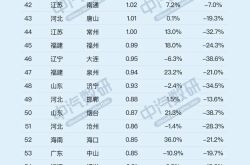
In September, Shanghai reclaimed the top spot with 51,800 units sold, marking a 4.7% year-on-year decrease. It stands out as virtually the sole first-tier city to have successfully 'stemmed the bleeding'. Chengdu followed closely with 48,600 units sold, but experienced a steep 30.5% year-on-year decline. Guangzhou recorded sales of 44,100 units, down 28.7% year-on-year, while Beijing sold 43,200 units, representing a 24.6% year-on-year decrease.
Moreover, nearly 40 cities, including Wuhan, Qingdao, and Nanjing, witnessed year-on-year sales declines exceeding 30%.

Now, let's shift our focus to the cumulative rankings from January to September. Chengdu emerged as the leader with 393,200 units sold, surpassing Shanghai's 389,500 units. However, this 'championship' came with a 17.4% year-on-year decline.
Among the top ten cities — Chengdu, Shanghai, Beijing, Guangzhou, Hangzhou, Zhengzhou, Chongqing, Suzhou, Shenzhen, and Wuhan — none experienced year-on-year growth. Zhengzhou's cumulative sales plummeted by 22.3%, Wuhan's by 29.8%, Xi'an's by 24%, and Tianjin's by 22.2%.
The nation's dozen or so most pivotal automotive consumption hubs have collectively witnessed negative growth.

So, where have all the sales vanished? In Guanchejun's perspective, they have likely been overdrawn. From 2024 to 2025, a confluence of trade-in subsidies, replacement subsidies, and new energy vehicle purchase tax exemptions has preemptively fulfilled the car purchase demand for the next two to three years.
Public data reveals that the total number of trade-ins in 2025 surpassed 11.5 million, with over half of domestic retail participants involved. By 2026, the combination of policy rollbacks and the overdraft effect will create a demand vacuum, signaling the end of the dividend period for this round of policy-driven market boom.
Dialectically speaking, this may not be entirely negative: Prosperity fueled by subsidies does not reflect genuine market demand. Sales figures, once the 'water' is squeezed out, represent the true foundation of China's auto market.
Another question arises: Why did Chengdu top the list instead of Shanghai?
From January to September, Chengdu surpassed Shanghai, a scenario interpreted by many as the ascent of 'new first-tier cities.' However, in Guanchejun's view, Chengdu's growth trajectory stems from its vast population base and the siphoning effect of being a regional hub, concentrating auto purchase demand from across the southwest into a single city.
Shanghai, boasting one of the highest new energy vehicle penetration rates in the country, has already witnessed a significant release of replacement demand in the early stages, with its market nearing saturation — most eligible vehicles have already been replaced.
Thus, Chengdu's rise to the top is not indicative of it becoming stronger, but rather Shanghai having 'exhausted its inventory.' The ceiling for a city's auto sales precisely reflects the maturity of its automotive civilization. Shanghai's 4.7% year-on-year decline in September, despite a notable month-on-month increase, confirms this: its foundation remains robust, but it was consumed prematurely.
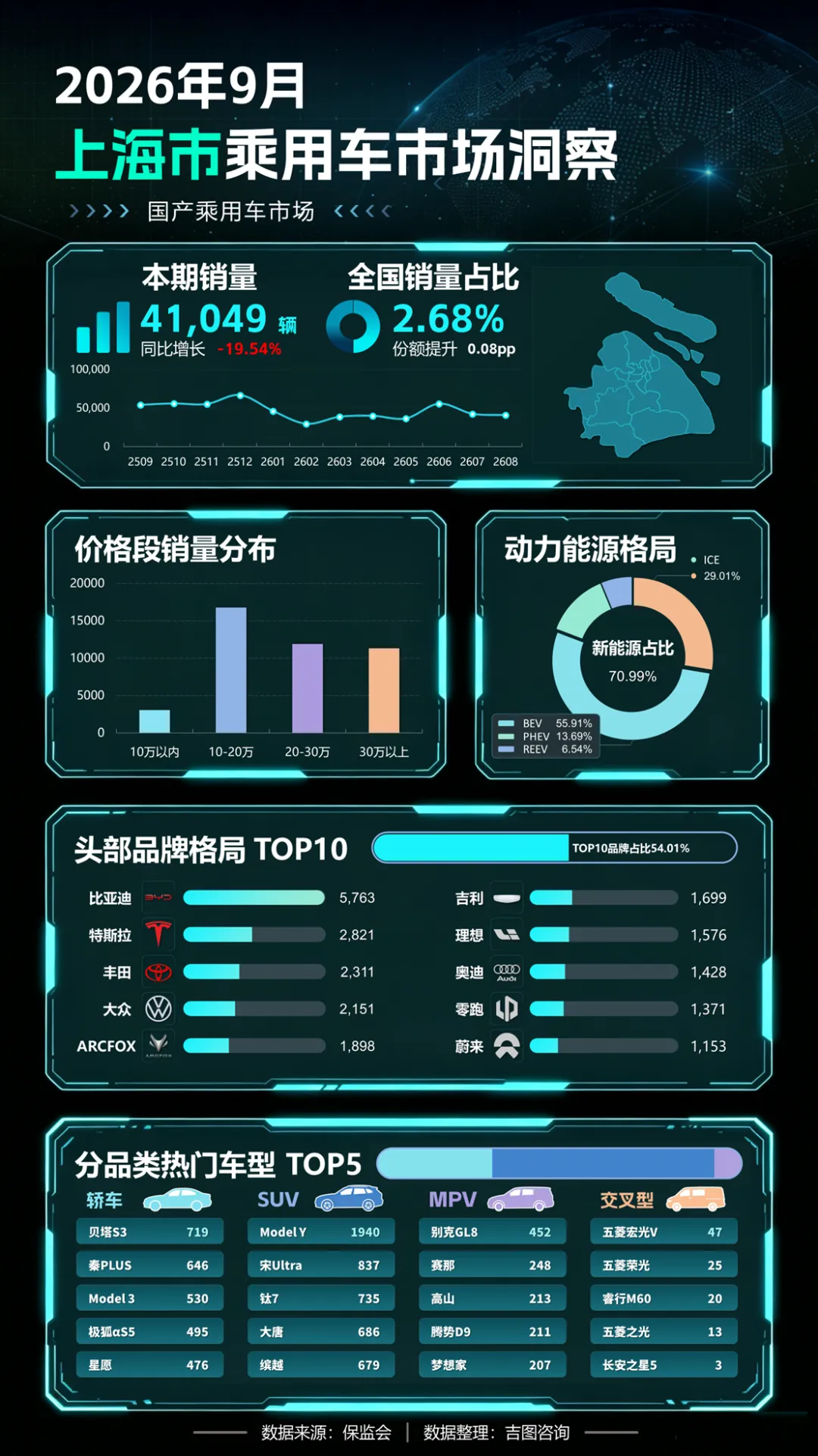
The final question pertains to cities experiencing 30% sales declines: What went awry? Guanchejun observes that these cities share a common characteristic: Their markets are predominantly mid-range and highly sensitive to policy subsidies and price wars.
Price wars have disrupted the pricing system for new cars, fostering a wait-and-see attitude among consumers. Cities more reliant on 'cost-effective purchases' have witnessed the most pronounced hesitation. Repeated price cuts have reinforced the expectation that 'waiting will lead to even lower prices,' prolonging the transaction cycle.
Another contributing factor is the impact on fuel vehicles. As of the September 24 price adjustment, domestic gasoline prices have risen by a cumulative 2,375 yuan per ton this year, equating to an increase of approximately 1.9 to 2.03 yuan per liter. When fuel prices surge, the first to hesitate are cost-conscious buyers in the mid-range market.
Overall, China's auto market is undergoing a painful transition from 'policy-driven' to 'product-driven' growth, weeding out speculators and leaving genuine players. Therefore, instead of betting on the next subsidy policy, focus on enhancing your own products.
Charts in this article, unless cited, are sourced from publicly disclosed information across various channels. This is stated here in acknowledgment. The views expressed herein are for reference only and do not constitute investment advice.
This article is original content from Leverage Auto Observations and is prohibited from reproduction without authorization. For reproduction, please obtain authorization. Additionally, when authorized for reproduction, please indicate the source and author at the beginning of the article. Thank you!
-
![]()
104th in Ultrafast Nonlinear Optics: Mid-Infrared Dual-Comb Spectroscopy and Compressive Sensing Sampling
-
![]()
Delving into AI-Native Smartphones with the Release of STEPX Neo
-
![]()
Major Breakthrough for Luxeed! Chery Takes a Daring Step
-
![]()
Collective Negative Growth in Metropolises: Beijing, Shanghai, Guangzhou — Who’s Behind the Slump in Car Sales?
-
![]()
TECNO’s AI Strategy: Not a Tool for Price Increases
-
![]()
Douyin Catches Up with Meituan, Then Local Life Services Begin to Compete on 'Internal Strength'
-
![]()
AI Won't Rebel, It Just Bypasses You
-
![]()
iPhone Duo: Pre-sale Sells Out in a Flash, Resale Prices Skyrocket by Up to 7,000 Yuan