Douyin Catches Up with Meituan, Then Local Life Services Begin to Compete on 'Internal Strength'
 10/19 2026
 550
From Inspiration to Fulfillment: A Shift in Douyin's Local Life Services
Just after the Double Festival, Douyin Life Services released the <2026 Mid-Autumn Festival and National Day Consumption Report>. Group-buying order volume increased by 53% year-on-year, with Catering (catering) orders rising over 61%, Wine Travel (travel and hospitality) orders growing by 42%, and hotel and guesthouse orders approaching 79%.
Viewing these figures alongside industry trends this year, one clear impression emerges: the approach to local life services has indeed changed.
The report also highlights two interesting growth figures: for deep travel experiences of 5 days or more, group-buying sales increased by 51% year-on-year; for pure play small group tours and private tours, group-buying sales grew by 70%. These orders share a common trait: users first decide where to go, what to eat, and how many nights to stay before opening the platform to find group-buying deals and place orders.
This is markedly different from the path of 'seeing a video and casually snapping up a voucher' seen a couple of years ago. The report sets the tone for this round of consumption: deep experiential consumption has become mainstream, with consumers increasingly purchasing 'an experience' during holidays.
This report aligns with a broader context.
In 2025, Douyin's in-store payment GTV (pre-redemption basis) reached 800 billion yuan; in the first half of 2026, it exceeded 600 billion yuan, with a full-year projection of 1.2 trillion yuan. Meanwhile, Meituan's in-store GTV was estimated by Nomura to be 1.18 trillion yuan in 2025 and approximately 1.3 trillion yuan in 2026.
To some extent, Douyin has turned 'catching up' into a reality within two years.
After achieving parity in scale, the industry's concerns have shifted. The question used to be, 'Can Douyin's traffic translate into business?' Now, a more pertinent question is: when growth no longer relies primarily on traffic dividends, how should local life services compete?
01 From 'Stumbling Upon' to 'Searching For': After the Peak of Impulse Consumption
Douyin's local life services initially relied on content inspiration to drive impulse purchases. Short videos excel at sparking 'spur-of-the-moment' demands—a meal, a show, a last-minute weekend getaway—prompting immediate purchases upon viewing.
A common scenario: late at night, stumbling upon a restaurant exploration video, casually buying a 69-yuan Double meal voucher (coupon for two) that then quietly sits in the order list until an expiration reminder pops up.
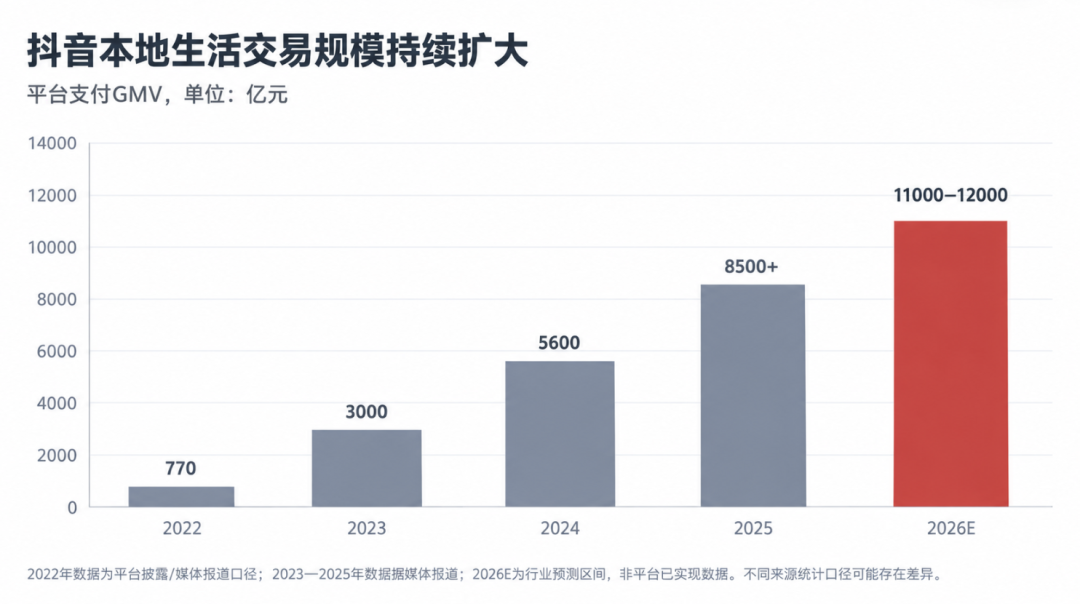
The efficiency of this path corresponds to a steep growth curve: the platform's local life services GMV rose from approximately 77 billion yuan in 2021 to 300 billion yuan in 2023, about 560 billion yuan in 2024, and exceeded 850 billion yuan in payment GMV in 2025, a 59% year-on-year increase—more than tenfold growth in four years.
However, under the impulse purchase model, redemption rates must be considered. Nomura estimates Douyin's local life services redemption rate at 40-50%, meaning a significant portion of orders remain 'purchased' without progressing to 'visited.'
Unused vouchers represent an inherent cost of content-driven platforms: users purchase based on emotions sparked by content, often without a formed consumption plan. The redemption rate hurdle also reflects the efficiency gap between content-driven and shelf-driven platforms—for a voucher sold, shelf-driven purchases typically involve users with clearer consumption intentions.
In 2026, the platform's efforts can be summarized as shifting the growth engine from 'content reach' to 'intention fulfillment.'
Several signals emerge when viewed together. Huang Wenjie, head of Douyin Life Services' KA Fast Food & Snack industry, disclosed at an industry conference that platform search GMV increased by 55% year-on-year in 2026. Search indicates users arrive with clear intentions, actively seeking stores, comparing prices, and placing orders—a classic 'human-to-goods' scenario.
This year, Douyin's fast food and snack category transaction volume increased by 114% year-on-year, with a 155% increase in merchant count—high-frequency, essential categories forming the foundation. Such consumption relies heavily on search and repurchase, not on a single viral video.
The dual-track distribution model is also altering merchant operations. Previously, succeeding on Douyin meant investing in content and influencers to make a video go viral; now, managing in-store search entry points, group-buying packages, reviews, and redemption experiences is equally crucial. The platform's role is shifting from 'helping merchants make a one-time sale' to 'helping merchants run a store.'
The transaction structure is also evolving. According to publicly disclosed information, travel and hospitality's share of Douyin Life Services GTV has risen to approximately 35%, with products like 'calendar hotels' transforming 'voucher hoarding' into 'reservations'—users select dates to lock room availability, providing merchants with more certain schedules and enabling the platform to forecast supply. Reserved orders naturally align more closely with actual in-store consumption than impulse-purchased vouchers.
The ceiling of impulse consumption becomes clear from growth curves. By 2025, content-driven platforms had largely exhausted incremental demand; to continue growing, they must capture users who already intended to consume.
02 Doushengsheng: Creating a Separate Transaction Field Beyond the Main App
The most visible move in shifting strategies is the launch of the independent app Doushengsheng this year.
QuestMobile data tracks its growth: within two months of launch, monthly active users reached 22.42 million, with 7.96 million daily active users; by May 10, daily active users approached 16 million; by June 30, they reached 21.03 million, continuously narrowing the scale gap with Dianping. This growth rate places it among the top tier of consumer apps launched in the same period.
Doushengsheng's product form differs significantly from Douyin's main app.
Its homepage features discounts and vouchers, with the second page dedicated to redemption codes. Absent are short video feeds; its core functions are fourfold: finding vouchers, comparing prices, placing orders, and redeeming them. It functions as a shelf, not a content engine. Its initial market success came from lower-tier cities—launching with subsidies and low prices, data from March shows 67.3% of users in second-tier and lower cities, later expanding to high-tier cities like Shanghai.
Why create a separate shelf?
To understand this move, one must first recognize the boundaries of Douyin's main app. The main app serves as a traffic engine and inspiration field, converting 'non-consumers' into consumers; however, users engage with the main app for 'content viewing,' resulting in longer transaction paths. Planned consumption—such as dining with guests next weekend or booking hotels for holidays—lacks a clean fulfillment venue within the main app.
Doushengsheng fills this gap: separating interest stimulation from transaction completion, delegating the former to content and the latter to the shelf.
Isolating the transaction field also serves a practical purpose: the main app's information flow ecosystem cannot withstand constant disruption from group-buying features; an independent app can freely implement price comparisons and redemption reminders, fully optimizing 'savings.'
More subtly, it links with the main app—service providers note that user tags from Douyin's main app also influence recommendation rankings in Doushengsheng. Intentions accumulated through main app inspiration are fulfilled in the shelf field.
According to public reports, Doushengsheng's daily active users continued to grow slightly in July, reaching approximately 22.6 million, though growth slowed as subsidies decreased and commissions increased.
However, this slowdown does not constitute a loss of momentum. ByteDance's 2026 target for life services is to surpass Meituan in transaction volume and achieve overall profitability—the growth narrative is giving way to an operational narrative. User scale acquired through subsidies must ultimately be sustained naturally.
03 After Catching Up, the Competition Lies in Fulfillment
One fact easily overlooked: parity in pre-redemption transaction scale does not equate to business parity, given the redemption rate gap. Douyin's redemption rate stands at 40-50%, while Meituan's in-store redemption rate is notably higher. This gap represents a lesson both sides are now learning.
Douyin is enhancing certainty. At this year's open day, the platform disclosed that its 'Peace of Mind' series now covers 11 categories, with over 218,000 qualified high-quality merchants signed, serving 180 million consumers and accumulating 650 million 'peace of mind' orders. In the first half of the year, 436 new commercial complexes joined, with payment GMV increasing by 240% year-on-year and related content accumulating 56 billion exposures.
Slow-building efforts in merchant operations, consumer trust, and offline fulfillment are replacing subsidies as new growth drivers for the platform. According to media reports, Douyin Life Services had 15.198 million active merchants in 2025, with 3.99 million new merchants joining—the supply foundation is laid, and the next challenge is operating each store effectively.
Meituan is enhancing content. Addressing its short video content weakness, Meituan built an official live streaming matrix, supplementing content supply with hit columns; on the supply side, it stabilized the dining foundation with innovative offerings like branded satellite stores and 'Pinghaofan'; this year, it acquired Dingdong Maicai's China business to strengthen front-end warehouse supply chains; drone delivery has become routine in multiple cities. In 2025, Meituan's full-year revenue reached 364.9 billion yuan, with core local commerce revenue at 260.8 billion yuan—its financial foundation remains solid.
The competition's scope is also expanding. A QuestMobile mid-year report judges that local life services are evolving from in-store group-buying to 'comprehensive consumption portals,' with blurring boundaries between instant retail, food delivery, and in-store services. Meituan connects front-end warehouses, lightning warehouses, and drones into a fulfillment network, while Douyin deepens categories like travel and supermarket shopping vouchers beyond in-store services. Both are moving toward becoming total entry points for users' daily consumption.
Downstream of this competition lies an entire service provider ecosystem: agency operations, exploration influencers, SaaS tools, and supply chain services. Each platform strategy shift reshuffles roles within this chain.
An industry backdrop exists: in 2025, the local life services sector completed a full cycle of 'competition escalation—regulatory talks—platform self-regulation—subsidy decline'; entering 2026, regulation shifted from talks to institutionalized governance, with subsidy declines becoming the norm. The window for scaling through burning money has closed, with competition now focusing on fulfillment efficiency, merchant supply, and user experience.
Viewing these factors together, the competition logic in local life services has changed: from 'capturing entry points' to 'competing on fulfillment,' stably converting content-driven traffic into in-store visits, repurchases, and merchant operational efficiency.
Douyin is making its transaction structure more Meituan-like, while Meituan is enhancing its content capabilities closer to Douyin's. The two companies are mutually cramming (learning from each other), and the industry is maturing through the intersection of their strategies.
For merchants, this may be the best news in recent years: platforms no longer offer a single choice, and operations can align with both logic sets. For users, competition focused on service itself means prices and experiences will be taken seriously together.
The significance of this strategy shift also lies in relocating the industry's benchmark from traffic to business. Catching up is merely a milestone; the mutual calibration of the two approaches is what truly propels local life services into a phase of competing on operational capabilities.
— END —
-
![]()
Major Breakthrough for Luxeed! Chery Takes a Daring Step
-
![]()
Collective Negative Growth in Metropolises: Beijing, Shanghai, Guangzhou — Who’s Behind the Slump in Car Sales?
-
![]()
TECNO’s AI Strategy: Not a Tool for Price Increases
-
![]()
Douyin Catches Up with Meituan, Then Local Life Services Begin to Compete on 'Internal Strength'
-
![]()
AI Won't Rebel, It Just Bypasses You
-
![]()
iPhone Duo: Pre-sale Sells Out in a Flash, Resale Prices Skyrocket by Up to 7,000 Yuan
-
![]()
The Most Critical AI Trends for 2027: Not About New Models, But About 'Outcomes'
-
![]()
Tesla can fly, but among the three versions of the Roadster, I only have high hopes for the one that doesn't fly.