Yuanbao Search Undergoes a Significant Upgrade! Tencent Keeps Investing in AI Search, But What Are Its Real Intentions?
 10/21 2026
 500
Giants Clash: Outcomes Take Center Stage
Using Yuanbao to stay updated on the latest news, relying on WorkBuddy to gather information and accomplish tasks... Many individuals have grown accustomed to delegating their online searches and tasks to AI. However, many of the Tencent AI products we utilize daily actually hinge on the same fundamental search capability—Yuanbao Search.
On October 20, Tencent unveiled a comprehensive upgrade to 'Yuanbao Search' and made it accessible to enterprises and individual developers through Tencent Cloud. In addition to offering a trillion-level index and encompassing 157 authoritative sources across 13 industries, Tencent has also overhauled the search's comprehension, ranking, and underlying architecture using advanced large models. The objective is to enhance the accuracy and reliability of search results while minimizing response times and call costs.
Becoming the 'Reliable External Brain' in the Age of Large Models
At a media briefing attended by Leitech in the afternoon, Ma Jin, Vice President of Tencent Cloud and Head of Yuanbao Search R&D, stated that search is undergoing a profound transformation: 'The users of search have transitioned from humans in the 1.0 era to intelligent agents in the 3.0 era.' As agents begin to dissect problems and conduct repeated searches, search engines are no longer merely providers of links for humans but have evolved into a fundamental capability for AI to complete tasks.
Tencent even aspires to position Yuanbao Search as the 'utilities' (akin to water, electricity, and gas) of the AI industry.
However, Tencent is not the sole contender eyeing this market. Alibaba Cloud, Volcano Engine, and Baidu already offer similar AI search services to enterprises and developers.
Given the intense competition for the search demands of agents, what sets Yuanbao Search's upgrade apart? Why should enterprises and developers opt for Yuanbao Search?
AI Initiates Its Own Searches, and Search Engines Must Adapt
Traditionally, using a search engine involved entering keywords, receiving a list of web links, and then discerning which information was pertinent. In the era of large models, AI directly reads search results and compiles answers, eliminating the need to individually review each link. However, as agents start assisting people with more complex tasks, search undergoes novel transformations.
For instance, when an agent formulates a travel plan, it may initially need to comprehend the destination's weather, attractions, and transportation options. Subsequently, it checks flight, hotel, and ticket prices and even repeatedly adjusts the itinerary based on the budget. Throughout this process, search is no longer a one-time query but a capability that permeates the entire task.
Indeed, the quality of search results not only influences whether AI can answer a question but may also directly determine whether it can accomplish a task. Agents necessitate not only accurate results but also more authoritative and up-to-date information, as well as sufficiently rapid response times.
In response to these changes, Tencent has upgraded Yuanbao Search in four key areas: cognition, algorithms, architecture, and content.
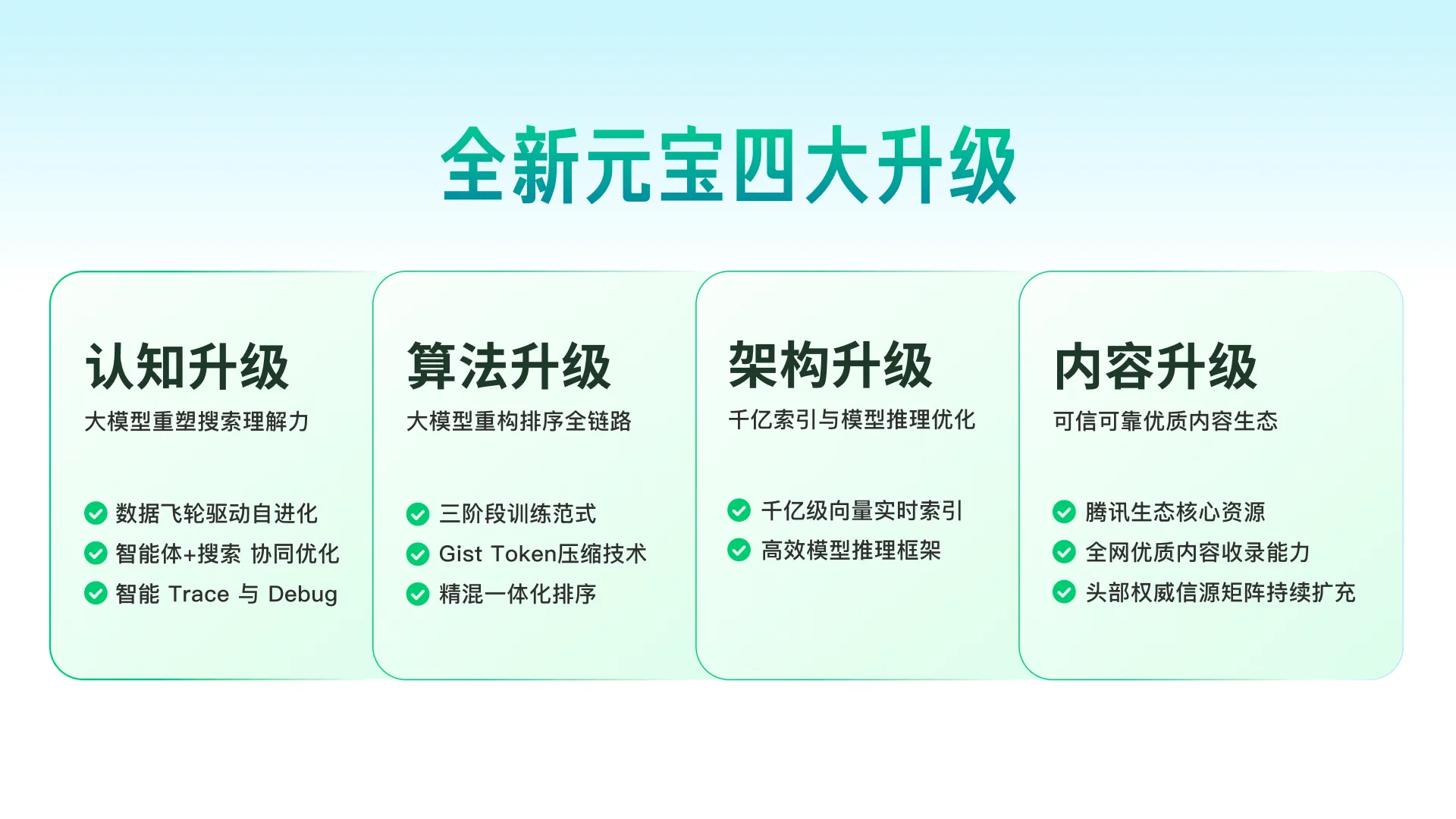
Image Source: Tencent
The initial step is to enhance the search engine's understanding of what agents are seeking.
Unlike traditional searches, which often revolve around keywords, the queries posed by agents may be subproblems derived from a complex task. Yuanbao Search now enables the search model to collaborate with the agent model: the agent is responsible for understanding the task and breaking it down into queries, while the search provides information on webpage authority, publication time, and ranking satisfaction to assist the agent in determining which results are more valuable.
Conversely, the sources cited by the agent and the answers it generates can also be fed back to the search system, serving as a foundation for subsequent optimizations.
Tencent also continually enhances search effectiveness through a data flywheel. By identifying issues with unsatisfactory search results, AI is employed to automatically annotate and generate training samples, which are then utilized for incremental model training. According to Ma Jin, iterations of the search system that once spanned months can now potentially be condensed to days.
This forms a closed-loop driven by self-evolution.
However, when confronted with a plethora of search results, ranking truly valuable content at the forefront is equally crucial.
To address this, Yuanbao Search has reconstructed its ranking pipeline using large models. In essence, the large model is initially trained to discern more complex ranking preferences, and then, through distillation, these capabilities are transferred to a lighter model for actual search utilization.
Simultaneously, Gist Token compression technology is introduced to reduce webpage content from thousands of tokens to approximately 100 tokens, combined with KV Cache reuse to diminish the time and cost of ranking inference.
Here's an often-overlooked issue. While large models can deepen the understanding of webpages in search ranking, if each search demands substantial computational power, the cost of frequent search calls by agents will also escalate.
Therefore, Yuanbao Search's upgrade is not solely about making search more intelligent but also about ensuring this capability is affordable and swift enough.
In terms of underlying architecture, Tencent has amalgamated traditional inverted indexes with vector indexes, supporting both keyword and semantic retrieval on a scale of hundreds of billions.
According to official data, Yuanbao Search's vector index now surpasses 150 billion, with an average retrieval time of about 8 milliseconds at the underlying level. Through a series of inference optimizations, unit inference costs have been slashed by 90%, achieving end-to-end speedups of over 1 second on the Yuanbao App.
But for both humans and agents, the crux of 'search' remains: Can you unearth truly useful and trustworthy information?
As Ma Jin articulated in his speech: 'Garbage in, garbage out.' If the search yields incorrect, outdated, or even AI-fabricated content, even the most potent large model may draw erroneous conclusions.
On one hand, Tencent leverages large models to augment webpage parsing and content quality judgment. On the other hand, it integrates content resources from Tencent and its external partners. Currently, Yuanbao Search encompasses 13 industries and 157 top-tier sources, including data from Tencent Maps, Tencent MedPedia, and partners like JD.com, Ctrip, Meituan, and Variflight.
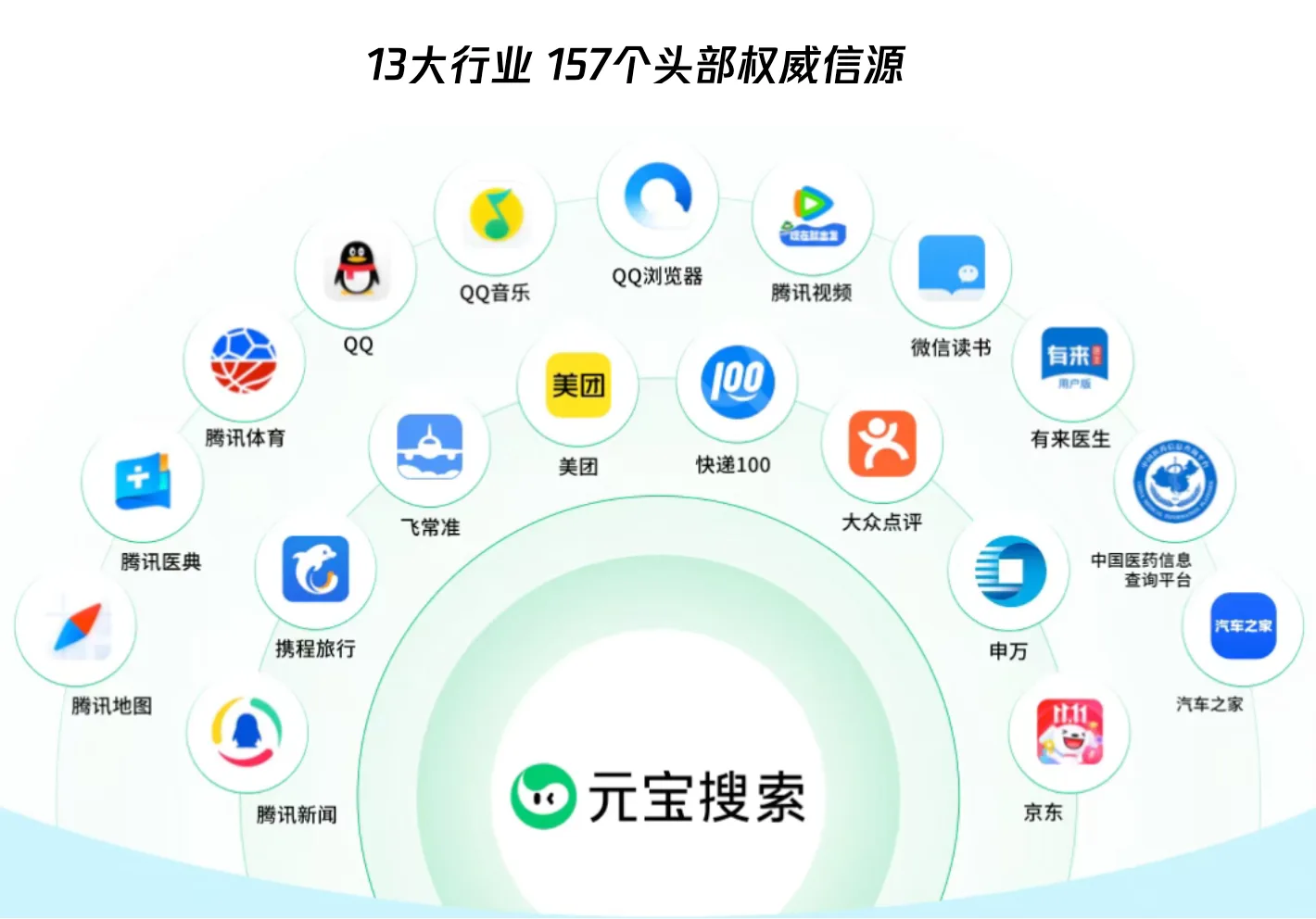
Image Source: Tencent
Yuanbao Search's strategy prioritizes authoritative sources and employs low-quality filtering to ensure verifiability and traceability, significantly curtailing the likelihood of model hallucinations. For agents planning itineraries, checking flights, or comparing products, structured and up-to-date industry information is paramount.
Notably, Tencent is not merely opening up web search but also these vertical content capabilities already integrated into Yuanbao Search. Developers can access them via API, MCP, or Skill without constructing complex search systems from scratch.
This capability has also been extensively utilized within Tencent. Over 50 products, including Yuanbao, WorkBuddy, ima, and Tencent Video, rely on Yuanbao Search. According to disclosures, ima's effective sources have augmented by over 10%, and Tencent Video's search information coverage has enhanced by 20%.
It's evident that Tencent is endeavoring to integrate the understanding, retrieval, ranking, and content capabilities traditionally dispersed across search engines into a foundational service more conducive to agent calls. However, the true value of Yuanbao Search's upgrade ultimately hinges on its effectiveness in reducing invalid searches by agents, lowering task costs, and improving task completion success rates.
What Gives Tencent an Edge in the New AI Search Battleground?
The comprehensive upgrade and openness of Yuanbao Search are not exclusive to Tencent.
In fact, Alibaba Cloud, Volcano Engine, and Baidu Intelligent Cloud have already launched analogous AI search services for enterprises and developers. Overseas, there are also search vendors like Exa and Tavily specifically catering to AI applications. As agents increasingly invoke search functions, search capabilities primarily designed for humans are becoming part of the AI infrastructure market.
Volcano Engine's Doubao Search is the closest to Yuanbao Search. In June, Volcano Engine upgraded its original web search service to Doubao Search, offering comprehensive internet and multi-vertical retrieval capabilities, and gradually incorporating features like authoritative source filtering, time range selection, image search, and MCP access.
Alibaba Cloud has taken it a step further. In addition to providing web search APIs, Alibaba Cloud has introduced Agentic Search, amalgamating search with task planning, knowledge base retrieval, and tool invocation capabilities, beginning to intervene in the process of agents completing tasks.
Baidu Intelligent Cloud is also not to be underestimated. Leveraging Baidu's long-accumulated Chinese search capabilities, Baidu AI Search has opened up multimodal retrieval services, including web, image, and video, to enterprises. It also offers capabilities like intelligent summarization and enterprise knowledge base access.
In other words, the authoritative sources, semantic retrieval, low latency, and agent access emphasized by Tencent are not unique capabilities in the industry. Search is becoming an increasingly mature AI service, and competition among vendors is no longer solely about who can locate more webpages.
So, where does Yuanbao Search's advantage lie?
In Leitech's perspective, it first resides in Tencent's long-accumulated content resources and internal application scenarios. Compared to merely providing comprehensive internet web retrieval, Yuanbao Search also integrates Tencent's unique content ecosystem and vertical data from partners like JD.com, Ctrip, and Meituan.
For enterprises developing intelligent assistants, smart cockpits, or office agents, having access to multiple information resources through a single integration is indeed enticing.
Another noteworthy aspect is that Tencent already boasts a considerable number of internal applications continuously testing this search system. From Yuanbao to WorkBuddy, ima, and Tencent Video, over 50 products cater to different search needs. They not only provide scale but also aid the search model in iterating continuously by exposing issues during actual use.
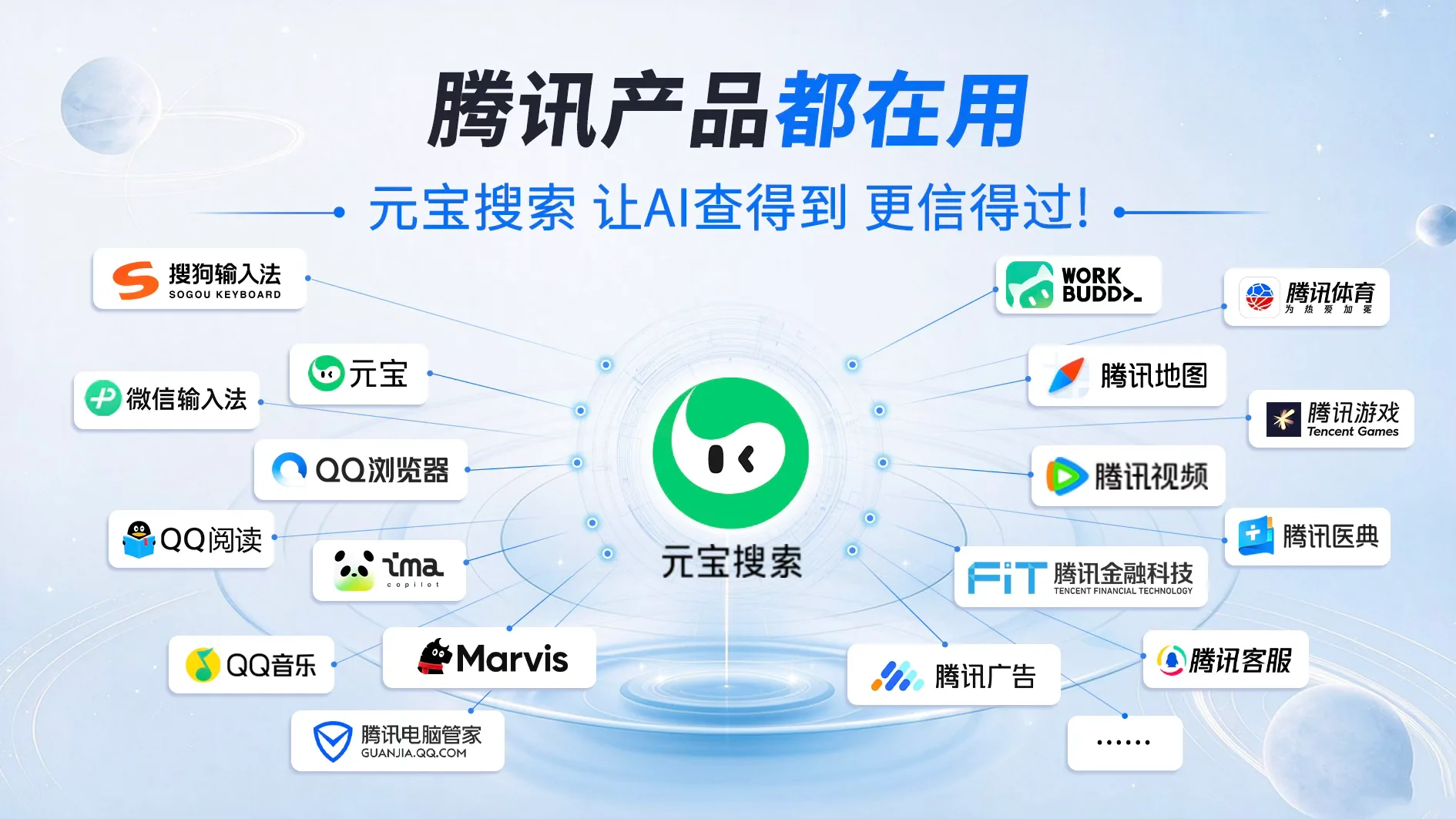
Image Source: Tencent
This aligns with Tencent's emphasis on the data flywheel and the collaborative evolution of search and agents. However, whether these advantages can translate into reasons for developers to choose Yuanbao Search remains to be further substantiated.
After all, what enterprises truly care about is not how many billion indexes a search vendor possesses or what ranking model it employs but whether, after integration, their agents, applications, or AI hardware can locate information more accurately, reduce repeated searches, and complete tasks at a lower cost.
Price cannot be overlooked either. Just days before Yuanbao Search's upgrade, Alibaba Cloud had already slashed the prices of its web search service, with the Pro version dropping from 36 yuan per thousand calls to 18 yuan. As search APIs become more prevalent, the cost per call is bound to become a pivotal factor in enterprise vendor selection.
From this vantage point, Tencent's endeavors to reduce costs through large model distillation, Gist Token compression, and inference architecture optimization are not merely technical pursuits but also preparations for impending market competition.
In Conclusion
As agents emerge as significant users of search, search is no longer merely an internet gateway but also a foundational service that needs to be stable, cost-effective, and always accessible. However, the value of infrastructure must ultimately be validated through effectiveness. Today's AI search is not lacking in products that can return webpages, summaries, and citation sources; the key is how to assist agents in avoiding detours and completing tasks faster and more reliably.
Tencent's Yuanbao Search upgrade is clearly a stride in this direction. However, to persuade more enterprises and developers to invest in it, verification through Tencent's own products is insufficient; it still necessitates more real-world accomplishments from external applications.
Source: Leitech
Images in this article are sourced from the 123RF royalty-free image library. Source: Leitech
-
![]()
Ant Group Sets Sights on AI Financial Agent; Entropy Simple Technology Secures Series C Financing
-
![]()
Deep Blue Aerospace Advances, While Nebula-1 Awaits Its Maiden Flight
-
![]()
Why does the same intelligent driving solution require readjustment when applied to a different vehicle model?
-
AI Revenue Surges 830%! SpaceX's Q3 Revenue Reaches $14.575 Billion, Turning Losses into Profits Year-Over-Year
-
![]()
Yuanbao Search Undergoes a Significant Upgrade! Tencent Keeps Investing in AI Search, But What Are Its Real Intentions?
-
![]()
Preparing for Listing? HiCar Pursues Independent Automobile Manufacturing Qualification, Speeding Up Restructuring Efforts within Harmony Intelligent Travel
-
From 'Separate North and South' to 'Integrated North and South': The 22-Year Transformation of Toyota China's Structure
-
![]()
Q3 Mobile Phone Market Undergoes Major Shift: Price Increases Pose Daunting Challenges, Huawei and Apple Shine as Top Performers