Deep Blue Aerospace Advances, While Nebula-1 Awaits Its Maiden Flight
 10/21 2026
 354
Founded in 2016, Deep Blue Aerospace is fast approaching its tenth anniversary.
With nearly RMB 2 billion in funding secured, the successful rollout of a 5-meter-diameter stainless steel co-bottom tank, and the completion of a long-duration test for a 130-ton-class engine, Deep Blue Aerospace has demonstrated consistent progress. While the Nebula-2 is already targeting a 25-ton low-Earth orbit (LEO) payload capacity, the earlier-scheduled Nebula-1 has yet to achieve orbital insertion.
Space exploration demands patience, and research and development plans inherently allow for flexibility. However, when a commercial rocket company repeatedly sets clear expectations for its maiden flight, only to see those dates pass without fulfillment, the wait transcends mere technical challenges.
01 Maiden Flight Announced Three Years in Advance
In December 2023, Deep Blue Aerospace successfully completed the deployment and retraction test of the landing legs for Nebula-1. In March 2024, Hainan Commercial Space Development announced that Nebula-1 was scheduled to complete its maiden orbital insertion flight in Hainan by the end of the year.
By September, Nebula-1 had conducted its first high-altitude vertical recovery flight test in Inner Mongolia. The rocket flew for 179 seconds, landing within 0.5 meters of the theoretical target before shutdown. However, an abnormal thrust adjustment servo during the engine's landing shutdown phase resulted in partial damage to the rocket body. Despite completing 10 out of 11 main verification tasks and yielding valuable technical insights, the predetermined complete landing goal was not achieved. The company then proposed another test in November, though no subsequent public record of this re-flight was documented.
In February 2025, the maiden flight timeframe was adjusted to the second quarter. In November, the first stage of Nebula-1 completed a 30-second test with nine engines operating in parallel, and the company announced that all propulsion system tests preceding the maiden flight had been concluded, entering the countdown phase.
In February 2026, founder Huo Liang stated that Nebula-1's first orbital insertion flight would take place after the Spring Festival. In March, Xinhua Daily reported that the maiden flight rocket had already arrived in Haiyang, Shandong, with an anticipated launch in the first quarter. In April, the company disclosed the completion of a joint exercise for the rocket-ground and fueling systems but did not provide a new launch date. In September's financing news, the inaugural mission of Nebula-1 was still progressing, but the specific maiden flight window was no longer mentioned.
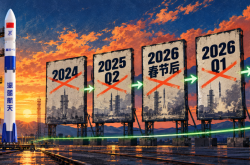
From the end of 2024 to the second quarter of 2025, and then to the first quarter of 2026, the maiden flight timeline had been repeatedly specified, only to lapse each time. The countdown, which should have been steadily decreasing, has almost become a rhetorical device that spans years for Nebula-1.
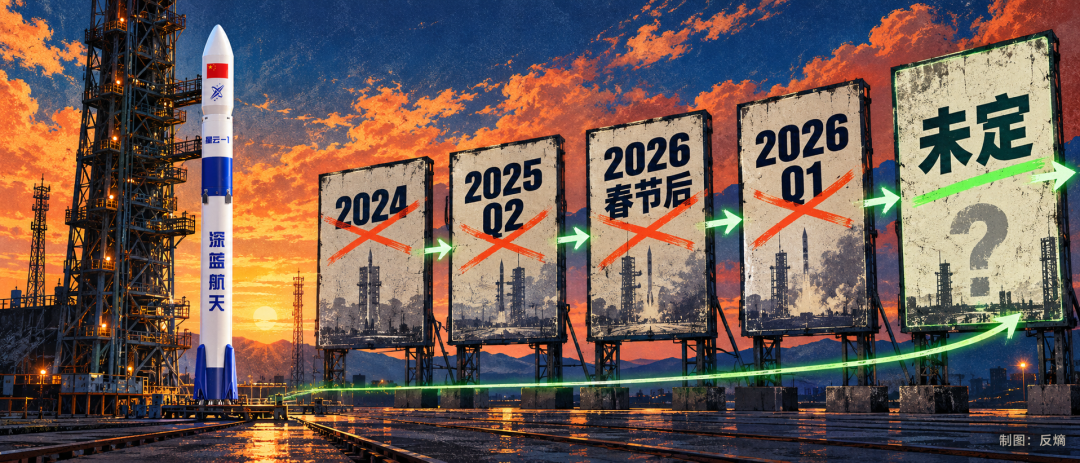
Rocket development is fraught with uncertainties in technology, testing, and launch conditions. The anomalies encountered during the 2024 test necessitated adjustments, analysis, and corresponding improvement verifications, making delays not uncommon. However, given that risks are an inherent part of the process, why did the company repeatedly provide such specific maiden flight windows beforehand? Where exactly did the initial progress assessments go awry?
To date, explanations for these changes in publicly available information remain limited.
02 The Big Challenges of a Small Rocket
The challenges faced by Nebula-1 extend beyond the technical hurdles of orbital insertion and recovery to include the commercial constraints of a small-capacity rocket.
According to the design scheme disclosed in early 2025, Nebula-1 adopts a two-stage liquid oxygen and kerosene configuration, with the first stage equipped with nine engines. Its designed LEO payload capacity is 2 tons in a non-recoverable state and 800 kilograms in a recoverable state.
Small rockets still find a market for dedicated launches, specific orbit deployments, and small-batch network replenishment. However, for low-Earth orbit constellations requiring the deployment of thousands of satellites, a smaller per-launch capacity generally means more launch missions need to be arranged, increasing the pressure on launch site resources, test launch organization, and mission coordination.
First-stage recovery also necessitates reserving propellant and configuring recovery equipment, and the recovered rocket body requires inspection and maintenance. Whether the saved manufacturing costs can offset the capacity loss and additional expenses depends on the number of reuses, refurbishment costs, and turnover efficiency, and cannot be judged solely by the term "recoverable."
For products with relatively limited capacity, achieving a balance between recovery capability, payload, and launch costs directly relates to the product's commercial competitiveness.
Technical difficulties should not be underestimated simply because the rocket is small.
The previous high-altitude vertical takeoff and landing test of Nebula-1 verified some key technologies but could not fully simulate the return environment after an orbital insertion mission. Achieving orbital insertion, realizing first-stage recovery, and then flying the recovered rocket body again represent distinct verification stages.
Deep Blue Aerospace is already addressing the issue of insufficient capacity through model iteration. The Nebula-1 currently displayed on the official website features a three-stage configuration, with a power configuration of "11+2+upper stage," achieving a designed LEO payload capacity of 4 to 6 tons. However, the maiden flight model that completed the nine-engine parallel test in November 2025 still publicly discloses a two-stage configuration with an LEO payload capacity of about 2 tons.
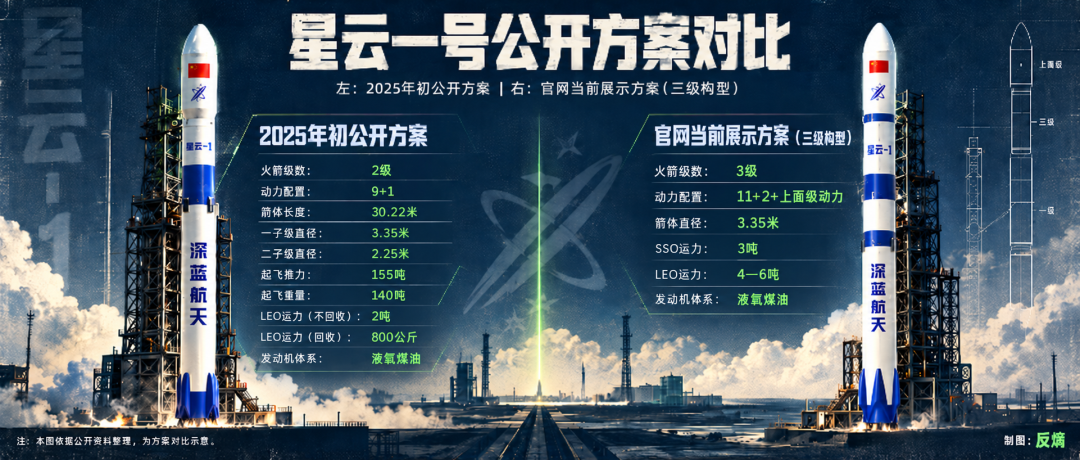
The test accumulations of the old configuration can support the development of new models but cannot directly prove that the new configuration possesses the corresponding flight capability.
The first orbital insertion report card has not yet been submitted, and the product plan has already been updated with a new version.
03 Peers Who Have Moved Ahead
If we consider only Deep Blue Aerospace's own research and development pace, the long wait might still be understood as a common difficulty in commercial rocket development. However, in the context of China's commercial aerospace industry in 2026, this matter now has different implications.
In 2019, i-Space's Hyperbola-1 achieved orbital insertion; in 2020, Galactic Energy's Ceres-1 followed suit; in 2023, Space Pioneer's Tianlong-2 and LandSpace's Zhuque-2 successively completed liquid rocket orbital insertions.
Each company has pursued different technical paths. Deep Blue Aerospace has chosen a liquid oxygen and kerosene recoverable route, attempting to simultaneously verify first-stage recovery in its first orbital insertion mission, and thus needs to bear additional technical risks.
On September 1, 2026, Galactic Energy's Pallas-1 Yaoyi successfully achieved orbital insertion. Following Ceres-1, this company has also obtained orbital insertion flight data for a liquid rocket.
At the same time, the verification of reusable rockets in China has also begun to cross new thresholds. On July 10 of the same year, after orbital insertion, the first stage of the Long March 10B was recovered at sea through net capture; on August 19, LandSpace's Zhuque-3 Yaoer achieved orbital insertion, and its first stage landed on a recovery pad in Minqin, Gansu, using landing legs.
Of course, successful recovery does not yet equate to normalized reuse. But at least inspectable flight results have been achieved.
The industry's technical references are evolving.
In 2024, Nebula-1's high-altitude recovery test was sufficient to attract attention. Two years later, when peers have successively achieved orbital insertion, and some models have even completed first-stage recovery, the persuasiveness of "maiden flight imminent" is naturally much weaker than before. Deep Blue Aerospace certainly still has opportunities to catch up, but the outside world will ultimately judge its technological progress based on flight results.
04 Credit That Cannot Be Reused
Nebula-2 carries greater expectations and aims for a larger market.
This rocket is planned to have an LEO payload capacity of 25 tons, with the first stage equipped with 11 Super Thunder engines, and plans to adopt tower capture recovery. The rollout of the tank and engine tests also indicates that related development work is progressing.
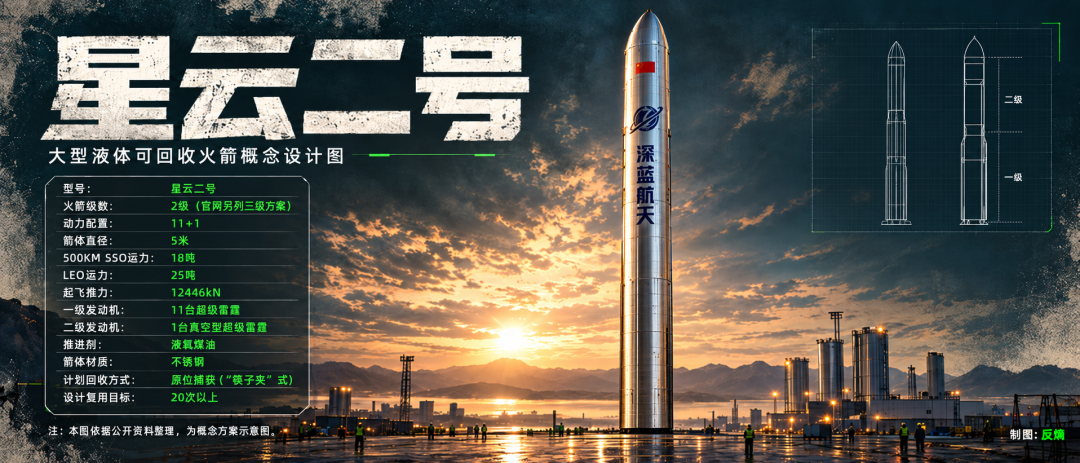
However, its maiden flight timeline has also been adjusted multiple times. In July 2024, Deep Blue Aerospace proposed a maiden flight by the end of 2025; in February 2025, the plan was adjusted to 2026; in May of the same year, Huo Liang stated that the first flight was expected in 2027. The new financing report in September 2026 continued to use the 2027 target.
Nearly RMB 2 billion in financing has provided financial support for Deep Blue Aerospace's subsequent development and indicates that investors still favor its prospects.
The maiden flight timelines announced by enterprises to the outside world are usually expectations of research and development progress and do not necessarily equate to contract delivery deadlines for customers, but they still carry credit costs. They affect the task arrangements of potential customers and relate to investors' judgments on research and development progress.
One missed expectation may stem from technical uncertainties; repeatedly providing clear time windows and then repeatedly missing them requires the enterprise to explain the judgment deviations more seriously. Otherwise, when the next announcement of "maiden flight imminent" comes, how many people will be willing to believe it?
We should be tolerant of failures in technical tests, but there is no need to take repeatedly ineffective public timelines for granted. Nebula-2 can continue to aim for a 25-ton payload capacity and tower capture, but the orbital insertion gap left by Nebula-1 cannot be filled by the grand goals of the next-generation model.
Planned performance and flight-verified capabilities are ultimately two different things. Deep Blue Aerospace has been forecasting enough. Next time, it should speak with flight results.
References for This Article
1. "Explanation of the First High-Altitude Recovery Flight Test of Deep Blue Aerospace's Nebula-1," Deep Blue Aerospace, September 22, 2024
2. "Commercial Aerospace Excellent Achievements | Highly Reliable and Low-Cost Reusable Launch Vehicle," provided by Jiangsu Deep Blue Aerospace Co., Ltd., Sina Finance, January 18, 2025
3. "Deep Blue Aerospace: 'Nebula-1' Launch Vehicle to Execute First Orbital Insertion Launch and Vertical Recovery Verification in the Second Quarter," IT Home, February 21, 2025
4. "WGDC2025 | Huo Liang: 'Nebula-1' to Have Maiden Flight This Year, 'Nebula-2' Maiden Flight Rocket to Enter Production Next Year," Taibo.com, May 22, 2025
5. "Deep Blue Aerospace's First Commercial Reusable Launch Vehicle: 'Nebula-1' First-Stage Power System Successfully Completes Nine-Engine Parallel Test, Maiden Flight Enters Countdown," IT Home, November 3, 2025
6. "Deep Blue Aerospace Founder Huo Liang: Creating a Normalized, Low-Cost 'Space Freight Shuttle,'" Economic Observer, February 13, 2026
7. "Deep Blue Aerospace: 'Nebula-1' Ready for Maiden Flight," Xinhua Daily, March 2, 2026
8. "Nebula-2 Rocket Development Update | Covering Full Mission Duration! 130-Ton Thunder RS Achieves Over 200-Second Long-Duration Test," Deep Blue Aerospace, August 28, 2026
9. "Deep Blue Aerospace Raises Nearly RMB 2 Billion to Accelerate Development of Reusable Liquid Rockets; 'Nebula-2' Planned for Maiden Flight by End of Next Year," Wuxi Daily, September 27, 2026
10. "5-Meter Diameter, Largest in China! Co-Bottom Tank Rolled Out, Large Liquid Reusable Rocket Nebula-2's Second Stage Ready," Deep Blue Aerospace, October 12, 2026
11. "Pallas-1 (Yaoyi) Launch Vehicle Achieves Successful Maiden Flight and Orbital Insertion, Galactic Energy Opens a New Chapter in Solid-Liquid Dual-Drive," Galactic Energy Space, September 2, 2026
12. "China Successfully Implements Reusable Launch Vehicle Recovery Mission for the First Time," "China Successfully Implements Reusable Launch Vehicle Land Recovery for the First Time," China National Space Administration, July 10 and August 19, 2026
-
![]()
Ant Group Sets Sights on AI Financial Agent; Entropy Simple Technology Secures Series C Financing
-
![]()
Deep Blue Aerospace Advances, While Nebula-1 Awaits Its Maiden Flight
-
![]()
Why does the same intelligent driving solution require readjustment when applied to a different vehicle model?
-
AI Revenue Surges 830%! SpaceX's Q3 Revenue Reaches $14.575 Billion, Turning Losses into Profits Year-Over-Year
-
![]()
Yuanbao Search Undergoes a Significant Upgrade! Tencent Keeps Investing in AI Search, But What Are Its Real Intentions?
-
![]()
Preparing for Listing? HiCar Pursues Independent Automobile Manufacturing Qualification, Speeding Up Restructuring Efforts within Harmony Intelligent Travel
-
From 'Separate North and South' to 'Integrated North and South': The 22-Year Transformation of Toyota China's Structure
-
![]()
Q3 Mobile Phone Market Undergoes Major Shift: Price Increases Pose Daunting Challenges, Huawei and Apple Shine as Top Performers