"The New Generation of PayPal Mafia"? Young Chinese Are Seizing Silicon Valley
 10/27 2026
 455
Source: Shenlan Finance
A group photo of interns from a decade ago has revealed half of Silicon Valley's AI circle.
On October 19, Alexandr Wang, the head of Meta's Advanced Intelligence Lab, posted a group photo with the caption: "got the HRT gang back together."
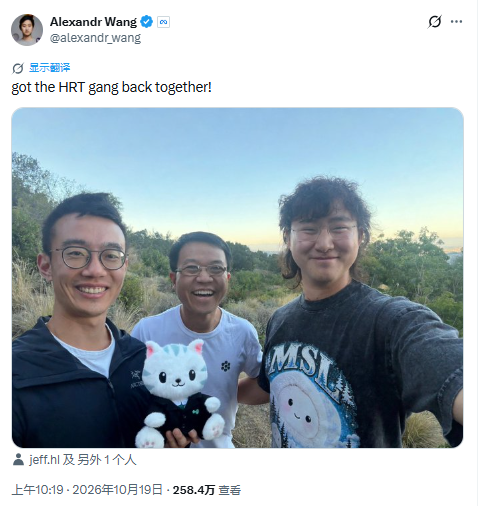
The other two faces in the photo are Scott Wu, founder of Cognition, and Jeff Yan, founder of Hyperliquid.
More surprisingly, this post directly led to the discovery of a group photo of interns from a decade ago:
Eleven young people gathered around a cake for a group photo, with 7 of them being of Chinese descent. Today, 4 of them have become founders of unicorn companies, with their companies' total valuation exceeding $100 billion.
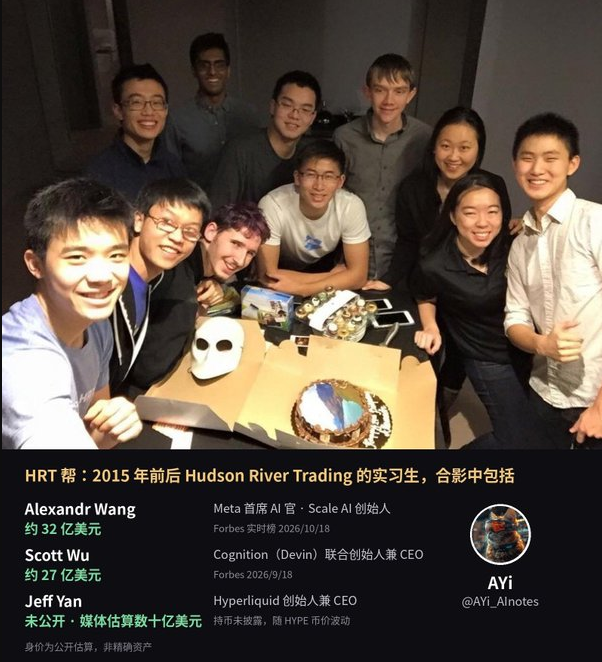
A decade ago, they crowded into the same internship office at quantitative giant HRT, researching high-frequency algorithms. A decade later, they have all stood at the center of the AI data, AI programming, and on-chain trading tables.
Netizens have directly named them: "The New Generation of PayPal Mafia."
It implies that this group of young Chinese individuals are entering the same technological revolution at an astonishing rate and rapidly reaching the centers of capital, technology, and commercial power.
Let's first look at this group photo.
On the far right is Alexandr Wang, also known as Wang Tao, a second-generation Chinese whose parents are both physicists. He entered MIT at 18, dropped out a year later, and founded Scale AI in 2016, specializing in data annotation for AI models. In 2025, Meta invested approximately $14.3 billion in Scale AI, bringing the 29-year-old Wang directly into Meta to head the Advanced Intelligence Lab.
Standing in the center is Scott Wu, a three-time gold medalist in the International Olympiad in Informatics, who founded AI programming company Cognition and launched "the world's first AI programmer," Devin. In September 2026, Cognition's valuation soared to $48 billion.
Jesse Zhang, who took a selfie with his phone, interned at HRT during his junior year at Harvard and later founded AI customer service company Decagon, pushing its valuation to $4.5 billion in three years.
There's also Jeff Yan, founder of Hyperliquid, who, with a dozen people and no external funding, turned the crypto trading platform into one of the most attention projects in the track .
The remaining individuals, although not entrepreneurs, hold important positions in AI companies or wield influence on Wall Street.
For example, Wang Tao once revealed that among those 10-plus interns, an intern named Vicky Yei is now part of Anthropic's core team.
This is not an isolated case.
Zooming out, the concentration of Chinese individuals in Silicon Valley's AI circle has reached a point where foreign employees complain about being marginalized for not knowing Chinese.
At Musk's xAI, 5 out of 12 founding members are Chinese.
Zuckerberg's initial 11-person core team for Meta's Advanced Intelligence Lab included 7 individuals with Chinese backgrounds.
Among ChatGPT's initial 87-person core team, 9 were Chinese; in GPT-4o's key team of 17, 6 were Chinese.
NVIDIA CEO Jensen Huang Speak frankly in an interview with Axios that "half of the world's AI researchers are Chinese."
The data is even more direct: Among top AI talents in the United States, 38% are originally from China, surpassing the 37% from the United States. Among employees in Silicon Valley's tech industry with a bachelor's degree or higher, 18% are from China, one percentage point higher than the 17% born in California.
Even more striking is their age.
Wang Tao is 29, Scott Wu is around 30, and Jesse Zhang is 27.
Behind them, the "post-2000s" generation continues to surge:
A 19-year-old Chinese girl founded Datacurve, securing $15 million in Series A funding. Jessica Wu, 22, dropped out of MIT to found Sola Solutions, raising $21 million.
Carina Hong, 24, leads Axiom Math in machine theorem proving, securing $64 million in seed funding with a valuation of $300 million.
The title of "youngest billionaire" in Silicon Valley is changing hands frequently.
So, what are these young Chinese individuals seizing in Silicon Valley's tech circle?
They're not just vying for a desk; they're seizing every key node in the AI industry chain.
At the bottom layer of computing power, NVIDIA's Jensen Huang, AMD's Lisa Su, Broadcom's Hock Tan, and Intel's Lip-Bu Tan, the four semiconductor giants, are led by Chinese individuals.
In the middle layer of data, Scale AI's Wang Tao and Surge AI's Edwin Chen divide the core market for high-quality training data.
At the top layer of applications, Cognition writes code, Decagon provides customer service, Perplexity Refactoring s search, and Fireworks AI serves as the reasoning hub.
From chips to data, from models to products, Chinese faces are no longer just supporting characters in Silicon Valley's stories; they're the ones sitting at the table dividing the chips.
Throughout Silicon Valley's history, there has never been a shortage of Chinese faces and influence. Today, in the AI wave, Chinese individuals are flocking to the forefront in batches.
They may not belong to the same "gang," but they share similar training, networks, and ambitions.
The real question worth asking is not how they compete, but how this network of Chinese talent will define the next stage of Silicon Valley.
*Disclaimer: The views expressed in this article are solely those of the author. The market is risky, and investment should be made with caution. Under no circumstances shall the information or opinions expressed in this article constitute investment advice to anyone.
Shenlan Finance New Media Cluster, originating from the Shenlan Finance Journalist Community, has a 16-year history and is a well-known financial new media outlet in China. Its accounts focus on China's most valuable companies, cutting-edge industry developments, and emerging regional economies, providing valuable content for investors, corporate executives, and the middle class. Welcome to follow.
-
![]()
Leapmotor’s Staff Increases by 9,732 in Just Over a Year. Can Zhu Jiangming’s ‘Mini BYD’ Outpace Geely and BYD?
-
![]()
Why Are AI Glasses So Popular, Yet Goertek's Q3 Sales Drop by 2.4 Billion Yuan with Inventory Reaching 22.4 Billion Yuan?
-
![]()
POLYVISION's IPO Review: Persistent Decline in Gross Profit Margin and Weakening Industry Outlook
-
![]()
Audi’s Strategic Split: SAIC-Audi’s Two-Year Plan Leads to Gasoline Vehicle Sales Until 2027 End | Mirror Pro
-
![]()
Racing to Become the "Pioneer Large-Scale Model Stock on the U.S. Stock Exchange": Anthropic Reports Over $80 Billion in Losses Within Half a Year
-
![]()
Wang Teng, Ex-Xiaomi Exec, Proves Prescient Half a Year Ago: Domestic Smartphone and Tablet Product Lines Face Discontinuation Wave
-
![]()
Post-2000s Female Employee Causes Stir at XPENG Launch Event
-
Anthropic Still Needs to Keep 'Sprinting'