Leapmotor’s Staff Increases by 9,732 in Just Over a Year. Can Zhu Jiangming’s ‘Mini BYD’ Outpace Geely and BYD?
 10/27 2026
 455
Produced by Zhineng Technology
In the first half of 2026, Leapmotor delivered 356,500 vehicles, generating revenue of RMB 38.107 billion and a net profit of RMB 208 million. By the end of June, the company's workforce had grown to 31,388, an increase of 9,732 from the previous year.
As vehicle sales and organizational scale expand, Leapmotor is starting to resemble a large-scale manufacturing enterprise in terms of personnel and factory setup. The question now is: when will its profitability catch up?
Comparing Leapmotor’s scale and growth potential to NIO, Li Auto, and XPeng is no longer fitting. Instead, Geely and BYD should be the benchmarks.
01 Staff Increases by 9,732 in a Year: Is Leapmotor Really Reducing Wages?
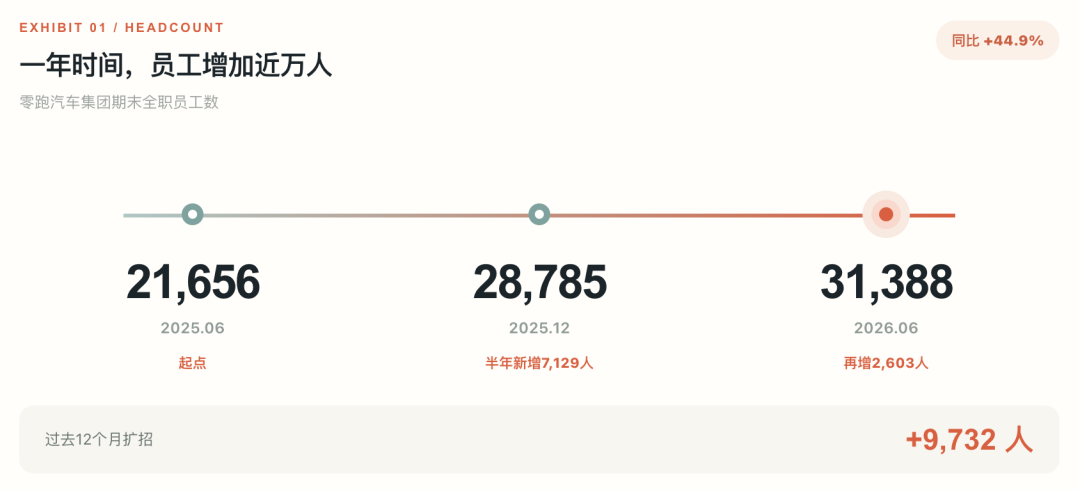
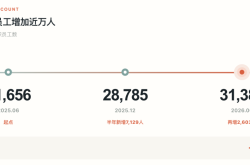
Leapmotor’s workforce grew from 21,656 at the end of June 2025 to 31,388 by the end of June 2026, marking a 44.9% increase in one year.
In the first half of 2026 alone, the company added a net 2,603 employees compared to the 28,785 at the end of the previous year.
For an automaker targeting annual sales of 1 million vehicles in the short term (and 4 million in the long term), this reflects a rapid transition from a startup to a large-scale production, parts manufacturing, and global delivery system.
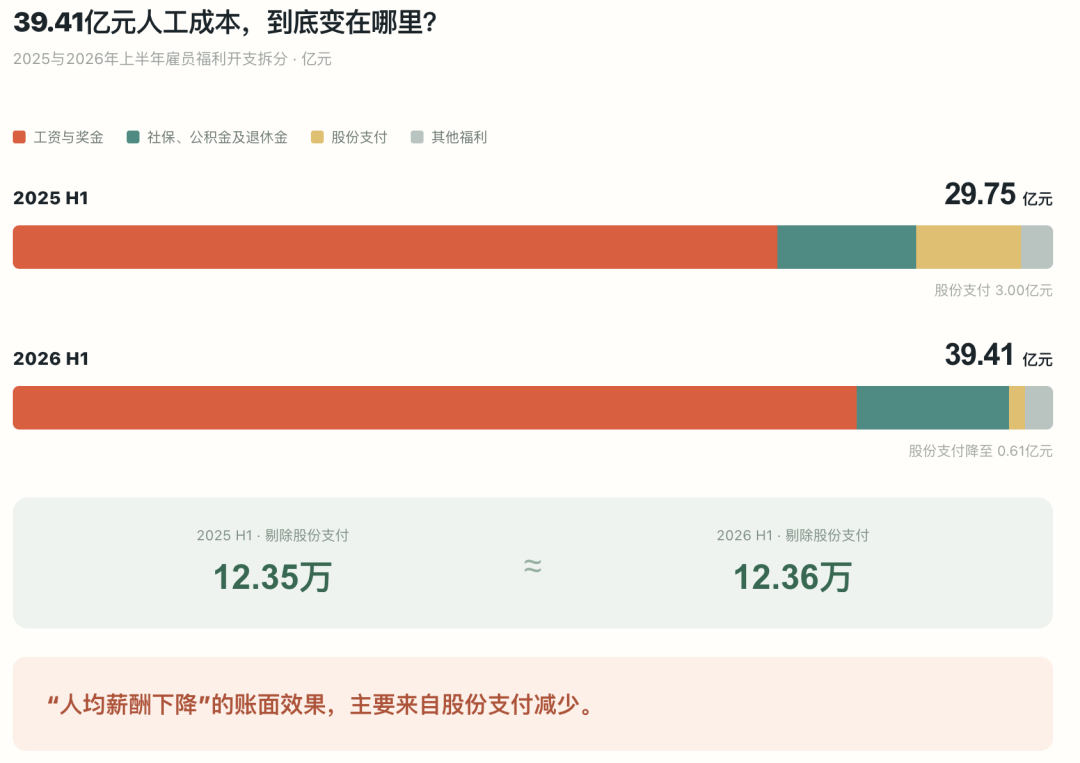
Despite the 44.9% workforce increase, employee benefit expenses rose only 32.5% in the first half of the year, from RMB 2.975 billion to RMB 3.941 billion.
When dividing benefit expenses by the number of employees at the end of June, the per-capita cost was RMB 137,400 in 2025 but dropped to RMB 125,500 in 2026.
In the first half of 2025, Leapmotor’s share-based compensation expenses were RMB 300 million; in the same period of 2026, they fell to RMB 61 million, an 80% reduction.
Meanwhile, salaries and bonuses increased from RMB 2.186 billion to RMB 3.198 billion, up 46.3%—slightly outpacing headcount growth.
Calculating salaries and bonuses per employee based on end-period numbers, the figures were approximately RMB 100,900 and RMB 101,900, respectively. Adding social security, housing funds, pensions, and other benefits, the per-capita semi-annual cost (excluding share-based compensation) remained around RMB 123,500-123,600 for both periods.
The per-capita intensity of cash compensation benefits remained stable, allowing Leapmotor to rapidly expand its workforce to 30,000 employees at nearly its original unit labor cost. The key question now is: how much additional profit can these extra employees generate?
02 Compared to Geely, Leapmotor’s Scale Is Significant, but Its Profitability Efficiency Is Still Developing
Leapmotor is pursuing a capital-intensive manufacturing strategy.
As revealed at its 2026 Technology Day, Leapmotor operates 18 parts factories, with in-house R&D and manufacturing covering approximately 65% of total vehicle costs and a platform commonality rate of 90%.
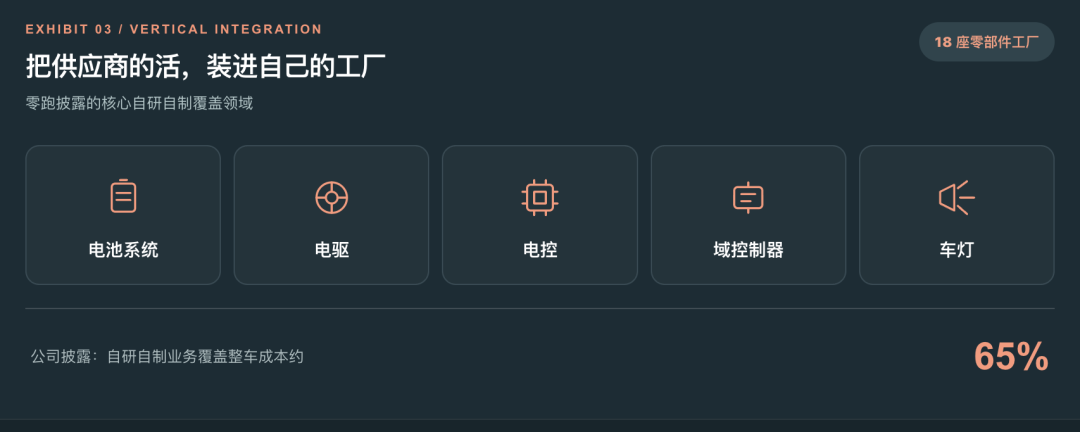
Battery systems, electric drives, electronic controls, domain controllers, lighting, and other components are gradually being brought in-house.
Processes, equipment, and employees that could have been outsourced to suppliers are increasingly being integrated into Leapmotor’s own operations.
This approach keeps parts profits within the company and shortens coordination chains between R&D, procurement, and manufacturing.
The trade-offs are clear:
◎ Significant upfront investment in molds, equipment, factories, and personnel is required;
◎ New models may not achieve scale quickly, with capacity utilization and depreciation impacting gross margins early on.
Geely provides the most direct comparison.
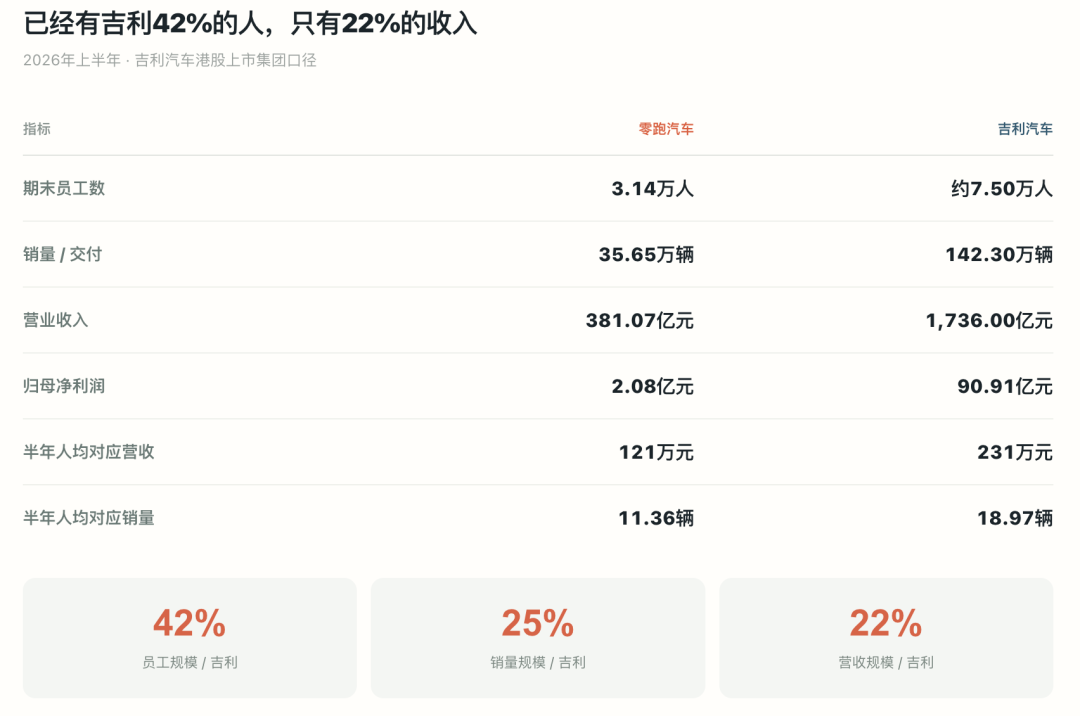
As of the end of June 2026, Geely Automobile’s Hong Kong-listed group employed approximately 75,000 staff, sold 1.423 million vehicles in the first half, generated revenue of RMB 173.6 billion, and reported net profit attributable to shareholders of RMB 9.091 billion.
In the same period, Leapmotor had 31,400 employees, delivered 356,500 vehicles, generated revenue of RMB 38.107 billion, and reported net profit attributable to shareholders of RMB 208 million.
In other words, Leapmotor’s workforce now equals 42% of Geely Automobile’s listed group, but its sales volume is only about 25% and revenue about 22% of Geely’s.
Calculating by end-period numbers:
◎ Leapmotor delivered 11.36 vehicles per employee in the first half, while Geely delivered approximately 18.97.
◎ Leapmotor generated RMB 1.21 million in revenue per employee in the first half, while Geely generated approximately RMB 2.31 million.
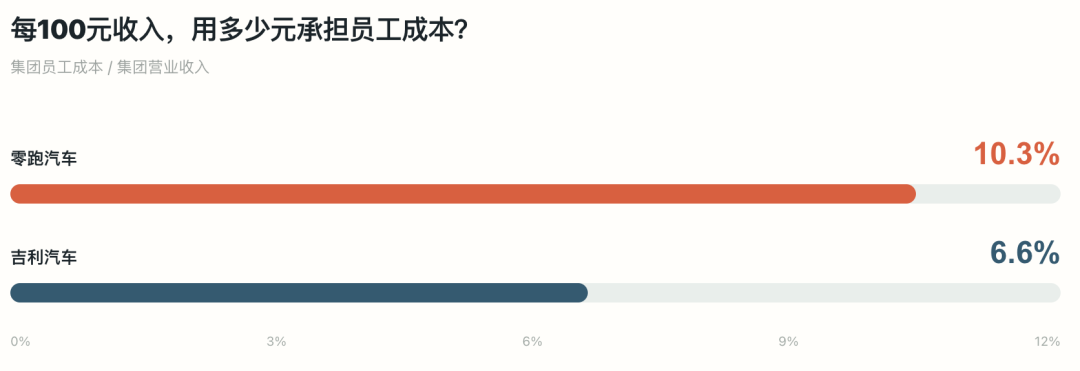
Leapmotor’s employee benefit expenses in the first half were RMB 3.941 billion, accounting for 10.3% of revenue;
Geely Automobile’s employee costs were RMB 11.448 billion, accounting for 6.6% of revenue.
Geely also incurs costs for R&D, factories, management, and sales but has already diluted labor expenses through its larger sales volume.
Leapmotor’s deliveries have grown rapidly since last year, up 60.8% year-on-year in the first half of 2026.
However, this sales growth has not synchronously brought gross margin improvements: the group’s gross margin fell from 14.1% in the first half of 2025 to 11.7% in the first half of 2026, with total gross profit increasing only 29.8% from RMB 3.426 billion to RMB 4.445 billion.
Depreciation included in sales costs rose from approximately RMB 221 million to RMB 463 million during the period, as new manufacturing assets entered the cost structure.
This is Leapmotor’s greatest challenge: its in-house R&D and manufacturing capabilities are now established, but it needs sufficiently high vehicle volumes, production line utilization rates, and stable per-vehicle gross margins to convert these capabilities into profits.
Proving it can manufacture components cheaply is not enough; those components must consistently be installed in vehicles and delivered to customers.
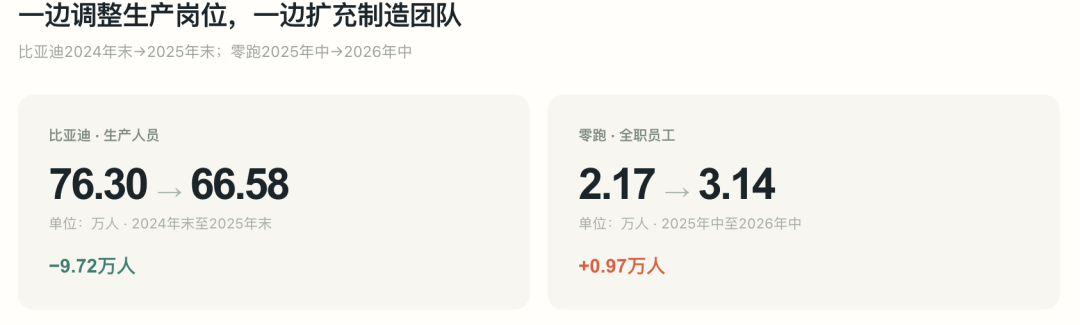
BYD’s path differs again.
BYD employed 968,900 staff at the end of 2024, which fell to 869,600 by the end of 2025—a reduction of approximately 99,300 employees in one year.
Production staff declined from 763,000 to 665,800 (a reduction of 97,200), while technical personnel remained at 127,700, an increase from the previous year.
After years of vertical integration and capacity expansion, the company is now increasing technical reserves while adjusting production-side workforce levels.
Both companies are making similar supply chain choices but operate in vastly different business stages. BYD is already adjusting personnel allocation within its massive system; Leapmotor is still bringing external supply chain work in-house.
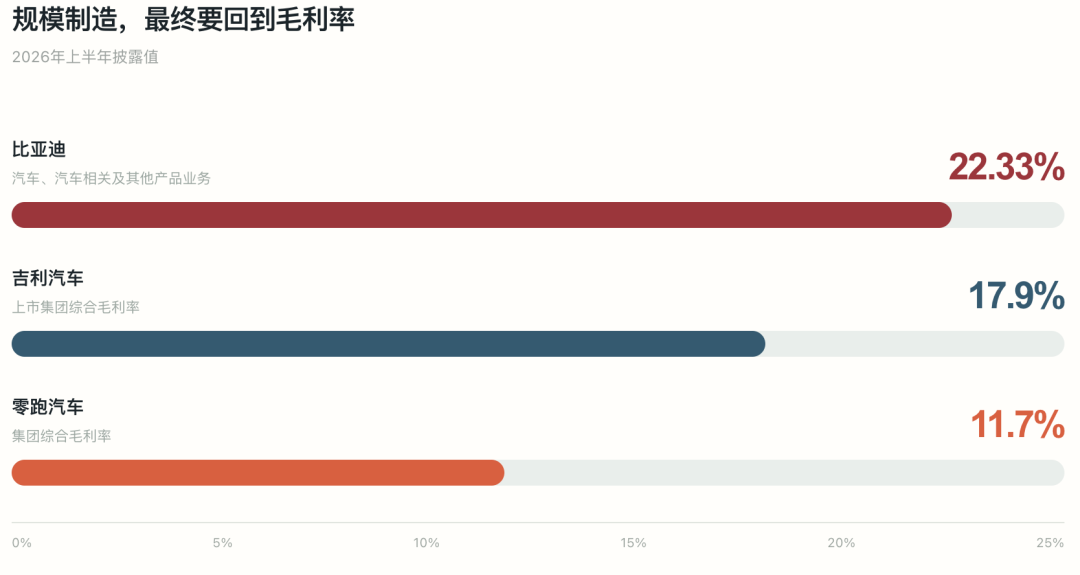
In the first half of 2026:
◎ BYD’s automotive, automotive-related products, and other product businesses had a gross margin of 22.33%;
◎ Geely Automobile’s listed group had a consolidated gross margin of 17.9%;
◎ Leapmotor’s consolidated gross margin was 11.7%.
During the same period, BYD Group reported net profit attributable to shareholders of RMB 12.325 billion, Geely reported RMB 9.091 billion, and Leapmotor reported RMB 208 million.
In the first half of 2026, net cash flow from operating activities was RMB 2.17 billion, down from RMB 2.858 billion a year earlier; free cash flow was RMB 140 million, compared to RMB 860 million last year.
Zhu Jiangming aims to control costs through in-house R&D and manufacturing, having applied this approach to vehicle architecture, batteries, electric drives, electronics, and various components.
Summary
Leapmotor previously needed to prove it could survive as a leading new-force automaker. Now, with monthly deliveries of 100,000 vehicles, a 30,000-strong organization, and 18 parts factories, the question has evolved.
Going forward, Leapmotor should compare itself to Geely and BYD: can its similar vertical integration investments achieve comparable scale efficiency and profitability?
Zhu Jiangming has already established the framework of a large-scale manufacturing enterprise.
-
![]()
Leapmotor’s Staff Increases by 9,732 in Just Over a Year. Can Zhu Jiangming’s ‘Mini BYD’ Outpace Geely and BYD?
-
![]()
Why Are AI Glasses So Popular, Yet Goertek's Q3 Sales Drop by 2.4 Billion Yuan with Inventory Reaching 22.4 Billion Yuan?
-
![]()
POLYVISION's IPO Review: Persistent Decline in Gross Profit Margin and Weakening Industry Outlook
-
![]()
Audi’s Strategic Split: SAIC-Audi’s Two-Year Plan Leads to Gasoline Vehicle Sales Until 2027 End | Mirror Pro
-
![]()
Racing to Become the "Pioneer Large-Scale Model Stock on the U.S. Stock Exchange": Anthropic Reports Over $80 Billion in Losses Within Half a Year
-
![]()
Wang Teng, Ex-Xiaomi Exec, Proves Prescient Half a Year Ago: Domestic Smartphone and Tablet Product Lines Face Discontinuation Wave
-
![]()
Post-2000s Female Employee Causes Stir at XPENG Launch Event
-
Anthropic Still Needs to Keep 'Sprinting'