Wang Teng, Ex-Xiaomi Exec, Proves Prescient Half a Year Ago: Domestic Smartphone and Tablet Product Lines Face Discontinuation Wave
 10/27 2026
 491
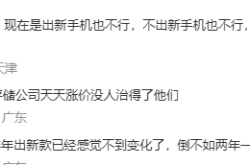
Rising costs in the consumer electronics sector are cornering manufacturers into a vicious cycle. Without raising prices, they can't cover costs; but raising prices leads to declining sales... The most daunting aspect of this dilemma is that not launching new models erodes competitiveness, while launching new models that don't sell well only escalates costs further. After all, without sales to support them, the expenses for establishing production lines and marketing systems become sunk costs. As one netizen aptly put it, "It's a lose-lose situation now—launching new models doesn't work, and neither does not launching them. It's like being stuck between a rock and a hard place. Not launching leads to a decline in market share, while launching results in losses." 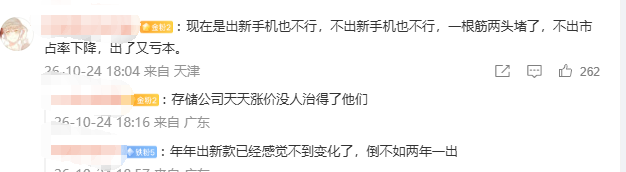
Another netizen commented, "It's a dead end. To make a profit, prices must be high, but high prices don't sell (especially with declining consumer purchasing power), leading to even lower profits. Factories can't bear it, companies can't bear it, resulting in layoffs. After layoffs, competitiveness declines again. It feels like a reshuffle is inevitable." 
Consequently, manufacturers find themselves in a bind: the more products they launch, the more losses they incur. This situation has been a persistent headache for smartphone manufacturers since the beginning of the year. For instance, in March, a blogger noted, "The current industry scenario is that the later new models are released, the higher the material costs become. If released earlier, the lifecycle of the previous generation is compressed. How can this be balanced?" 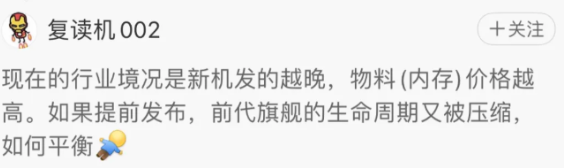
In response, Wang Teng, a former Xiaomi executive who has since left the smartphone industry and founded Jryxio, suggested halting new model launches. Wang Teng proposed a strategy for the smartphone industry: "Stop launching new models; focus on maintaining and upgrading existing products..." 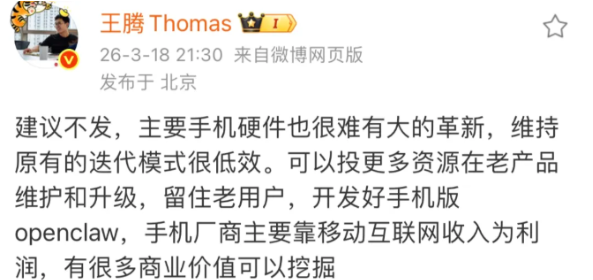
Wang Teng believes that significant innovations in smartphone hardware are rare, and maintaining the current iteration model is inefficient. Instead, more resources should be invested in maintaining and upgrading existing products to retain old users. He also argues that smartphone manufacturers primarily rely on mobile internet revenue for profits, with significant commercial value to be tapped, such as developing AI-related services. At the time, few took Wang Teng's statement seriously.
A person who stepped down from the position of General Manager of Redmi casually remarked on social media that "significant innovations in smartphone hardware are rare, and maintaining the existing iteration model is inefficient." This sounded more like a relaxed comment from someone no longer in the position, bordering on the 'out-of-office, out-of-mind' mentality. However, the trend in the domestic smartphone market in the second half of this year seems to have validated Wang Teng's prediction! According to a leak from blogger Digital Chat Station, "It's time to say goodbye. Several well-known smartphone or tablet product lines will soon be discontinued due to unbearable costs. The more new models launched, the greater the losses." 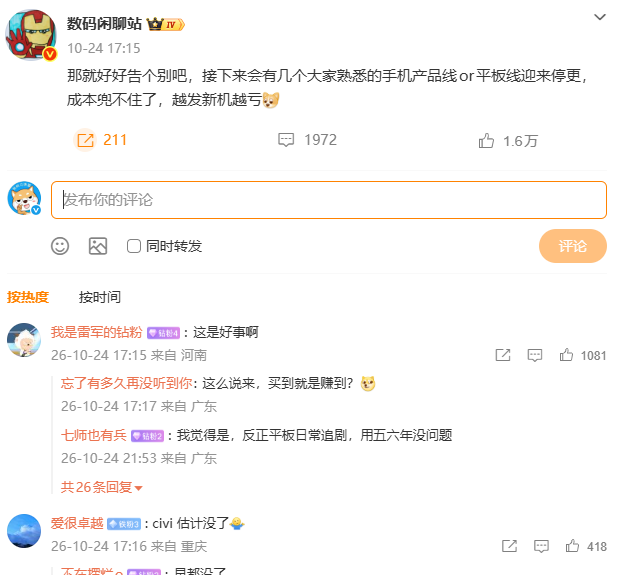
Although the blogger did not specify which brands or product lines would be affected, the reality is that since this year, not only has the frequency of new smartphone launches decreased, but some sub-brands have also integrated or exited the market. For example, in the comments section, someone mentioned that Xiaomi's Civi line is likely gone, and indeed, Civi has not been seen in the public eye for a long time. On the other hand, Meizu has completely exited the smartphone market. Shortly after Meizu's announcement, ASUS also declared that it would no longer release new smartphones, focusing instead on PCs and AI devices.
A giant that started with motherboards has officially admitted defeat in the smartphone business. Meanwhile, Realme recently announced its complete withdrawal from the Chinese market—Realme Exits Chinese Market! Vice President Xu Qi Issues Lengthy Statement: "A Rational Turn..." 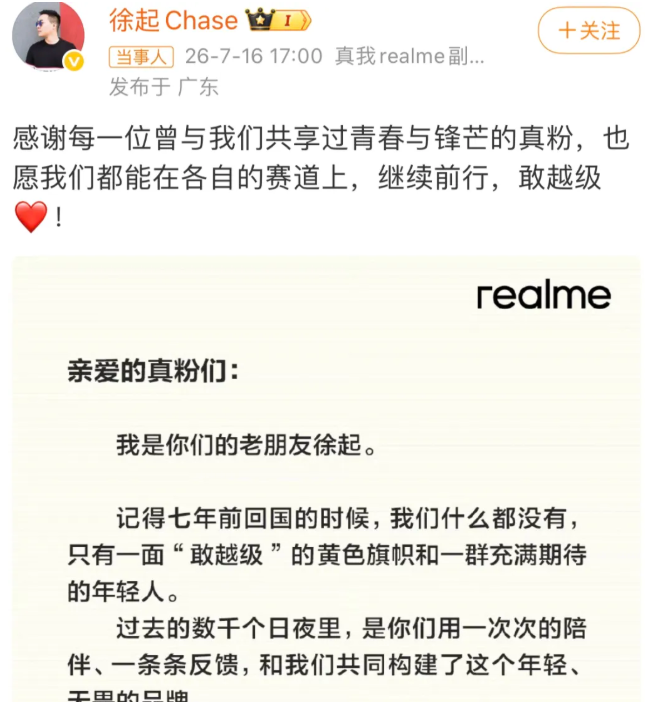
Realme's exit is somewhat regrettable, as it was a strong contender, boasting 300 million global sales, which sounds impressive. However, when broken down, it hardly made a dent in the Chinese market and instead competed internally with its sibling brand, OnePlus, with overlapping positioning, price segments, and redundant R&D investments.
Now, Realme's withdrawal from the Chinese market and refocusing on overseas markets is a microcosm of OPPO's strategy to streamline its product lines, making way for OnePlus domestically. Looking at OnePlus's moves, its contraction is quieter but follows the same direction. It has paused new product launches in Europe and North America, retreating to focus on China and India.
Turning back to Xiaomi, it launched a mid-range foldable phone this year, but the Xiaomi 18 Ultra was reported to be temporarily absent—though not 'canceled,' leaving some wiggle room. However, it's clear to insiders that high-end flagship models, which rely heavily on premium components, are most sensitive to storage costs. Skipping this generation is essentially a cost-saving measure. 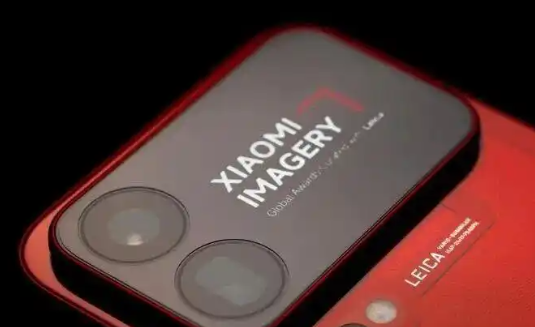
The iQOO Ultra series is also likely to be paused for a generation, with the official explanation being "iteration only when breakthrough technology is available." However, given the cost context in 2026, the real reason is not hard to guess. Additionally, Honor's 7.9-inch small tablet project was shelved before it even started. Even Samsung has slashed its Galaxy A series shipment target for 2027 from 120 million to 100 million units, a reduction of 20 million.
Brands that have fallen, withdrawn, merged, or paused for a generation—these four types of actions share the same underlying logic: reallocating resources away from "launching one model, losing money on one model" to areas that still make financial sense. Looking back at Wang Teng's earlier suggestion to "stop launching new models," he was simply acknowledging a fact happening earlier than most: the arithmetic that has sustained the smartphone industry for over a decade no longer adds up. Remember, in the early years, smartphones were still a blue ocean market, and manufacturers, vying for market share, deployed full-scale product lines, flooding the market with numerous models and sub-brands, with almost monthly product launches. 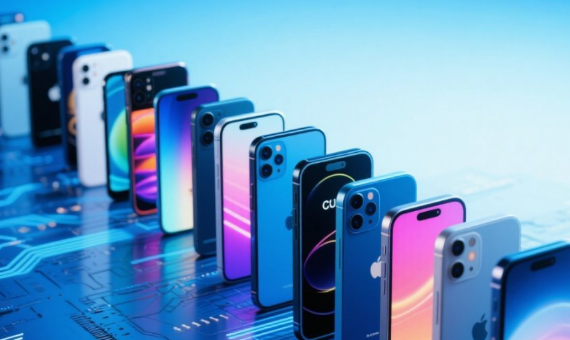
A single brand might have five or six product lines, launching over a dozen models a year, even holding separate launch events for different color variants. By offering a range of configurations and pricing tiers, they filled every price point, leveraging scale to dilute R&D and supply chain costs while capturing market share through broad coverage. This strategy was effective in a growing market, as there were always new users entering, and each additional product line increased the chances of capturing them.
However, in 2026, the four words "memory price hikes" exposed the flaw in this arithmetic. When storage costs rose from over 10% to more than 30% of total material costs, the fixed cost allocation logic for each new model changed: it was no longer about launching more models to reduce per-unit costs but about launching more models to subsidize memory manufacturers.
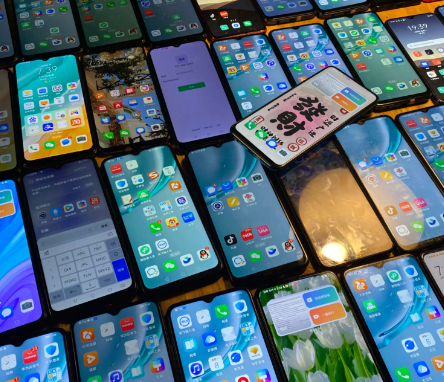
In the first quarter of 2026, DRAM contract prices surged by over 90% quarter-on-quarter, while NAND flash memory rose by 55% to 60%. In the second quarter, DRAM prices increased by another 58% to 63%, and NAND by 70% to 75%. Overall, memory costs had risen nearly 300% compared to the same period in 2025.
What does this mean?
For a mid-to-low-end smartphone priced at around 2,000 yuan, storage costs originally accounted for 10% to 15% of material costs. Now, IDC data shows that this proportion has surged past 20%, with Omdia reporting an even more alarming figure: in the first quarter of 2026, for models priced below $400, storage costs accounted for nearly 60% of total material costs.
From another perspective, against the backdrop of rising memory costs, the strategy of flooding the market with numerous models has reached its end. More intriguingly, this round of contraction exposes a long-held industry denial: many product lines should never have existed in the first place.
For instance, at its peak, a certain brand's sub-brand had over 20 smartphone models on sale domestically, with five product lines (GT, Digital, Q, V, Neo) launching over a dozen models a year. The configurations were largely similar, with unclear pricing differentiation, making it difficult for users to distinguish between models.
But then again, this farewell show is only just beginning, and the most brutal phase is yet to come.

Data shows that global smartphone shipments in the third quarter of 2026 fell by 22% year-on-year to 255.3 million units, marking the largest single-quarter decline on record. Domestic shipments hit a 14-year low for the same period, down 15.4% year-on-year to around 57.9 million units, marking the sixth consecutive quarter of decline.
Furthermore, Counterpoint predicts that shipments will decline by 13.9% to 1.08 billion units in 2026, followed by a slight decline in 2027, with the industry not returning to positive growth until 2028.
More brutally, with memory prices continuing to rise, budget smartphones are exiting the market, while mid-to-high-end models keep getting pricier, further stifling consumer demand. Meanwhile, without significant hardware breakthroughs, consumers are choosing to hold onto their devices longer, delaying upgrades, or opting for secondhand phones.
Clearly, this process will inevitably spark another round of reshuffling in the smartphone market. The era of smartphones is about to turn a new page!
The sound of an era turning always seems like a sigh. But once it turns, it's on to the next page.
END
-
![]()
Leapmotor’s Staff Increases by 9,732 in Just Over a Year. Can Zhu Jiangming’s ‘Mini BYD’ Outpace Geely and BYD?
-
![]()
Why Are AI Glasses So Popular, Yet Goertek's Q3 Sales Drop by 2.4 Billion Yuan with Inventory Reaching 22.4 Billion Yuan?
-
![]()
POLYVISION's IPO Review: Persistent Decline in Gross Profit Margin and Weakening Industry Outlook
-
![]()
Audi’s Strategic Split: SAIC-Audi’s Two-Year Plan Leads to Gasoline Vehicle Sales Until 2027 End | Mirror Pro
-
![]()
Racing to Become the "Pioneer Large-Scale Model Stock on the U.S. Stock Exchange": Anthropic Reports Over $80 Billion in Losses Within Half a Year
-
![]()
Wang Teng, Ex-Xiaomi Exec, Proves Prescient Half a Year Ago: Domestic Smartphone and Tablet Product Lines Face Discontinuation Wave
-
![]()
Post-2000s Female Employee Causes Stir at XPENG Launch Event
-
Anthropic Still Needs to Keep 'Sprinting'