Why Are AI Glasses So Popular, Yet Goertek's Q3 Sales Drop by 2.4 Billion Yuan with Inventory Reaching 22.4 Billion Yuan?
 10/27 2026
 413
Produced by Zhineng Zhixin
By 2026, AI glasses have emerged as one of the most sought-after product categories in the consumer electronics sector, with optics, sensor, acoustics, and device manufacturers all exploring new growth avenues. However, despite this enthusiasm, manufacturers have seen their revenues decline year-on-year in the third quarter.
Goertek Inc's Third Quarter Performance:
◎ Revenue: 28.174 billion yuan, down 7.80% year-on-year, representing a decrease of approximately 2.4 billion yuan compared to the same period last year;
◎ Net profit attributable to shareholders: 1.153 billion yuan, down 1.51% year-on-year;
◎ Net profit after non-recurring gains and losses: 997 million yuan, down 3.56%.
Inventory levels surged from 13.077 billion yuan at the beginning of the year to 22.451 billion yuan. Net operating cash flow for the first three quarters turned negative at 2.638 billion yuan, marking a year-on-year shift from positive to negative.
Given the popularity of AI glasses, why hasn't a major player like Goertek, deeply entrenched in intelligent hardware manufacturing, seen a significant revenue boost in the third quarter?
Part 1: Growth in the First Half, Decline in Q3: What Happened?
◎ In the first half of 2026, Goertek's revenue reached 40.046 billion yuan, up 6.65% year-on-year;
◎ However, in the third quarter alone, revenue dropped to 28.174 billion yuan, marking a 7.80% year-on-year decline;
◎ Total revenue for the first three quarters stood at 68.220 billion yuan, up only 0.17% year-on-year (equivalent to a year-on-year decrease of approximately 2.384 billion yuan in the third quarter).
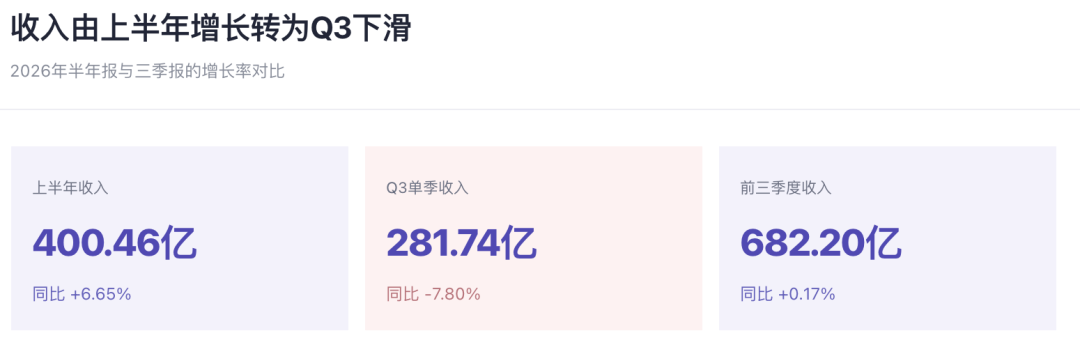
The growth momentum came to an abrupt halt in the third quarter, prompting a closer look at Goertek's product mix and production delivery rhythm to uncover the underlying reasons.
Goertek's revenue is derived from three distinct segments, each with significantly different gross profit margins.
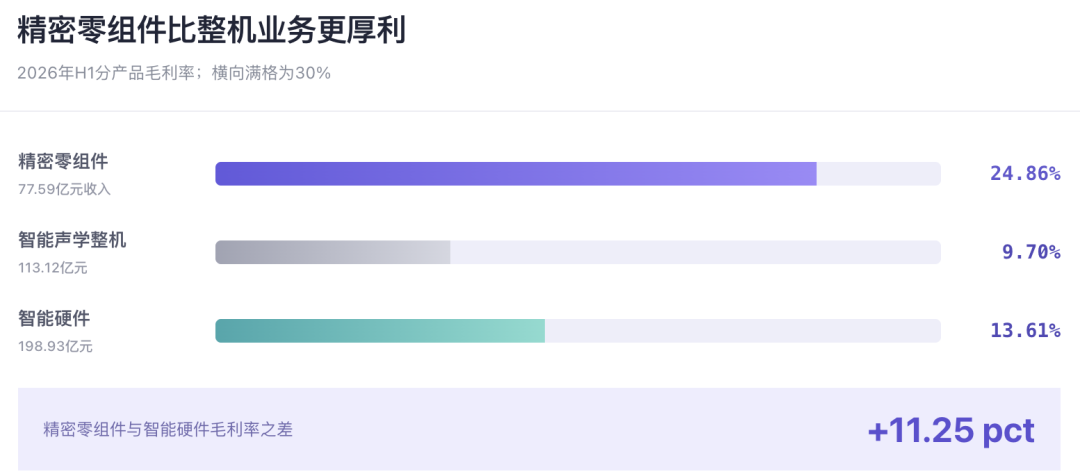
◎ In the first half of 2026, precision zero component revenue amounted to 7.759 billion yuan, with a gross profit margin of 24.86%;
◎ Intelligent acoustic device revenue reached 11.312 billion yuan, with a gross profit margin of 9.70%;
◎ Intelligent hardware revenue stood at 19.893 billion yuan, with a gross profit margin of 13.61%.
Notably, the revenue scale of precision zero components is less than half that of intelligent hardware, yet their gross profit margin is 11.25 percentage points higher.
Despite approaching 20 billion yuan in revenue, the intelligent hardware segment still experienced a 2.20% year-on-year decline in the first half.
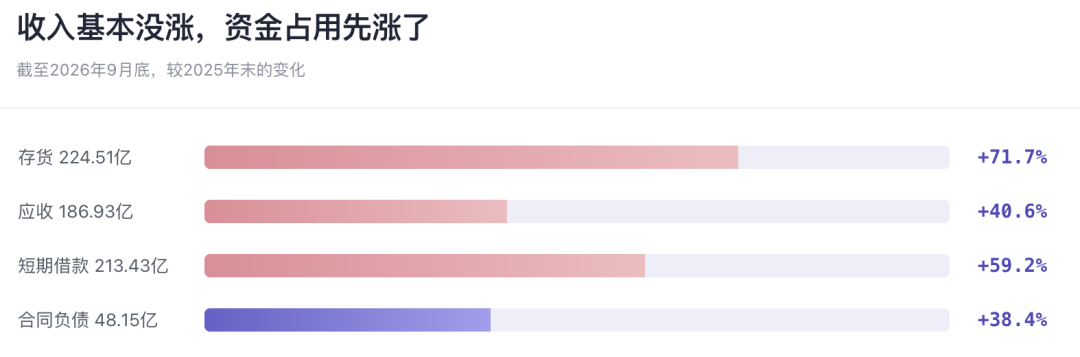
Throughout the first three quarters of this year, Goertek's revenue remained relatively stagnant, while inventory levels soared.
Inventory at the end of September reached 22.451 billion yuan, an increase of 9.374 billion yuan from the beginning of the year. Accounts receivable rose to 18.693 billion yuan, up 5.398 billion yuan from the start of the year. Short-term borrowings increased by approximately 7.933 billion yuan to 21.343 billion yuan. Meanwhile, contract liabilities surged to 4.815 billion yuan, an increase of approximately 1.335 billion yuan from the beginning of the year.
While the increase in advance payments from customers is a positive sign, the simultaneous expansion of inventory, accounts receivable, and short-term financing indicates that the operational cycle requires more funds.
Goertek operates as a global consumer electronics supply chain enterprise.
The preparation cycle for new products from large customers, from trial production and material preparation to concentrated market launch, is relatively lengthy.
Suppliers are required to purchase chips, optical components, and structural parts in advance, as well as arrange labor, equipment, and production lines. These investments are initially reflected as inventory and cash outflows and only contribute to revenue after delivery.
The change in cash flow accelerated significantly in the third quarter.
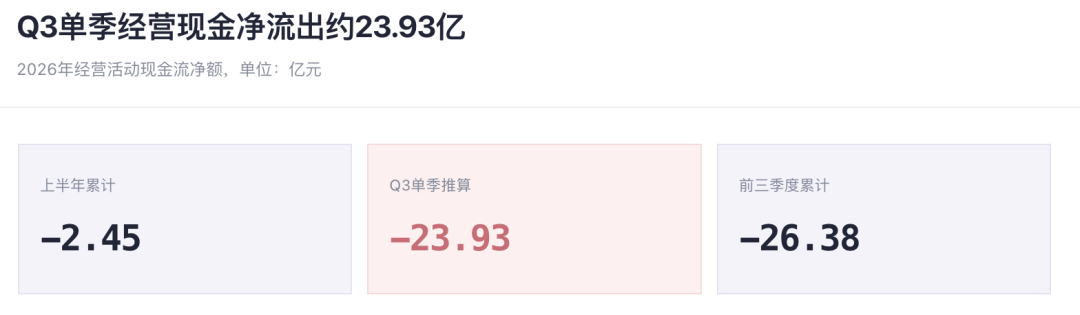
◎ Net operating cash flow for the first three quarters turned negative at 2.638 billion yuan, with only a negative 245 million yuan in the first half, calculated by cumulative subtraction.
◎ The net outflow in the third quarter alone was approximately 2.393 billion yuan (calculated by subtracting the first half cumulative value from the first three quarters cumulative value; the company disclosed that the change in cash flow was mainly affected by increased raw material purchases and production preparation expenditures).
Entering the peak period of stockpiling and delivery, Goertek utilized a substantial amount of cash. Even with customer order support, these investments must go through product delivery, acceptance, and payment collection to complete the cash cycle.
◎ Net profit attributable to shareholders in the third quarter was 1.153 billion yuan, with non-recurring gains and losses contributing approximately 156 million yuan.
◎ The company's investment income for the first three quarters reached 621 million yuan, up 55.17% year-on-year, including gains related to foreign exchange derivatives. Financial expenses soared to 960 million yuan, up 133.49% year-on-year. The company explained that this involved exchange rate fluctuations and changes in equity related to fund partnerships.
Global manufacturers must navigate exchange rates, financing, and inventory management while operating factories, all of which impact final profits.
Part 2: Where Does the Profit Lie in AI Glasses?

The value chain of AI glasses is more extended than that of traditional device orders.
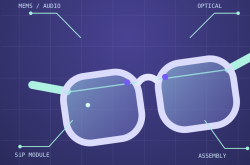
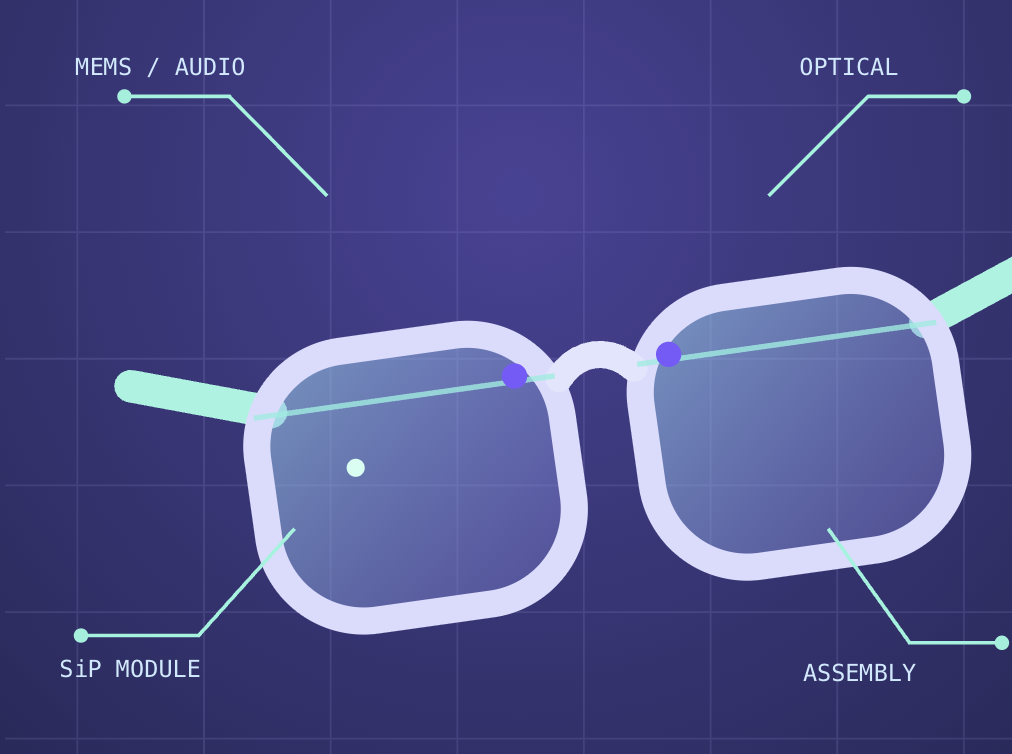
Lightweight frames necessitate multi-microphone arrays, miniature speakers, sensors, cameras, wireless connectivity, and low-power computing modules. Products with display capabilities also incorporate optical components such as waveguides.
From acoustics and MEMS to optical modules, SiP packaging, and device assembly, the value positions on the manufacturing chain vary, and no single company dominates all components in the industry landscape.
Goertek has strategically positioned itself in multiple zero components and device businesses across these key segments.
For a company, the sales growth of a pair of glasses and the number of high-gross-margin components it can supply contribute differently to profits.
The engineering constraints of AI glasses differ significantly from those of smartphones. The volume of the temple is limited, microphones must maintain recognition rates in wind noise, speakers must control sound leakage, and cameras and optical components affect weight and assembly tolerances.
New features often entail more complex materials and processes, requiring repeated balancing of power consumption, heat dissipation, weight, and manufacturing yield. If suppliers can participate in early joint design, the profit opportunities for zero components are usually better than those for only undertaking final device assembly.
Summary
Goertek's third-quarter financial report highlights a transitional period in the new hardware industry. Revenue continued to grow in the first half but fell by 7.8% year-on-year in Q3. The zero component business boasts a higher gross profit margin, while device manufacturing demands larger-scale investment in funds and capacity.
From MEMS acoustics to optical modules, from SiP to device assembly, Goertek possesses multiple capabilities to participate in the AI glasses industry chain. However, the product's popularity has not yet translated into actual delivery, gross profit, and cash collection.
-
![]()
Leapmotor’s Staff Increases by 9,732 in Just Over a Year. Can Zhu Jiangming’s ‘Mini BYD’ Outpace Geely and BYD?
-
![]()
Why Are AI Glasses So Popular, Yet Goertek's Q3 Sales Drop by 2.4 Billion Yuan with Inventory Reaching 22.4 Billion Yuan?
-
![]()
POLYVISION's IPO Review: Persistent Decline in Gross Profit Margin and Weakening Industry Outlook
-
![]()
Audi’s Strategic Split: SAIC-Audi’s Two-Year Plan Leads to Gasoline Vehicle Sales Until 2027 End | Mirror Pro
-
![]()
Racing to Become the "Pioneer Large-Scale Model Stock on the U.S. Stock Exchange": Anthropic Reports Over $80 Billion in Losses Within Half a Year
-
![]()
Wang Teng, Ex-Xiaomi Exec, Proves Prescient Half a Year Ago: Domestic Smartphone and Tablet Product Lines Face Discontinuation Wave
-
![]()
Post-2000s Female Employee Causes Stir at XPENG Launch Event
-
Anthropic Still Needs to Keep 'Sprinting'