The Start of Double 11 with AI: Merchants Foot the Bill, Users Try Out New Experiences
 10/27 2026
 377
Has AI-Powered Shopping Really Arrived?
Author|Yixiu
Editor|Xiaobai
Illustrations|Generated by AI
Produced by|Qiangdiao Next
Merchants have already started paying for AI, while the consumer side still relies on subsidies to drive orders.
At 8:00 PM on October 20, Tmall's Double 11 sale began. Four hours later, 124 brands had surpassed 100 million yuan in transaction volume. Three days later, media tests revealed that a kitchen paper towel from the same store cost 27.9 yuan on Douyin E-commerce but only 17.43 yuan after subsidies and coupons via Doubao. Qianwen's "Double 11 Help Me Choose" page also offered consumer coupons and supported in-app product selection, ordering, and payment.
A price difference of 10.47 yuan was enough to prompt consumers to switch ordering platforms. Doubao brought Douyin livestreams into chat windows and used channel discounts to attract purchases. AI began to take over the shopping process, and e-commerce's familiar subsidies followed suit.
Merchants took a different approach. On October 14, Qianwen Office launched an e-commerce version, revealing that 20% of its existing paying users came from the e-commerce industry. While consumers received discounts for shopping with AI, merchants were already paying for AI-powered operations.
This Double 11, AI commercialization first cashed in on merchants' operational budgets. A similar proportional shift has yet to occur on the consumer side. Design, operations, and analytics fees that merchants already paid have become revenue streams for AI.
For e-commerce companies, this is clearly an easier business proposition than creating entirely new consumer spending.
Coupons Move to AI, and the Battle for Entry Points Shifts
Last Double 11, Taobao and Tmall introduced six shopping guide apps, including "AI Universal Search" and "AI Help Me Choose." This year, competition has advanced to the transaction phase.
Media tests found that Doubao could recommend Douyin livestreams during conversations, while Qianwen enabled in-app product selection, ordering, and payment. This step altered the relationship between AI and e-commerce. Previously, users consulted AI before returning to shopping apps to make selections.
Now, AI entry points themselves can facilitate transactions. Whoever first addresses a user's query gains the opportunity to direct them to a specific store. Overseas, more concrete evidence of transactions has emerged.
Adobe's monitoring of U.S. retail websites showed that in July 2026, visitors arriving via AI links had a 60% higher purchase conversion rate, 53% higher revenue per visit, and 28% higher cart addition rate than those from non-AI sources.
This data tracks behavior after leaving AI and entering merchant websites. AI need not handle payments to become a commercially valuable customer acquisition channel.
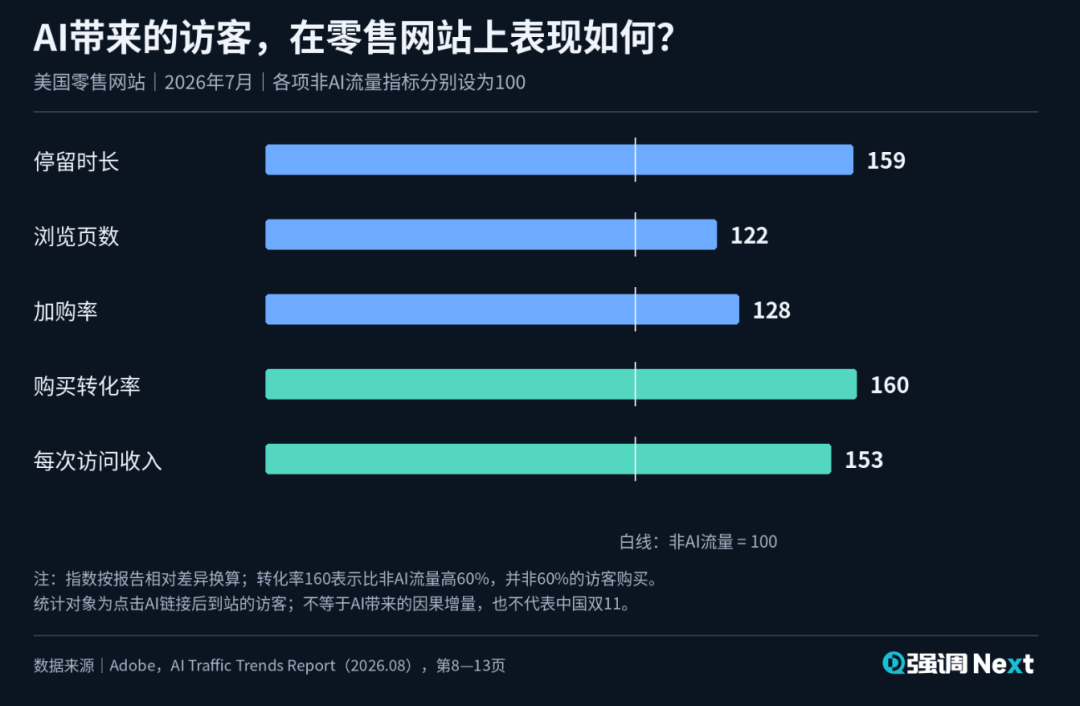
This intensifies competition among e-commerce companies, as users can complete transactions on Taobao or JD.com, but the process of filter (screening) products and deciding where to buy may occur elsewhere.
For external entry points like Doubao, influencing order destinations justifies competing for merchant budgets. For e-commerce companies, retaining payment and fulfillment does not necessarily mean they still dominate purchasing decisions.
Doubao's subsidies illustrate this competition. The aforementioned paper towels purchased via Doubao cost approximately 37.5% less than through Douyin E-commerce. Users had reason to try it even without believing AI understood products better than they did.
ByteDance is using price differences to cultivate the habit of opening Doubao before shopping. Subsidies cover the cost of users changing pathways, while Douyin merchants and livestreams handle transactions. Both companies are bringing existing e-commerce capabilities to new user interfaces.
For Alibaba, Qianwen must address consumer inquiries after they leave Taobao. For ByteDance, Doubao provides a pathway into Douyin's product ecosystem without requiring users to first watch short videos or livestreams.
However, at its current stage, AI shopping remains in early competition, heavily influenced by e-commerce dynamics. Models interpret vague demands, product libraries determine availability, and discounts influence willingness to order.
Relying solely on conversational abilities makes it difficult to wrest transactions from existing shopping channels. This explains why platforms' claims of "AI-driven transactions" must be viewed critically. A person originally planning to buy paper towels who switches to using Doubao coupons primarily represents order migration.
ByteDance gains access to a shopping entry point, and consumers save money, but this order cannot yet be fully attributed to AI-created demand. Seizing an order is easier than creating new demand.
AI shopping guides have entered this type of competition. For e-commerce companies, capturing purchasing demand from other entry points justifies the investment.
A Good Shopping Guide Doesn’t Necessarily Make a Good Salesperson
In June, a Shanghai Consumer Council survey based on 4,308 questionnaires revealed that 84.56% of respondents had tried AI shopping features, but only 16.06% believed AI could accurately match products. 38.79% reported that AI failed to meet low-price screening needs, prioritizing higher-priced items, while 29.71% noted mixed high- and low-priced products still required manual filtering.
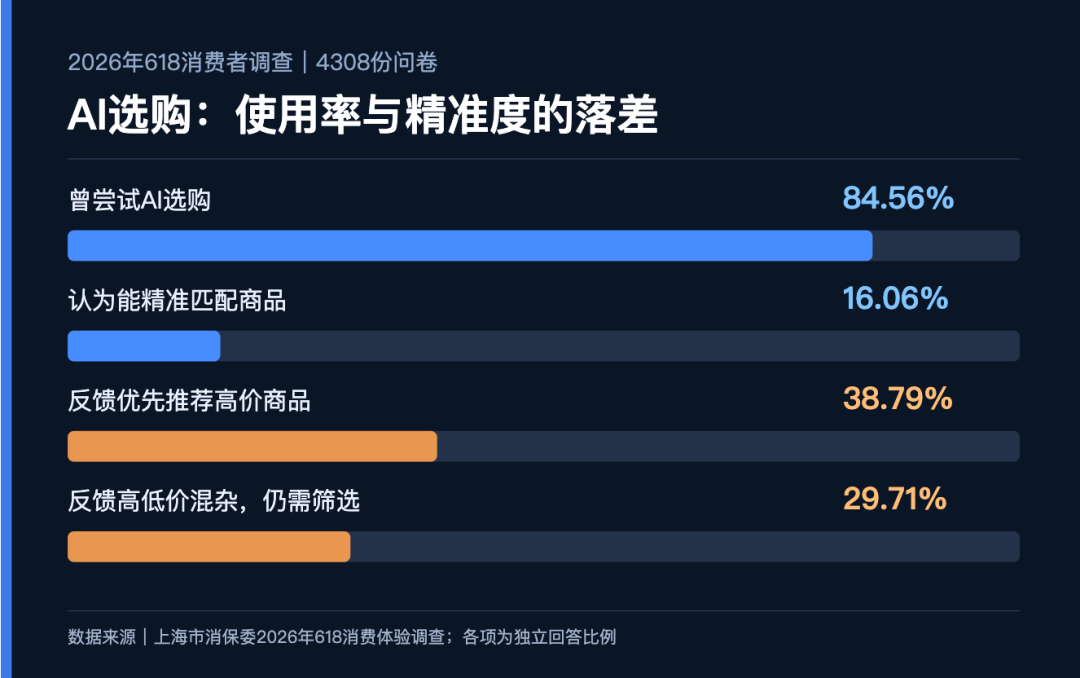
Consumers are willing to engage, but tools haven't eliminated enough work for them. After stating budgets once, users must still redo screening themselves. The longer the conversation, the more AI shopping guides' value diminishes.
Technological advancements can reduce such errors, but the fundamental issue is whose side AI shopping guides are on. Consumers want fewer mistakes and lower costs. E-commerce companies need to increase transactions, and merchants want to sell more products.
A user already has a functional computer, and AI suggesting continued use may be good advice—but it brings no orders to merchants. Recommending cheaper alternatives may help consumers reduce spending while lowering average order values.
Traditional search allows such disagreements to remain hidden among listed products, with users comparing prices manually. AI delivers a direct conclusion, shifting selection responsibility onto itself.
The more it resembles a consumer's personal advisor, the more consumers will ask: Whose interests does this advice serve? Conversational interfaces cannot resolve this conflict of interest.
E-commerce companies can recommend products in natural language, but transforming trial usage into long-term trust requires accepting that some inquiries will end with "buy less" or even "don't buy." This is precisely why consumer-facing AI is harder to monetize than merchant tools.
Merchants pay AI to manage their operations, with relatively clear tasks. Consumers using a free assistant provided by an e-commerce company to save money face inherent service goal conflicts. Even as models grow smarter, this issue will persist.
Token Storefronts: Competing for Where Customers Pay
In September, Tmall launched a Token recharge portal, with vendors like Zhipu and MiniMax gradually joining. JD.com also introduced corresponding service stations. AI services are now packaged into monthly, quarterly, and annual subscriptions, leveraging e-commerce's store and order systems for sales.
Tmall reported that on Double 11's first day, Token category transactions increased 450% month-over-month. On October 23, Yicai observed that cumulative sales of related products in Tmall's Zhipu flagship store reached approximately 300 units, while a Zhipu monthly subscription on JD.com showed over 100 units sold.
These stores are still ramping up, and 450% growth is far from indicating Token products have become mass-market hits.
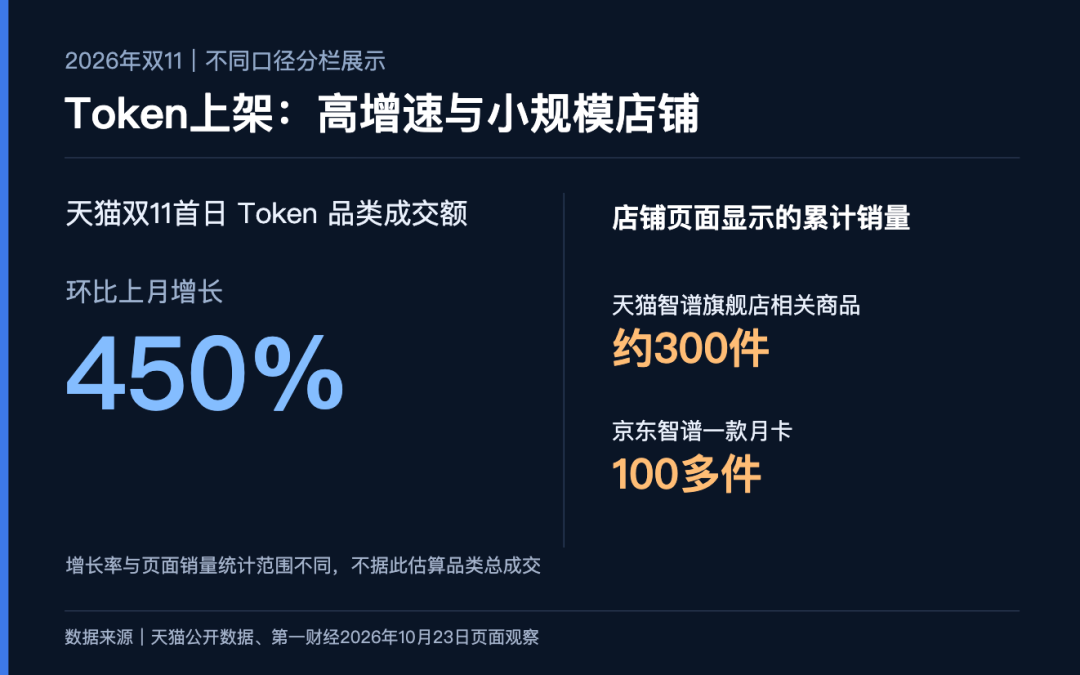
Tmall has not rushed to grow this category with subsidies. President Jialuo stated in an interview that no specific discount investments are planned for this category. Compared to attracting orders with channel coupons on the consumer side, Token storefront investments are clearly more restrained.
Here, competition focuses on the purchasing pathways for existing paid demand. Those needing model services previously paid on vendor websites but can now buy on Taobao or JD.com.
E-commerce companies first establish transaction entry points, then strive to keep package comparisons, purchases, and renewals within their systems. This resembles the channel competition for consumer shopping habits but targets model users instead.
Token sales measure how many AI service orders e-commerce channels secure, not whether AI shopping guides understand consumers or represent overall AI commercialization progress.
Mixing these two business types creates an illusion: stronger AI product sales equate to better AI salesmanship. In reality, Taobao could find new operational opportunities through AI service transactions even if consumers still distrust AI recommendations.
Saving on Content Costs, Paying More for Customer Acquisition
The composition of Qianwen Office's paying users explains why Alibaba prioritized integrating an industry version into e-commerce. Merchants don't need AI to prove it can create consumer demand before deciding to purchase.
Product detail pages must be created, operational data analyzed, and products tested. If AI can deliver these tasks at lower costs, it gains entry into existing budgets.
Liu Xianglong, a women's shoe merchant featured in Qianwen Office's promotional materials, said AI reduced the timeline for launching a 3D-printed shoe store from 30 days to 7 days, with costs dropping from 30,000–50,000 yuan to a few hundred yuan in Token fees.
This merchant case study highlights changes in operational sequencing: some market research and promotional materials can be completed in advance, allowing merchants to validate ideas more cheaply before committing to production and inventory funding.
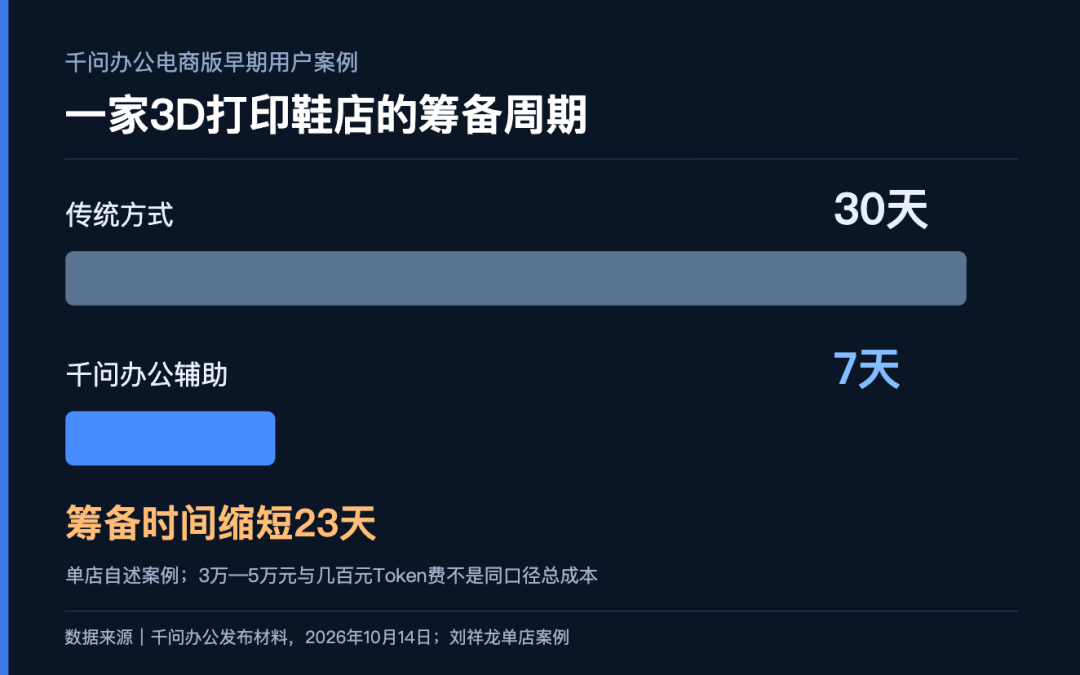 Merchants purchase a more affordable trial. Even if new products fail to sell, completed materials and analyses retain value. AI service providers can thus receive payment before products generate sales.
Alibaba's further integration of tools like Business Advisor, Qianniu, Youzan, and Alimama's Wanxiangtai extends functionality from content creation to operations and advertising. After creating materials, merchants can analyze performance and adjust budgets without leaving the tool ecosystem.
This allows AI to participate in operations continuously, not just during store setup. A deeper change is that while AI reduces production costs, e-commerce competition doesn't necessarily become cheaper. A store producing ten content pieces daily can be matched by competitors.
With product images easier to create, consumer attention remains limited, forcing merchants to compete for exposure and clicks. As content supply increases, the importance of screening and advertising rises. Savings on production costs may be offset by subsequent customer acquisition competition.
For Alibaba, this creates two revenue opportunities: Qianwen Office handles tool budgets, while Alimama manages advertising budgets.
Merchants save in earlier stages, enabling continued investment in later stages. AI improves operational efficiency, increasing incentives for merchants to remain within this operating system.
Thus, "AI helps merchants reduce costs" only tells part of the story. Determining who benefits from efficiency gains decides whose situation AI ultimately changes.
Tool service providers receive subscription fees upfront, e-commerce companies control traffic allocation, and merchants must continue competing against increasingly efficient rivals.
This Double 11, merchants represent AI's clearest group of payers. How much profit they retain remains uncertain—cheaper image creation is just the beginning, with customer acquisition costs still looming.
- END -
-
![]()
Leapmotor’s Staff Increases by 9,732 in Just Over a Year. Can Zhu Jiangming’s ‘Mini BYD’ Outpace Geely and BYD?
-
![]()
Why Are AI Glasses So Popular, Yet Goertek's Q3 Sales Drop by 2.4 Billion Yuan with Inventory Reaching 22.4 Billion Yuan?
-
![]()
POLYVISION's IPO Review: Persistent Decline in Gross Profit Margin and Weakening Industry Outlook
-
![]()
Audi’s Strategic Split: SAIC-Audi’s Two-Year Plan Leads to Gasoline Vehicle Sales Until 2027 End | Mirror Pro
-
![]()
Racing to Become the "Pioneer Large-Scale Model Stock on the U.S. Stock Exchange": Anthropic Reports Over $80 Billion in Losses Within Half a Year
-
![]()
Wang Teng, Ex-Xiaomi Exec, Proves Prescient Half a Year Ago: Domestic Smartphone and Tablet Product Lines Face Discontinuation Wave
-
![]()
Post-2000s Female Employee Causes Stir at XPENG Launch Event
-
Anthropic Still Needs to Keep 'Sprinting'