Physical AI Fuels Optical Components! Yongxin Optics Reports 37.43% Surge in Q3 Net Profit
 10/27 2026
 328
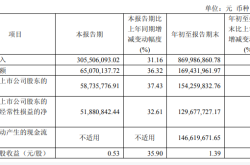
On October 26, Yongxin Optics released its third-quarter financial results for 2026. During Q3 2026, the company achieved revenue of RMB 306 million, marking a year-on-year increase of 31.16%. Net profit attributable to shareholders reached RMB 58.7358 million, up 37.43% from the same period last year, while core net profit (excluding non-recurring items) climbed to RMB 51.8808 million, representing a 32.61% year-on-year rise.
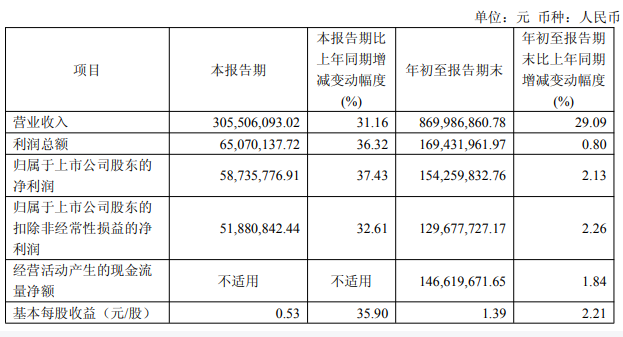
For the first nine months of the year, net profit attributable to shareholders stood at RMB 154 million, showing a modest 2.13% year-on-year increase, with core net profit growing by 2.26%. The significant leap in profit growth in Q3 alone highlights a pivotal shift—the translation of revenue expansion into tangible profits was fully realized for the first time, following the mitigation of exchange rate losses.
This transformation is not an isolated event. In the first half of the year, Yongxin Optics reported revenue of RMB 564 million, up 28% year-on-year, but net profit attributable to shareholders decreased by 11.80% year-on-year, mainly due to exchange rate losses amounting to approximately RMB 33 million. Excluding government subsidies and exchange rate fluctuations, net profit attributable to shareholders increased by 24.9% year-on-year. This indicates that the improvement in core operating profits did not commence in Q3; rather, Q3's importance lies in its clear manifestation.
Analyzing the growth drivers, LiDAR emerges as the most dynamic factor. In the first half of the year, Yongxin Optics' LiDAR optical component revenue more than doubled year-on-year, bolstered by deep partnerships with global leaders such as Hesai, Innovusion, and Valeo. Product applications have expanded from automotive use to service robots, unmanned delivery, dexterous hands, and other general robotics sectors.
The significance of this expansion lies in the diversification of incremental revenue sources: While the adoption rate of automotive LiDAR is subject to vehicle model cycles, the growth trajectory of general robotics scenarios aligns more closely with the industrial proliferation of physical AI, characterized by steeper and more fragmented demand curves. This directly challenges the capacity flexibility and rapid delivery capabilities of optical component suppliers.
It is important to note that the absolute scale of general robotics scenarios remains relatively small. Public information suggests that clients like Hesai and Innovusion still derive the majority of their revenue from automotive front-end installations in the short term, so the current impact on revenue should not be overestimated.
Meanwhile, the microscope business acts as a profit stabilizer. In the first half of the year, microscope revenue reached RMB 170 million, up 3.13% year-on-year, with the proportion of high-end microscope sales rising to 45%. The localization rate of four-color laser confocal microscopes reached 96%, and the domestic market share climbed from 0% to 7%.
From a broader perspective, Yongxin Optics' '3+2' business model (optical microscopes, barcode machine vision, and LiDAR as the three core businesses, with medical optics and professional optics as two emerging sectors) positions its business across several rapidly growing and intersecting areas within the optics industry.
The professional optics segment encompasses semiconductor optics and professional imaging, with semiconductor optical products covering key processes such as photolithography and metrology. Orders for core subsystem components for photolithography equipment remain strong. In barcode machine vision, the company is transitioning from a Tier 2 component supplier to a Tier 1 module supplier, with bulk deliveries of complex modules beginning to drive up unit prices and enhance customer loyalty in this segment.
A key variable to monitor is the structural change in gross profit margins. In the first half of the year, the consolidated gross profit margin was 35.71%, down 4.62 percentage points year-on-year, primarily due to the increased proportion of low-margin barcode scanning modules. While modular upgrades are a positive signal for revenue growth, whether their dilutive effect on gross margins can be gradually offset by economies of scale and yield improvements will determine the sustainability of profit growth acceleration. Q3 data suggests a positive trend, but one quarter of improvement is insufficient to confirm a lasting shift.
The core takeaway from Yongxin Optics' Q3 report is whether the profit improvement is genuine and sustainable. The 37% profit growth in Q3 alone, coupled with doubled LiDAR growth and high-end microscopes nearing half of sales, provides initial validation.
Demand for optical components driven by physical AI is just entering an acceleration phase. The ultimate impact of modularization on gross margins and whether general robotics scenarios can generate bulk orders beyond automotive applications will serve as the next set of benchmarks for assessing the resilience of this optical precision manufacturing leader.
-
![]()
Q3 Report | Shannon Semiconductor’s Revenue Tops 100 Billion, Net Profit Soars Nearly 14-Fold Amid Storage Business Expansion
-
AI-Driven Computing Power Propels Segment Leader’s Q3 Net Profit Up by 160.77%
-
Anthropic Unveils IPO Prospectus, Reveals $16.3 Billion in H1 Revenue
-
![]()
The Largest IPO in History is Imminent: Tencent, Alibaba, and ByteDance Compete for Cards as Anthropic and Chinese Giants Go All-in on Computing Power
-
“Scoring High” Doesn’t Equate to “Deliverability”: AI Leaderboards Are Undergoing a Credibility Reassessment
-
![]()
Jiemei Technology Unveils Massive 2.684 Billion Yuan Investment to Boost Optical-Grade BOPET Film and High-End MLCC Release Film Production!
-
![]()
Physical AI Fuels Optical Components! Yongxin Optics Reports 37.43% Surge in Q3 Net Profit
-
![]()
Raising 1.3 Billion Yuan, Former Doubao Leader Embarks on New Journey: Developing an AI Assistant, Yet Profitability Still a Hurdle