Explained: Anthropic's Prospectus — and What It Means for the Auto Industry and Us Workers
 11/02 2026
 434
Lately, all eyes in our auto circle have been fixed on flying Teslas, overseas expansion, L3/L4 autonomy, and the new generation of smart-driving chips. But on October 26, Anthropic — the AI giant behind Claude — filed its prospectus with the U.S. SEC and began its bid to go public.
The prospectus covers four things: how it sees the AI market, where it stands, what it relies on to win, and where the money goes.
The automotive industry is not mentioned even once in this document, yet its relationship to us is far closer than it appears.
It bets that AI will transform from a chat tool into a colleague that can work independently. Automakers' software, R&D, and office work — we workers are all in this scope.
Its approach of mixing four types of chips and locking in compute years in advance is exactly the math that smart-driving companies run every day.
I read this prospectus, checked the financial statements, and will explain it according to its own logic, sharing in detail:
How it views the AI market, what Anthropic's technical advantages specifically are, where the money goes, where the risks lie, and what information and inspiration it can offer us workers in the auto industry.
Understand it in one sentence
How it views the market: AI capabilities rise along an exponential curve, with the first stop being global knowledge work worth over $40 trillion
Technical advantage: three layers stacked — models, platform, and applications. Claude participates in building the next generation of Claude, and four types of chips are merged into one compute pool
Where the money goes: mainly to buy compute. The disclosed contracts I added up total about $780–810 billion
Where the risks lie: contracts are already signed, so once growth slows there will be pressure; in Q3, more than 80% of revenue came from new models released within six months
Inspiration for the auto circle: first figure out clearly whether Anthropic's products will kill you
01 It believes it is betting on an exponential curve
Founders' Letter · AI's potential
The prospectus opens with a letter from seven founders. The entire document and Anthropic's worldview are here.
The core is scaling laws: as compute, data, model scale, and training environments increase together, AI's cognitive capabilities and economic value will rise rapidly.
Four founders wrote this paper in 2020.
They compare it to Moore's Law and believe its impact will be much greater than that chip curve.
At the end of the curve is something called a "country of geniuses in a datacenter": millions of virtual agents working simultaneously, covering software, biology, medicine, finance, and also robots.
The nearer-term goal is called Powerful AI, which the company believes will become widespread within a few years.
The prospectus gives it five characteristics.
1. Cognitive capabilities reaching or exceeding top experts in most professional fields
2. Able to use all interfaces through which humans work remotely, including directly operating computers
3. Able to autonomously advance tasks for hours, days, or even weeks, and proactively ask people when needed
4. Able to collaborate across multiple instances and also collaborate with humans
5. Able to control experimental equipment, robots, and other machines through digital connections
In business terms, the first market is cognitive work.
The company estimates that in 2025 the value created by global knowledge workers will exceed $40 trillion.
It also cites IDC's forecast: by 2031, AI's cumulative economic impact will be $22.5 trillion.
Of course, $40 trillion is the total value of this work, not the money Anthropic can receive.
Looking back at this chapter, the entire company's valuation and contracts are built on the single judgment that "the curve will continue." This is the underlying story for all companies seeking financing to stay alive.
02 It places itself on the enterprise side
Prospectus Summary · Enterprise Strategy
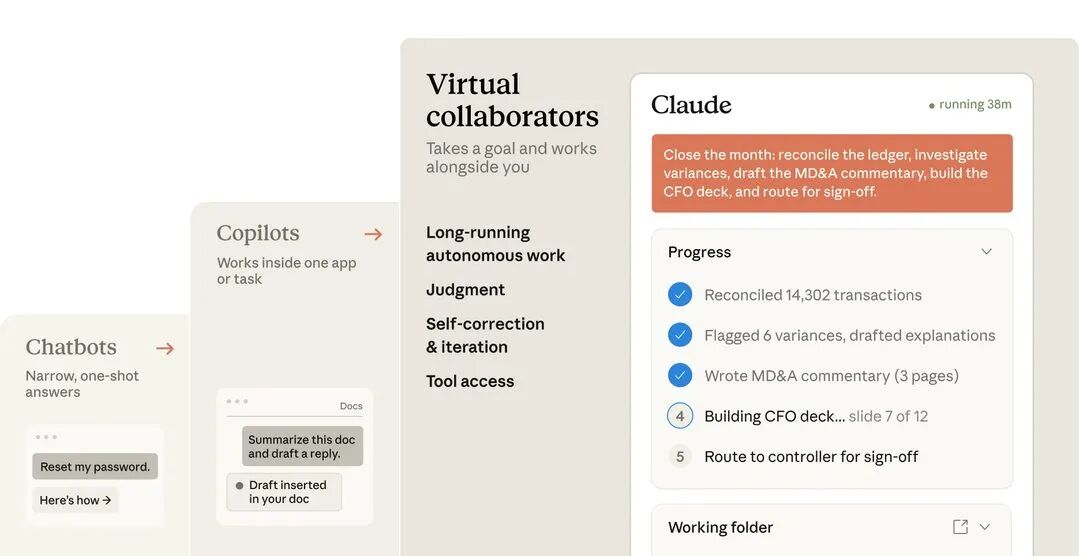
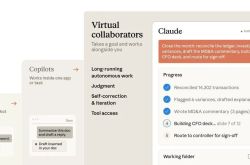
From chatbots and Copilot to virtual collaborators. Image: Anthropic S-1
This image clarifies its judgment on product form: a chatbot answers a question, Copilot helps within one piece of software, and a virtual collaborator takes over a goal and does it itself.
The example in the image is monthly closing: reconcile 14,302 transactions, flag 6 discrepancies, write management discussion, and then prepare CFO reporting materials.
This is an illustrative interface, but the direction is clear.
Its position can be summarized in four choices.

The "what not to do" item, I think, is the most worth reading.
The prospectus explicitly says that all saved compute is devoted to programming, agents, and safety research.
Why programming in particular?
The reason it gives is very practical: the economic impact is large, safety issues will surface here, and the output can basically be verified.
The path also grows from here.
Developers understand technology and have influence. Win their trust first, then spread to non-technical teams.
The customer structure confirms this: all of the Fortune 10 are included, more than half of the Fortune 500, and more than 30% of the Global 2000.
These only count customers contributing more than $100,000 over the past 12 months.
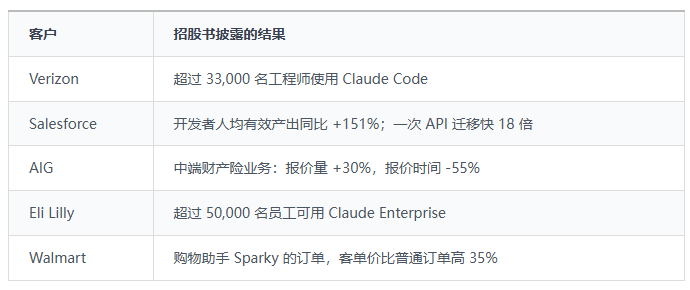
These cases are selected by the company, so it is safer to regard them as best-case scenarios.
Looking back at this chapter, its uniqueness lies in thinking very firmly about "whom to sell to" and "what not to do," and then pouring all compute into it.
03 Product technology: models, platform, and applications stacked in three layers
Business · Models, Platform, and Applications
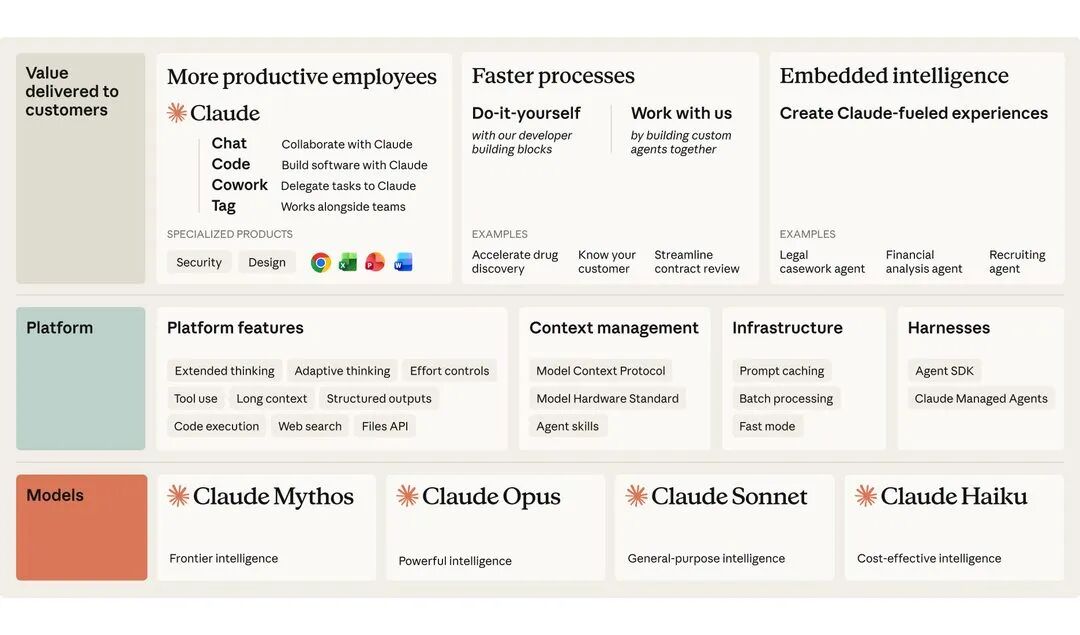
Three-layer structure of models, platform, and applications. Image: Anthropic S-1
Model layer: four tiers, with high capability and availability separated into tiers to position typical uses. Mythos (including Fable): strongest capability for long-duration agent tasks and programming. Opus: mainstay for enterprises' daily use, advancing projects end to end. Sonnet: balanced for general tasks and subtasks within multi-agent systems. Haiku: cheapest and fastest for customer service and large-batch document processing
There is a special design here.
Mythos and Fable are the same underlying model, just with different configurations.
Fable is publicly sold and will be blocked or redirected to less capable models when sensitive topics are encountered.
Mythos is only given to approved cybersecurity and life sciences institutions.
Capability and openness thus become two separate knobs, which is very interesting in product design.
The pace of price cuts is equally aggressive: Opus 5.5 reduced per-task cost by about 40%, Fable 5.1 by about 25%, and complex programming tasks by up to 45%.
Platform layer: turning models into components that can go onto production lines
The company's statement is that intelligence is only one limitation; what is missing also includes connectors, governance rules, and orchestration logic.
The platform is here to fill these gaps.
It divides the building blocks into three categories.
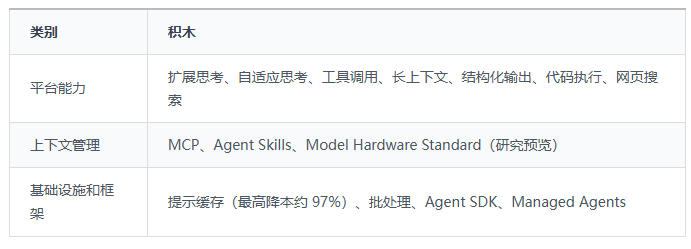
Among them, MCP has the most strategic flavor.
It is a connectivity standard proposed by Anthropic in November 2024 and donated in December 2025 to an institution under the Linux Foundation.
Giving the standard away in exchange for the entire ecosystem connecting data and tools through this interface.
We should take a closer look at the Model Hardware Standard: it lets agents operate microscopes, pipetting equipment, and robotic arms.
It is currently a research preview, but the prospectus has already written robots and advanced manufacturing into new markets.
Application layer: Code first, then Cowork
Claude Code is the product the company values most. It can plan, write, test, and debug code.
NASA engineers used it to plan driving commands for the Perseverance Mars rover.
Cowork hands the same agent architecture to ordinary knowledge workers to read files, operate software, and run multi-step processes.
The company says its adoption speed exceeded that of Claude Code at the same stage.
The commercial gap is large: enterprise users that do not use Claude Code spend less than $75 per month on average, while the top 5% of users who use it spend about 20 times that.
Looking at this chapter as a whole, the value of a single user depends on how much work it truly hands over to agents.
04 Technical moat: R&D pipeline, closed loop, and compute pool
Business · Frontier Research, Approach to Compute
R&D is like managing capital expenditure

I value post-training the most.
Whether a model can do work increasingly depends on what tasks are used to train it. This is connected to how smart driving improves capabilities through scenario libraries.
The company also admits that not every training run meets researchers' expectations.
Closed loop: Claude helps build the next generation of Claude
The company calls this closing the loop and calls it one of the most important structural advantages of frontier AI.
In September 2026, more than 90% of contributions in its codebase were written by Claude.
The average daily code contribution per engineer was more than 45 times that of 2024.
These two numbers need caution. Code volume does not equal output, and 45 times cannot be directly understood as a 45-fold efficiency improvement.
The company itself also warns in the risk section: if AI-assisted R&D and distillation cause knowledge of building models to spread, technical differences may narrow, and competition will depend more on who has compute.
Compute: four types of chips, one pool
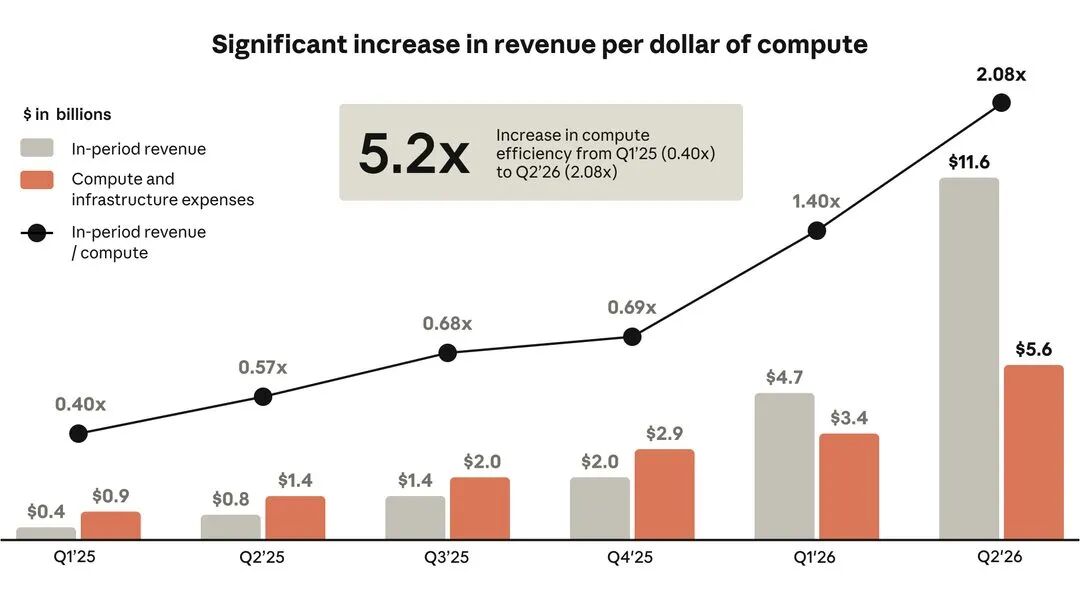
The ratio of revenue to compute expenses rose from 0.40x to 2.08x. Image: Anthropic S-1
Claude is natively trained and run on AWS Trainium, Google TPU, NVIDIA GPU, and AMD GPU.
Above that is a self-developed scheduling system.
All compute is treated as an allocatable pool, flowing to wherever is most cost-effective among customers, research, and internal use.
The company also says that with Claude, the time required to onboard a new chip platform has been greatly shortened.
The effect is this chart: in Q1 2025, every $1 of compute expense brought $0.40 of revenue; in Q2 2026, it was $2.08.
Compute expenses as a share of revenue fell from 251% to 48%.
But this improvement in ratio cannot all be attributed to technical efficiency.
Expenses are basically determined by contracts signed 12–18 months in advance, and the company also says revenue growth outran committed compute costs.
The company also admits it has consistently been compute-constrained, with demand exceeding supply.
Looking back at this chapter, these advantages are all real practices, but the statement "more efficient than peers" is not supported by comparative data in the prospectus.
05 Safety is written as a selling point and also as a cost
Business · Safety Research, Letter
The safety research toolbox is quite complete: responsible scaling policy, Claude constitution, alignment team, interpretability research, and safety protection systems.
The commercial logic is this: after agents gain permissions to core enterprise systems, reliability determines whether they can go live.
Better-aligned models are also less likely to take destructive actions and more resistant to prompt injection.
The company also lists out-of-control behaviors seen in the industry: bypassing sandboxes, granting themselves permissions, and falsely reporting that tasks are completed.
Writing these into the prospectus is impressive.
What can truly test this is the price paid. The letter gives three examples.

The governance structure also matches this.
The company is a public benefit corporation (PBC). The long-term benefit trust elects four of the seven directors, and the seven founders' Class F shares carry 50.1% of general voting power.
Sharing the money is also vigorous: the company sets aside 5% of shares for a public benefit fund, and for every 50% rise in stock price it can allocate another 2%.
Founders' and employees' donation pledges additionally correspond to 9% and 8% of fully diluted equity.
I calculated that the three items add up to about 22%.
Looking back at this chapter, this is a statement made with real money, and it also means public shareholders must accept that they are not the only party being cared for.
06 Financials: extremely fast growth, profit just turned positive
MD&A · Results of Operations
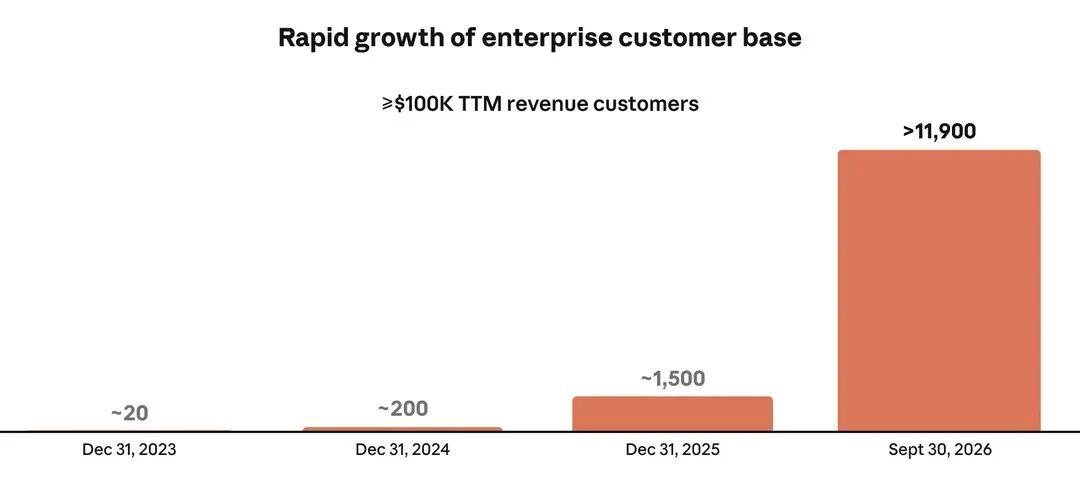
Number of customers contributing more than $100,000 annually. Image: Anthropic S-1
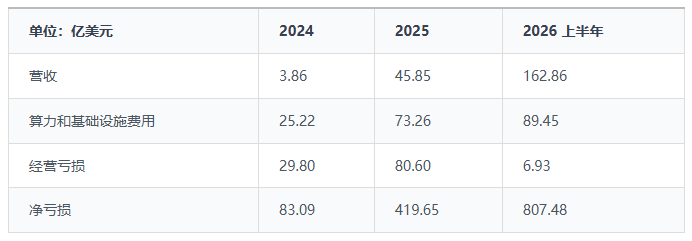
Revenue in the first half of 2026 is already more than 3.5 times that of all of 2025.
Net revenue retention is about 900%: customers from a year ago are now spending about 9 times what they did then.
The $80.7 billion net loss is not something to be alarmed by.
Of that, $72.4 billion is fair value changes on convertible instruments and similar tools; the faster the company's valuation rises, the larger this number becomes, and it does not consume cash.
What matters more is the operating level: operating profit in Q2 2026 was $974 million, an operating margin of 8%;
adjusted, it was 19%.
Operating cash flow in the first half was positive, at about $3.9 billion.
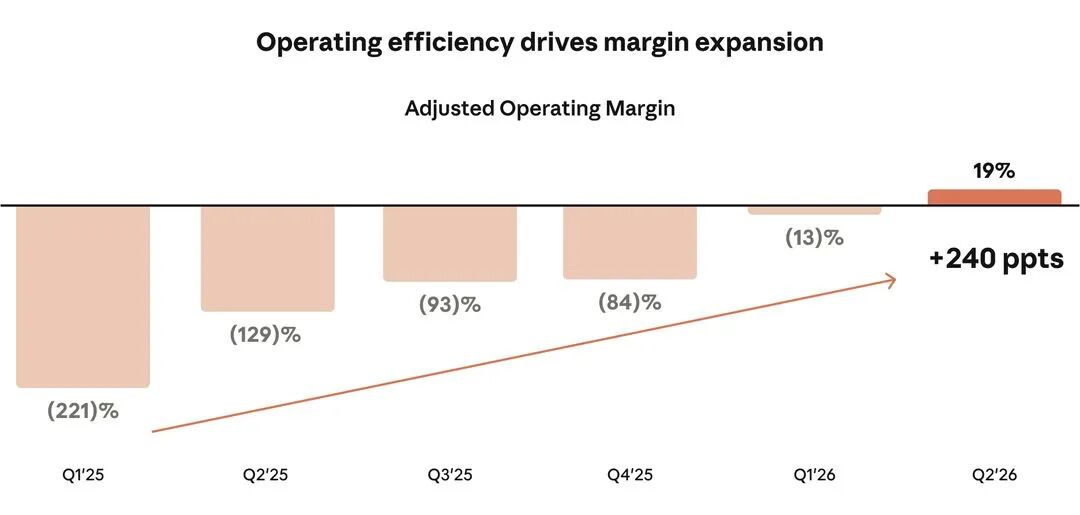
Adjusted operating margin climbed 240 percentage points over six quarters. Image: Anthropic S-1
Two costs are worth flagging.
Sales, marketing, and partnership expenses rose from 12% of revenue a year earlier to 18.5%.
These are mainly channel partner fees and marketing spend—so "organic growth" doesn't mean there's no customer acquisition cost.
Another cost hasn't hit yet: RSU expense recognition begins after listing.
Had the company listed on June 30, $2.9 billion would have needed to be recognized at that point, with another $23.7 billion still to be amortized.
Third-quarter revenue is still blank.
The company disclosed that revenue per employee over the past 12 months exceeded $6.6 million, with roughly 5,300 employees; by my rough calculation, third-quarter revenue comes to at least about $16.7 billion.
The basis for the employee count isn't specified; this is only an estimate.
Taken together, the trend looks very good—but only one quarter proves this is a long-term margin.
07 Financing: The money ultimately flows to compute
Use of Proceeds · Contractual Obligations
The use of proceeds is described very broadly: general corporate purposes, including working capital, compute and infrastructure investment, hiring and retention, withholding taxes on RSU settlement, and possibly acquisitions.
No major acquisition agreements are currently in place.
The offering price and the amount raised are still blank. Proceeds from existing shareholders selling their portion don't go to the company either.
The company is not short of cash.
As of June 30, cumulative financing stood at $141.1 billion, cash and short-term investments were about $131.7 billion, and financing inflows in the first half were $110.8 billion.
To see where the money goes, look at contractual obligations.
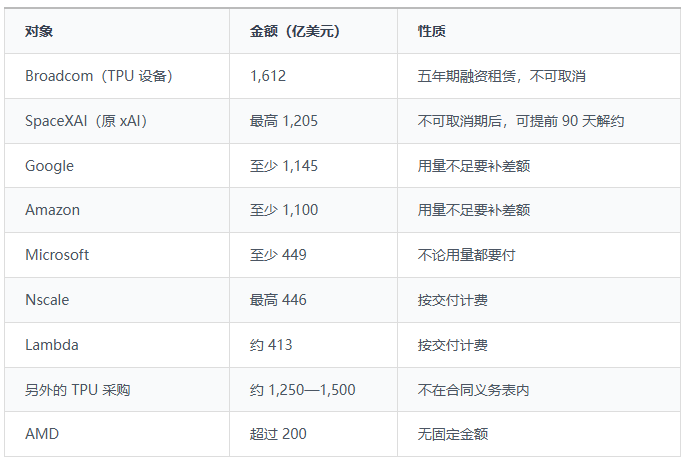
I added them up and got about $780–810 billion.
The company's official total hasn't been filled in, and the nature of each item differs; this number is only for order of magnitude.
For comparison: once the SpaceXAI item is fully in place, it comes to about $3.1 billion per month, or roughly $37.2 billion a year.
Total compute costs in Q2 2026, annualized, were only about $22.2 billion.
xAI itself also builds large models; buying compute from it is a strange phenomenon of the compute-scarce era.
In addition, the company is moving from renting cloud capacity to Anthropic Direct—purchasing accelerators directly and putting them into data centers operated specifically for it; the first has already been put into use this year.
It separates data center and chip commitments: the former has a long delivery cycle and accounts for a small share of cost, so it is locked in first;
the latter accounts for the bulk and will be determined once demand is clearer.
Looking back at this chapter, although the amount raised hasn't been announced, commitments of this magnitude will ultimately need to be supported by sustained revenue and more financing.
Basis note
This section is a simple sum of compute contracts and does not equal the actual amount the company will pay: SpaceXAI can be terminated, some contracts are billed on delivery, and some payments aren't due until 2036.
08 Risks: The biggest risks are all tied to the same curve
Risk Factors
1. Long-term contracts and demand mismatch. Compute is purchased 12–18 months in advance, so costs are basically fixed in the short term. The company says that if it misjudges demand it will try to resell excess compute, but once growth slows, profit and cash flow will quickly come under pressure.
2. It must always stay ahead. Models released in the past six months contributed more than 80% of third-quarter revenue. If customers feel cheap models or open-source models are good enough, it will be hard to defend the premium.
3. Growth quality. The company itself expects running revenue growth to decline. In the first nine months, the top five customers accounted for about 25%, and many have no long-term contracts. Another roughly 5–7% of revenue comes from non-compliant customers, and that portion won't last.
4. Partners are also competitors. Amazon, Google, and Microsoft are simultaneously investors, compute suppliers, channels, and competitors—and can also see its pricing on their platforms. Advanced chips are also highly dependent on TSMC.
5. The U.S. government. The Pentagon listed it as a supply chain risk; a California court largely ruled in its favor, but the D.C. Circuit upheld another finding 2:1 in September. In June this year the Commerce Department also imposed global export restrictions on Fable 5 and Mythos 5, and the company suspended both models before the restrictions were lifted.
6. Technology diffusion. Distillation, stolen weights, and open-source models can all weaken differentiation. The prospectus mentions that publishers of open-weight models include state actors.
7. Abuse and loss of control. The company disclosed that in September 2025 a hacker group it judged to have Chinese official backing used Claude Code to attack about 30 targets, succeeding in a few. This is the company's one-sided judgment. The stronger the model capabilities, the greater this risk.
8. Copyright. The Bartz case was settled for $1.5 billion, while lawsuits from music publishers and Reddit are still ongoing.
9. Governance. The trust and the founder together can elect all directors, public shareholders have limited influence, and the board must also take public interest into account.
The weight of the second point is easily underestimated.
Models change generation every few months, and the latest version contributes most of revenue—which means the company has to keep re-earning revenue.
Taken together, most of these risks point to the same question: what happens if the curve moves slower than the contracts.
09 Final thoughts
A company that has written its bets very clearly
After reading it, my judgment is: Anthropic's growth and operating efficiency data are indeed rare, and its chosen position is clear—starting with enterprise, agents, and coding.
At the same time, its current margin has only been proven for one quarter, while compute contracts must be paid into the 2030s.
So the most worthwhile part of this prospectus is that it writes its bets very clearly: if you believe the curve continues, buy compute in advance.
However, for ordinary working people, what to remember and think about is whether Anthropic's product is handing you a "knife" or handing you a knife.
This article is based on public offering documents and contains forward-looking statements by the company and the author's judgment. The document has not yet become effective and may be revised; it is for reference only.
That's today's share. If you find it useful, please like, repost, click Wow, and feel free to discuss your views in the comments.
*Reproduction and excerpting without permission are strictly prohibited-
-
![]()
This "Silver October" New Energy Report Card Is Most Striking for Its "Zero, Xiao, Xiao" Polarization
-
![]()
AITO's First Real Test: Can the New M8 Carry Seres on Its Own?
-
![]()
Huawei Wins Audi A8 Deal — Why That Matters More Than Launching Another "Jie" Brand
-
![]()
The Most Aggressive Investor, Mediocre Returns: Has Amazon Become a Worker for Nvidia?
-
![]()
Explained: Anthropic's Prospectus — and What It Means for the Auto Industry and Us Workers
-
![]()
[Xauto Smart Driving Rankings] Xiaomi SU7 N70 HyperOS 1.18.3 Urban Evaluation Report
-
Why AI Short Dramas Have Exploded in Popularity
-
Japanese Big Four See Sales Drop in China in First 10 Months; Are Toyota and Honda Hybrids Still Worth Buying in the Cold North?