AITO's First Real Test: Can the New M8 Carry Seres on Its Own?
 11/02 2026
 504
The AITO New M8 is set to launch on November 13, with presales starting at 389,800 yuan.
This is the first vehicle rolled out under AITO's new "exclusive dedicated operation" partnership model. The official line: Seres takes the lead on product definition, design, channels, and services, while Huawei Terminal plays a supporting, enabling role.
But how much weight the word "lead" actually carries in the marketplace—the new M8 will be the first real test case.
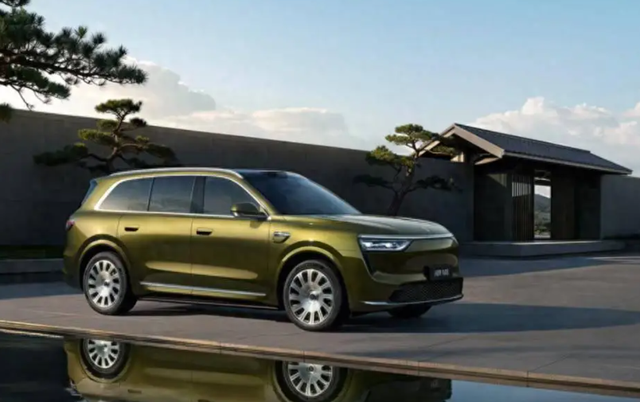
On September 15, HIMA and AITO announced an adjustment to their cooperation model, with AITO shifting to exclusive dedicated operation. On September 30, the two sides signed the agreement in Shenzhen. On October 1, they officially announced a new five-year partnership and jointly formed a dedicated team for AITO's business. Both Yu Chengdong and Zhang Xinghai were present.
Publicly, AITO remains a member of HIMA. In reality, however, Seres has taken back operational leadership, while Huawei has retreated to an enabling role.
What makes this launch so significant is not the literal adjustment of the cooperation model, but the sales trajectory of the outgoing M8.
The M8 hit a peak monthly sales of 21,564 units in July 2025, then slid steadily downward: 7,381 units in January 2026, a brief rebound to 6,889 in April, then a continued fall to just 1,435 units in August and 1,216 in September.
From 21,000 units to 1,200—a 90% drop in fourteen months.
What the AITO New M8 must pull off is a ground-skimming takeoff.
I. "AITO" Must Prove Its Brand Premium on Its Own
The new M8's entire lineup has switched to an L3-oriented architecture. The main roof lidar has been upgraded from 192 lines to 896 lines, with four lidars and 38 sensors across the vehicle. Huawei Qiankun ADS 5 remains onboard, alongside 800V architecture, rear-wheel steering, and a combined range of 1,435 kilometers for the range-extender version. Officials say 1.5 billion yuan was invested in the facelift.
By comparison, the Li Auto L8 starts in the 320,000 yuan range, and the Denza N8L fast-charging version starts at 319,800 yuan. The new M8's 389,800 yuan sits at the upper edge of this price band.
There are legitimate configuration reasons for the price increase. The problem is that the increase comes at the very moment when brand endorsement is at its weakest.
In the past, AITO's premium pricing logic rested largely on the phrase "Huawei runs the show."
When consumers walked into a Huawei store and saw a car, the trust transmission chain was very short, and the discount cost of brand premium was very low. Now that Seres has taken back operating rights, Huawei's name is still on the technology list, but no longer in the operator's seat.
One customer who had already paid a deposit said in the community: "People buy AITO for Huawei. If Huawei steps back, why should consumers accept such a high premium?"
Such voices may not represent all orders, but they point to a real problem: when "Huawei's car" becomes "a car led by Seres and enabled by Huawei," the 389,800 yuan price tag needs to answer a new question:
"On what grounds?"
The new M8's small orders exceeded 10,000 units within 24 hours of presale—not a cold start by current market standards. But compared with the first-generation M8's 32,000 firm orders within 24 hours of launch, the drop in heat is obvious.
The first generation's firm orders were also more meaningful. The conversion ratio from a 500 yuan intent deposit to a firm order was already discounted, while the new M8's 5,000 yuan small order has not yet reached the firm-order stage.
Order numbers cannot be directly equated with final sales, but they at least show that the first AITO car under Seres' leadership has not inherited the first generation's habit of "reserve first, decide later."
Huawei's technology is still in the car, but Huawei's signboard no longer hawks for Seres.
II. The Test of Channel Transformation
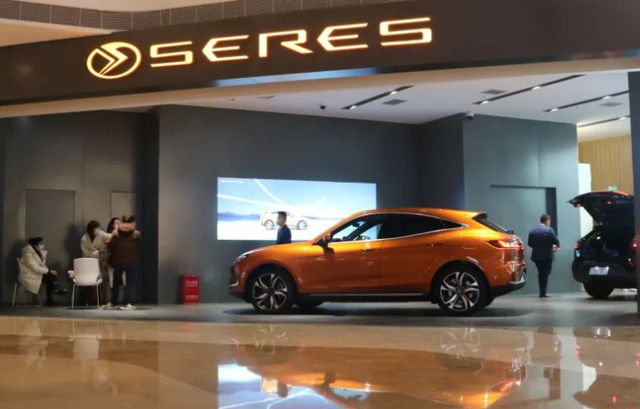
AITO currently has about 1,146 brand-authorized touchpoints, of which 637 are located in Huawei consumer electronics stores—55.6% of the total.
After exclusive dedicated operation is implemented, Seres needs to take over or replace these touchpoints. Seres denies the simple claim of "withdrawing from Huawei specialty stores," but the direction has not changed: channel costs shift from "service fees paid to Huawei" to "store operation and customer acquisition costs borne by Seres itself."
Let's do a rough calculation.
Estimating an average annual operating cost of 8 million to 12 million yuan per store, the annualized incremental cost of taking over 200 stores would be between 1.6 billion and 2.4 billion yuan. Seres' total sales expenses in 2025 were 24.194 billion yuan, of which advertising, image store construction, and service fees accounted for 22.953 billion yuan; sales expenses in the first half of 2026 were 8.471 billion yuan.
In the past, a considerable portion of this money was channel marketing service fees paid to Huawei. Now the same money must be split across store rent, personnel, regional marketing, and customer acquisition spending. The spending is heavier, but efficiency may not be higher.
Foot traffic at Huawei stores was diluted by the phone business; AITO's independent stores must buy foot traffic back inch by inch on their own.
More realistic pressure lies in terminal sentiment. Voices on the channel side say the new M8's "orders differ too much from expectations, and most customers are waiting to see."
What they are waiting to see is not only the product, but also one thing: after Seres manages channels itself, whether after-sales response, OTA cadence, and store density can maintain the original level.
Channel network separation moves the accounting from the "service fee" line item to the "operating expense" line item. The number may not necessarily grow larger, but every penny must be earned back by Seres itself.
The traffic discount brought by Huawei stores is gone. Seres must use real money to bring people back into stores.
III. On What Grounds Does Seres Stand?
Seres' foundation is quite solid.
In the first half of 2026, AITO delivered 160,800 vehicles, a year-on-year increase of 10.2%, with a comprehensive gross margin of 23.3%, cash reserves exceeding 73.15 billion yuan, and interest-bearing debt accounting for only 3.2% of total assets.
The automation level and integrated die-casting capability of Seres' Chongqing factory rank among the best in the industry. AITO's user base has exceeded 1.2 million, and the M9 remains a force to be reckoned with in the above-500,000 yuan segment.
These are Seres' fundamentals after the track switch.
But manufacturing capability and brand pricing power are two separate accounts.
The strongest capability Seres developed over the past seven years on the AITO project is to build cars defined by Huawei with high quality and high tempo, and to pull production capacity and the supply chain up to withstand the impact of monthly sales of 20,000 vehicles.
The question it has not independently answered is: for an AITO starting at 389,800 yuan, once it is no longer called "Huawei's car," what will make a customer who was originally considering the Li Auto L8 or Denza N8L pay 50,000 to 60,000 yuan more?
The new M8's 896-line lidar and ADS 5 are the product answer, but the product answer does not automatically equal the brand answer. The old M8's fall from 21,000 units to 1,200 has already shown that customers' patience with AITO is not unlimited—and they really will walk away during model-change gaps.
Manufacturing cards can ensure that Seres builds the new M8 well, but the question "on what grounds does it sell for 389,800 yuan" must be answered by order conversion rates.
Dongcha
Seres taking back AITO's operating rights aligns with strategic needs from a long-term financial logic.
But for investors holding Seres, what is worth watching after November 13 is not the total number on the firm-order poster, but four more detailed indicators.
First, whether the new M8's terminal transaction price can hold the 389,800 yuan presale price, or whether hidden discounts or added benefits will soon appear;
Second, whether the in-store conversion rate of AITO's own channels and taken-over stores can fill the gap left after Huawei stores withdraw;
Third, where the sales expense ratio will surge to in the second half of the year, and whether the cost of channel switching will be cleared out once or continue bleeding;
Fourth, and the most direct thermometer—how the new M8's firm-order conversion rate in its first sales month compares with the old M8 in the same period.
The first-generation old M8 had 32,000 firm orders in 24 hours, while the new M8 currently has only 10,000 small orders in 24 hours. The difference between these two sets of numbers explains better than any spec sheet how much brand foundation Seres has left after the track switch.
AITO used to rely on Huawei's name to sell cars at a premium. Now Seres must rely on itself to re-establish that premium.
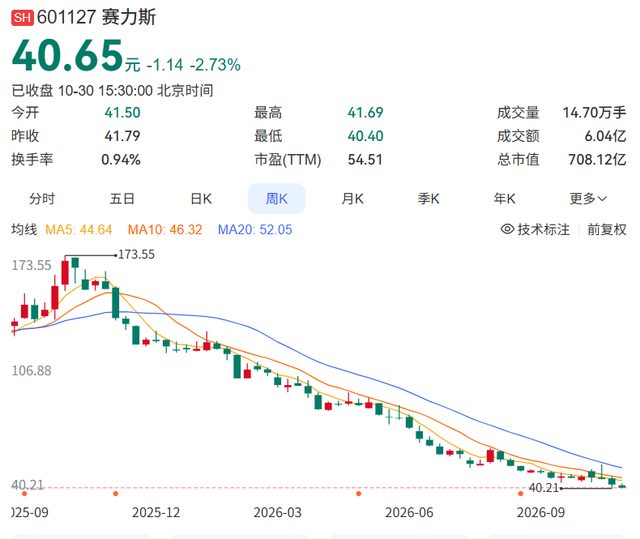
The most nerve-wracking part is still the stockholders.
-
![]()
This "Silver October" New Energy Report Card Is Most Striking for Its "Zero, Xiao, Xiao" Polarization
-
![]()
AITO's First Real Test: Can the New M8 Carry Seres on Its Own?
-
![]()
Huawei Wins Audi A8 Deal — Why That Matters More Than Launching Another "Jie" Brand
-
![]()
The Most Aggressive Investor, Mediocre Returns: Has Amazon Become a Worker for Nvidia?
-
![]()
Explained: Anthropic's Prospectus — and What It Means for the Auto Industry and Us Workers
-
![]()
[Xauto Smart Driving Rankings] Xiaomi SU7 N70 HyperOS 1.18.3 Urban Evaluation Report
-
Why AI Short Dramas Have Exploded in Popularity
-
Japanese Big Four See Sales Drop in China in First 10 Months; Are Toyota and Honda Hybrids Still Worth Buying in the Cold North?