[Xauto Smart Driving Rankings] Xiaomi SU7 N70 HyperOS 1.18.3 Urban Evaluation Report
 11/02 2026
 330
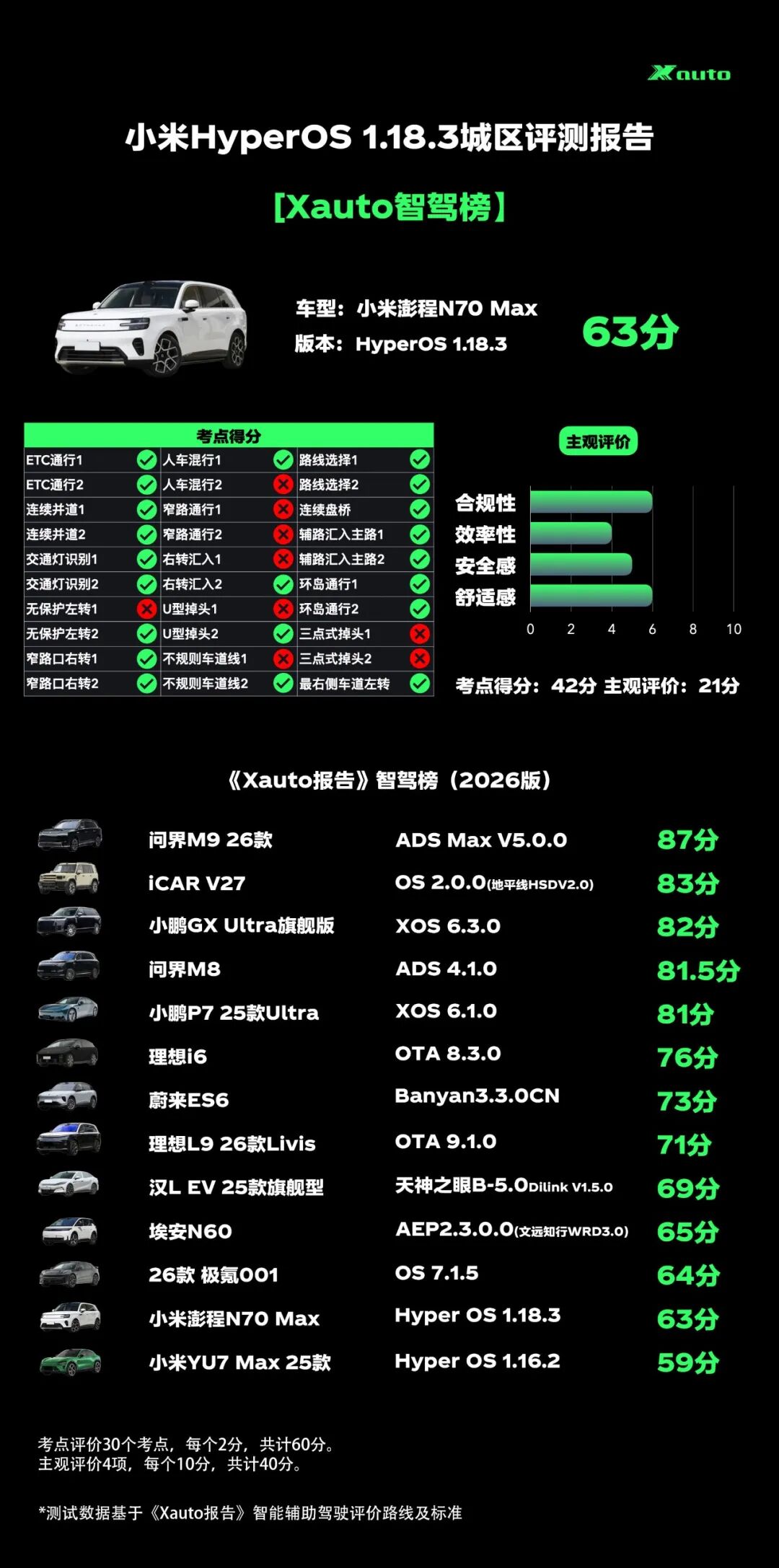
——Test Point Evaluation
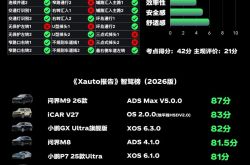
In the test point evaluation, the Xiaomi SU7 N70 MAX running HyperOS 1.18.3 failed 9 test points and scored 42 points.
This marks some improvement over version 1.16.2. Six test points lost points in both versions: one mixed pedestrian-vehicle scenario, two narrow-road passage scenarios, one irregular-lane scenario, and two three-point-turn scenarios. Narrow-road passage and three-point turns remain capabilities the system simply does not have.
The other three test points where points were lost were unprotected left turns, right-turn merging, and U-turns. All three were passed last time but were not completed this time.
This shows that the system's capability ceiling remains insufficient and that overall performance is not stable enough. Once an unexpected event occurs, the system score suffers.
From the user's perspective, it is relatively difficult to pin down the capability and safety boundaries of Xiaomi assisted driving, which leaves users lacking confidence when using it.
We believe the overall state is still on par with the 1.16.2 experience: a mediocre capability ceiling, unstable performance, and considerable room for growth in vehicle control details.
——Subjective Evaluation
Compliance dimension (6 points): Compared with version 1.16.2, the improvement lies in the pedestrian-yielding strategy. After this upgrade, the system yields to pedestrians very well—basically yielding whenever pedestrians are spotted and stopping from far away.
Points were deducted in four areas: driving in the wrong direction after the first right turn in the continuous lane-change test point, failure to recognize traffic lights in construction zones, driving straight in a right-turn lane, and multiple instances of crossing solid lines.
Efficiency dimension (4 points): Following distance has been optimized this time, but overall there are still many problems.
Deduction points: First, as can be seen from multiple test points, there is an obvious delay when starting after the system brakes to a stop.
Second, this is also an old problem from version 1.16.2: the system tends to drive below the speed limit, following slow vehicles continuously, and dislikes changing lanes.
Third, in multi-lane selection, it cannot select lanes efficiently. At the same time, it lacks anticipation of traffic flow and will move into slow lanes.
Fourth, it dislikes detouring and mainly follows and waits.
The constraints for system detouring are not written well enough. It usually requires a large amount of surrounding space redundancy before it may execute, and the system's current detour angle is still relatively large.
Fifth, there are inexplicable operations. For example, when the system is supposed to go straight, it will follow the trajectory of the vehicle ahead and move into the lane of a temporarily parked car.
Sense of safety dimension (5 points): This time it still cannot reach a passing grade. First, what most affects the sense of safety is the drifting driving trajectory and unclear direction, which has also been a major problem in the Xiaomi assisted driving experience. There are frequent instances of hesitation in lane selection, and after left or right turns it also snakes between two lanes.
Second, there is the sense of insecurity brought by the aggressive lane merging mentioned above, disregarding side and rear vehicles.
Third, deceleration is insufficient in scenarios with blind spots. The most typical is the scenario before a zebra crossing. In addition, this problem also exists in mixed pedestrian-vehicle scenarios, narrow-road passage, and U-turn scenarios.
Fourth, another source of a poorer sense of safety is poor detour timing and excessively large angles.
Comfort dimension (6 points): The problem of uneven speed control by the system is still very obvious, and sudden braking and intermittent braking occur frequently. In some lane merging scenarios, there is also a disjointed feeling of sudden braking and speed reduction before merging.
In the subjective evaluation section, the total score is 21 points. Test point evaluation + subjective evaluation: the final score of the Xiaomi SU7 N70 MAX HyperOS 1.18.3 version is 63 points.
——Supplementary Sharing
From this score, everyone can also see that the new version of Xiaomi assisted driving has improved, but rather limitedly, and it is still in a not-very-usable state.
The main reason is that major problems such as insufficiently refined left and right turn angles, hesitation in lane selection, relatively large detour angles, and a disjointed feeling in lateral and longitudinal vehicle control have not been changed, so the experience will not differ much from the previous version. We believe that Xiaomi still has a relatively long way to go in basic vehicle control capabilities.
At the cognitive level, the Xiaomi assisted driving system still needs to improve its understanding of spatial scenarios. For example, bicycles on the road shoulder do not need to be detoured around, and the system should not accelerate on narrow roads. The system does not have this common sense.
At the same time, the soft constraints in planning and control are not written precisely enough, causing the system's lane preference to keep changing, and coupled with the system's obvious sense of delay, this greatly affects safety and efficiency.
Therefore, overall, the improvement in version 1.18.3 is better than nothing, and we still look forward to the next major version.
-
![]()
This "Silver October" New Energy Report Card Is Most Striking for Its "Zero, Xiao, Xiao" Polarization
-
![]()
AITO's First Real Test: Can the New M8 Carry Seres on Its Own?
-
![]()
Huawei Wins Audi A8 Deal — Why That Matters More Than Launching Another "Jie" Brand
-
![]()
The Most Aggressive Investor, Mediocre Returns: Has Amazon Become a Worker for Nvidia?
-
![]()
Explained: Anthropic's Prospectus — and What It Means for the Auto Industry and Us Workers
-
![]()
[Xauto Smart Driving Rankings] Xiaomi SU7 N70 HyperOS 1.18.3 Urban Evaluation Report
-
Why AI Short Dramas Have Exploded in Popularity
-
Japanese Big Four See Sales Drop in China in First 10 Months; Are Toyota and Honda Hybrids Still Worth Buying in the Cold North?