BYD Reports 566.3 Billion Yuan, Geely 272.6 Billion Yuan: A Recap of Revenue and Profit for Ten Automakers in the First Three Quarters
 11/03 2026
 573
With the third-quarter reports for 2026 now fully disclosed, the operating performance of ten major listed automakers has come into sharper focus. Data for the first three quarters reveals an industry-wide pattern of mixed revenue performance and broadly pressured profits, with only a handful of companies achieving simultaneous growth in both revenue and profit.
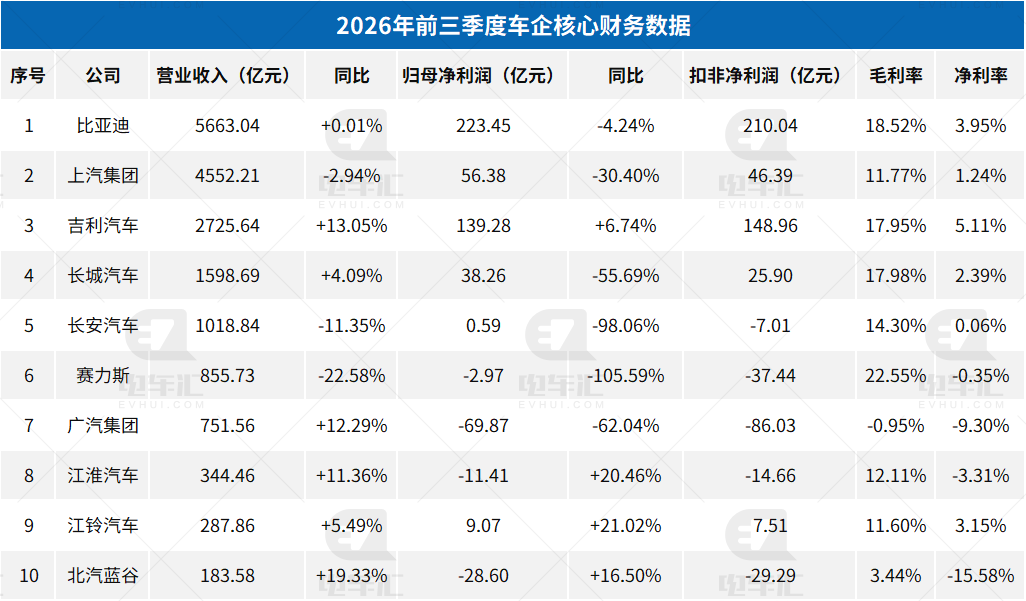
Key financial data of automakers for the first three quarters of 2026
BYD led the pack with 566.304 billion yuan, essentially flat year on year. SAIC Motor followed with 455.221 billion yuan, down 2.94% year on year, while Geely Automobile ranked third with 272.564 billion yuan, up 13.05% year on year. GAC, JAC, and BAIC BluePark all posted revenue growth above 10%, whereas Seres saw its revenue drop 22.58% year on year—the steepest decline among the ten.
Five of the ten companies were profitable: BYD, Geely, SAIC, Great Wall, and Jiangling. Changan Automobile's net profit attributable to the parent company came in at 59 million yuan, hovering near break-even. BYD held the top spot with 22.345 billion yuan, and Geely ranked second with 13.928 billion yuan. GAC posted a loss of 6.987 billion yuan, the largest among the group, while BAIC BluePark, JAC, and Seres also remained in the red.
Seres recorded the highest gross margin at 22.55%, but heavy expense investments kept its net margin in negative territory. Geely's net margin stood at 5.11%, a relatively strong figure among the profitable companies. GAC's gross margin was -0.95%, reflecting a gross profit inversion in vehicle sales.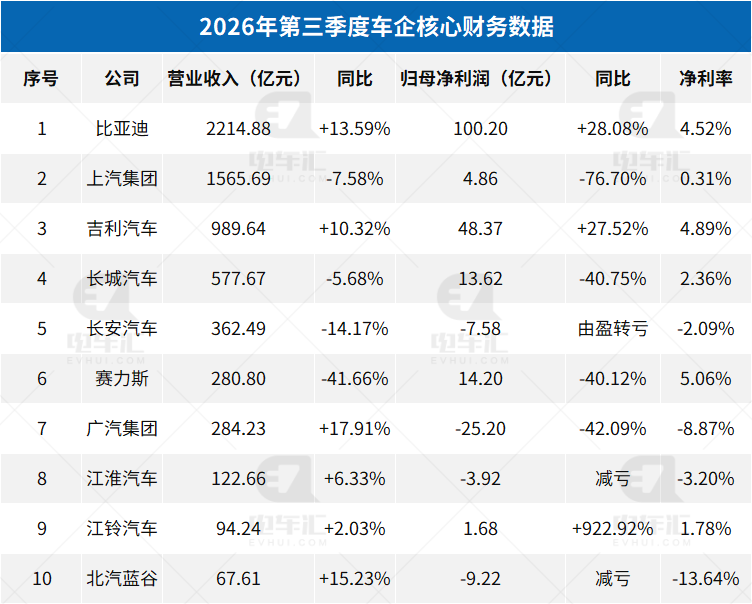 Key financial data of automakers for the third quarter of 2026
In the third quarter, BYD achieved double-digit growth in both revenue and profit, with net profit attributable to the parent company reaching 10.020 billion yuan—roughly 45% of its profit for the first three quarters. Geely saw simultaneous revenue and profit growth, with relatively stable operating performance. Changan Automobile slipped from profit to loss in the single quarter, while SAIC and Great Wall both saw their profits decline significantly year on year. Seres' single-quarter net profit attributable to the parent company was 1.420 billion yuan, but its net profit after deducting non-recurring gains and losses for the first three quarters was -3.744 billion yuan, with profit mainly driven by non-recurring items. Although GAC's revenue rose 17.91%, its loss still widened year on year. Jiangling's surge in third-quarter net profit stemmed from a one-off base effect caused by adjustments in subsidiary operations and did not represent a substantial improvement in the profitability of its main business during the period.
The third-quarter data points to two fairly clear industry characteristics.
First, scale and profit are highly concentrated. The combined revenue of BYD, Geely, and SAIC exceeded 1.29 trillion yuan, accounting for more than 70% of the ten companies' total revenue. The combined profit of BYD and Geely made up the vast majority of the total profit of the ten profitable companies.
Second, revenue growth without profit growth is widespread. GAC, Great Wall, JAC, and BAIC BluePark all achieved revenue growth, but their profits did not improve in tandem—a reflection of the continued squeeze on profit margins from price competition. Jiangling Motors is one of the few companies with simultaneous growth in revenue and profit, with profit growing faster than revenue.
Based on the operating conditions cited by listed companies in their financial reports, the squeeze on profit margins from price competition is a common pressure facing all ten automakers. At the same time, many companies saw revenue growth without a corresponding profit improvement, and rigid increases in expense investments made it difficult to convert gross profit into net profit, while industry differentiation continued to intensify.
-
![]()
Commentary: The "Li Fenggang Phenomenon" — An Unfinished Experiment in Talent Localization
-
![]()
Apple Bows, Alibaba Goes Bottom-Fishing: The AI Ticket for the China-Market iPhone
-
US Sales Drop 4%, Japan Plummets 27%—Are Only Chinese Consumers Obsessed with Face? iPhone 18 Pro Surges 29%
-
![]()
BYD Reports 566.3 Billion Yuan, Geely 272.6 Billion Yuan: A Recap of Revenue and Profit for Ten Automakers in the First Three Quarters
-
![]()
After the Big Price Cut, Is the MONA L05 Still Overpriced?
-
![]()
Mercedes' Anchor Is Adrift
-
Beijing Hyundai’s New Energy Transition Slams on the Brakes
-
![]()
Will AI Also 'Take Over' Airport Bookstores?