Mercedes' Anchor Is Adrift
 11/03 2026
 366
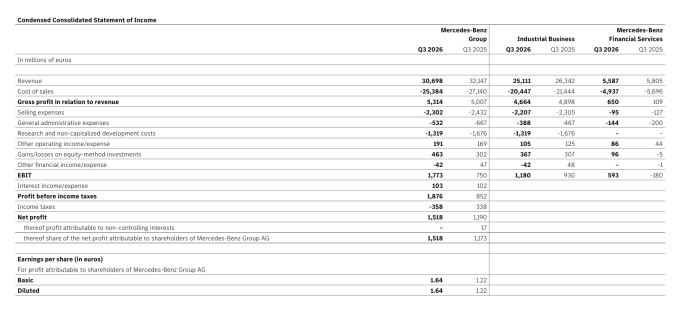
On October 28, Mercedes-Benz Group officially released its Q3 2026 financial report. The data shows revenue of €30.7 billion for the period, down 4.4% year-on-year from €32.1 billion in the same period last year; EBIT came in at €1.77 billion, up 136% year-on-year, and net profit reached €1.52 billion, up 27.7% year-on-year. Strip out one-off gains and losses, however, and EBIT fell 15% year-on-year to €1.78 billion. The same report thus presents a sharp jump in profit and a contraction in core profit at once—two signals pointing in opposite directions.
In fact, the profit surge this quarter stemmed mainly from a prior-year base depressed by one-off expenses. Excluding that factor, the brand's core operating profit was in fact declining. Set against Mercedes-Benz Group's performance across different regions worldwide, the reasons behind this report full of contradictions become self-evident.
According to officially disclosed figures, Mercedes-Benz passenger cars delivered 407,232 units globally in Q3 2026, down 8% year-on-year. Europe and North America delivered 168,710 and 83,240 units respectively, both posting slight growth.
The Chinese market stands in sharp contrast. In Q3, Mercedes-Benz delivered 86,792 units in China, plunging 31% year-on-year. Once the brand's most reliable global growth engine, China has now become the core drag on its overall performance.
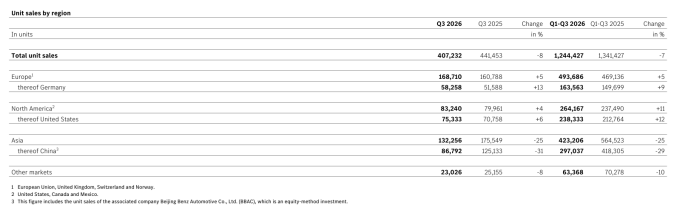
This regional scorecard, marked by stark contrasts, also reflects the unprecedented competitive pressure Mercedes-Benz faces in China's high-end market.
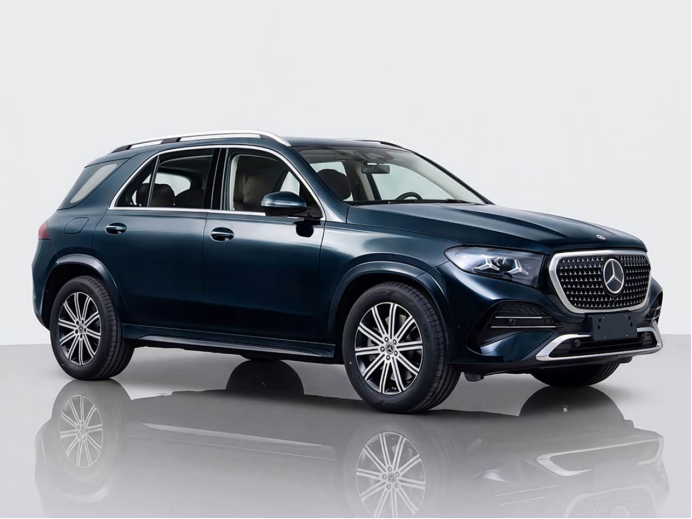
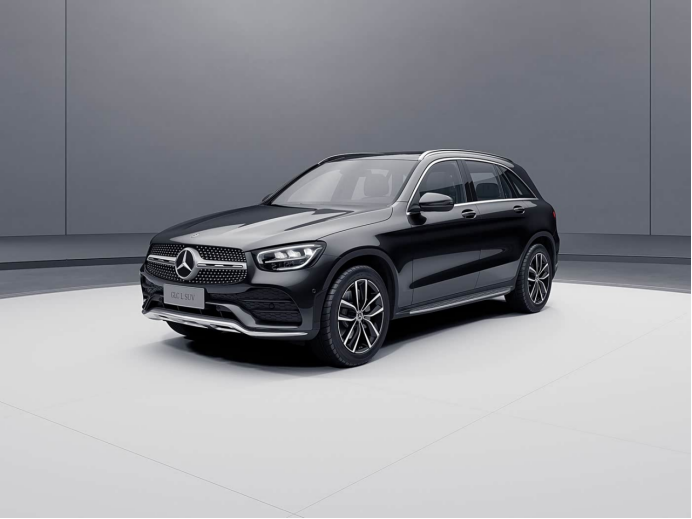
On the weak showing in China, Mercedes-Benz first attributed the decline to the model changeover cycle of its main models between old and new generations, which constrained the supply side. The brand's sales in China still depend on traditional core models: the GLC and E-Class together accounted for nearly two-thirds of Q3 sales. At the same time, several volume models happened to be at the old-to-new transition point—the all-electric GLC L was launched in July and is still ramping up capacity, while the domestically produced long-wheelbase GLE L only entered the market in mid-September.
Capacity for older models is gradually shrinking, while the new generation has yet to achieve stable delivery capacity. Add to that the wait-and-see sentiment among consumers that a model changeover brings, and short-term sales took a hit.
Yet judged purely on global electric market performance, Mercedes-Benz actually delivered an impressive result. The financial report shows that global BEV sales reached 68,400 units in Q3, up 29% quarter-on-quarter and up 61% year-on-year—the brand's highest single-quarter record in history. This at least shows that Mercedes-Benz's electric products are not uncompetitive and have won consumer recognition in some overseas markets.
Moreover, BEVs' share of Mercedes-Benz's total passenger car sales rose to 16.8%, 7.2 percentage points higher than the same period last year. Include plug-in hybrids, and one in every four Mercedes-Benz vehicles sold is electrified. Electrification is thus no longer a marginal supplement in Mercedes-Benz's sales mix; it is gradually becoming an important part of the brand's global sales.
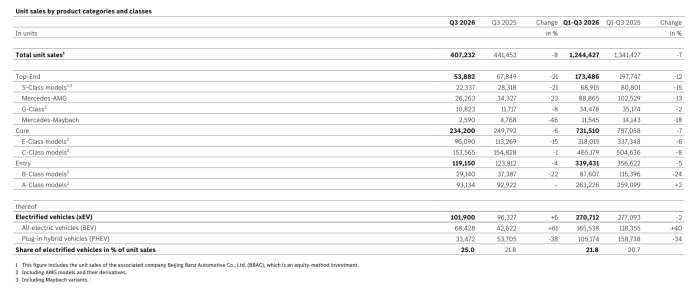
Yet this electrified lineup, which has gained traction in overseas markets, has not replicated the same momentum in China.
That is hardly surprising. After all, the competitors and consumer demands in today's domestic high-end market have long since changed. For years, the high-end market in the 300,000 to 500,000 yuan price range was dominated by BBA. Car buyers cared more about brand heritage, chassis feel, and mechanical quality.
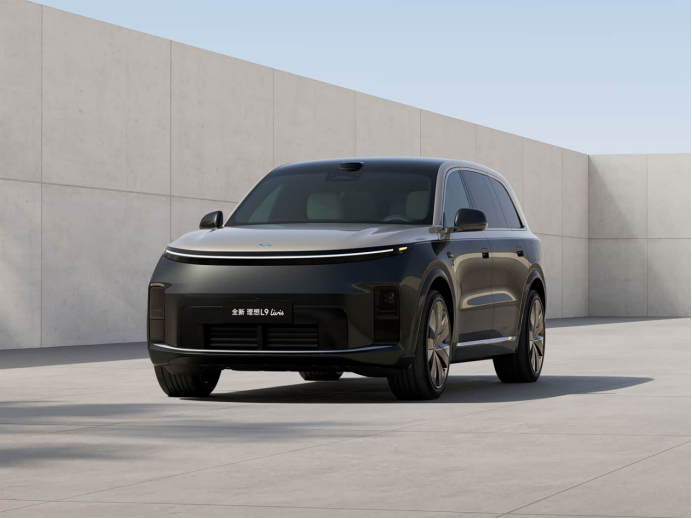
Today, domestic high-end NEV brands keep pushing into this price band. Brands such as Li Auto, Zeekr, Xiaomi, and BYD rarely competed in the 400,000 yuan class in the past, but all have now become formidable rivals. Smart cockpits, advanced driver assistance, and cabin comfort are becoming the new yardsticks by which users judge a car.
Within the same budget, consumers now compare Mercedes-Benz products with domestic high-end NEV offerings, and brand premium alone is already hard-pressed to persuade buyers.
At the same time, price competition in China's luxury car market continues to intensify, and dealer discounts keep widening. This not only affects order conversion but also continuously squeezes per-vehicle profit margins, further increasing pressure on business operations. Feedback from dealer channels shows that discounts on volume models such as the Mercedes-Benz C-Class, E-Class, and GLC have widened compared with the same period last year, and actual transaction prices for some configuration versions have dropped noticeably.
Facing these market changes, Mercedes-Benz is taking active countermeasures.
On the one hand, under the Group's plan, by the end of 2027 Mercedes-Benz will launch more than 40 all-new or facelifted models, billed as the "largest product launch wave in history." For the Chinese market, by 2027 Mercedes-Benz will launch seven China-exclusive models and jointly develop an advanced intelligent driving solution with Momenta.
On the other hand, Mercedes-Benz Group plans to advance supply chain localization, reduce component procurement costs, accelerate the rollout of intelligent functions, and try to narrow the gap with domestic NEV brands in software and intelligent experience. Under the target plan, by 2027 local material costs will be reduced by about 10% compared with 2024, fixed costs by more than 10%, and the target reduction for both variable production costs and fixed costs in China is 20%.
Overall, the brand dividend Mercedes-Benz accumulated in the combustion engine era is gradually fading, and the market's criteria for judging luxury products have changed. It still has brand assets, cash flow, and R&D investment capacity, and is also accelerating its adaptation to the Chinese market. These strengths should not be underestimated. But competition now tests not only engines and chassis, but also comprehensive capabilities in product strength, software iteration, localization decisions, and intelligent development.
The real question Mercedes-Benz needs to answer is not whether it can still build good cars, but how to make Chinese consumers once again believe it is worth the price.
(Images from the internet, deleted if infringing)
-
![]()
Commentary: The "Li Fenggang Phenomenon" — An Unfinished Experiment in Talent Localization
-
![]()
Apple Bows, Alibaba Goes Bottom-Fishing: The AI Ticket for the China-Market iPhone
-
US Sales Drop 4%, Japan Plummets 27%—Are Only Chinese Consumers Obsessed with Face? iPhone 18 Pro Surges 29%
-
![]()
BYD Reports 566.3 Billion Yuan, Geely 272.6 Billion Yuan: A Recap of Revenue and Profit for Ten Automakers in the First Three Quarters
-
![]()
After the Big Price Cut, Is the MONA L05 Still Overpriced?
-
![]()
Mercedes' Anchor Is Adrift
-
Beijing Hyundai’s New Energy Transition Slams on the Brakes
-
![]()
Will AI Also 'Take Over' Airport Bookstores?