From Lipstick to Tokens: AI Vendors Muscle In on Double 11
 11/06 2026
 465
Author | Wuzi
This year's Double 11, AI is no longer a backstage player helping platforms cut costs and boost efficiency—it has stepped into the spotlight as something consumers can actually add to their shopping carts.
On the evening of November 2, 2026, Chen Yusen, Vice President of Alibaba Group and CEO of Qianwen Office, appeared in Li Jiaqi's Taobao livestream room. The Qianwen Office Personal Basic Edition monthly card, originally priced at 28 yuan, was offered for just 1 cent, and nearly 100,000 copies sold within half an hour—roughly equivalent to 2 trillion tokens' worth of quota.
Taobao is not alone. On platforms such as JD.com and Douyin, major streamers have also been hawking token packs for models like DeepSeek, Zhipu GLM, and MiniMax, with unprecedented popularity. JD.com data shows that its 3C digital procurement and sales livestream room distributed over 1 billion tokens within the first hour of broadcasting, and within two hours, sales of large-model token pack products surged 20-fold month-on-month.
As AI technology matures, large-model vendors are taking a page from consumer brands—competing for consumer mindshare through livestream e-commerce, rock-bottom prices, and limited-quantity flash sales. As AI shifts from a parameter arms race to mass-market consumption, can it be purchased as routinely as lipstick, clothing, and video-streaming memberships?
01 Tokens Hit the Shelves: AI Services Become Consumer SKUs
Previously, model invocation packages were mainly sold through vendors' official websites or open platforms, and AI application memberships were mostly subscribed to within their respective products. This Double 11, AI vendors are not only selling AI services on e-commerce platforms but also hoping to lower the learning curve and purchase threshold through intuitive product specifications, pricing strategies, and demonstration methods.
Overall, the AI services put on shelves during Double 11 fall into three categories: model invocation packages, AI application memberships, and AI benefits bundled with hardware.
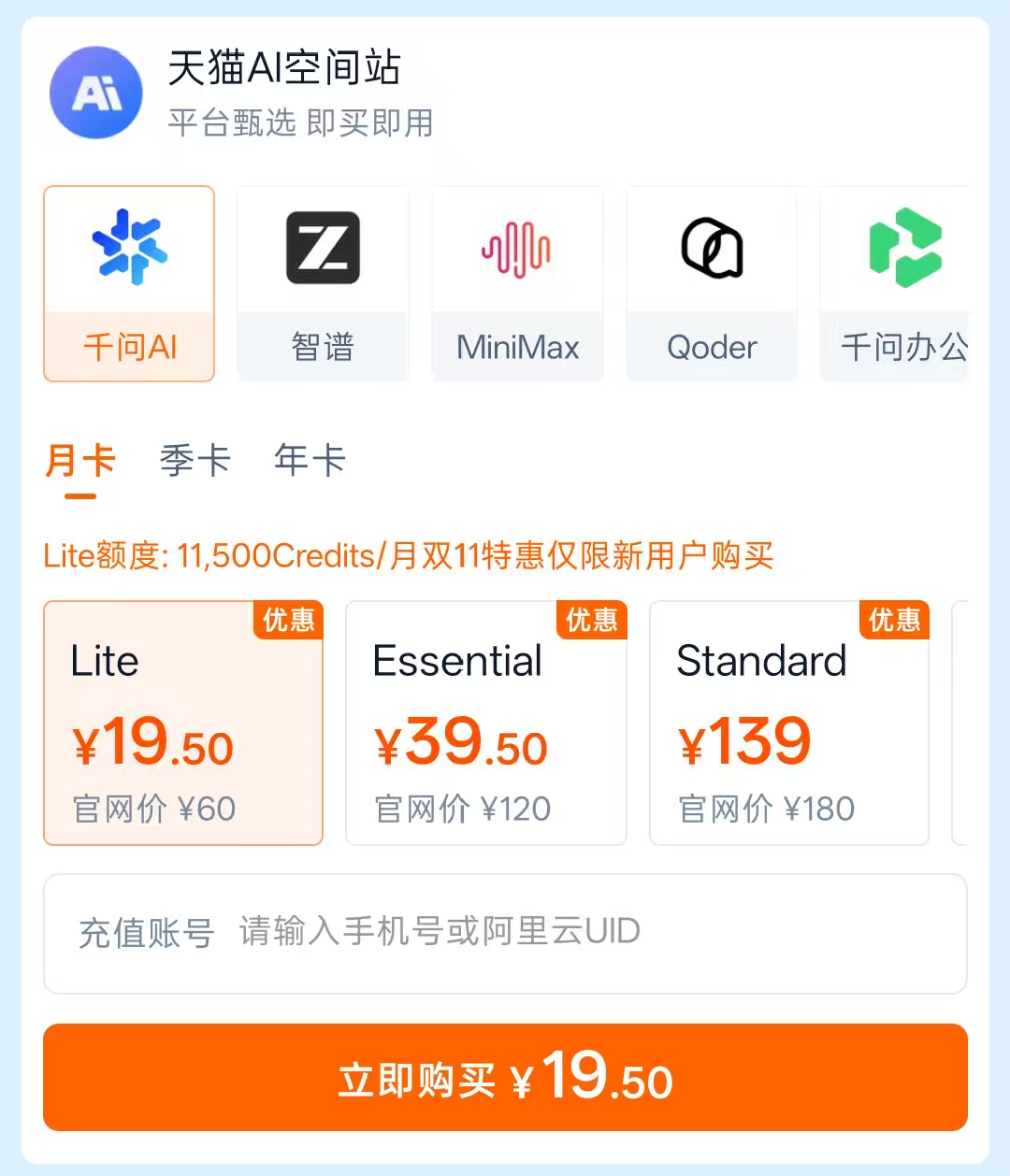
Image source: Taobao
E-commerce platforms such as Tmall and JD.com have launched token recharge centers modeled on the logic of traffic top-ups, offering subscription packages for large-model services such as Qianwen AI, Zhipu, and MiniMax. Consumers can choose monthly, quarterly, or annual cards according to their needs.

Image source: Taobao
In addition, AI applications such as Qianwen and Doubao are also selling subscription memberships in livestream rooms, including multiple tiers from low to high. After subscribing, users can enjoy benefits such as coding, image generation, and video during the validity period.
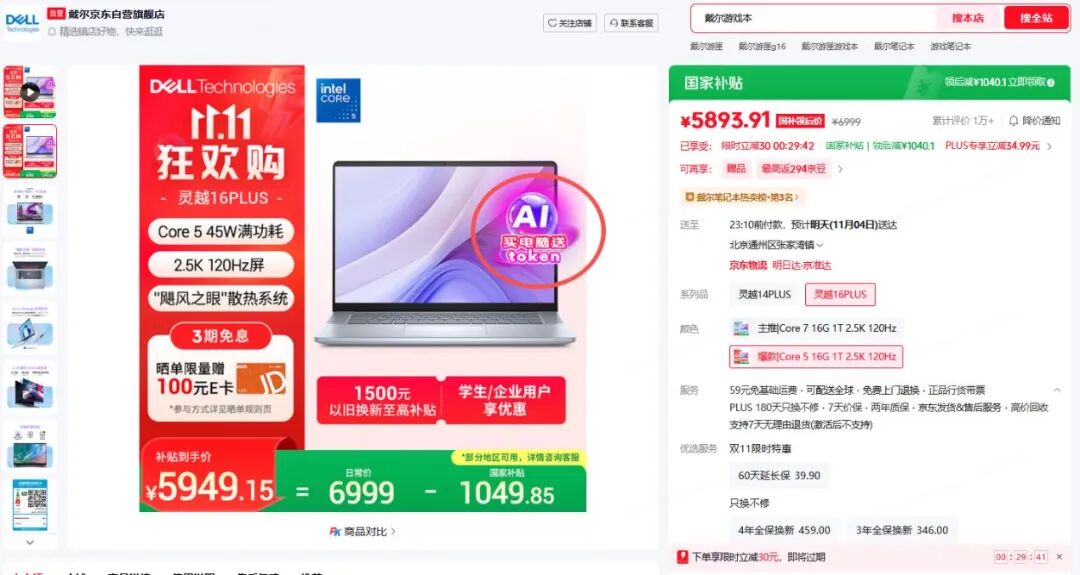
Image source: JD.com
Beyond selling tokens and memberships directly, some hardware companies are also throwing in corresponding AI benefits when selling hardware products. On the JD.com platform, for example, consumers who place orders for models such as Dell Inspiron 16 Plus, Dell XPS 13 Air, and Alienware Starlight 16X receive a JD Cloud token starter pack containing 13,000 points. When purchasing devices such as voice recorders and AI glasses, vendors also bundle in corresponding AI service memberships.
These products correspond to different needs: model invocation packages fit development and tool invocation scenarios, application memberships target specific tasks, and hardware-bundled benefits lower the threshold for first-time experience. In terms of sales channels, recharge zones capture active search-and-purchase demand, livestream rooms help users understand usage through demonstrations, and hardware bundling allows AI services to enter usage scenarios alongside devices.
It can be said that this Double 11 marks a significant shift in the AI industry's "match point." Previously, AI vendors focused more on developing models with powerful performance. Now, they have begun to learn from consumer brands—actively entering e-commerce platforms, packaging AI services as products, and working to increase consumers' willingness to pay through scenario-based demonstrations.
02 Paid Conversion Stays Low: Vendors Look to Double 11 to Crack the Market
In fact, as early as the first half of 2026, as Agents gradually matured, many AI vendors launched paid services—but to this day, paid penetration among individual users remains relatively low.
In May 2026, a survey on netizens' AI consumption initiated by the Tencent Research Institute showed that although as many as 95.6% of respondents had used AI large models in the past three months, the payment ratio among AI users was only 9.8%.
The reason is that AI vendors have not yet effectively completed market education. Only by letting users feel the incremental value of paid services in specific tasks can conversion be further promoted.
The Tencent Research Institute pointed out in a research report that the more obvious users' perception of efficiency, the higher their willingness to pay. Users with "efficiency improvement but increased workload" had the highest payment rate, at 18.9%, while the payment rates of users with "partial efficiency improvement" and "no impact/not used" were 5.6% and 1.8%, respectively.
However, most users currently rely mainly on free AI chat tools, with a usage rate as high as 92.9%. The usage rates of AI efficiency tools and AI development platforms aimed at productivity scenarios are only 22.9% and 14.2%, respectively.
Clearly, the biggest challenge facing the commercialization of AI technology today lies in the "supply-demand mismatch." The threshold AI vendors need to cross is moving users from existing habits such as Q&A and writing to the execution of more complex tasks—and getting them to recognize that paid services offer irreplaceable value compared with free features.
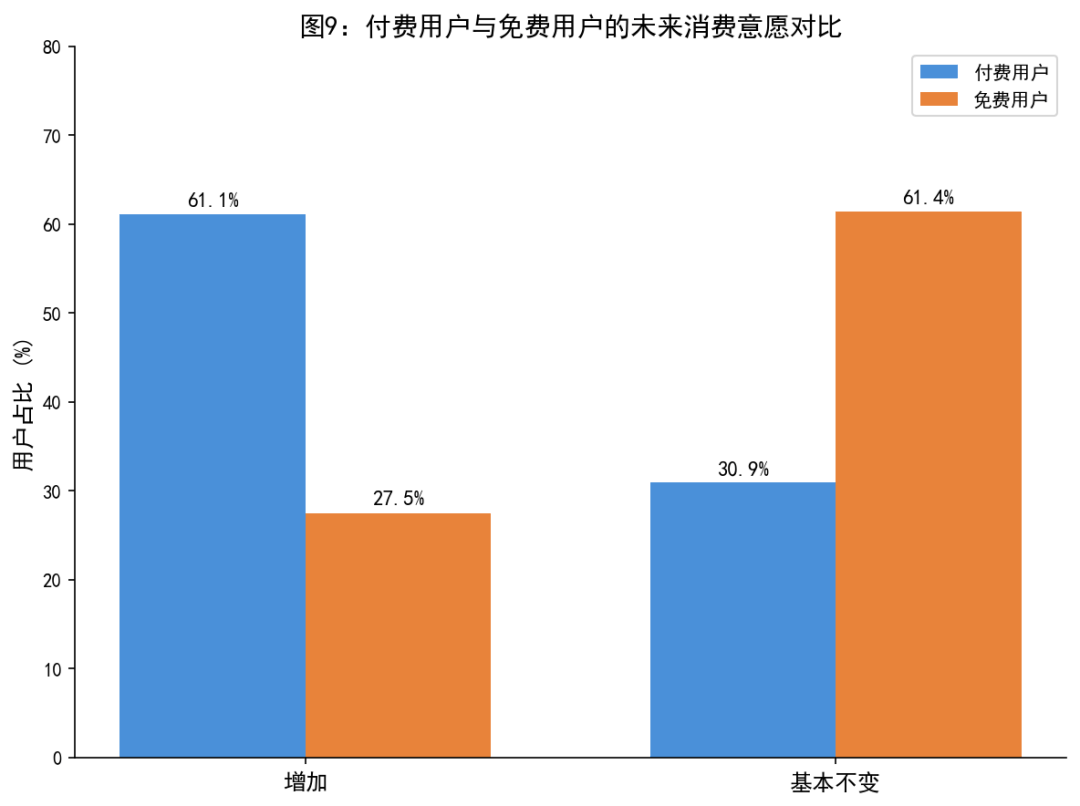
Image source: Tencent Research Institute
Tencent Research Institute survey data shows that in the next three months, among paying users, the proportions saying their payment amount will increase and remain basically unchanged are 61.1% and 30.9%, respectively; among free users, these two figures are 27.5% and 61.4%, respectively. There is clearly a pronounced K-shaped divergence in the AI industry: paying users are more willing to pay, while free users tend to stick with free services.
If AI vendors combine this market trend with friendly trial policies to guide free users toward trying paid features, it is possible to gradually build a virtuous cycle of "AI services create value—usage habits form—continuous payment."
From this perspective, the 2026 Double 11 shopping festival is not only a promotional battle for the AI industry but also an experiment in concentrated conversion of AI services. By reducing the cost of trying new things through subsidies and enhancing the sense of presence through streamers' scenario-based demonstrations, AI services have established closer connections with users' actual production scenarios and are expected to convert more paying users.
03 A 1-Cent Card Can Drive Traffic, but What Will the Next Payment Rely On?
During the Double 11 shopping festival, although sales of many AI services are considerable, they have not contributed much revenue to vendors. Take the Qianwen Office Personal Basic Edition monthly card sold in Li Jiaqi's livestream room: based on 1 cent per copy and 100,000 copies sold, the total amount paid by all consumers is only about 1,000 yuan—not even enough to buy an entry-level REDMI phone.
It should be noted that the original price of the Qianwen Office Personal Basic Edition monthly card is as high as 28 yuan/month. Although the 0.01 yuan trial price significantly lowers the purchase threshold, there is a huge gap between it and the original price. After the trial monthly card expires, how to persuade 100,000 users to subscribe to the basic membership at the original price will become a major challenge facing Qianwen Office.
Combined with industry survey data, the first renewal of AI service monthly cards can be described as an important watershed.
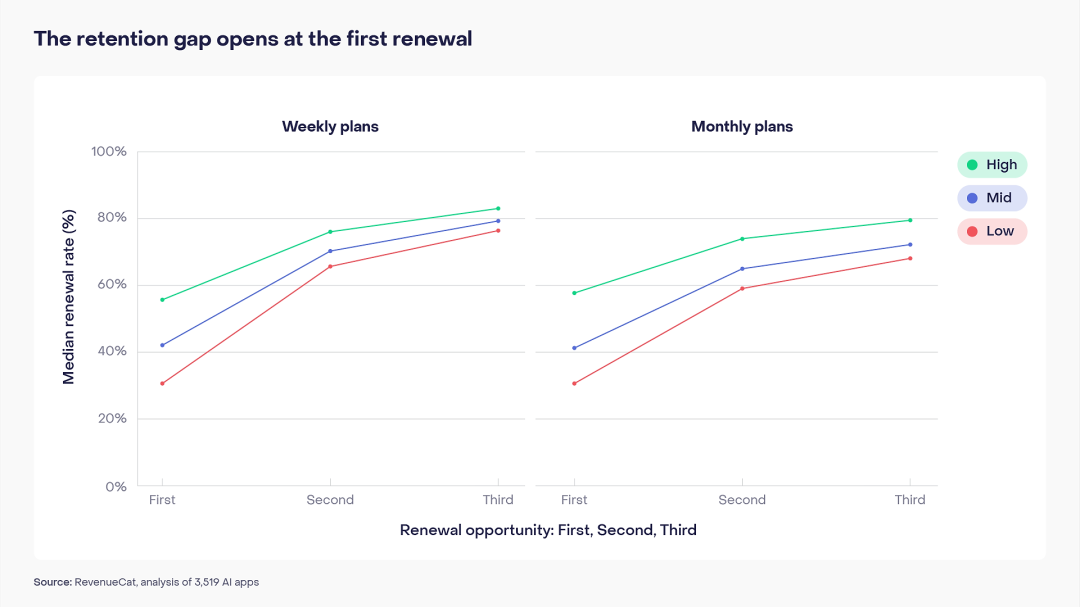
Image source: RevenueCat
RevenueCat's research on 3,519 AI app configurations and more than 50 million paid subscriptions found that among monthly payment packages, the first renewal rate of users of high-retention apps was 57.9%, while the first renewal rate of users of low-retention apps was only 30.2%. By the third-month renewal node, the renewal rates of the two groups were 79.5% and 68.5%, respectively, narrowing the gap.
Therefore, for AI vendors fighting in the 2026 Double 11 shopping festival, the real question is not how to attract more people to buy trial monthly cards, but after Double 11, how many people rely on AI to complete specific tasks—and how many are willing to continue subscribing after the discounts end.
From the perspective of ordinary users, although the performance of major AI vendors' large models varies, daily work mainly involves relatively simple needs such as Q&A, writing, and summarization. It is difficult for different AI services to create significant differentiation and persuade more users to keep paying.
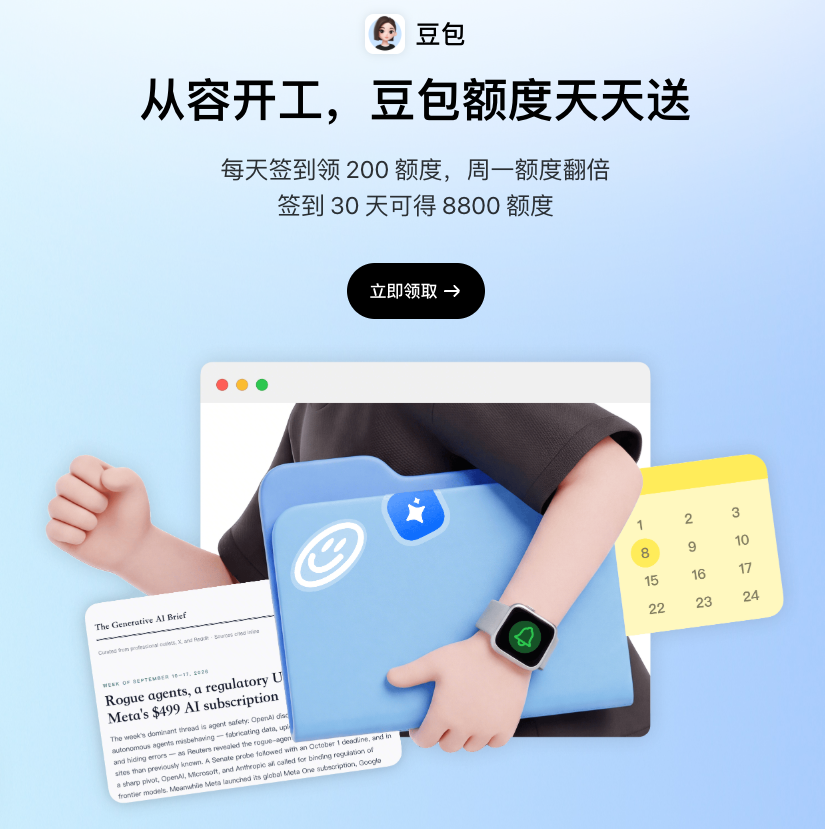
Image source: Doubao
Typically, although WorkBuddy and Doubao Work have both launched paid memberships, they continue to attract and retain users by giving away memberships, offering quota for check-ins, and providing limited-time free access.
Next, AI vendors will compete for a fixed position in users' workflows. For ordinary users, free tools can often already meet Q&A, writing, and summarization needs. Paid products need to prove whether they can connect files and applications, retain project context, and stably complete more complex production tasks.
On this basis, what truly supports the premium is how much time users save on revision and verification, and whether accumulated materials, preferences, and processes can make the next use more worry-free. This also poses a cost test for vendors: the more complex the task, the higher the investment in computing power and services may be. Double 11 can buy a one-time trial, but renewals after the discounts end must be supported by both repeatable delivery value and sustainable service costs.
When tokens and lipstick appear in the same livestream room, AI vendors begin to face a familiar set of consumer-market rules: consumers compare prices, wait for discounts, and switch among multiple free products. Double 11 provides a larger stage for AI technology to showcase, while also pushing the issue of pricing power to the forefront. If users only remember the "1-cent monthly card," what vendors may gain is a group of customers waiting for the next subsidy.
At a deeper level, this is also a competition among e-commerce platforms for AI service distribution entrances. In the past, users completed purchases on vendors' official websites. Now, platforms and streamers participate in demand discovery, product demonstrations, and transactions. Who controls the renewal entrance and who bears after-sales responsibility will affect the profit distribution of this business. As AI vendors move toward the masses by borrowing consumer-brand tactics, they may also gradually take on the channel costs and promotional dependence familiar to consumer brands.
Therefore, the significance of this year's Double 11 for the AI industry still needs to be tested by the accounts after the promotion: whether new revenue can cover subsidies, channel, and computing power expenses, and whether users have formed a habit of continuous payment.
AI trial monthly cards can be sold quickly with the help of shopping festivals, but a viable AI business with pricing power needs to be established slowly through daily use.
Interactive topic
Did you buy tokens during Double 11? How was the experience?
This article is original content of Farsight. Reproduction is prohibited without authorization.
-
Thank You, Chinese Apple Fans, for Giving Apple's New CEO Two Big Gifts!
-
![]()
You Paid for the Flagship Model—But What You Get May Be a Watered-Down Version
-
![]()
Model Factories Are Bleeding, Cloud Vendors Are Counting the Money
-
Trump Loses Midterm Elections, U.S. Stocks Wipe Out Over $2 Trillion in One Night, AI Bubble Bursts, China's Chance to Overtake Has Come
-
![]()
Why Did OpenAI Label Its Own New Model GPT-6 Cyber with a "Critical" Warning?
-
![]()
$1.8 Trillion! The AI Investment Frenzy Is Running Red-Hot
-
![]()
Baolong Technology, a Leader in Air Suspension, Posts 12.07 Million Yuan Q3 Loss, but Non-Recurring Net Profit Rises 53% to 51.71 Million Yuan
-
![]()
Xiaomi Auto Tops 50,000 Again in October: Stock Surges 18% in Just 4 Days!