Baolong Technology, a Leader in Air Suspension, Posts 12.07 Million Yuan Q3 Loss, but Non-Recurring Net Profit Rises 53% to 51.71 Million Yuan
 11/06 2026
 467
Baolong Technology is a relatively well-known name in air suspension systems.
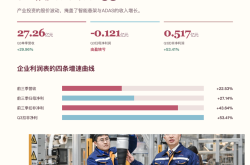
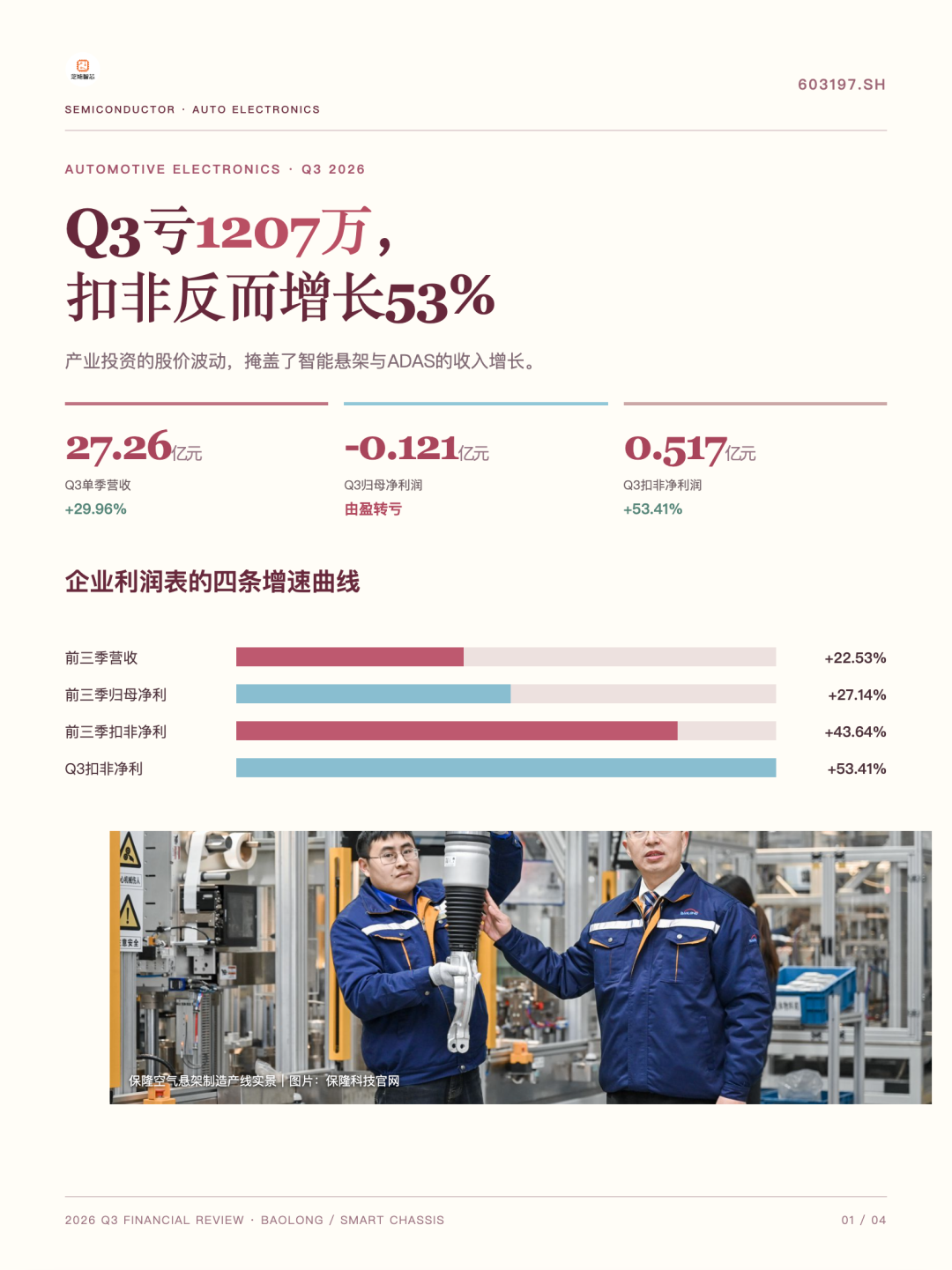
Third-quarter revenue reached 2.726 billion yuan, up 29.96% year on year. Net profit attributable to shareholders was a loss of 12.07 million yuan, swinging from profit to loss year on year. Non-recurring net profit came in at 51.71 million yuan, up 53.41% year on year.
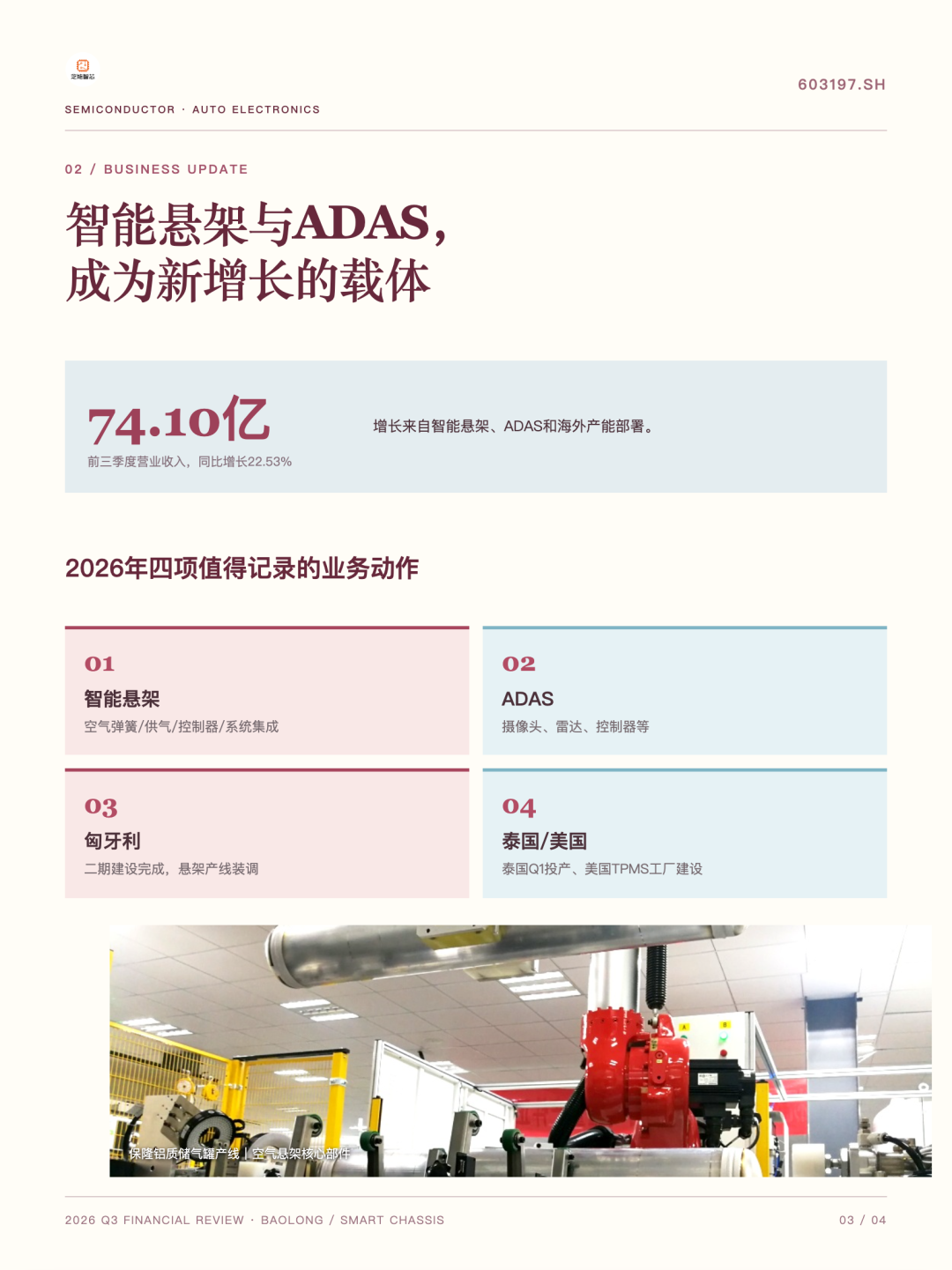
For the first three quarters, revenue was 7.410 billion yuan, up 22.53% year on year. Net profit attributable to shareholders was 252 million yuan, up 27.14% year on year. Non-recurring net profit was 190 million yuan, up 43.64% year on year.
From Baolong Technology's perspective, growth in its core automotive electronics business continues, while fair value fluctuations from equity investments suddenly swallowed part of its book profit.
Part 1: The Loss Is on the Books; the Growth Is in the Core Business
Baolong's Q3 net profit attributable to shareholders was -12.07 million yuan, and non-recurring net profit attributable to shareholders was 51.71 million yuan, a difference of about 63.78 million yuan. This corresponds to a net non-recurring gain or loss attributable to shareholders of the listed company of about -63.78 million yuan for the quarter.
Fair value changes arising from financial assets and financial liabilities held by non-financial enterprises, as well as gains and losses from disposal of financial assets, were about -70.26 million yuan for the quarter.
The sharp decline in Q3 total profit and net profit attributable to shareholders was mainly affected by stock price fluctuations of listed companies in which Baolong holds stakes. Baolong makes industrial investments to build deeper connections between its product business and the smart car ecosystem.
Baolong's base covers tire pressure monitoring (TPMS), valve stems and balance weights, metal pipe fittings, and automotive sensors, and in recent years it has continued to build out smart suspension and ADAS.
Its 2026 semiannual report said first-half revenue grew 18.59%, mainly from rapid growth in smart suspension and ADAS, while TPMS and sensor businesses maintained growth. In the third quarter, single-quarter revenue growth further reached 29.96%.
Smart suspension is one example. Air suspension systems require air springs, air reservoirs, air supply units, electronically controlled shock absorbers, suspension controllers, body height sensors, and system integration. As automakers upgrade from traditional mechanical suspension to air suspension, suppliers can expand from supplying individual components to more system components.
ADAS is similar, upgrading from perception hardware such as cameras and radar to controllers and system solutions.
Baolong has both a sensor business providing an electronics foundation and chassis components, as well as automotive manufacturing customers, enabling it to bundle multiple components into platform projects.
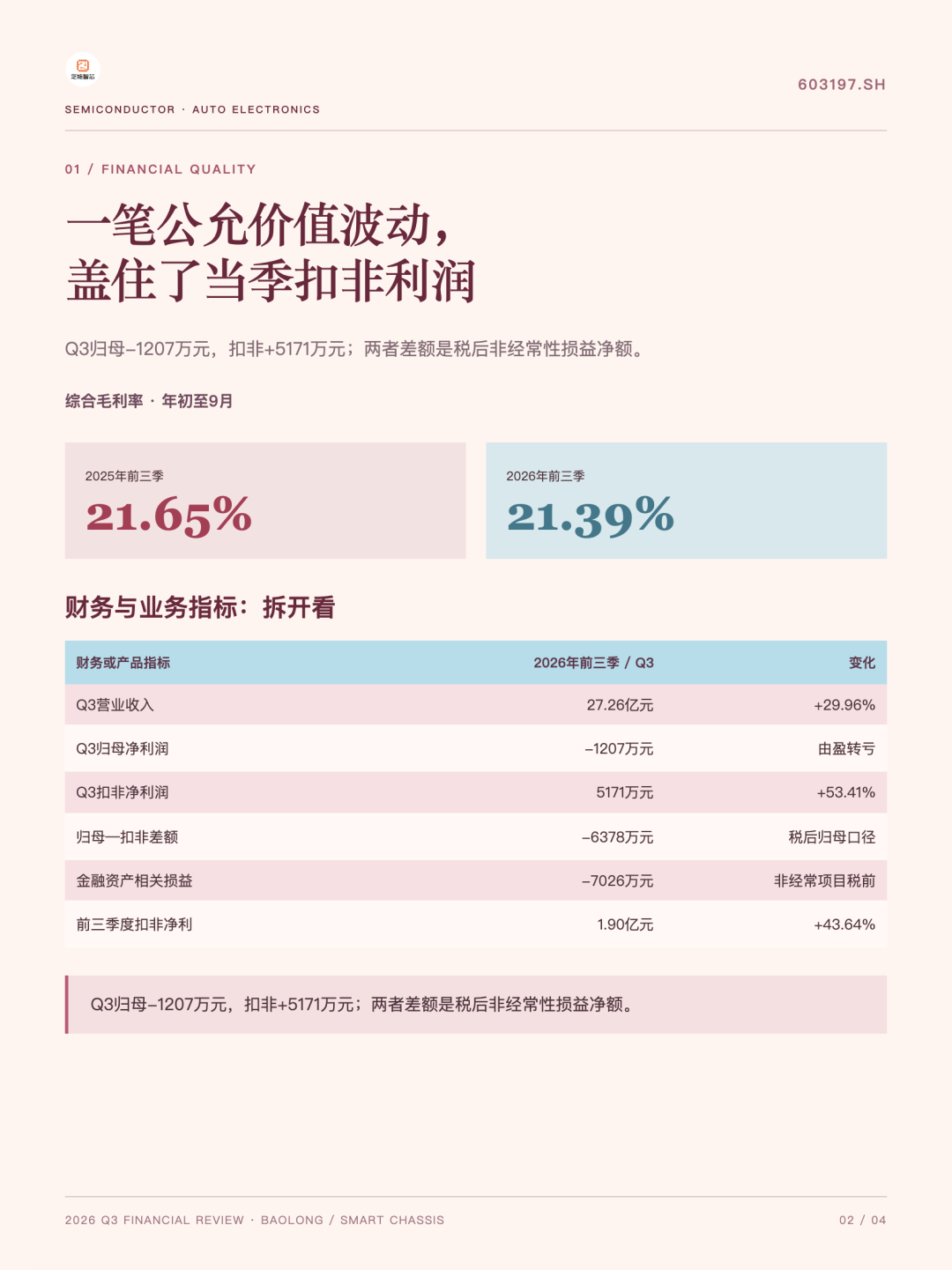
In the first three quarters, Baolong's consolidated gross margin was estimated at about 21.39% based on revenue and cost, versus about 21.65% in the same period last year, a slight decline.
Part 2: Overseas Capacity Expansion and Development Direction
Baolong's supply chain layout is also globalizing:
◎ Phase II of the Hungary campus has been completed, and the air suspension production line has been installed and commissioned;
◎ The new Thailand factory was put into operation in the first quarter, undertaking valve stem production and rubber capability building;
◎ Construction of the U.S. TPMS factory has started and is expected to begin production in 2027;
◎ With locations in Europe, Southeast Asia, and North America, Baolong is shifting further from production in China and global sales toward localized manufacturing close to overseas customers.
Different product lines adopt different location layouts, related to customer needs and the trade environment.
◎ Air suspension parts are relatively large, making delivery time and engineering service radius important;
◎ TPMS has both OEM customers and aftermarket replacement markets in North America and Europe;
◎ Valve stems and balance weights are high-frequency, large-scale products with broad geographic coverage.
Being close to customers can improve supply chain resilience, but overseas factories initially go through equipment investment, employee training, certification, and capacity ramp-up, creating capital expenditure and operating pressure in the short term.
The semiannual report warned:
◎ Prices of materials such as copper, aluminum, natural rubber, neoprene, plastic pellets, PCB, and memory chips may all affect parts profitability;
◎ Appreciation of the renminbi against the U.S. dollar and euro also brings exchange losses.
In the first three quarters:
◎ Financial expenses were 118 million yuan, versus about 43.61 million yuan in the same period last year, a relatively large increase; core operations remain constrained by raw materials, overseas funds, and exchange rate costs.
◎ In the first three quarters, Baolong's non-recurring net profit was 190 million yuan, up 43.64% year on year,
◎ Net operating cash flow was 220 million yuan, but down 25.09% year on year.
Compared with first-half operating cash flow of 177 million yuan, third-quarter single-quarter net operating cash inflow was about 43.31 million yuan, still positive. The core business is not just book profit, but expansion has not simultaneously accelerated cash recovery.
At period end, accounts receivable were 2.605 billion yuan, up about 220 million yuan from 2.385 billion yuan at the beginning of the year; monetary funds were 743 million yuan, up from 435 million yuan at the beginning of the year, while net cash inflow from financing activities was relatively large.
For a rapidly expanding auto parts company, inventory, mold and production line investment, and customer payment terms all tie up cash.
Baolong is still advancing overseas factories and mass production of new products, and the stability of cash flow explains growth sustainability better than a single quarter's net profit or loss attributable to shareholders.
Baolong has become a collection of multiple business risks.
◎ Traditional TPMS and valve stems are relatively mature, with demand related to global vehicle parc and replacement cycles;
◎ Air suspension and ADAS are more affected by new model nominations and configuration penetration rates;
◎ Overseas factories are affected by ramp-up cycles, local customers, and exchange rates;
◎ Equity investments are also affected by the prices of listed companies.
Summary
At first glance, Baolong Technology was loss-making in the third quarter, but non-recurring profit is still decent, and gross margin is also decent.
-
Thank You, Chinese Apple Fans, for Giving Apple's New CEO Two Big Gifts!
-
![]()
You Paid for the Flagship Model—But What You Get May Be a Watered-Down Version
-
![]()
Model Factories Are Bleeding, Cloud Vendors Are Counting the Money
-
Trump Loses Midterm Elections, U.S. Stocks Wipe Out Over $2 Trillion in One Night, AI Bubble Bursts, China's Chance to Overtake Has Come
-
![]()
Why Did OpenAI Label Its Own New Model GPT-6 Cyber with a "Critical" Warning?
-
![]()
$1.8 Trillion! The AI Investment Frenzy Is Running Red-Hot
-
![]()
Baolong Technology, a Leader in Air Suspension, Posts 12.07 Million Yuan Q3 Loss, but Non-Recurring Net Profit Rises 53% to 51.71 Million Yuan
-
![]()
Xiaomi Auto Tops 50,000 Again in October: Stock Surges 18% in Just 4 Days!