Xiaomi Auto Tops 50,000 Again in October: Stock Surges 18% in Just 4 Days!
 11/06 2026
 374
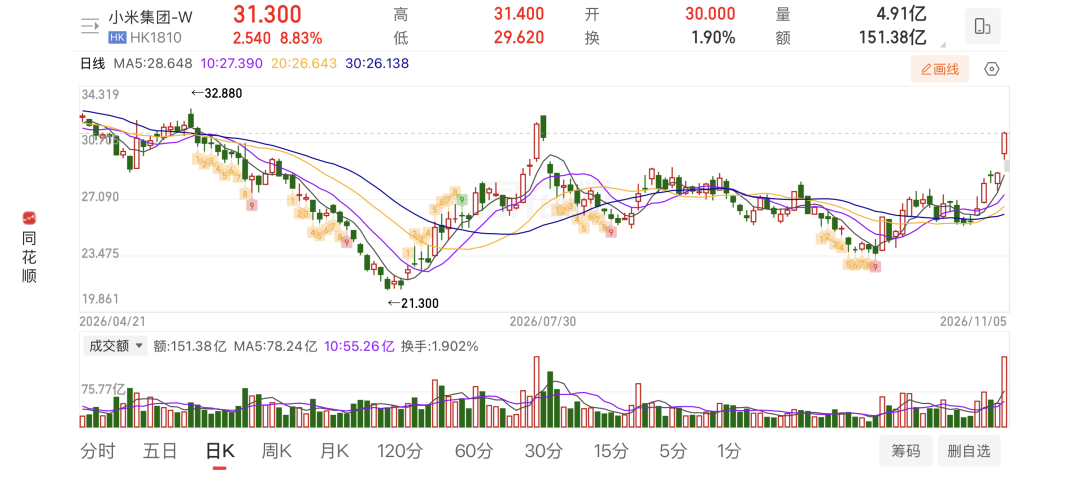
On November 5 Beijing time, Hong Kong-listed Xiaomi Group (01810.HK) opened with a gap up and climbed steadily throughout the session, ultimately closing up 8.83%. Its market capitalization returned above HK$800 billion, closing at HK$807.41 billion, with a closing price of HK$31.30.
Since Xiaomi Group announced on November 1 that Xiaomi Auto's October sales had once again exceeded 50,000 units, the stock has posted a cumulative gain of 18.20% over the four trading days beginning November 2.
The month-over-month increase in vehicle deliveries is the main driver behind this rally. Over the past three months—August, September, and October—Xiaomi Auto's monthly deliveries came in at 30,000+, 40,000+, and 50,000+ respectively, growing by 10,000 units each month. The last company to post such steady month-over-month growth was Leapmotor.
The previous time Xiaomi Auto broke the 50,000 mark was in December 2025, after which deliveries declined steadily. Before the extended-range brand Pengcheng began deliveries, Xiaomi Auto relied on just two pure electric models to keep monthly sales steady at around 30,000 units.
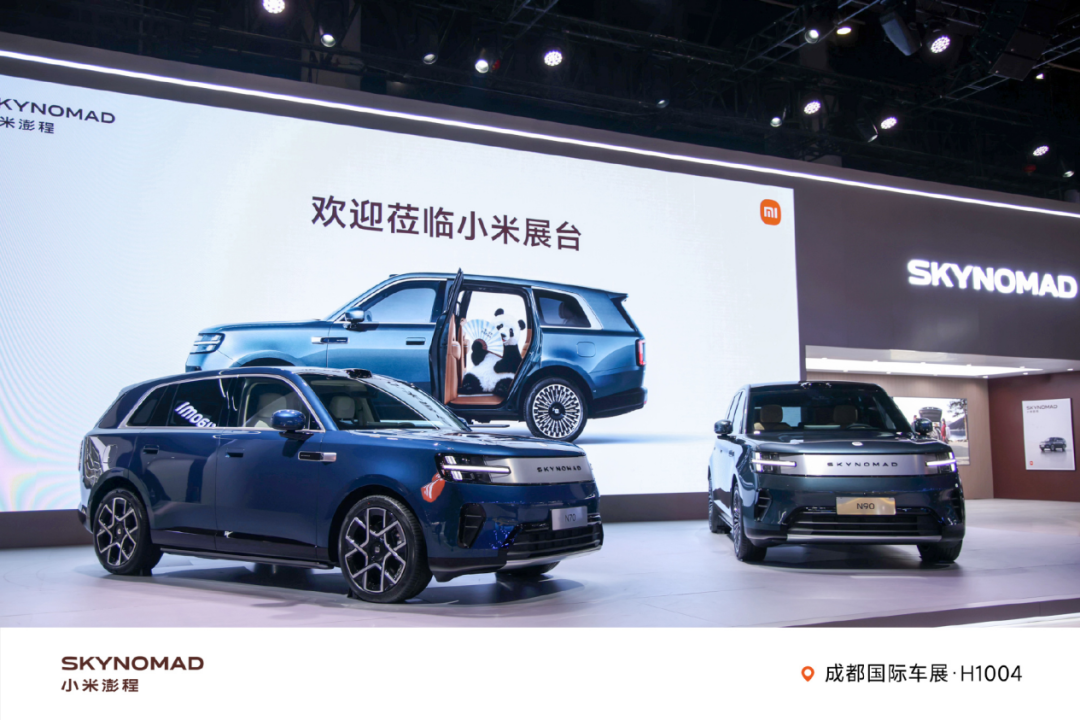
Clearly, after the two models from its all-new extended-range brand Pengcheng began deliveries in September, they injected a fresh growth engine into Xiaomi Auto. Based on Xiaomi's previously announced figure of over 70,000 cumulative locked orders for the Pengcheng series one month after launch, Xiaomi Auto's November deliveries could reach 60,000+, setting a new monthly delivery record since the company's founding.
Whether Xiaomi's stock price can break through its previous high of HK$32.4 remains to be seen—after all, the stock has already rebounded to HK$31.4 today. Xiaomi's previous stock price peak was also set on July 30, driven by a rebound after Xiaomi announced its all-new extended-range brand, Pengcheng, on July 9.
The extended-range market that Li Auto built from scratch is still going strong in 2026, helping Xiaomi break through its own sales ceiling. It remains to be seen how Xiaomi Pengcheng's monthly deliveries will look in 2027 once accumulated orders have been exhausted. After all, the extended-range market has been shrinking for some time, with its market share continuously declining.
Huatai Securities said in a research report on November 4 that it maintains a Buy rating and a HK$32 target price for Xiaomi Group, expecting Q3 vehicle deliveries of about 103,000 units and a delivery peak in Q4.
On November 24, Xiaomi Group will announce its Q3 2026 financial results. That date may mark a watershed for this wave of stock price recovery.
Some also attributed Xiaomi's stock price rise to a Barclays report on November 4 stating that Xiaomi's Q3 phone average selling price (ASP) is expected to hit a record high. Previous financial reports showed Xiaomi's phone ASP reached a new high of 1,321 yuan in Q2.
However, the record-high phone ASP is entirely due to upstream memory chip price increases, which prompted Xiaomi to proactively cut shipments of low-priced phones—not because of any brand strategy to move upmarket in phones.
Proactively reducing low-priced phone shipments is Xiaomi's way of "controlling volume to protect profit." Secondary market investors approve of this approach—after all, the financials look good.
In January 2026, Xiaomi lowered its phone shipment target from 170 million units to 135 million units, then further lowered it to 95 million units in June, before subsequently raising its annual phone shipment target to 110 million units in July.

According to IDC statistics, Xiaomi's global phone shipments in Q3 were 30.7 million units, ranking third after Samsung and Apple with a 12% market share, but down 29.2% year-on-year. By comparison, Samsung and Apple declined only 6.8% and 4.0% respectively. Xiaomi nevertheless outperformed OPPO and vivo, which ranked fourth and fifth and declined 34.5% and 31.5% respectively.
Turning to the domestic phone market, Xiaomi's Q3 shipments of 7.99 million units fell 20.4% year-on-year, ranking fifth. Huawei and Apple ranked first and third, with Q3 shipments both exceeding 10 million units—12.22 million and 10.31 million respectively. OPPO and vivo ranked third and fourth. Among all brands, Huawei was also the only one to achieve year-on-year growth, at 17.3%.
It is worth mentioning that Huawei is about to launch a new phone brand (rumored to be named Xingmang), which may further squeeze the market share of all brands except Apple. The most affected may be Honor, but Xiaomi's sub-brand Redmi also falls within the impact range.
As for memory prices, which affect all phone brands, there is no possibility of a pullback in the short term. Even Apple can no longer secure cheap memory and can only respond with price increases—which is why Apple's sales have also declined.
-
Thank You, Chinese Apple Fans, for Giving Apple's New CEO Two Big Gifts!
-
![]()
You Paid for the Flagship Model—But What You Get May Be a Watered-Down Version
-
![]()
Model Factories Are Bleeding, Cloud Vendors Are Counting the Money
-
Trump Loses Midterm Elections, U.S. Stocks Wipe Out Over $2 Trillion in One Night, AI Bubble Bursts, China's Chance to Overtake Has Come
-
![]()
Why Did OpenAI Label Its Own New Model GPT-6 Cyber with a "Critical" Warning?
-
![]()
$1.8 Trillion! The AI Investment Frenzy Is Running Red-Hot
-
![]()
Baolong Technology, a Leader in Air Suspension, Posts 12.07 Million Yuan Q3 Loss, but Non-Recurring Net Profit Rises 53% to 51.71 Million Yuan
-
![]()
Xiaomi Auto Tops 50,000 Again in October: Stock Surges 18% in Just 4 Days!