$1.8 Trillion! The AI Investment Frenzy Is Running Red-Hot
 11/06 2026
 544

AI investment continues to expand at an unprecedented pace.
A report released by Goldman Sachs Research in August 2026 shows that by the end of 2026, total global investment related to artificial intelligence will reach approximately $1 trillion; from 2022 through the end of 2026, cumulative global investment in the AI field will reach $1.8 trillion.
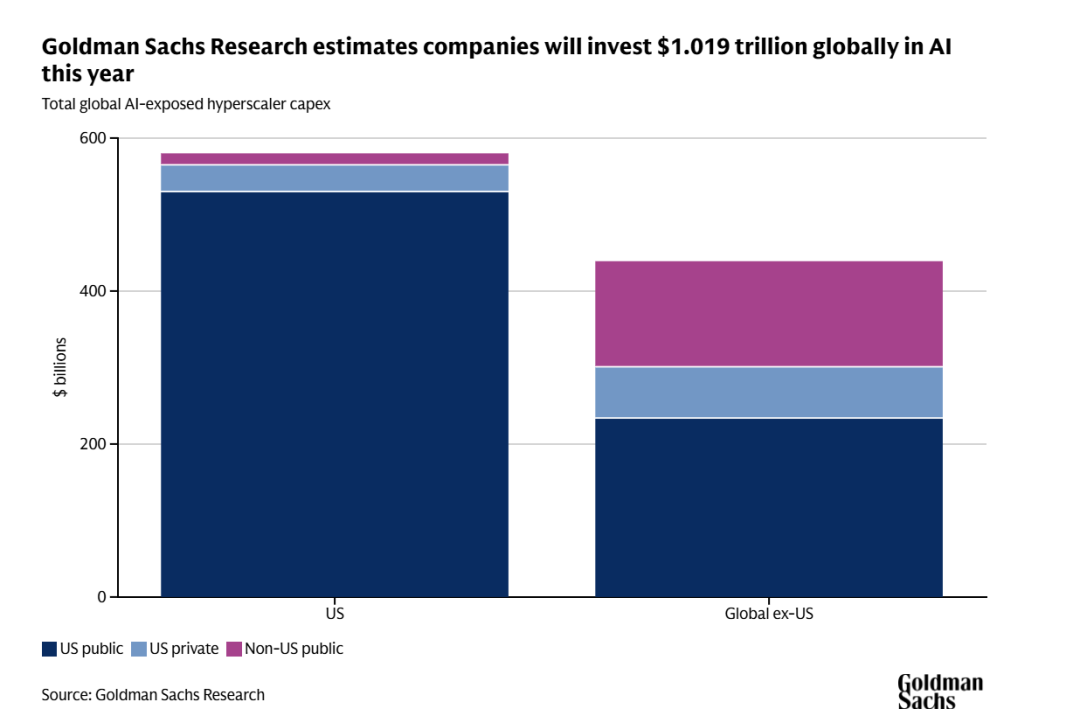
That sum is already close to the annual economic output of a medium-sized developed economy.
Gartner offers a similar judgment on a broader scale. In January 2026, the firm stated that total global AI spending that year would reach $2.52 trillion, a year-on-year increase of 44%.
Put simply, in 2026, nearly $7 billion per day on average is being poured into AI-related spending worldwide.
01 The Trillion-Dollar Rush
To understand the current frenzy of AI investment, one must first grasp the full picture of the numbers.
Let us shift our perspective from the macro whole to the micro individual. According to Bloomberg statistics based on the latest financial reports, the combined future expenditure commitments of Alphabet, Meta, Microsoft, Amazon, and Oracle on leases, buildings, energy, and other equipment have exceeded $3 trillion.
Among them, Google alone has disclosed commitments exceeding $1 trillion—nearly eight times the figure a year ago. Meta follows closely with commitments exceeding $800 billion, nearly half of which is for data center leases that have not yet begun, with repayment periods of up to 30 years.
The pace of domestic AI investment is in sync with the global wave.
Data from Donghai Securities and Moody's also confirm the scorching heat of this boom—and the staggering scale of the money being burned.
The former estimates that the combined capital expenditure of the four major tech giants is growing at an annual rate exceeding 80%, with funds mainly flowing to data centers, GPUs, and intelligent computing clusters; the latter predicts that China's leading tech enterprises will spend approximately $140 billion in capital expenditure in 2026.
It is far more than just a few tech giants that are spending heavily on AI.
The limit of computing power is electricity—and this has become an industry consensus.
As hyperscale data centers spring up everywhere, power infrastructure is undergoing an expansion wave driven by AI. From long-term power purchase agreements for renewable energy to a surge in interest in small modular nuclear reactors to exploding orders for electrification equipment, capital is pouring frantically into the energy sector.
Some institutions estimate that by 2030, investment required for the electrification of AI data centers alone could be as high as trillions of dollars.
The financial industry is also pouring money into AI. In 2025, the six major state-owned banks invested a total of 130.091 billion yuan in fintech, accounting for 3.31%–5.78% of their operating revenue.
There is also the telecom operator system. In the first half of 2026, the three major operators publicly disclosed a total of 32 intelligent computing tender projects, with a total budget of approximately 15.758 billion yuan.
To some extent, the capital scale of this AI carnival has exceeded the scope of traditional capital expenditure. It is more like a generation of enterprises mortgaging their balance sheets for the coming decades to AI in advance.
02 Regulators Speak Up
As tech giants successively make astronomical spending commitments for the coming years—driving global AI-related investment to approach or even break through the trillion-dollar level in 2026—an unavoidable question surfaces: will this become an excessive bet dominated by capital inertia?
In fact, the phenomena of overheated AI investment and excessive concentration have already drawn regulatory attention.
Recently, Xiao Yuanqi, Deputy Director of the National Financial Regulatory Administration, said at the Fifth International Financial Leaders Investment Summit: "A large amount of capital has poured into the technology industry and leading enterprises, pushing up leverage levels in these sectors... increasing financial burdens, weakening enterprises' ability to reinvest and expand production, and also increasing credit risk."
Xiao Yuanqi believes that policymakers should formulate corresponding policy frameworks in advance for the AI-driven economic transformation, so as to strengthen macroeconomic management and prevent economic and financial risks.
The regulator's statement is not groundless.
When capital flows into only one track and converges around only one narrative, the first thing pushed up is the leverage level.
Once leverage rises, the impulse to expand is amplified as well—the more money borrowed, the more necessary it is to scale up as quickly as possible to prove the rationality of the financing story, so the pace of expansion often outruns the rhythm of cash flow recovery.
And the end of this chain usually lands on credit risk. Borrowed money must eventually be repaid; when debt obligations are locked in for the coming years while the outline of returns remains in the clouds, what banks and bondholders bear is a risk of maturity mismatch—something the financial industry must especially pay attention to in this round of AI boom.
Second, the crowding-out effect. Capital swarming into the AI narrative not only squeezes traditional industries and pushes up their borrowing costs, but is also detrimental to industrial coordination.
This logic is not hard to understand. When tech giants and AI companies issue debt on a large scale and compete for institutional funds from the same pool, the credit resources available to traditional industries become relatively scarcer, and the price of funds rises accordingly.
In this process, traditional industries may not have done anything wrong; they are simply at a disadvantage in the financing competition because they are not part of the AI narrative. For manufacturing and small and medium-sized enterprises with thin profits that rely on bank loans for working capital, every increase in borrowing costs compresses and tests their room for survival.
Yet the implementation of AI must ultimately land in specific sectors such as manufacturing, retail, healthcare, and energy, and relies on thousands of industries to provide scenarios, data, and willingness to evolve. If the reinvestment capacity of traditional industries themselves is suppressed by financing costs, the process of digital and intelligent transformation will be delayed, and the expansion of AI application scenarios will be constrained accordingly.
03 Conclusion
Returning to Xiao Yuanqi's statement: policymakers should formulate corresponding policy frameworks in advance for the AI-driven economic transformation.
The weight of this sentence lies in the two words "in advance."
The danger of overheated AI investment does not lie in investment itself. Computing infrastructure is the foundation of the AI era, and the giants' rush to invest has its rationale in technological evolution.
What truly deserves vigilance is whether the pace, structure, and financing methods of investment exceed the boundaries that enterprises' cash flow and the financial system can comfortably absorb—as well as the threat to traditional industries.
The wheels of history roll on, constantly reminding us: between the narrative of technological revolution and the laws of financial cycles, maintaining a sense of clarity may be more necessary than ever.
*Note: The cover image is sourced from AI-generated imagery. The information or opinions involved in this article do not constitute any advice. For reprinting of original articles, please contact Xiao Qi.
-
Thank You, Chinese Apple Fans, for Giving Apple's New CEO Two Big Gifts!
-
![]()
You Paid for the Flagship Model—But What You Get May Be a Watered-Down Version
-
![]()
Model Factories Are Bleeding, Cloud Vendors Are Counting the Money
-
Trump Loses Midterm Elections, U.S. Stocks Wipe Out Over $2 Trillion in One Night, AI Bubble Bursts, China's Chance to Overtake Has Come
-
![]()
Why Did OpenAI Label Its Own New Model GPT-6 Cyber with a "Critical" Warning?
-
![]()
$1.8 Trillion! The AI Investment Frenzy Is Running Red-Hot
-
![]()
Baolong Technology, a Leader in Air Suspension, Posts 12.07 Million Yuan Q3 Loss, but Non-Recurring Net Profit Rises 53% to 51.71 Million Yuan
-
![]()
Xiaomi Auto Tops 50,000 Again in October: Stock Surges 18% in Just 4 Days!