Liu Qingfeng Delivers Half of iFlytek's AI Report Card
 11/09 2026
 381
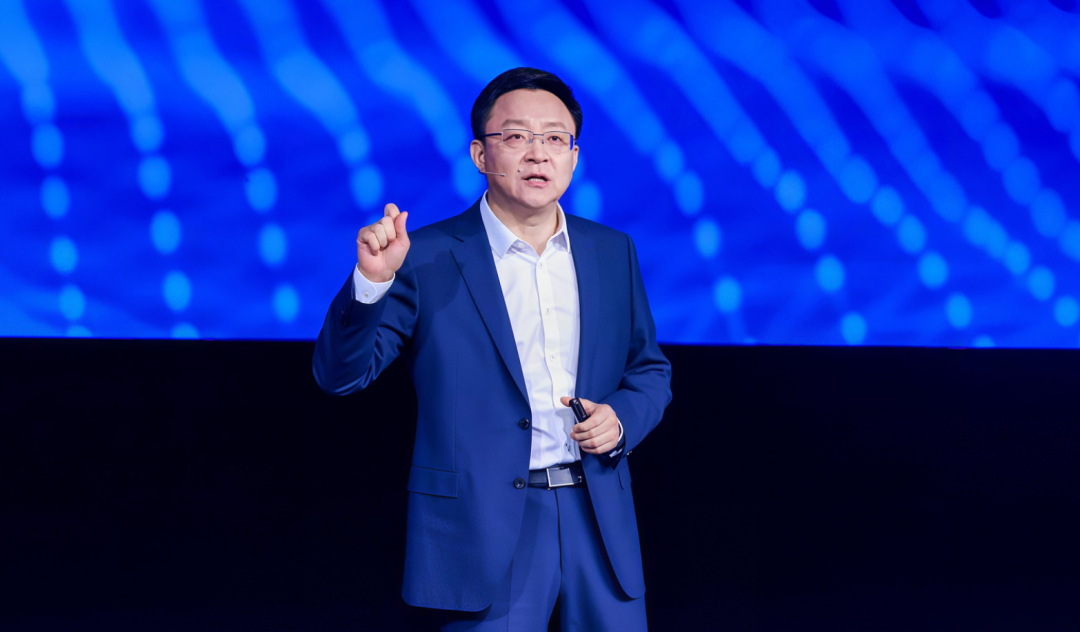
How much of iFlytek's AI promise has actually been kept?
At the earnings briefing on April 29, iFlytek Chairman Liu Qingfeng raised the topic of market value unprompted. He acknowledged that for many investors, the company has fallen short of expectations. "We feel a bit sorry about that," he said, adding that "the company's market value should be higher. We need to help everyone see through this difficult path of domestic chips and understand the business logic clearly."
His subtext was clear: iFlytek, which has committed to a fully domestic computing power route, is significantly undervalued—its market value stood at roughly 115.4 billion yuan that day.
At the same briefing, Liu Qingfeng set a deadline for resolving the domestic computing power dilemma. He conceded that training ultra-long context models is indeed constrained, but the difficulties are "already clearly visible." iFlytek is working closely with the relevant Huawei team and expects results by October, after which the pain will subside.
iFlytek Delivers on Technical Expectations
Half a year later, he began to show results.
On the afternoon of October 22, the 1024 Developer Festival was held in Beijing for the first time. Liu Qingfeng unveiled the device-cloud integrated Spark X2.6, which for the first time ran million-level ultra-long context code and agent training on domestic chips, improving ultra-long context training efficiency by roughly fourfold.
Three days earlier, after market close on October 19, iFlytek released its third-quarter 2026 financial report. During the period, the company generated operating revenue of 6.564 billion yuan, up 7.99% year on year; net profit attributable to shareholders of the parent company was 226 million yuan, up 31.05% year on year; cumulative net profit attributable to shareholders of the parent company for the first three quarters was 21.8872 million yuan, turning profitable year on year.
However, after deducting non-recurring gains and losses, the third quarter still posted a loss of 126 million yuan, with a cumulative loss of 763 million yuan in the first three quarters.
Two quarters later, the business logic of this path is still being tested, and its market value has fallen to 87.8 billion yuan, down more than 40% from its stage high at the beginning of the year.
Technology is advancing smoothly, but financial performance is lagging. This gap precisely reflects the outside world's AI expectations for iFlytek: half technology, half business.
On the technology side, the question is whether domestic computing power can support mainstream large models, and whether code and agents can keep up; on the business side, the question is whether money can come in once the technology is implemented, and whether the market value recognizes it.
Liu Qingfeng has delivered well on the first half; the second half, especially market value, remains up in the air.
In other words, what he has handed in is only half of iFlytek's AI report card.
Over the three years of large models, Liu Qingfeng has not made empty promises on technology, and the goals he set have largely been met. For example, on May 6, 2023, Spark large model 1.0 was released, and he said it would benchmark against ChatGPT (GPT 3.5) by October, laying out a timetable for three upgrades within the year: bolster mathematics, bolster code, surpass in Chinese, and match in English.
Five months later, Spark V3.0 was released, and Liu Qingfeng said: "We have delivered on the timetable we gave everyone, as scheduled."
The protagonist in 2026 is the Agent, and the most computing-intensive areas in this round of competition are code and agents. iFlytek's solution is a hard push: on the training side, long tasks are split and run in parallel, with computing power allocated according to task length; on the inference side, it relies on multi-layer caching and distribution to overcome the "can't fit, can't train" bottleneck.
He revealed at the main forum that the coverage of agent tasks that edge-side models can complete independently has risen from the industry average of 12.8% to 41.9%. In terms of training efficiency, the efficiency of long chain-of-thought reinforcement learning has risen from 30% to 84%, and the full MoE chain from 30% to 93%. The cost is that whenever a mainstream international algorithm emerges, iFlytek cannot use it directly and must first spend three to six months adapting and running it on domestic cards. This time cost ultimately falls into R&D expenses, growing heavier year by year.
Compared with A-share software companies whose R&D expense ratios are generally 15%–20%, iFlytek's R&D expense ratio has remained around 25% for several consecutive quarters.
But awkwardly, the "delivery" on technology has not driven the company's revenue and market value as much as expected.
In February 2021, at the annual planning conference, Liu Qingfeng set goals for the AI 2.0 era: "one billion users, 100 billion revenue, one trillion ecosystem." The completion deadline was set for 2025, the final year of the 14th Five-Year Plan. The 100 billion revenue target was split into goals for seven segments, which add up to exactly 100 billion yuan. At that time, iFlytek's annual revenue was only 13.025 billion yuan, meaning revenue had to increase seven and a half times in five years.
In 2025, the target expired. iFlytek posted revenue of 27.105 billion yuan, doubling from five years earlier. This growth rate is not slow for A-shares, but compared with the 100 billion revenue target, the gap is glaring.
The profit composition beyond revenue is also telling. In 2025, net profit attributable to shareholders of the parent company was 839 million yuan. After deducting non-recurring gains and losses, only 264 million yuan remained: a little over 30% was earned by the main business, and the bulk of the rest was 636 million yuan in government subsidies included in profit and loss.
This subsidy corresponds to national projects it undertakes and is not free money, but it does inflate book profit.
Beyond the income statement, there is also this money tied up in receivables. At the end of 2025, iFlytek had 16.296 billion yuan in accounts receivable on its books, equivalent to 60% of annual revenue, of which 5.6 billion yuan was more than two years old.
In other words, for every 10 yuan of business iFlytek does, 6 yuan has not yet been collected, and 2 yuan of that has been on the books for more than two years. For businesses like education and government affairs, delivery and payment cycles are inherently long, and the more projects there are, the more it has to front.
iFlytek is profitable, but its collection cycle is relatively long.
Is iFlytek undervalued?
The moat Liu Qingfeng dug is domestic computing power, which is both his talisman and his ceiling.
At the 2023 1024 Developer Festival, iFlytek and Huawei jointly released China's first fully domestic 10,000-card platform, "Feixing No. 1." Liu Qingfeng repeatedly stressed: other companies only adapt domestic chips at the inference stage, while iFlytek has used them since the training stage.
This is its selling point, but shortcomings also objectively exist. At the earnings briefing in August this year, iFlytek admitted that in ultra-long context above 256K, complex agents, and code training, there is roughly a fivefold gap with Nvidia H200.
Liu Qingfeng said, "Because domestic computing power limits ultra-long context, in this wave of market hotspots dominated by code and agents, iFlytek appears to be somewhat absent."
It is not easy for him to be willing to put the gap on the table. For the fully domestic signboard, there is no second company in China. Its confidence still comes from Huawei's new cards. Ascend 950DT benchmarks against H200 and has already achieved 65% to 85% comprehensive performance. The company expects significant improvement from the end of this year to next year.
However, in Liu Qingfeng's view, this gap does not hurt the foundation: in industry applications such as education, healthcare, automobiles, and central state-owned enterprises, 90% or even 95% of scenarios do not need such long context; a few hundred thousand tokens are enough.
If the market next compares not parameters but tokens, is iFlytek's computing power investment still worth it?
Liu Qingfeng said, "The revenue we actually obtain from APIs and pure token consumption is already much higher than that of other model companies."
This is verified in the financial report. iFlytek disclosed that in 2025, its large model API and MaaS revenue was 385 million yuan, up 263% year on year.
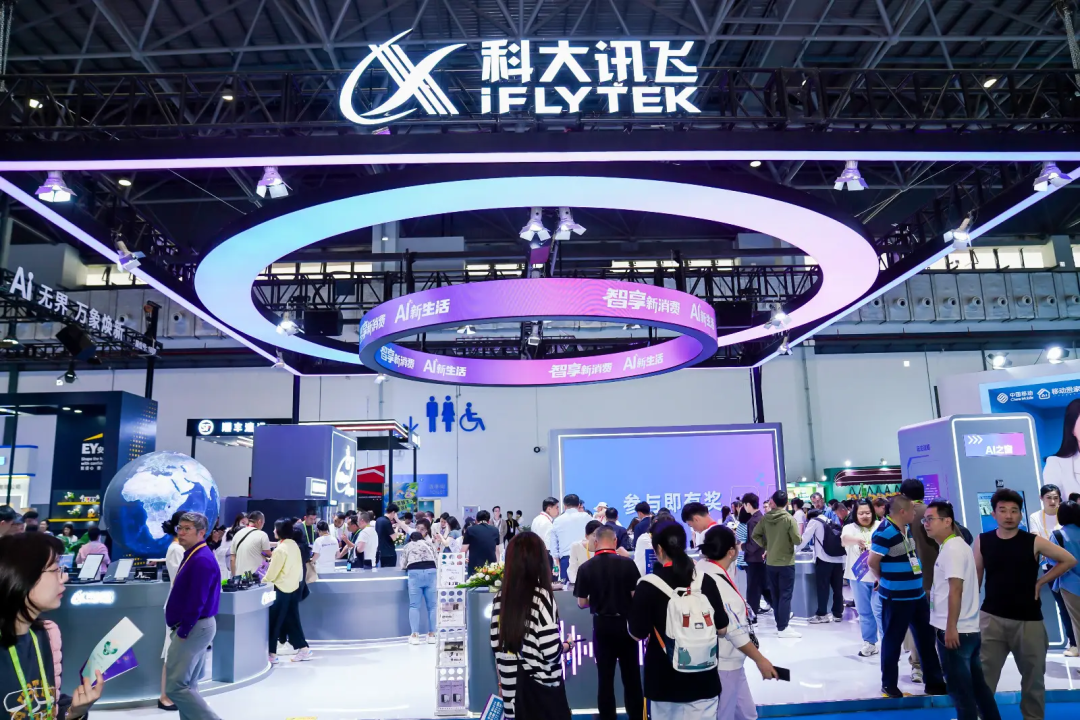 iFlytek booth, image source: Internet
Technology has delivered a complete report card, so why doesn't the market recognize it? This is not just iFlytek's issue.
Zhipu and MiniMax, which listed at the beginning of the year, also fell back from highs. The change lies in pricing methods: previously people listened to stories, now they calculate tokens and look at ARR (annual recurring revenue). The most typical indicator is P/ARR, that is, market value divided by annual recurring revenue. It calculates how much the market is willing to pay for one yuan of "money that can be continuously collected."
This valuation method suits pure model companies whose APIs charge continuously by call volume. Take Zhipu as an example: its total revenue in 2025 was 724 million yuan. But the market priced it with reference to an ARR of 1.8 billion US dollars.
One is full-year recognized revenue, the other is annual recurring revenue. Even if iFlytek wanted to smooth out this difference, the magnitude is still several times apart—iFlytek's API and MaaS revenue for a whole year is roughly equal to only about ten days of Zhipu's ARR.
And this is still comparing iFlytek's business segment most similar to a model company with the other company's total revenue.
Therefore, in terms of token revenue, which the market currently recognizes most, the "much higher" Liu Qingfeng mentioned is leadership in growth rate, not in magnitude.
On iFlytek's open platform, average daily tokens increased 42 times in a year, while revenue is still only a few hundred million yuan for now.
Obviously, the token business is not iFlytek's home ground; its bulk is in industries such as education, healthcare, and government and enterprise. Its business model is project-based, requiring iFlytek to send teams one by one, accumulate data one company at a time, and deliver year after year. It is the path of a software company.
In 2025, the amount of large-model-related projects won was 2.316 billion yuan, ranking first in the industry in both number and amount, exceeding the combined total of the second to sixth place.
In other words, the market's "stereotype" of iFlytek is that it prices two kinds of business as one: companies whose revenue is billed by token enjoy high multiples; those whose revenue is settled by project are treated as traditional integrators.
Liu Qingfeng's Transformation
The market's pricing method cannot be changed in the short term; the only thing that can change is iFlytek itself. At the interim earnings briefing on the afternoon of August 21, Liu Qingfeng made three statements contrary to his past practices.
First, he publicly admitted that iFlytek was slow. He himself pierced the window paper of "somewhat absent," and also said, "In the first half of this year, we felt great regret and pressure toward investors." iFlytek Board Secretary Jiang Tao was also very candid. From revenue and profit to cash flow, "many investors expressed dissatisfaction with this interim report."
It is not common for the management of an A-share listed company to put investors' dissatisfaction on the table verbatim.
Second, iFlytek's computing power will change from buying to renting, either renting directly or co-building with the government and relevant manufacturers and then renting, no longer spending big money all at once.
Third, he drew a line for burning money: the Spark large model has been spun off into an independent company, which will next introduce external financing; even with external funds, it will not invest in computing power at all costs to pursue pure model "peak-chasing."
Facing reality, changing the model, and stepping on the brakes are very different from his past style of chasing peaks and revenue, buying computing power himself, and spending heavily on R&D.
Both iFlytek and Liu Qingfeng have realized that after technology is delivered, business expectations must also begin to be delivered.
From the book data of the third-quarter report and the interim report, iFlytek has obtained many "good results." For example, the revenue structure is shifting. In the first half of the year, open platform revenue was 3.705 billion yuan, up 36.01% year on year, surpassing smart education's 3.490 billion yuan for the first time. This shows that iFlytek's new AI business is gaining momentum and taking over the growth responsibility from old businesses such as smart hardware and smart cities.
R&D investment is also still increasing. In the first half of the year, R&D expenses were 3.007 billion yuan, more than 600 million yuan more than the same period last year, corresponding to a non-recurring loss of 637 million yuan.
This sends a signal that iFlytek's losses are because investment continues to increase, not because its business model has problems. Before this, Liu Qingfeng had expressed a related attitude. He said that increasing R&D investment is out of confidence in the future of large models. "If we chose to be conservative and saved all these investments, it seems profit would immediately appear."
With one inflow and one outflow, the gap can only be filled by financing: in the first three quarters, net operating cash flow was 264 million yuan, up 115.28% year on year, and collections are indeed improving; but capital expenditure in the same period was 3.478 billion yuan, free cash flow was still negative 3.2 billion yuan, topped up by net financing inflow of 6.059 billion yuan, including about 4 billion yuan from a private placement.
A private placement can cover the gap for a time, but for the market to truly revalue it on the four indicators of token, ARR, non-recurring net profit, and free cash flow, iFlytek still has a long way to go.
Liu Qingfeng remains confident in the assets he has built over the years: China's only mainstream large language model trained entirely on domestic computing power; more than two decades of accumulated data and industry expertise in education, healthcare, and the judicial sector; and a chain of integrated hardware-software terminals spanning learning devices, translators, office laptops, AI glasses, and automotive cockpits.
What's more, he firmly believes that "this is absolutely not something a so-called one-person company can accomplish with tools alone."
I've noticed that when outsiders look at this collection of assets, some remark that iFlytek's AI portfolio resembles a general store. But I don't take that as a criticism—building each of these capabilities one by one on domestic computing power is precisely the kind of pioneering capability that a leading AI company should possess.
Nevertheless, the mismatch between technological delivery and business expectations still leaves Liu Qingfeng facing an unavoidable question: when will iFlytek start making money from its core business?
In April, he said: "I believe that as our path widens in the future, we will definitely have the last laugh—and so will investors."
In my view, for iFlytek and its investors to have the last laugh, the company still needs to clarify its core business and re-examine its own systems. Only then can Liu Qingfeng complete iFlytek's full AI report card and continue to deliver on the promise he set: "standing on the same platform as all the top players."
References:
XAI Finance, "How Much of iFlytek's AI Expectations Has Been Fulfilled?"
TMTPost, "iFlytek's Liu Qingfeng: iFlytek Spark X2.6 Trained on Fully Domestic Computing Power"
-
![]()
MIIT SUV New Car Roundup: Lincoln's All-New Plug-in Hybrid Arrives
-
![]()
Can MONA, the pillar holding up half of XPeng's sky, stand on its own?
-
![]()
Clearing the Way for Major Changes: Toyota China Announces Leadership Transition
-
![]()
The Biggest IPO in History Is Seeing Its Valuation Cut in Half?
-
![]()
BMW Brilliance Cuts 1,800 Jobs: A Full Bet on the New Generation?
-
![]()
October 2026 Automotive Reputation Index Analysis Report
-
![]()
Liu Qingfeng Delivers Half of iFlytek's AI Report Card
-
![]()
Let the Data Speak: China Is Winning the Automotive Electrification Race While the US Market Remains an Island