The Biggest IPO in History Is Seeing Its Valuation Cut in Half?
 11/09 2026
 563
Anthropic hasn't rung the listing bell yet, but investors are already haggling over the price. The $2 trillion figure that had been floating around the market is now being negotiated at around $1.5 trillion—and some institutions still think that's too expensive. One of the most sought-after AI companies is now being put through the wringer of public-market pricing.
As of November 7 Beijing time, media reports indicate that Anthropic still plans to kick off its IPO roadshow in the week of November 9, with a listing targeted for the week of November 16. Some potential investors are pushing for further discounts, with a few floating a valuation closer to $1 trillion.
The company's official issue price and offering size have yet to be finalized, and the roadshow schedule remains a reported plan rather than a confirmed arrangement. What matters here is the shift in buyer sentiment. Investors used to worry about missing the AI boat; now they're starting to worry about overpaying for it. The technology keeps advancing, but asset prices need to be recalculated. Anthropic co-founder and CEO Dario Amodei

Valuation Climbing Too Fast
Looking back from 2024 to 2026, Anthropic's value has surged almost without interruption.
In early 2024, Forbes reported that the company was pushing ahead with a $750 million funding round at a proposed valuation of $18.4 billion. In November of that same year, it announced an additional $4 billion investment from Amazon, bringing cumulative investment to $8 billion—a historic milestone at the time. And the money kept coming.
In March 2025, a $3.5 billion Series E round was raised at a post-money valuation of $61.5 billion. By September, a $13 billion Series F round was raised at a valuation of $183 billion. In February 2026, a $30 billion Series G round was raised at a valuation of $380 billion. In May, a $65 billion Series H round was raised at a valuation of $965 billion.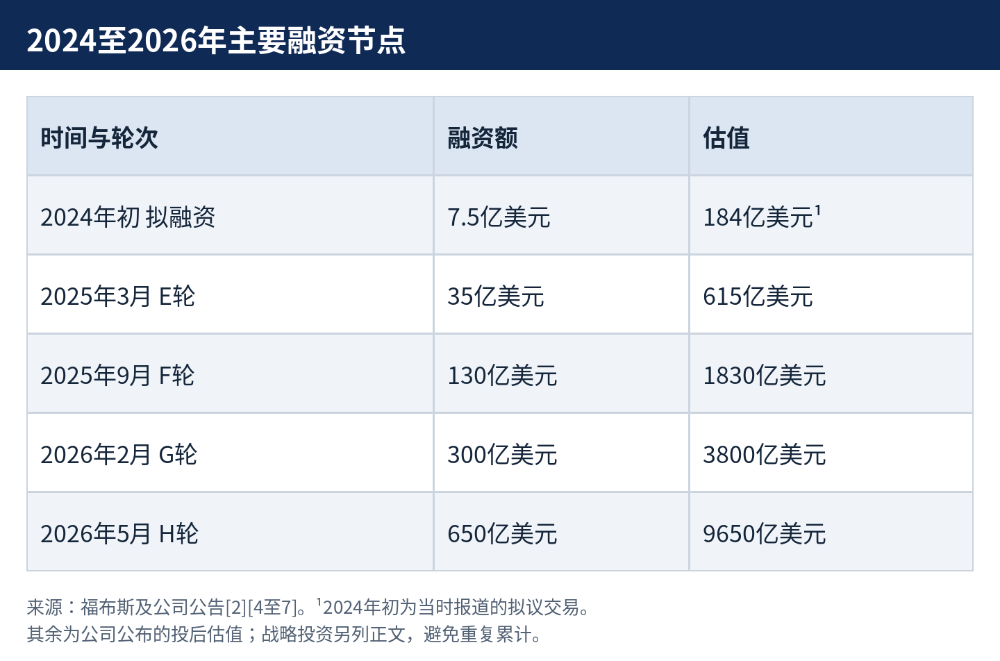
From March 2025 to May 2026 alone, the post-money valuation rose roughly 15.7-fold. Back-to-back mega-rounds make each new price the benchmark for the next. If someone was willing to invest in the previous round, a slightly higher price in the next one seems justifiable.
Valuation and fundraising amount are two different things, though. Valuation describes what the entire company is worth; the fundraising amount depends on how many shares are issued.
After the price drops, the company can adjust the issuance ratio or the financing scale—but each choice involves funding needs and the rights of existing shareholders. The core of the roadshow is to find the intersection between the business plan and the return requirements that investors will accept.
An IPO brings in more buyers and more comparison targets. Fund managers can buy cloud vendors, chip companies, or software enterprises that are already profitable.
Subscribing to Anthropic means forgoing the potential returns of other assets, so the price naturally has to withstand comparison. Retreating from $2 trillion to $1.5 trillion represents a 25% expected decline; close to $1 trillion would be equivalent to half of $2 trillion.
Even so, $1 trillion is still slightly above the most recent post-money valuation of $965 billion. Simply framing it as "financing valuation halved" is misleading. What's really being squeezed is the previous high premium expectation for the IPO.
Growing Fast, Profit Under Pressure
First, the business. SEC filings updated on November 2 show that Anthropic's third-quarter revenue was $16.956 billion, compared with $11.555 billion in the second quarter. Based on the disclosed figures, that's roughly 46.7% sequential growth—down from about 144.2% in the second quarter.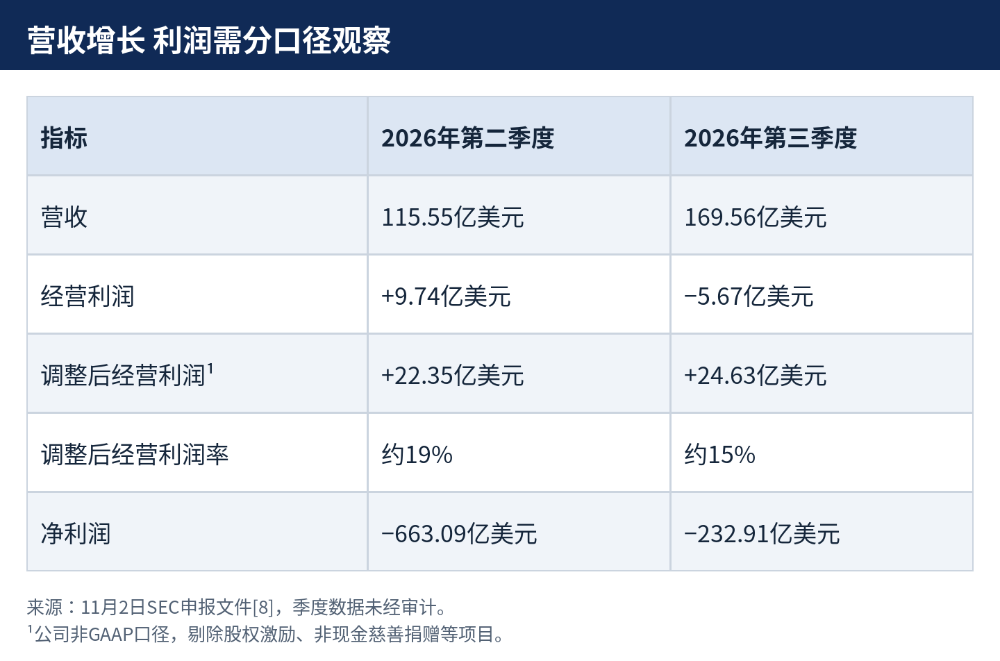
That kind of growth is still rare. The problem is that a trillion-dollar price tag has already baked in very high growth expectations. A company doing well and a stock being worth its price are two separate judgments. The latest media reports also point to some positive developments.
The Financial Times reported on November 6 that its annualized revenue run rate has reached about $81 billion. That figure comes from people familiar with the matter, and the updated filings still haven't filled in the corresponding value for the end of October. Annualized metrics reflect business velocity at a point in time; actual full-year revenue should be based on financial disclosures.
Profit needs to be examined separately. Second-quarter operating profit was $974 million, which turned into an operating loss of $567 million in the third quarter. The third-quarter net loss was $23.291 billion—much of which came from non-operating items such as changes in the fair value of financing instruments—so it can't be used to conclude that the core business had the same cash outflow in the quarter.
The company explained that third-quarter operating performance was mainly affected by costs related to $5 billion in short-term computing contracts and about $2 billion in non-cash charitable matching expenses. Short-term purchased computing power is currently significantly more expensive than multi-year contract purchases. This shows that when supply is tight, capturing customer demand also requires paying higher costs.
The other side of the picture should also be fully presented. Under the company's adjusted metrics, third-quarter operating profit was $2.463 billion, higher than $2.235 billion in the second quarter—but the corresponding margin fell from about 19% to 15%. This metric excludes items such as stock-based compensation and non-cash charitable donations, and should be read alongside operating profit under accounting standards.
Net cash inflow from operating activities in the first three quarters was $6.569 billion, which also shows a clear gap between the actual cash position and the book net loss. Operating cash flow is affected by the timing of receipts and payments, and also needs to cover capital expenditures.
Using a single metric to exaggerate risk or prove safety can easily distort the picture. The real pressure lies in whether costs can continue to decline. Traditional software usually has relatively limited replication costs when selling more copies; when AI completes more complex tasks, it often consumes more computing resources. The more customers use it, the more money the company collects—but also the more it pays in computing bills.
The Weight of Future Bills
As of the end of September, customers contributing at least $100,000 in revenue over the past 12 months exceeded 11,900, compared with about 1,500 at the end of 2025. The expansion of paying customers proves that Claude has entered the actual workflows of a considerable number of organizations. Demand has a foundation—and investment is heavy.
The filings disclose that procurement, leasing, and other agreements signed as of the end of September and thereafter total about $895.4 billion in expenditure commitments, almost all involving computing power and infrastructure. Of this, about $69.8 billion is expected to come due in the 12 months after the end of September 2026.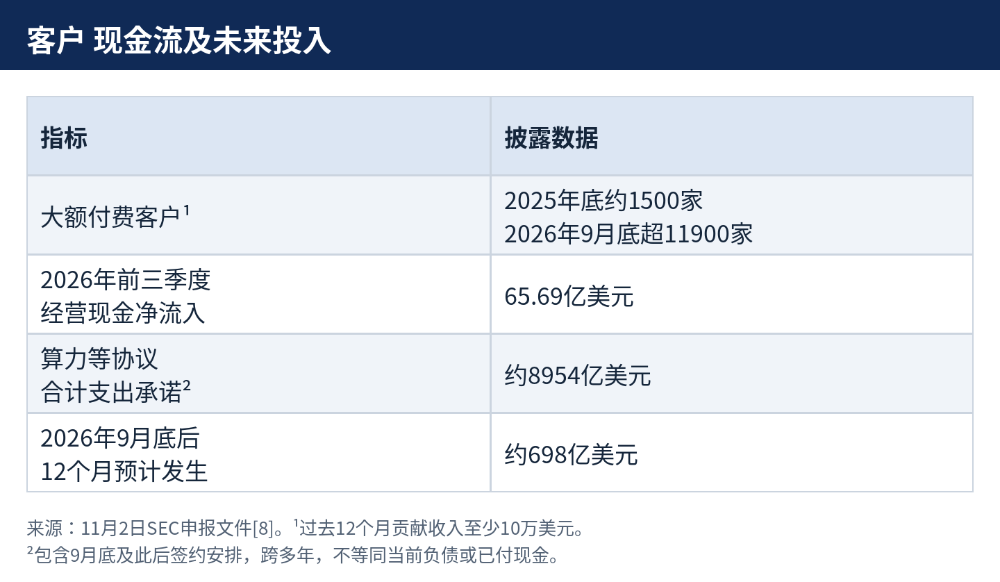
These contracts span multiple years, some extending to 2045. The total amount cannot be treated as current liabilities, let alone as money already spent this year. What investors focus on is when each batch of computing power is delivered, when payment is due, and whether the corresponding customer revenue can arrive on time.
Locking in computing power in advance can guarantee product services and may also secure better long-term prices. But once demand materializes more slowly than planned, idle resources and payment arrangements will drag down returns. The company also disclosed that some computing power suppliers rely on third-party financing; if financing is blocked or becomes more expensive, capacity delivery may be affected.
So the financing environment and operating risks are linked. When tech stocks fall, investors demand larger discounts; discounts in turn affect fundraising terms. For model companies that require continuous investment, a stable source of capital is itself part of operating capability.
Competitors Eyeing the Same Budget
Industry demand is still growing.
Menlo Ventures' 2026 enterprise AI report, released in November, estimates that enterprise AI deployment spending reached an annualized scale of $176.8 billion as of September—about 5.4 times the same metric a year earlier. Historical figures were reclassified, and this dataset is a research estimate.
The report estimates that in enterprise large-model API spending, Anthropic, OpenAI, and Google account for 55%, 31%, and 9%, respectively. The survey involved nearly 400 U.S. enterprise decision-makers, and Menlo is also an Anthropic investor. These results can be used to observe enterprise procurement trends, but their scope should be limited to the report's methodology.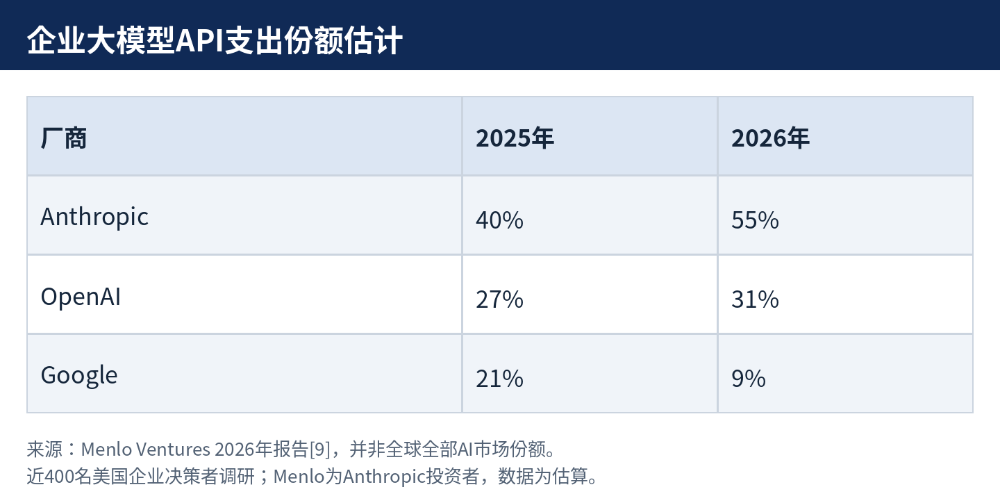
Anthropic's advantage lies in building Claude into programming and enterprise work. Enterprises are more willing to pay for tools that can complete tasks and reduce rework. But customers also calculate the total cost of each task, how long manual review takes, and how much they can save by switching to another model.
OpenAI's ChatGPT and Codex directly compete for work entry points and programming demand. Model capabilities and tools are constantly updated, and customers can assign complex tasks to products with better results and routine tasks to cheaper models. Procurement share must be defended through sustained performance.
Google has cloud, chips, and enterprise product channels and can embed Gemini into existing service systems. Anthropic, meanwhile, sells Claude through cloud platforms including Google and obtains computing power. This cooperation expands customer coverage but also complicates the relationships among supply, distribution, and competition. Price competition has already shown up in the financials. The filings note that new model price cuts and contract discounts in the third quarter offset about $600 million in revenue growth brought by increased usage.
Customers pay for results and will also seek more favorable terms. Call volume continues to rise, but average pricing and delivery costs need to be observed together to judge the quality of growth. Pressure from open models and low-cost models will also persist over the long term. High-end models need to prove that higher charges truly deliver better outcomes. Capability leadership can bring a premium, but how long that leadership lasts determines how solid the premium is.
After Listing, the Whole Industry Will Recalculate
If Anthropic successfully lists, the model industry will gain a more transparent price reference.
The growth stories told during fundraising will thereafter be tested by quarterly financial reports. Investors will keep comparing how much revenue increased, how much was invested to achieve it, and how much return was ultimately left. This shift will ripple through the industrial chain. Model companies' fundraising capacity affects computing power procurement, and the pace of procurement fulfillment in turn affects growth expectations for cloud, chips, and data centers.
Each company has a different customer structure, and the market will more carefully distinguish realized revenue, contractual commitments, and long-term assumptions. Financing for other AI startups will also be affected. The public trading price of leading companies will become an important reference in negotiations between investors and entrepreneurs. Projects that previously obtained premiums based on high growth expectations need to provide more solid customer and operating evidence.
Successful fundraising can also strengthen Anthropic's R&D and product investment, further raising the competitive threshold.
Application companies that want to stand firm need to master customer business, industry data, and service capabilities. Products that simply wrap a model interface will face more direct competition. This valuation tug-of-war reflects that short-term industry prices have accumulated a bubble. Demand and product value are growing, but capital once priced years of future success into current valuations.
Any slowdown in growth or rise in costs could force the market to take back part of the premium. A valuation correction alone is still not enough to conclude that the entire industry is in a bursting bubble. Anthropic's paying customers, revenue, and product progress all have factual support. A more accurate judgment is that some prices ran ahead of operating fulfillment, and now buyers are starting to demand more room. In the long run, AI is worth anticipating. In the short run, even the best technology needs an appropriate purchase price.
A company's true confidence comes from customers continuing to renew, from improved delivery capability, and from being able to leave returns after investment. Capital's willingness to bet on the future is an important condition for innovation to move forward. Only by keeping quotations rational and giving operations time can today's enthusiasm have a chance to become tomorrow's value that can withstand scrutiny.
What do you think about this hot topic? We look forward to your civilized and rational comments in the message area.
Disclaimer: This article provides analysis of trending financial topics from a professional standpoint. All data and materials are sourced from publicly available information, company announcements, and Tonghuashun iFinD. The views expressed are for reference only and should not be construed as investment or consumer advice.
#FinancialHotTopics #InDepthAnalysis #BusinessEconomics #InvestmentBankingCommunity #ListedCompanies #PrimaryMarket #IPO #AI
-
![]()
MIIT SUV New Car Roundup: Lincoln's All-New Plug-in Hybrid Arrives
-
![]()
Can MONA, the pillar holding up half of XPeng's sky, stand on its own?
-
![]()
Clearing the Way for Major Changes: Toyota China Announces Leadership Transition
-
![]()
The Biggest IPO in History Is Seeing Its Valuation Cut in Half?
-
![]()
BMW Brilliance Cuts 1,800 Jobs: A Full Bet on the New Generation?
-
![]()
October 2026 Automotive Reputation Index Analysis Report
-
![]()
Liu Qingfeng Delivers Half of iFlytek's AI Report Card
-
![]()
Let the Data Speak: China Is Winning the Automotive Electrification Race While the US Market Remains an Island