October 2026 Automotive Reputation Index Analysis Report
 11/09 2026
 561
AutoMen.com recently released its October 2026 Automotive Reputation Index Analysis Report. In October, the automotive reputation index reached 16,699.55, a slight decline from September but still at a high level overall.
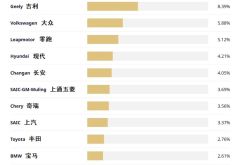
This month, more automakers and models entered the reputation feedback list. Among the top 10 automakers on the reputation list, seven saw their reputation indices decline to varying degrees, and the top 10 automakers accounted for only 41% of the reputation index. While the overall reputation index declined, problem concentration also decreased.
According to the problem feedback data, new cars within three years remained the main source of problems, and problems occurred mostly in domestic models. Body electrical and service were the focus of problem feedback. At the same time, the problem feedback rate for older cars over six years old remained high, with American-brand vehicles becoming a key feedback target.
The following is a detailed analysis of the October automaker reputation index.
October reputation index rises sharply
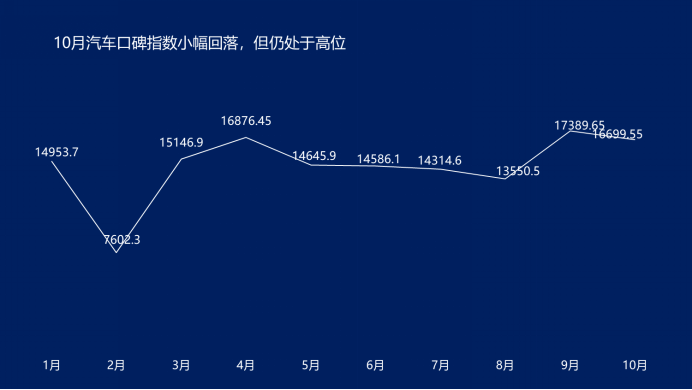
In terms of the monthly trend, after a sharp rise in September that set the highest value so far this year, the reputation index edged down in October but remained significantly above the annual average, with various reputation problems still occurring frequently.
Multiple new models appear on the reputation index list
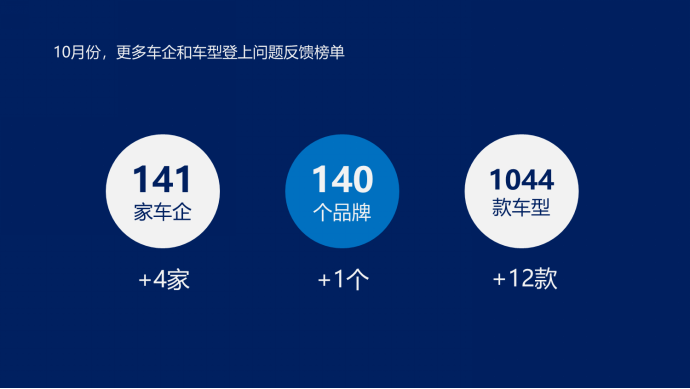
In October, a total of 141 automakers, 140 brands, and 1,044 models appeared on the problem feedback list, with both the number of automakers and models increasing compared with September. Moreover, according to the list, the top 10 shares of both the automaker and model reputation index lists in October were lower than in September, indicating a decline in problem feedback concentration.
Share of electric vehicle problem feedback rises
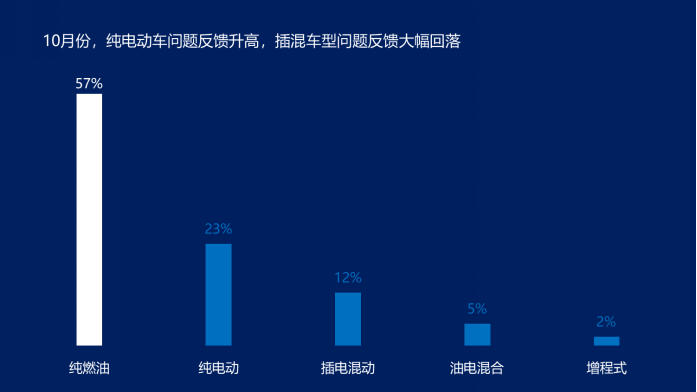
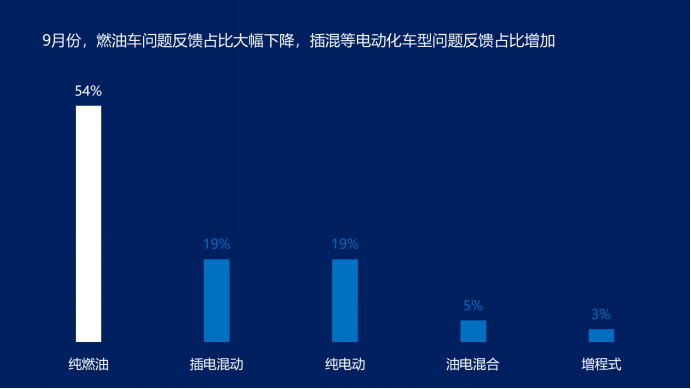
From the perspective of the powertrain types of models with problems, fuel vehicles remained the main target of user complaints, accounting for nearly 60% of problem feedback. Among electrified models, the share of problem feedback for pure electric vehicles rose, while the share for plug-in hybrid models fell sharply.
SUVs remain the largest source of problem feedback
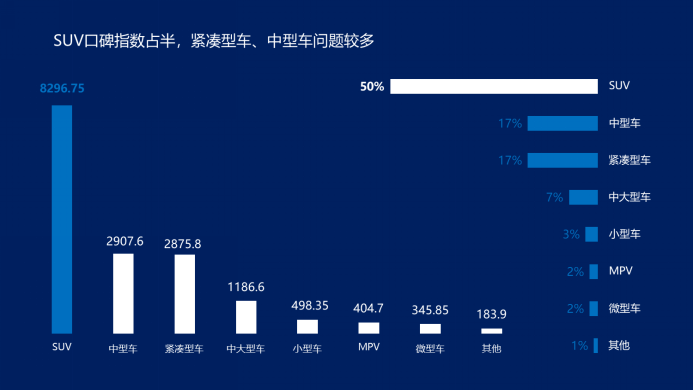
From the perspective of vehicle class, the problem feedback shares of various models in October continued the proportions of recent months. SUVs still had the highest problem feedback rate at 50%. Compact cars and mid-size cars followed, each with a problem feedback share of 17%. The share for mid-to-large cars also reached 7%. The problem feedback rates of these major categories also reflect their market inventory.
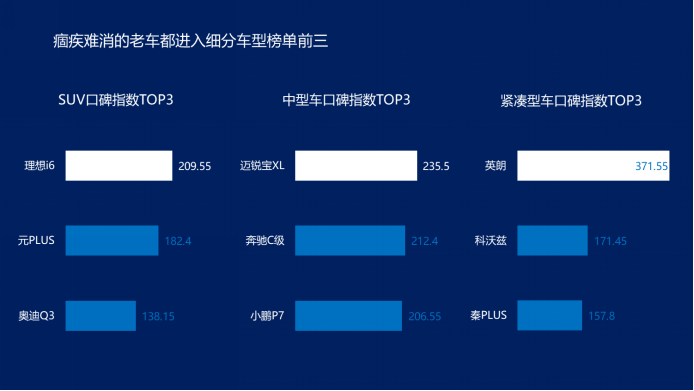
Specifically, the top of the reputation index lists for the three major segments with the highest problem feedback shares were mostly long-time regulars that have dominated the lists for years, while new cars also appeared. The top three compact cars were swept by the Excelle, Cavalier, and Qin PLUS. On the SUV list, the Li Auto i6 surged to the top, with air conditioning odor problems drawing concentrated complaints from owners. On the mid-size car list, the Malibu XL and Mercedes-Benz C-Class remained firmly in place, while the XPeng P7 became a "new force," with high-voltage power three-in-one assembly failures pushing the XPeng P7 to third place on the mid-size car reputation list.
Service and body electrical remain the main problems
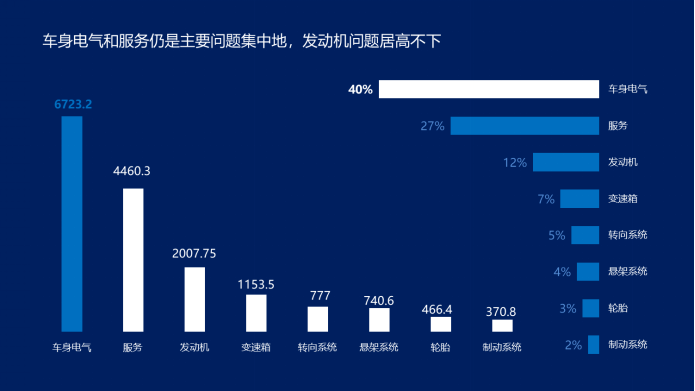
From the problem classification, in October, body electrical and service complaints remained the two most frequently reported problems, and their problem feedback shares were flat compared with the previous month. Various problems triggered by electrification and intelligentization kept the body electrical reputation index running at a high level. Occasional failures to deliver cars, failure to upgrade infotainment systems, and increasing numbers of unfulfilled commitments and refusal to refund deposits kept service-related problems high. At the same time, the feedback share for engine problems also reached 12%. Behind this, Honda, with continuous engine abnormal noises, and Mercedes-Benz, which recently faced the risk of the engine camshaft center valve filter screen falling off, became the driving forces.
Air conditioning faults and power batteries become the biggest sticking points in body electrical
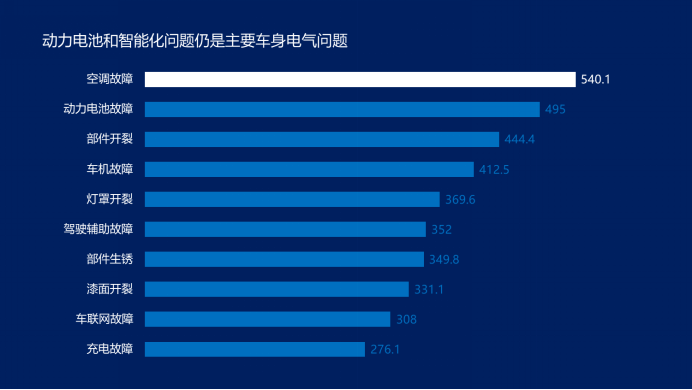
In terms of body electrical, in October, air conditioning faults became the biggest body electrical problem, and the widespread air conditioning odor in the Li Auto i6 triggered collective complaints from owners. At the same time, electrification-related problems such as power battery faults, infotainment system faults, driver assistance system faults, and connected vehicle faults were also among the most frequently reported body electrical problems by owners. Common long-standing problems such as paint cracking, lamp cover cracking, and component rusting also aroused owner dissatisfaction this month.
Unfulfilled commitments become the biggest service problem
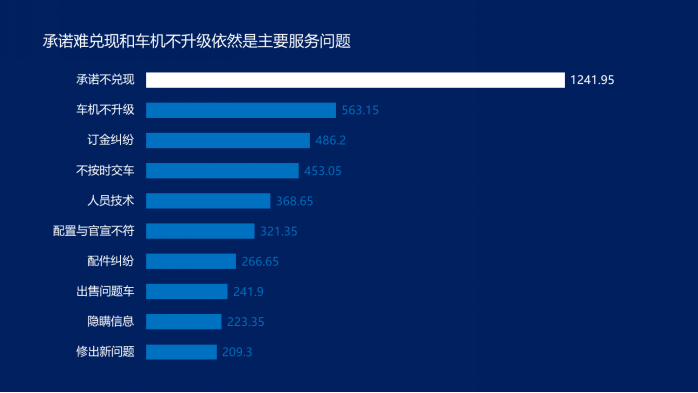
In terms of service feedback, various unfulfilled commitments remained the most frequently reported service problems by users. Various pre-sales promised rights that could not be fulfilled aroused user dissatisfaction again this month. At the same time, long-standing service problems such as failure to upgrade infotainment systems, refusal to refund deposits, and failure to deliver cars on time remained high in feedback rate. Dealer-related after-sales service problems such as the use of non-original parts, new problems arising from repairs, and the sale of problematic vehicles also received a large amount of user feedback this month.
Chinese-brand vehicles have louder complaint voices, while Japanese, German, and American brands weaken
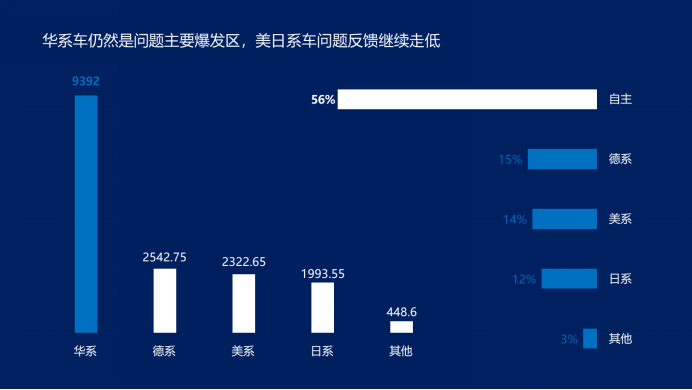
From the perspective of the country of origin of models with problems, Chinese-brand vehicles remained the series with the highest problem feedback rate this month, accounting for 56% of problem feedback. German, American, and Japanese vehicles followed closely. This also confirms the current market inventory of each vehicle series. It is worth mentioning that the problem feedback shares of German and American vehicles both rose this month. Behind this, the risk of the Mercedes-Benz camshaft center valve filter screen falling off and Tesla's price reduction issues were concentratedly reported by many owners, pushing up the reputation indices of German and American vehicles.
Chinese-brand vehicles top all series in multiple problems
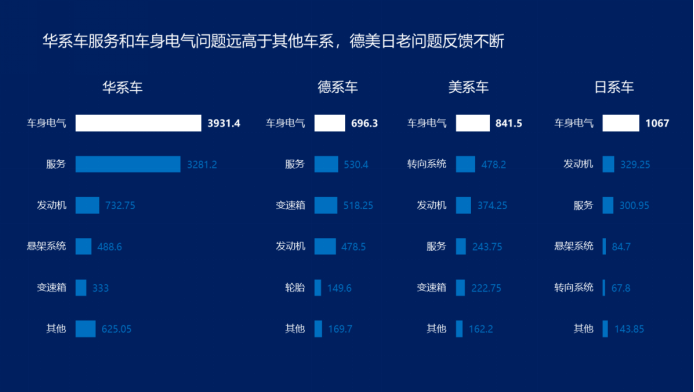
The distribution of various complaint problems by vehicle series shows that Chinese-brand vehicles, with the largest inventory, had feedback rates for multiple sub-problems far higher than other vehicles. From the specific problems of each series, body electrical once again became a common complaint across all series. At the same time, each series also had its own typical problems. Chinese-brand vehicles, with the highest degree of electrification and intelligentization, objectively also gave rise to a high incidence of service problems. German vehicles' transmission problems still drew complaints from many users this month, while Japanese vehicles' engine problems and American vehicles' steering sticking and abnormal noise problems remained typical complaints for their respective series this month.
2026 model year vehicles become the model year with the highest share of problem feedback
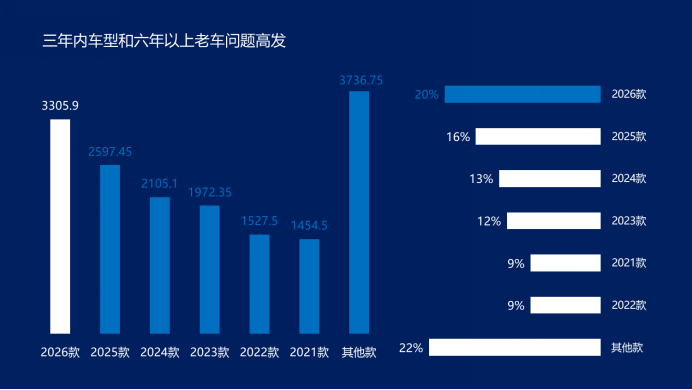
From the distribution of problem models by model year, 2026 model year vehicles, with continuously increasing inventory, remained the model year with the highest reputation index this month. 2025 and 2024 model year vehicles followed, and new cars within three years together accounted for nearly half of problem feedback. At the same time, the reputation index for vehicles over six years old still exceeded 22%, and many old cars' "chronic problems" drew complaints from long-time owners again this month.
Problems in new cars within three years occur mostly in Chinese-brand vehicles
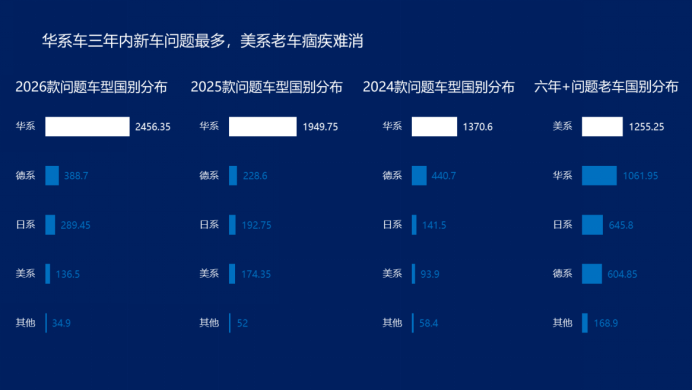
From the perspective of vehicle series involved in complaints by model year, Chinese-brand vehicles remained the series with the most problem feedback within three years, with a reputation index far higher than other series. Their huge inventory objectively gave rise to various problems. American-brand vehicles remained the series with the highest problem feedback rate for older cars over six years old, driven by continuous problem feedback on steering sticking and abnormal noise.
Electrification problems more prominent in Chinese-brand vehicles
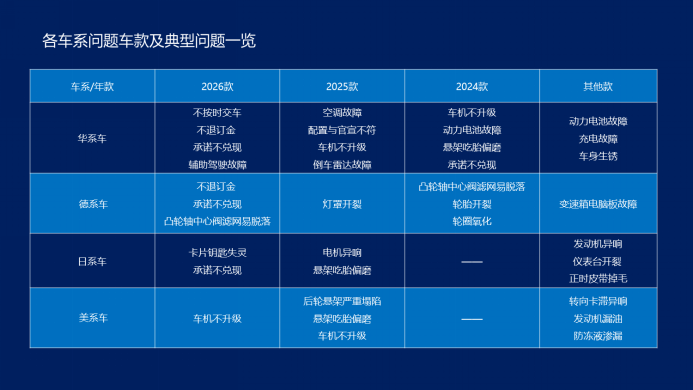
From the model years and typical problems of problem models by vehicle series, in October, Chinese-brand vehicles had more typical problems in new cars within three years, and the problems were mostly related to electrification and intelligentization. The new car reputation indices of German, Japanese, and American vehicles were generally lower. Behind this, the fundamental reason is that Chinese-brand vehicles, which have had a higher intelligentization penetration rate in recent years, have higher sales. Among older cars over six years old, American, German, and American vehicles had relatively higher problems. On the one hand, German, Japanese, and American vehicles had very high sales at the time. On the other hand, many old cars' chronic problems are difficult to eliminate, which in turn causes dissatisfaction among long-time users.
Complaint Index: AutoMen.com's automotive quality reputation index calculation model (abbreviated as QCMS) divides vehicle quality complaints into eight major categories, assigns weights according to the severity of impact of problems such as engine, transmission, body and electrical, braking system, steering system, suspension system, tires, and service, and additionally weights concentrated incidents, ultimately forming an effective reputation index. The larger the index, the more serious the problem.
Data source: AutoMen.com
Time period: 2026.10.1-2026.10.31
Production unit: AutoMen.com Data Department
(Images are from the internet and will be deleted if infringing)
-
![]()
MIIT SUV New Car Roundup: Lincoln's All-New Plug-in Hybrid Arrives
-
![]()
Can MONA, the pillar holding up half of XPeng's sky, stand on its own?
-
![]()
Clearing the Way for Major Changes: Toyota China Announces Leadership Transition
-
![]()
The Biggest IPO in History Is Seeing Its Valuation Cut in Half?
-
![]()
BMW Brilliance Cuts 1,800 Jobs: A Full Bet on the New Generation?
-
![]()
October 2026 Automotive Reputation Index Analysis Report
-
![]()
Liu Qingfeng Delivers Half of iFlytek's AI Report Card
-
![]()
Let the Data Speak: China Is Winning the Automotive Electrification Race While the US Market Remains an Island