Ancient Surveillance Footage Goes Viral: "Real Video" of Wu Song Fighting a Tiger Leaks Online, AI Memes Leave Netizens Dumbfounded
 11/12 2026
 424
Keep entertainment as entertainment—don't let AI muddy the truth.
Recently, Xiaolei stumbled upon a trending topic about AI memes being banned from confusing public perception. After reading through it, I couldn't help but feel that this world is becoming more and more surreal.
First, there was a video titled "Surveillance Footage from the Hongmen Banquet Scene, 206 BC Leaked." Clicking in, I found black-and-white footage with a time code ticking in the upper right corner. The camera was trained on the banquet hall, where Xiang Yu and Liu Bang sat drinking face to face, Xiang Zhuang performed his sword dance, and Fan Kuai burst into the tent—every movement so natural it seemed almost unreal.
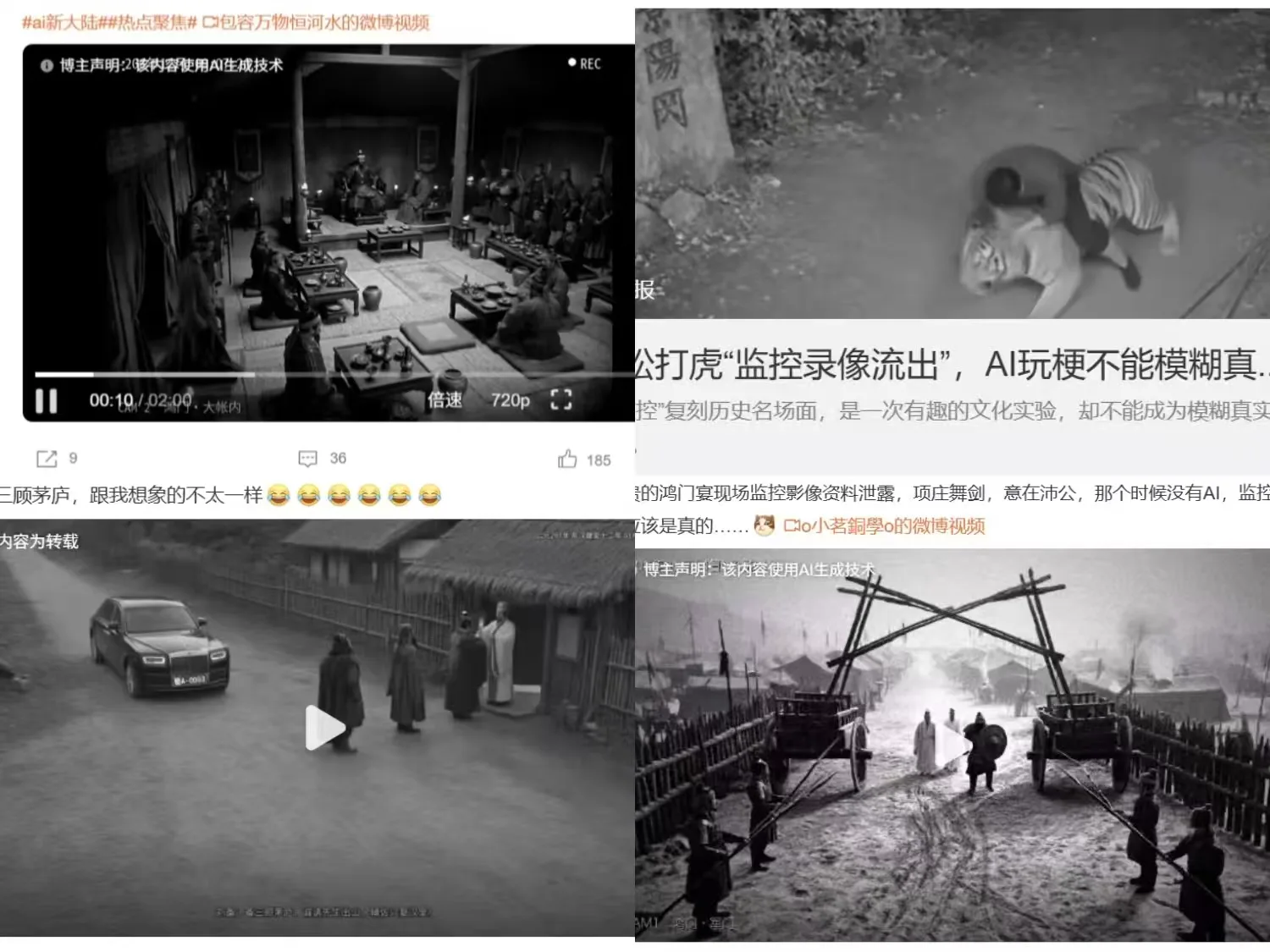
Image source: Weibo screenshot
Surveillance in ancient times? At first I thought this was just the blogger's creative meme, but the more I scrolled, the more absurd it got. There was actual surveillance footage of the Xuanwu Gate Incident, on-site video of Wu Song fighting a tiger, and even Yang Guifei's daily life at Huaqing Pool—all filmed with perfect clarity.
One has to admit, the barrier to AI creation has dropped absurdly low. Before, if you wanted to make a meme, you had to know editing and photo manipulation, and spend ages hunting for material just to produce one piece. Now you type a sentence, and AI instantly generates a video for you—any style you want.
AI memes keep coming in endless variety
The hottest thing right now is the ancient surveillance series. Using AI to generate historical event footage and then overlaying a surveillance camera aesthetic—black-and-white quality, a few floating snowflake noise dots—perfectly replicating the texture of old surveillance footage.
The first one to blow up was the Hongmen Banquet video. It even captured small details like Fan Zeng raising his jade jue and Xiang Bo rising to block a sword—all rendered with incredible accuracy. The caption read: "Archaeological team accidentally discovers Qin Dynasty surveillance hard drive, restoration shocks the entire internet." Relying on the pseudo-documentary gimmick and finely detailed visuals, this video quickly racked up millions of views and ignited the entire ancient surveillance creation trend. Many bloggers followed suit, and soon multi-angle surveillance of Qin Shi Huang's coronation ceremony and Wu Song fighting a tiger at Jingyang Ridge appeared, with the theme being a full documentary of ancient life.
The comment section was full of meme reactions: "No wonder history books have such detailed records—turns out there was video recording!" Everyone knew it was a joke, and they were having a blast with it.

Image source: Douyin screenshot
If ancient surveillance was still creative meme-making, then the AI derivative content of Jensen Huang took the contrast to the extreme and went completely viral.
Everyone probably knows that Jensen Huang publicly admitted to being unfaithful to his wife, and the scandal with industry executive Huang Le caused a huge stir. It was originally just business gossip, but netizens paired it with AI and turned it into a cheesy romance drama. Various derivative works kept popping up, paired with old-school web novel lines like "He controls the world's computing power, but can't control his own heart," turning a tech giant into a cheesy romance protagonist.
What really left netizens not knowing whether to laugh or cry was the AI face-swapped version of "Trouble Maker." Netizens synthesized Jensen Huang's and Huang Le's faces onto the classic duet dance clip. On one side, a leather-jacket-wearing boss at the pinnacle of global computing power; on the other, an ambiguously charged stage dance track—the dissonance was off the charts, and it blew up across all platforms within days.
When Xiaolei saw it, I couldn't help but sigh—Jensen Huang probably never imagined that after a lifetime of hard work becoming the godfather of AI, he'd end up being memed by AI.
Thinking about it now, AI memes have long permeated every corner of the internet.
Classic old dramas have been spoofed before. In Journey to the West, Tang Seng uses navigation to fetch scriptures, Sun Wukong uses a drone to scout ahead, and Zhu Bajie orders takeout on his phone. In Empresses in the Palace, the concubines use smartphones and trash-talk each other in palace drama group chats. This kind of spoofed content leverages the built-in audience of classic IPs and spreads quickly—many people who've never seen the original dramas end up remembering the AI-adapted versions first.
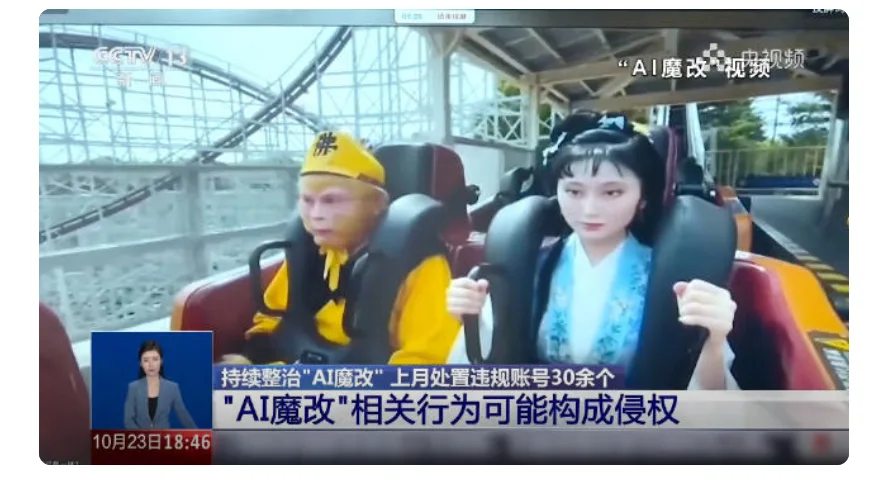
Image source: Weibo screenshot
Beyond visual derivative works, the formats of AI memes are constantly evolving. For example, adding AI-generated comedic dubbing to classic old films, making ancient characters speak authentic internet slang and tell dialect jokes—the contrast is maximized. There are also AI-generated absurd quotes from various celebrities, paired with visuals and made into short videos that many people can't resist forwarding. Some bloggers even use AI to mass-produce funny short stories—from script to visuals to voiceover, all done by AI, producing dozens a day. Nowadays, some AI memes will generate anything as long as it grabs attention.
If everyone knew it was fake, that would of course be fine. But the problem is, a lot of AI-generated content, as it spreads, turns into "truth."
The boundary between true and false is getting blurrier
Why is content that's clearly just memes so easily confused with reality? Xiaolei thinks there are three reasons.
First, AI generation technology is advancing too fast. A couple of years ago, AI-generated videos were full of flaws—you could tell at a glance they were fake. Now, whether it's text-to-video or AI face-swapping, character movements and subtle facial expression changes are rendered incredibly naturally.
Second, creators mislead. Many creators deliberately use misleading captions like "precious surveillance footage leaked" or "freshly excavated material." Even many marketing accounts, when reposting, deliberately omit the AI-generated label to chase traffic.
The more novel and contrasting the content, the higher the completion and share rates—so AI-generated attention-grabbing videos get pushed to more people. Videos with traces of AI labeling erased often only get dealt with after they've already spread. By then, many people have already formed first impressions and taken the content as real.
Finally, most people scroll short videos to relax and don't watch with a truth-verification mindset. When they see an interesting video, their first reaction is to find it funny, then casually like and share it without wondering if it's real. It's just a meme anyway—even if it's fake, who cares, as long as it's entertaining.
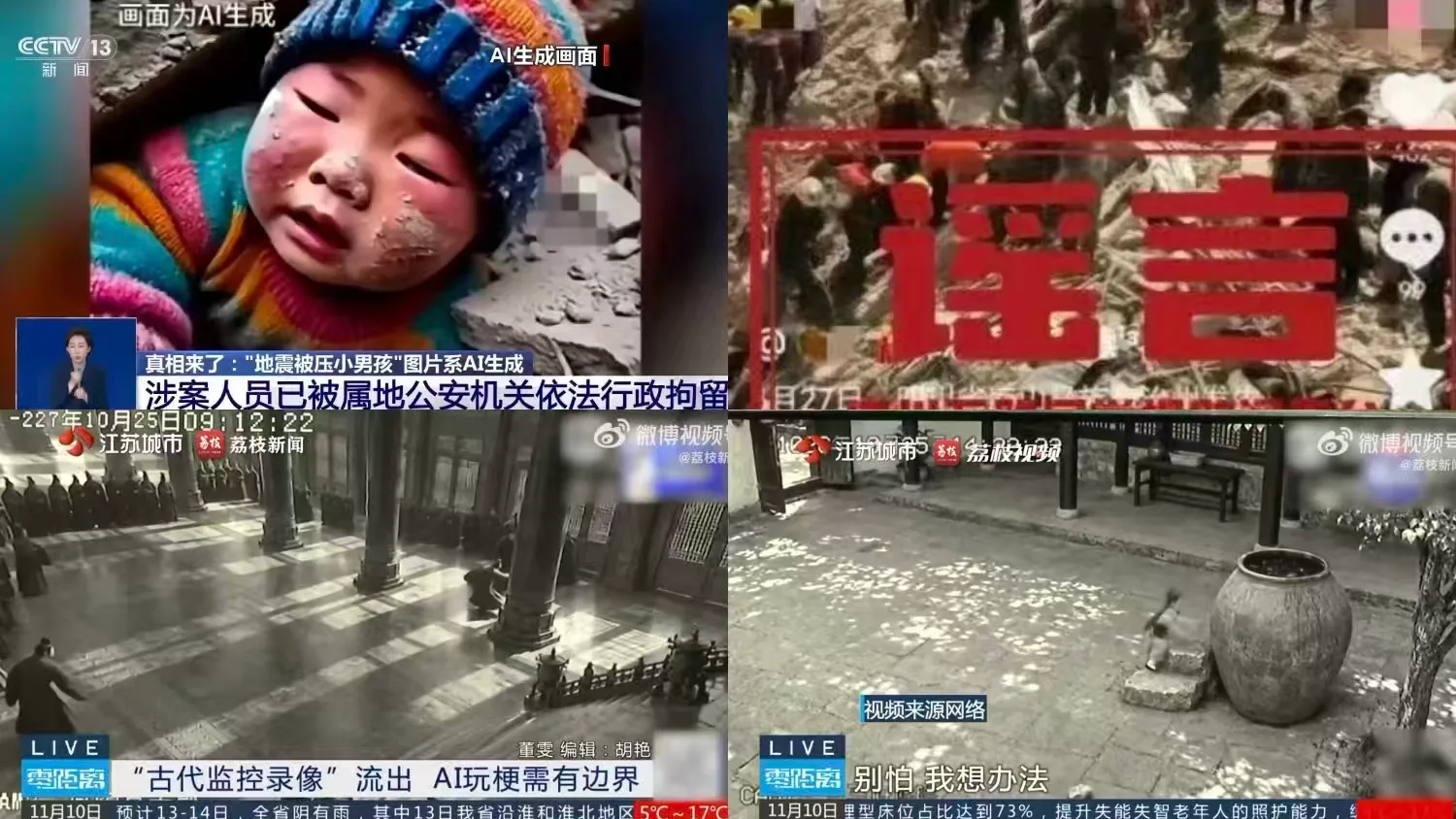
Image source: Weibo screenshot
That mindset itself isn't wrong, but when enough people share it, fake gradually starts to look real. For groups unfamiliar with AI—the elderly, children—they have no idea AI can now produce such realistic videos and are easily misled.
What's more worth vigilance is that police in multiple regions have previously reported AI face-swapping fraud cases, where scammers used AI face-swapping to impersonate the victim's relatives and friends, swindling hundreds of thousands of yuan in minutes. Even public figures haven't been spared. Not long ago, actress Wu Yue posted late at night angrily denouncing someone using AI technology to impersonate her for livestream selling—many viewers couldn't tell the difference and were easily misled into placing orders.
Similar situations are no longer isolated cases. Many veteran actors and public figures have been face-swapped by AI into livestream selling rooms without their knowledge, yet they end up taking the blame for counterfeit products. Unlike ordinary creative memes, this kind of forgery is aimed at profit. The cost of forgery is extremely low—just a few clips of publicly available footage are enough to generate a complete set of convincingly fake livestream visuals.
The trouble is, these livestream rooms often operate for a few days before switching accounts and running off. After consumers are scammed, it's very hard to find the behind-the-scenes merchants, nor can they hold the impersonated artists accountable—the threshold for safeguarding rights is very high. If people keep using AI to generate fake videos and deliberately spread rumors and manipulate public opinion in accidents and social hot topics, the consequences would be unimaginable.
That said, Xiaolei thinks a lot of AI derivative content has already crossed the line. Many AI face-swaps are done without the person's consent—they just slap someone's face on. Whether it's a public figure like Jensen Huang or an ordinary person on the street, this actually constitutes infringement of portrait rights and privacy.
If someone deliberately pulls a prank, face-swapping a classmate's or colleague's face onto a bizarre video and posting it online, the impact on the person involved would be enormous.
Final thoughts
Before, only professional teams could do video special effects. Now ordinary people can generate creative content with a single sentence. Xiaolei Bibi (ID: xiaoleibbb) thinks this itself is a good thing.
But none of this should be built on misleading and deception. Users need to be more self-aware, and platforms need to do proper screening—you can't meme without boundaries.
In Xiaolei Bibi's (ID: xiaoleibbb) view, technology is innocent—what matters is how it's used. AI is the same: it can help us create and improve efficiency, but it can also be used for rumor-mongering and fraud. AI technology will only become more advanced, and generated content will only become more realistic. When fake content floods everywhere, we'll be the ones who suffer.
Keep entertainment as entertainment—don't let AI muddy the truth.
Lastly, I want to ask: what does everyone think about AI memes getting out of hand and blurring right and wrong? Do you enjoy watching AI derivative videos? Let's chat in the comments.
Source: Leitech
Images in this article are from: 123RF licensed image library Source: Leitech
-
![]()
Final Word: Latest CAAM Data Reveals Four Distinct Features of China's Auto Market in the First 10 Months
-
![]()
Ancient Surveillance Footage Goes Viral: "Real Video" of Wu Song Fighting a Tiger Leaks Online, AI Memes Leave Netizens Dumbfounded
-
![]()
Anthropic IPO Massively Oversubscribed, Valuation Eyeing $1.5 Trillion
-
The Auto Market Enters an Era of Pure Survival
-
![]()
What ChatGPT's Teen Mode May Take Away from Teenagers: The One Thing They Need Most
-
![]()
October New Energy Vehicle Segment Sales Revealed: All Four Xiaomi Models Make the Cut, While Tesla Is "Left Out in the Cold"
-
How Does Tencent Hunyuan Hy4 Perform When Working at Tongfu Inn?
-
The First Wave of Smart Glasses Cheaters Have All Flunked Their Exams