CoreWeave: A "Bullish" Report Card, Standing Firm Against "Wild" Stock Price—Can Nvidia's "Godson" Really Rise?
 11/12 2026
 426
AI cloud upstart CoreWeave (CRWV.US) released its Q3 earnings after the U.S. market close on November 10, Eastern Time. On the face of it, this quarter's results were quite strong: both revenue and backlog accelerated and beat expectations, margins continued to improve, the adjusted operating margin reached double digits a quarter ahead of the company's own target, and full-year guidance was raised across the board. The details:
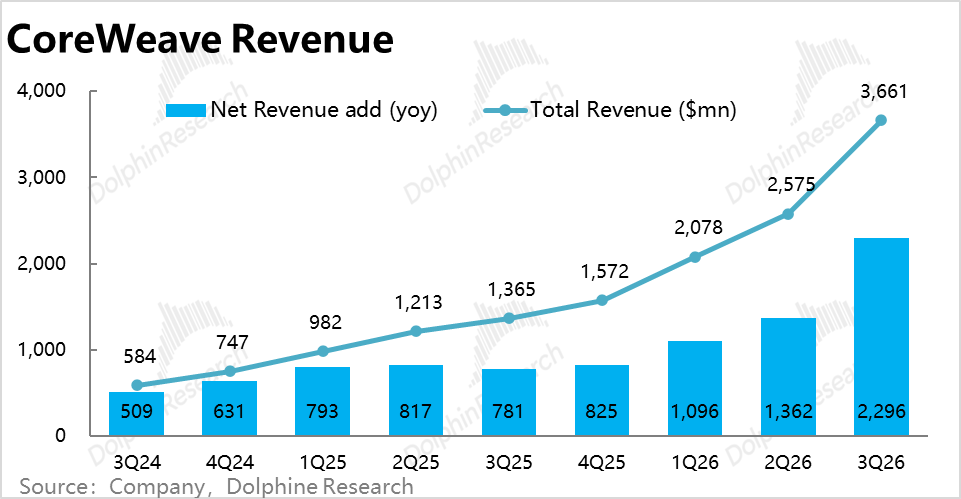
1. Revenue: Up $1.1 billion QoQ, growth reaccelerating
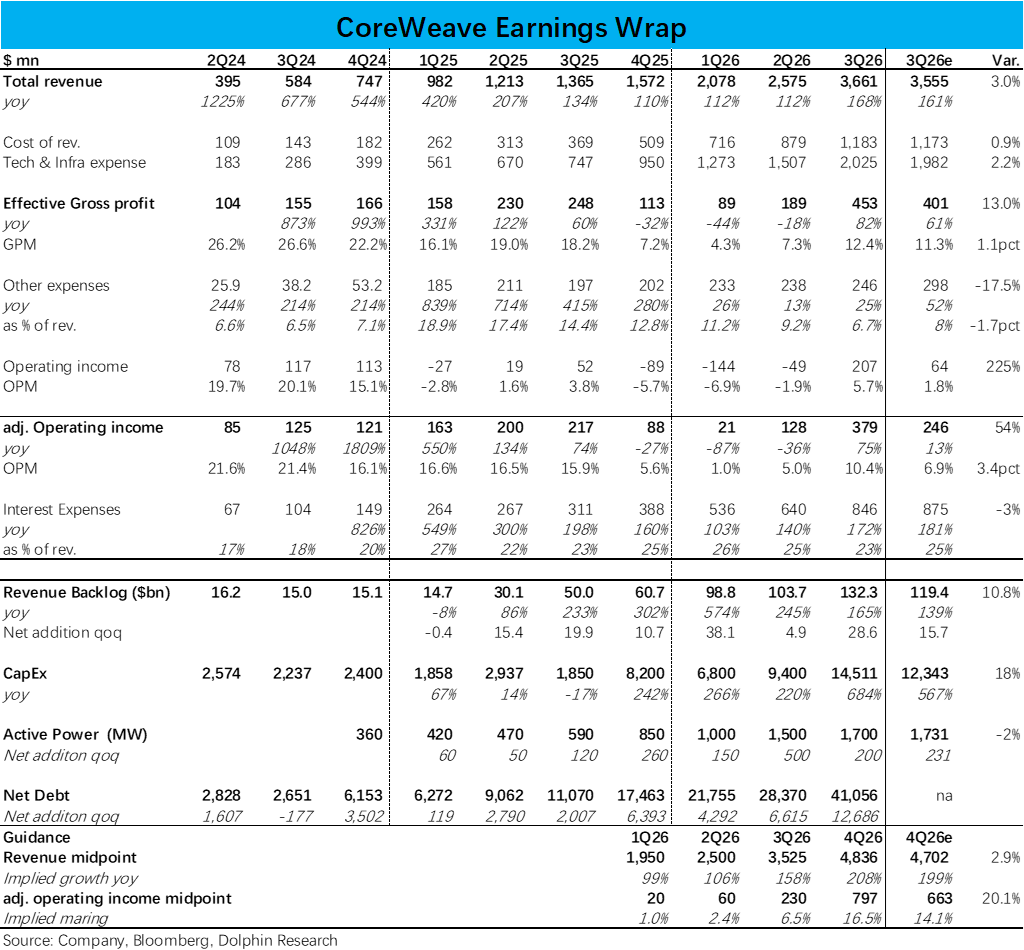
3Q26 revenue came in at $3.66 billion, a net QoQ increase of roughly $1.09 billion—more than double the prior quarter's gain. Revenue beat consensus by about 3% and also topped the high end of guidance at $3.6 billion—a solid growth performance.
Management attributed the growth to favorable pricing and strong demand. On the earnings call, the company confirmed: prices for various compute tiers rose about 25% in July, with another roughly 10% increase later in the quarter; prices continued to climb in 4Q, with increases outpacing cost increases; prices for previous-generation "old cards" (Ampere, Hopper, etc.) also rose 30%–50% QoQ this quarter, above original contract prices.
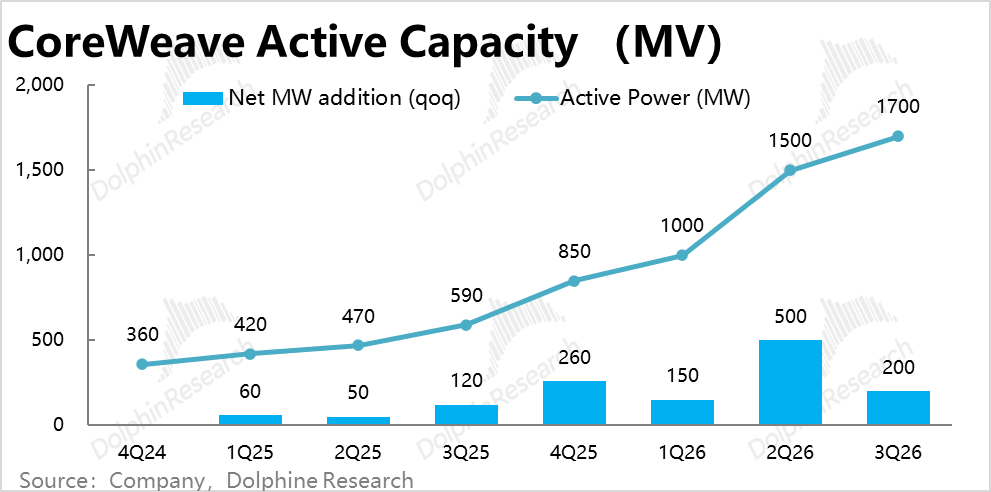
On volume, active power this quarter rose only about 200MW (versus about 500MW last quarter), which is not particularly fast; therefore, this quarter's better-than-expected revenue should be attributed more to the large amount of compute brought online at the end of last quarter that began generating revenue this quarter.
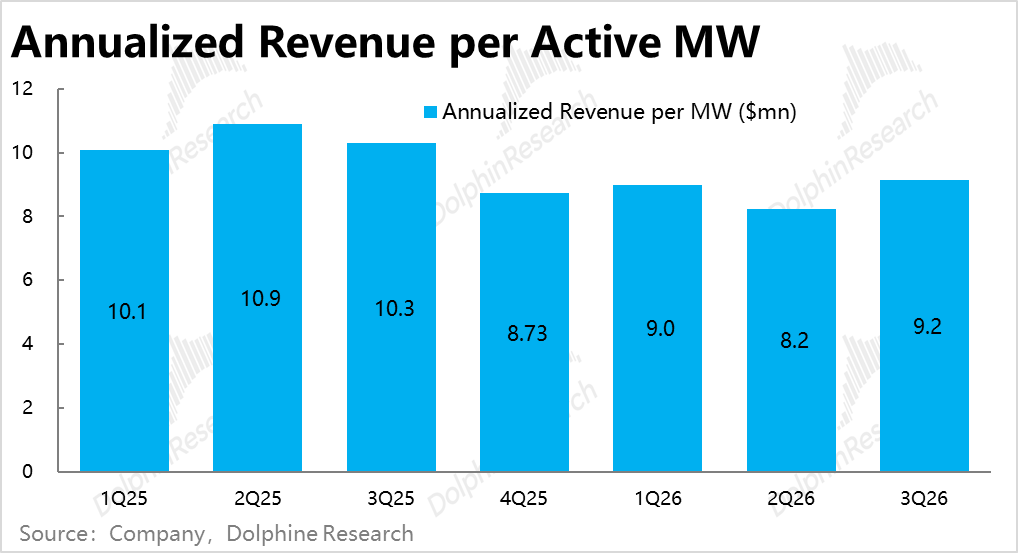
Based on average active power, annualized revenue per MW this quarter was approximately $9.15 million, up significantly from about $8.24 million last quarter—confirming the rise in leasing prices visible in the financials.
In short, looking in the rearview mirror, compute demand is indeed strong and supply falls short of demand.
2. Backlog: Nearly $29 billion added in one quarter, driven mainly by long-term contracts
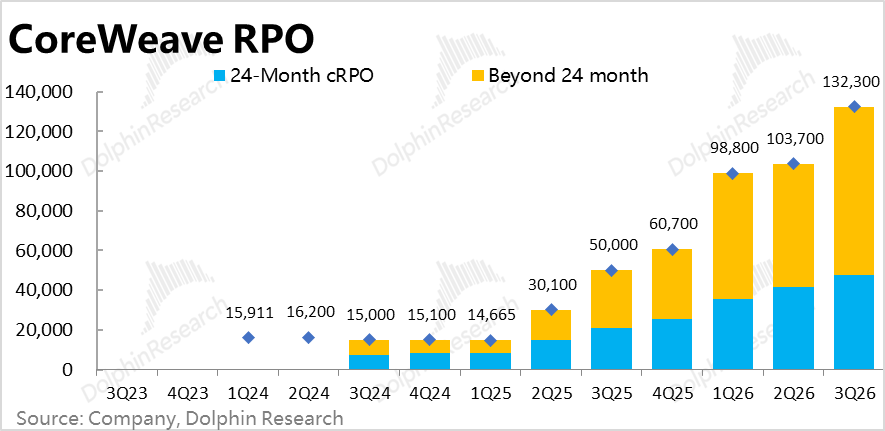
RPO at quarter-end was $132.3 billion, up about $28.6 billion QoQ—the second-largest quarterly increase on record (behind only 1Q26) and about 11% above consensus. Not only was quarterly revenue strong, but new order demand was equally robust.
Management said new orders came from both existing and new customers, with a more diversified customer mix: more than half of new customers this year came from industries outside AI labs and technology.
By tenor, the share of long-term contracts of 24 months or more rose 4pct this quarter, while the net QoQ increase in short-term contracts was roughly comparable to last quarter. This quarter's strong order growth was driven mainly by contracts of two years or more.
3. Compute deployment and Capex: Deployment in line with expectations; Capex pulled forward and above guidance
Active power at quarter-end reached over 1.7GW, roughly in line with consensus (about 1,731MW). The quarterly increase of over 200MW marks a notable slowdown versus last quarter's addition. Meanwhile, the company maintained its target of over 1.85GW of active power by year-end, implying only about 150MW added in 4Q and a year-end scale below consensus of about 1.91GW.
So while this quarter's revenue was strong, the pace of compute buildout was not particularly fast (this quarter's revenue was driven more by the large amount of compute deployed last quarter).
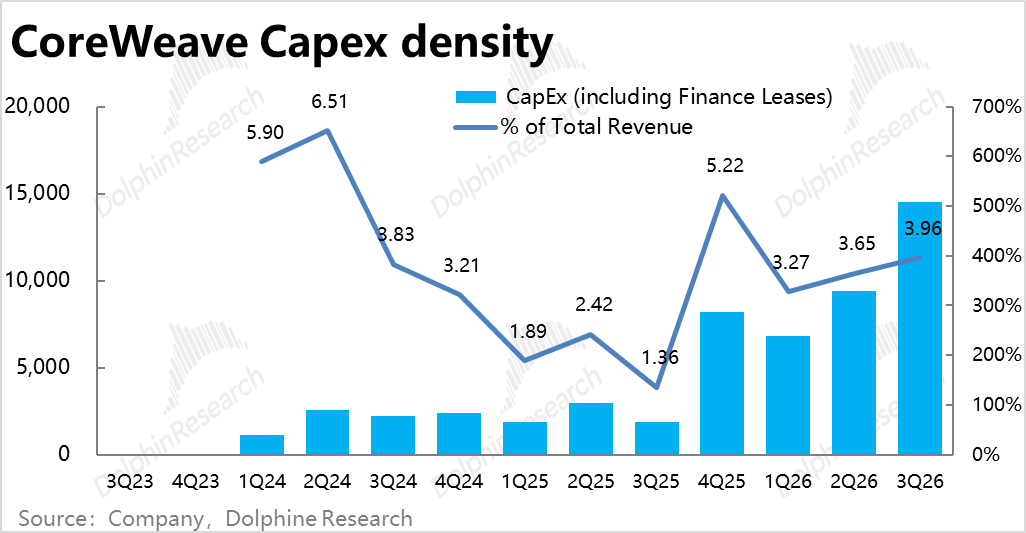
However, Capex this quarter (including finance leases, net of changes in construction in progress) reached as high as $14.5 billion, well above market expectations and the high end of guidance at $13.5 billion; the Capex-to-revenue multiple also climbed to nearly 4x. The investment burden required to support revenue growth is becoming increasingly evident.
Asked about the modest compute additions alongside the Capex surge, the CFO explained that some 4Q investments were pulled forward into 3Q. But Dolphin Research believes the company's per-unit compute construction cost should also have risen (hardware price increases); by rough calculation, this year's cost may be up about one-fifth to one-quarter versus 2025.
4. Margins: Adjusted operating margin about 10%, reaching double digits a quarter early
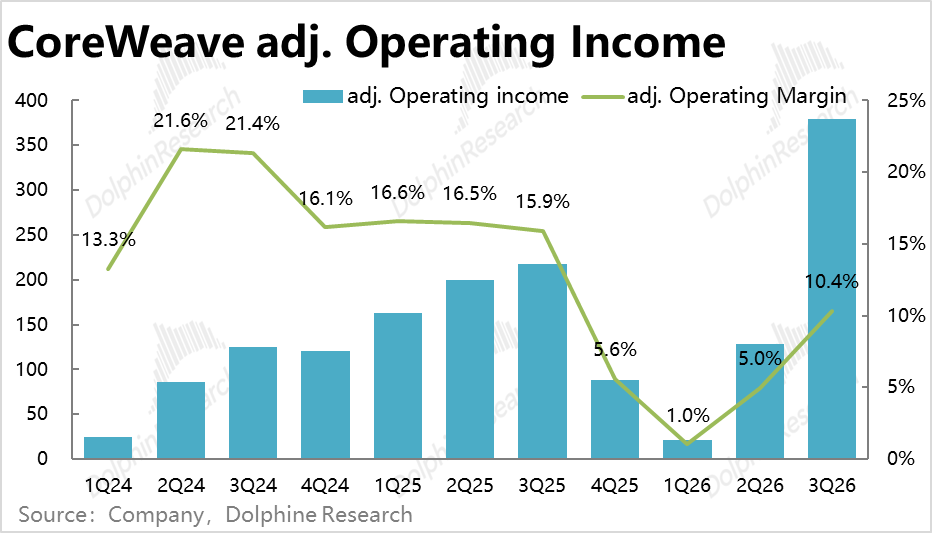
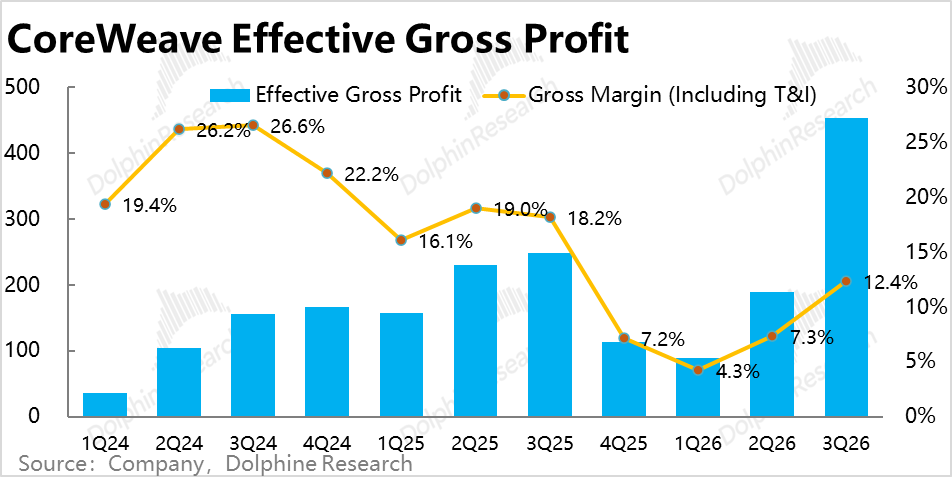
Adjusted operating profit this quarter was $379 million, a margin of 10.4%, well above consensus of 6.9%—achieving the company's double-digit margin target a quarter ahead of schedule.
Breaking it down, "true gross margin" after deducting cost of revenue and infrastructure R&D costs (T&I) was about 12.4%, up from about 7.3% last quarter but still below about 18% a year ago. The improvement came mainly from a decline in depreciation as a percentage of revenue within T&I, from 54.1% to 51.6%.
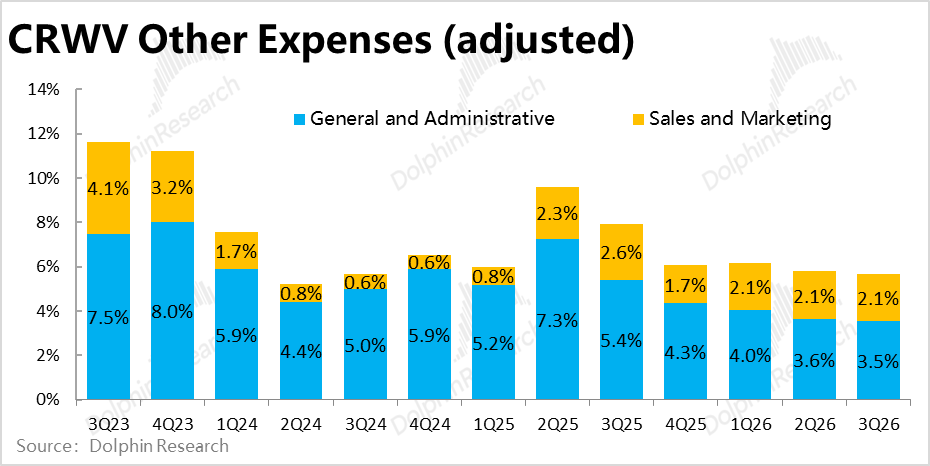
In addition, the operating expense ratio—mainly energy, rent, and labor—also declined about 1.8pct QoQ. As for selling and administrative expense ratios, which have always been low, they continued to be diluted this quarter as revenue grew.
Combined with management's remarks, Dolphin Research sees two main reasons for the better-than-expected and sustained margin improvement: rising leasing prices (primary) and natural economies of scale as revenue increases.
The CFO explicitly stated that allocating available capacity to higher-margin short-term contracts "contributed significantly" to this quarter's performance. Currently, short-term contracts can generate annualized revenue exceeding $40 million/MW, and prices for new 4–5 year long-term contracts have also risen to $20–25 million/MW; short-term contracts pay back in 6–18 months, while long-term contracts recover hardware Capex in about 1–2 years.
5. Interest and financing: Interest below guidance, but liabilities up about $12 billion in one quarter
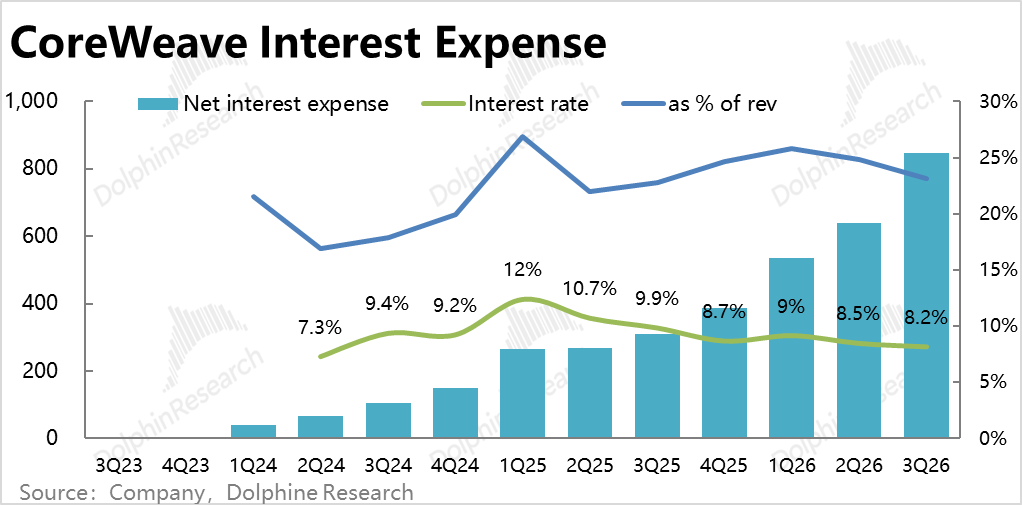
Net interest this quarter was $846 million, below the low end of guidance at $860 million. Based on a rough calculation of interest/average total liabilities, the average interest rate fell from 8.5% to 8.2%, and interest as a percentage of revenue also declined.
Unlike the recent notable rise in new cloud bond issuance costs in the market, the interest rate on the company's existing debt actually declined from a rearview perspective—somewhat unexpected. But this only reflects historical conditions, and caution should still be maintained regarding future interest pressure. Moreover, adjusted operating profit currently still cannot cover interest—the money earned is still not enough to cover the cost of funds on liabilities.
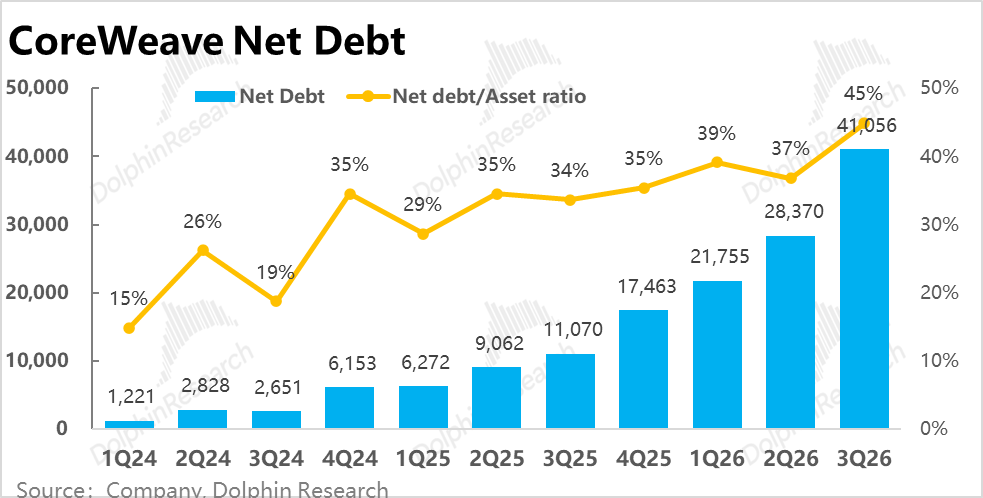
And although interest expense was slightly lower, total debt (including finance leases) at quarter-end was about $47.5 billion, with liabilities increasing about $12.2 billion in the quarter—also a historical high. To support continuously rising Capex needs, the company's financing pressure has not eased.
6. 4Q and full-year guidance: Revenue and profit raised across the board; 4Q interest continues to rise
For next quarter's outlook, the full-year guidance implies 4Q revenue of $4.69–4.99 billion, about 3% above consensus of $4.70 billion; at the high end, that would be a net QoQ increase of $1.3 billion, with growth continuing to accelerate from this quarter.
Adjusted operating profit guidance implies 4Q of $750–850 million, with the midpoint about 20% above consensus of $660 million, corresponding to a margin of about 16.5%—margins continuing to improve by leaps and bounds.
Year-end ARR (annualized revenue) guidance was raised from $18.5–19.5 billion to $20–21 billion, versus consensus of about $18.9 billion.
However, 4Q interest guidance is $1.05–1.15 billion, with the midpoint about 9% above consensus of $1.01 billion and about 30% higher than this quarter—comparable to the QoQ growth rate of 4Q revenue; the proportion of revenue consumed by interest has not declined significantly.
7. Below is an overview of core metrics
Dolphin Research View:
1. Summary of this quarter's financial performance
Judging from this quarter's revenue, orders, next quarter's revenue guidance, and continuously improving margins, CoreWeave's business itself is improving: demand is strong, prices are rising, and margins continue to climb. But correspondingly, the "cost" of supporting the business is also rising: liabilities increased by another $12 billion in one quarter, interest remains above adjusted operating profit, Capex has risen sharply, and free cash flow is deeply negative.
At the same time, what the market is really focused on—and what valuations ultimately reflect—is whether demand can sustain in 2027 and beyond, and whether the currently rising compute leasing prices (i.e., the supply-demand imbalance) will reverse. These questions cannot be answered by recent solid performance. Therefore, the market will give a modest reward to this good performance, but it will not bring a true logical reversal.
2. Performance outlook: Medium- to short-term trend continues upward
In the short term, the upward momentum in performance is relatively clear: 4Q guidance implies revenue will grow another roughly 30% QoQ, adjusted operating margin of about 16.5%, year-end ARR guidance raised to $20–21 billion, and management also said 4Q prices are still rising.
Longer term, the company for the first time provided a profitability timeline: adjusted net loss will narrow significantly in 2027, and adjusted net profit will turn positive in the first half of 2028 and for the full year.
3. Core issues to watch
Core issue one: Unit pricing is rising, but "renewals being more valuable" is built on the premise of supply falling short of demand
This quarter's growth was driven more by price than volume, as verified above: newly added compute was not much, while revenue per MW rose significantly, and 4Q guidance implies further increases. Compute is still a seller's market, and CoreWeave is allocating more capacity to high-priced short-term contracts, with price elasticity directly reflected in margins.
Looking ahead, management provided two supports: first, by the end of 2027, qualified demand will be 10x available capacity, and 2027 compute supply is basically sold out; second, renewals of old GPUs whose initial contracts expire could bring nearly $4 billion of incremental annualized revenue in 2027 at current prices, plus nearly $10 billion in 2028, and these assets no longer require depreciation, so margins will be higher.
But both points are built on the premise that compute will remain in shortage and leasing prices will stay high, while new industry supply is concentrated in the next one to two years—this premise may not hold.
Core issue two: Financing through customers largely resolves the financing challenge
Although interest rates on existing liabilities are declining, the market is more concerned about the cost of incremental funding, and recent external liability costs have been rising: the company's unsecured bond yield rose from about 11% in August to over 15% in October, and the coupon on September convertible bonds was also higher than in April.
Management's response is to shift the financing focus to customers: no new unsecured liabilities at the parent company level before 2027; subsequent Capex will mainly rely on DDTLs matched to specific customer contracts (delayed draw term loans: using customer orders as collateral—banks provide a loan facility in one go, but the company can draw in tranches as needed, with interest only accruing after drawdown) and customer prepayments.
According to the earnings call, 70% of this year's deals received prepayments, with some customers prepaying as much as 100% of the contract value; the company expects that by the end of 2027, the parent company level will need less than $5 billion of incremental financing.
This essentially represents a further shift of the company's business model toward "operating on behalf of customers": financing is tightly tied to customer orders and credit; as long as customers sign orders, there are prepayments and DDTLs collateralized by contracts, and construction funds arrive accordingly. The financing problem that the market worried about most in the past is thus largely resolved, at the cost of a further decline in the company's bargaining power and autonomy.
But the premise for this model to work is that compute supply remains tight and large customers need and are willing to procure compute from new clouds; once this premise loosens, orders, prepayments, and financing channels will contract simultaneously—this points to the same risk as core issue one.
Key Question 3: The peak of investment and financing is still ahead, and the company retains the option to slow down
This quarter's capex spike reflects accelerated delivery timelines. Full-year guidance implies fourth-quarter capex will come in well below consensus. However, unit investment costs are rising—meaning the same scale of deployment now requires more capital.
Moreover, our model suggests capex will peak in 2028–2029, with the largest funding gap likely in 2027. As such, the company's peak in investment and construction—along with the corresponding pressure on cash flow, total debt, and interest repayment—is only in the early stages of climbing.
In response, management noted that if the company were to deliver only its signed backlog, 2027 capex would be roughly flat versus this year. In other words, should the financing environment deteriorate, the company can slow expansion, stop signing large volumes of new orders, and thereby ease cash flow and financing pressure.
4. Forecast Adjustments and Investment Logic
Earnings forecast adjustments: Following this earnings release, we raised our fourth-quarter and full-year expectations in line with guidance. We also raised unit price assumptions from 2028 onward and assumed customer prepayments cover roughly half of capex, thereby significantly reducing new borrowings and interest. After these adjustments, 2028 adjusted operating profit is approximately $6.5 billion—about 13% higher than our prior estimate but roughly 16% below market consensus.
Key assumptions include:
① Computing capacity: year-end active power of approximately 4.6GW, with roughly 1.5GW added during the year (approximately 1.85GW and 3.1GW at end-2026 and end-2027, respectively);
② Unit price: annualized revenue per MW of approximately $11 million, roughly 20% higher than the approximately $9.2 million expected in 2026;
③ Margin: adjusted operating margin of approximately 15%, with depreciation at roughly 48% of revenue and cost of revenue at roughly 28%;
Valuation analysis: At the latest trading price, the stock has risen significantly since before the earnings disclosure, corresponding to approximately 6.1x our 2028 after-tax operating profit (assuming a 20% tax rate). Adding net debt of approximately $41 billion as of this quarter, EV corresponds to approximately 14x. However, based on our forecasted net debt at end-2028, the EV multiple is approximately 20x.
Conservative valuation: Applying a 16x EV multiple to 2028 after-tax operating profit and deducting our forecasted net debt of approximately $70 billion at end-2028 yields an equity value of approximately $12.7 billion, or roughly $23 per share. This price is unlikely to be reached in the near to medium term, but it clearly illustrates the considerable downside potential in a pessimistic scenario.
Note that due to high leverage, equity value is highly sensitive to multiple and debt assumptions: each 1x change in multiple moves per-share value by approximately $9.
On a P/EBIT basis, this price level corresponds to only approximately 2x 2028 adjusted operating profit, which appears extremely low. However, P/EBIT is distorted under high leverage: operating profit must first cover large interest payments, and the portion attributable to creditors is also included in shareholders' valuation—hence our use of an EV basis.
Investment logic and recommendation: This quarter's results were indeed impressive, and financing challenges have been largely alleviated. But this strong performance rests on the premise of significantly insufficient computing power supply. If the shortage persists, then based on current earnings growth trends, CoreWeave is already roughly near fair valuation. How long this premise can hold, however, is highly uncertain.
Recently, concerns and signals regarding phased overbuilding of computing power have been mounting. Reports indicate that Microsoft is scaling back new cloud partnerships and has chosen not to renew with Oracle. For CoreWeave—whose revenue and financing depend heavily on a small number of large customers—this is not a good signal.
Current performance appears robust, but once the supply-demand dynamic reverses, combined with the amplifying effect of high leverage, equity faces extremely high downside risk. Further consideration would be appropriate only after clear new AI demand emerges that is sufficient to prolong the computing power shortage.
- END -
// Reprint authorization
This article is an original article by Dolphin Research. Authorization is required for reprinting.
// Disclaimer and general disclosure notice
This report is intended for general comprehensive data purposes only, aimed at general reading and data reference for users of Dolphin Research and its affiliates, and does not consider the specific investment objectives, investment product preferences, risk tolerance, financial situation, and special needs of any person receiving this report. Investors must consult independent professional advisors before making investments based on this report. Anyone who makes investment decisions based on the use of or reference to the content or information mentioned in this report must bear the risk themselves. Dolphin Research shall not be liable for any liability or loss that may be directly or indirectly caused by the use of data contained in this report. The information and data contained in this report are based on publicly available materials and are for reference only. Dolphin Research strives but does not guarantee the reliability, accuracy, and completeness of the relevant information and data.
The information mentioned or views expressed in this report shall not, under any jurisdiction, be treated or regarded as an offer to sell securities or an invitation to buy or sell securities, nor do they constitute recommendations, inquiries, or endorsements regarding relevant securities or related financial instruments. The information, tools, and materials contained in this report are not intended or planned for distribution to citizens or residents of any jurisdiction where distribution, publication, provision, or use of such information, tools, and materials would conflict with applicable laws or regulations or would cause Dolphin Research and/or its subsidiaries or affiliates to be subject to any registration or licensing requirements in that jurisdiction.
This report reflects only the personal views, opinions, and analytical methods of the relevant creators and does not represent the position of Dolphin Research and/or its affiliates.
This report is produced by Dolphin Research, and the copyright belongs solely to Dolphin Research. No institution or individual may, without the prior written consent of Dolphin Research, (i) produce, copy, reproduce, duplicate, forward, or otherwise create any form of copies or reproductions in any manner, and/or (ii) directly or indirectly redistribute or transfer to other unauthorized persons. Dolphin Research reserves all related rights.
-
![]()
Europe's Auto Market 2035: A Ceiling of 16.7 Million Units and a 15% Window for Chinese Brands
-
![]()
A7L Wagon "Heads North": FAW Audi May Welcome Its First Shooting Brake
-
![]()
Complete PPT Guide to CAAM Production and Sales Data: October Auto Output and Sales Rise Month-on-Month but Fall Year-on-Year; NEVs Post Steady Growth; Auto Exports Top 1 Million Units for Fifth Strai
-
![]()
Half-Price Zunjie: Can It Recreate the M9 Myth?
-
![]()
CoreWeave: A "Bullish" Report Card, Standing Firm Against "Wild" Stock Price—Can Nvidia's "Godson" Really Rise?
-
AI: The New Bond Between Supply and Demand
-
![]()
Auto Manufacturers No Longer Want to Be Just the Customer
-
![]()
Autonomous Driving Has No Clear Winner Yet