DeepSeek's Quota Limits: A Prelude to Consumer-Side Paid Plans?
 11/17 2026
 394

DeepSeek's Road to AGI
Image source: Internet (please contact us for deletion if infringing). Partially AI-generated.
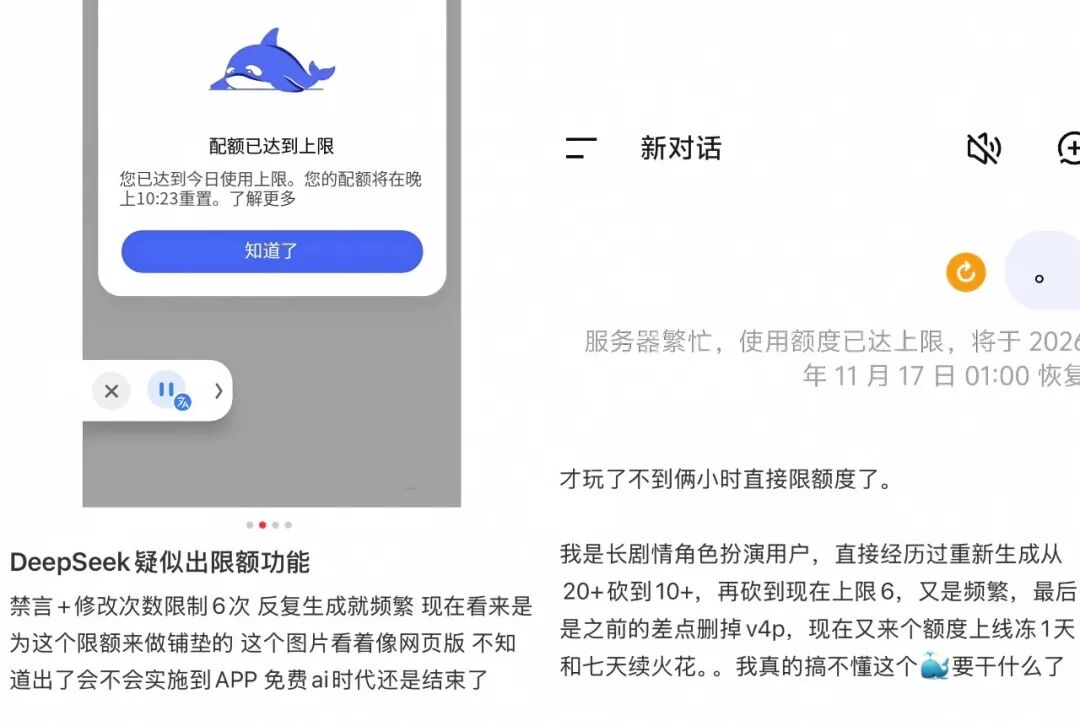
Over the past few days, DeepSeek users have received an unusual notice: due to insufficient compute, long conversations that have been inactive for more than 7 days can no longer be resumed, the single-input limit has been compressed to around 40,000 characters, and daily conversation quotas have also begun to be capped.
Some users hit the limit after less than two hours of continuous use, receiving the reply: "Due to server congestion, the usage quota has reached its limit."
The public's first reaction was unanimous: the free era is ending, and consumer-side paid plans are coming.
This judgment follows naturally, but it most likely misreads the direction.
Between quota limits and paid plans lies a gap that DeepSeek has deliberately not crossed.
What is more worth pondering is the fact that DeepSeek never put consumer-side paid plans in its priority sequence from the very beginning. This is a different matter from "it can't hold on much longer, so it is preparing to charge."

The quota limit is a matter of arithmetic
First, look at the technical substance of this quota limit. What DeepSeek restricts is "long conversations inactive for more than 7 days."
Long conversations continuously accumulate KV cache—that is, intermediate data the model keeps resident in GPU memory to maintain context. Sessions left idle for long periods continuously occupy scarce HBM memory.
When compute supply is tight, reclaiming these idle resources is meant to prioritize the inference needs of active users.
If the purpose were to pave the way for paid plans, a more reasonable approach would be: first launch paid tiers, then compress the free tier to the point where it is obviously insufficient.
But as of now, neither the DeepSeek web version nor the official app has any monthly package, subscription, or "Plus/Pro" plan, and the consumer side has never directly collected a single cent from users.
The direct cause of the quota limit is an exceedingly simple matter of arithmetic.
As of June 2026, DeepSeek's daily active users grew from 120 million to nearly 200 million, an increase of nearly 67%, but its compute reserves grew by only about 8.3% over the same period.
The gap between the demand curve and the supply curve is too large to be filled with scheduling tricks.
DeepSeek does not lack users. Within 20 days of launching during the 2025 Spring Festival, daily active users exceeded 20 million; by March 2026, monthly active users were about 127 million, and its web ranking is even better than its app ranking, because its core users—such as programming, scientific research, and deep productivity groups—naturally rely more on desktop scenarios.
At the same time, its dominance on the API side continues to expand.
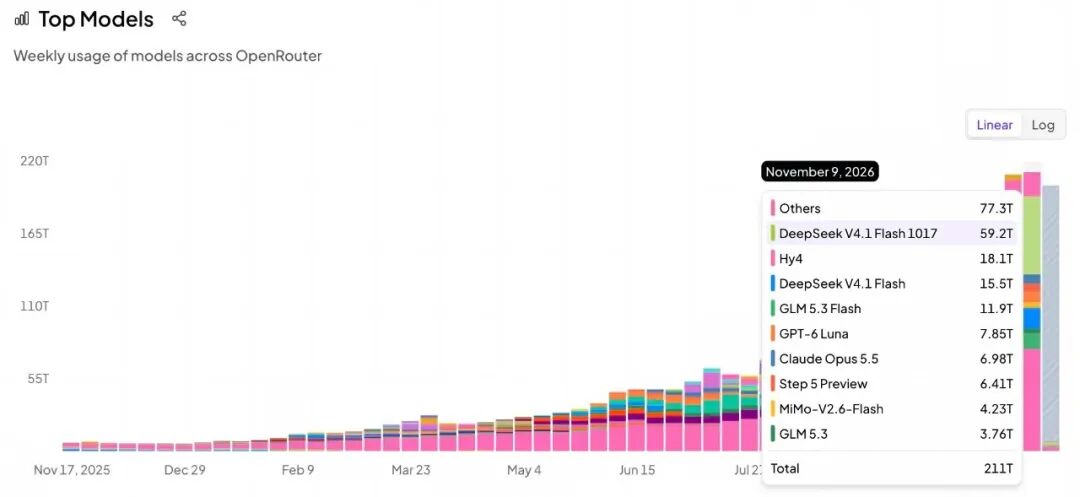
OpenRouter data shows that in October 2026, DeepSeek's request share reached 24.4%, ranking first among global vendors; during the week of November 9 to 15, the single V4.1 Flash model completed 59.2 trillion token calls, ranking first in the world, while two months earlier that number was only 15.8 trillion.
A model whose call volume ranks first globally charges not a single cent in subscription fees on the consumer side, yet is setting limits on "daily conversation quotas."
This apparent "irrationality" precisely shows that the quota limit is more like an engineering decision than a business decision.
The real problem DeepSeek faces is: how to allocate limited inference compute among training, API services, and the free consumer side.
Free consumer chat is a pure cost on the financial statements; every round of conversation corresponds to real compute expenditure, yet brings no direct return.
When compute growth far lags behind user growth, reducing consumer-side resource occupancy is a rational operational choice. It has nothing to do with a "carefully designed paid funnel."

API and the consumer side are two separate accounts
To understand why DeepSeek does not charge on the consumer side, one must first see clearly what it lives on, and what it has actively chosen to live on.
This quota limit targets the app and web version for ordinary users; the API interface used by developers has independent concurrency limits and a pay-as-you-go mechanism.
DeepSeek-flash and v4-pro have account concurrency caps of 2,500 and 500 respectively, isolated from the consumer-side service resource pool.
The API side even uses peak-valley time-of-use pricing to guide off-peak calls; the idle-time price is half the peak-time price.
If DeepSeek's intention were to push consumer users toward paid plans through quota limits, it would not need to do such fine-grained load scheduling on the API side.
Precisely because the consumer side and the API are operated under two separate logics, the quota limit presents the appearance of "limiting only the consumer side, not touching the API."
Liang Wenfeng explained the pricing logic very transparently at an investors' closed-door meeting in July 2026: DeepSeek's API pricing follows the principle of "cost recovery," with expected hardware depreciation recovered within 10 months, corresponding to roughly six times profit. His exact words were "only earn six times profit," not pursuing profit maximization, and "in the worst case, selling API can still support a listed company."
At the same time, DeepSeek has open-sourced its inference framework DeepInfer, protocol middleware, and Search/Fetch interfaces entirely under Apache 2.0, even disclosing core economics such as "about $38 in revenue per card per hour."
The logic of this approach is "turn model capabilities into infrastructure, sustain operations through reasonable cost recovery, and devote remaining resources to the AGI main line," rather than "use free service to exchange for traffic, then monetize the traffic."
Liang Wenfeng's judgment on open source is equally blunt: there is no conflict between open source and commercial payment, provided that you only earn six times profit. "If you want to earn a hundred times profit, open source will indeed affect you, because third parties will deploy it themselves."
In other words, DeepSeek actively suppresses its profit margin to a level where third parties cannot arbitrage through self-deployment. The goal of the API business is simply to "feed itself"; profit maximization has never been under consideration.
In 2026, DeepSeek's annualized revenue run rate exceeded $1 billion, with revenue coming almost entirely from API model calls; the consumer chat product remains free and ad-free, and has not yet generated subscription or advertising revenue.
Liang Wenfeng's phrasing on this is even more blunt: "We haven't put much effort into the consumer side; at one point we didn't even want to maintain those users, but users just wouldn't leave."
For an AI company with $1 billion in annualized revenue and zero consumer-side revenue, if it really wanted to collect money from the consumer side, there would be countless more respectable ways: launch a lightweight subscription, give paid users priority queues, turn long context into a value-added feature.
But it has done none of them. The reason is simple: this matter is not on its priority list.

The consumer side is the sesame seed; AGI is the watermelon behind it
The quota limit triggering paid-plan speculation has a deeper cause: most people still understand DeepSeek through the framework of "internet products": once the user base is large, it should monetize; once the free quota is insufficient, it should push paid plans.
But Liang Wenfeng's remarks at the closed-door meeting almost systematically dismantle this framework.
He stated the positions of the consumer side and the business side very clearly: "The consumer side and the business side are both byproducts on our road to AGI, both intermediate outputs, and they do not conflict with my pursuit of AGI. It's not that I do it for the consumer side or for the business side; rather, we do AGI for the sake of AGI, and it just happens to produce this thing, so I take it and commercialize it."
A more vivid way to put it is that in 2025 everyone fought bloody battles over consumer traffic, "and in the end someone who didn't go after it led it away," but "the AGI opportunity behind it will always be this big; we will also pick up the sesame seeds in front, but just pick up a little casually, and we won't stop."
He even clearly drew the boundary: DeepSeek "does not want to be the next super app, does not want to become the next ByteDance or Tencent."
At the organizational level, the company's core interest is defined as "maintaining team stability," while user scale or revenue targets must rank behind; the AGI roadmap is language models, CoT, Agents, continual learning, self-iteration, and embodied intelligence, and consumer products are not on this main line.
Once this coordinate system is established, "consumer-side paid plans" lose strategic significance.
If the consumer side is merely an intermediate output on the road to AGI, then distorting product logic, increasing operational complexity, and distracting the team in order to collect an extra subscription fee from the consumer side is, in Liang Wenfeng's framework, a bad deal.
Better to impose quota limits than to charge.
Charging is of course technically feasible, but charging would upgrade a "byproduct" into a main business that needs to be seriously operated, and this is precisely what DeepSeek has been avoiding.

The real variable comes after the lights turn on in the data center
Some might say: once compute catches up and the quota limits are lifted, won't it be time to charge?
This inference ignores a fact on the time scale: DeepSeek's compute gap cannot be filled by consumer subscriptions, and it is filling it in a way only AGI players would use.
In October 2026, DeepSeek completed a second financing round of about 105.5 billion yuan, with a post-investment valuation of about 615.5 billion yuan, and the primary destination of the funds is compute infrastructure. It plans to build a GW-level data center in Ulanqab, deploying at least 160,000 domestic AI chips, with part of the compute expected to be gradually commissioned between the end of 2027 and early 2028.
The V4 model has begun full adaptation to Huawei Ascend chips, shifting from the CUDA ecosystem to the CANN framework, a high-risk path with better long-term costs.
The V4 pricing explanation states frankly: "Limited by high-end compute, the current Pro version service throughput is very limited; it is expected that after Ascend 950 super nodes are mass-listed in the second half of the year, the Pro price will be significantly reduced."
The scale of these actions far exceeds the needs of a company that "improves cash flow through consumer subscriptions."
A product that truly intended to solve compute problems through consumer-side paid plans would prioritize optimizing payment conversion rates and ARPU; what DeepSeek is doing is concentrating limited compute on inference clusters and domestic chip adaptation, while using API peak-valley pricing and consumer-side quota management for load scheduling.
Under the investment logic of AGI, the modest revenue from consumer subscriptions does not even amount to a fraction of compute capital expenditure, yet it would come at the cost of product complexity and dispersed strategic focus.
The quota limits are real, and users' troubles are also real.
Long-conversation users, thesis-revision users, and deep users who need continuous context are indeed bearing friction in experience.
DeepSeek also deserves criticism for the transparency of its rules: quota standards are inconsistent, there is no unified official explanation, and there is no timetable for when the restrictions will be lifted.
But if the quota limit is directly read as "a prelude to consumer-side paid plans," it may both overestimate the position of charging on DeepSeek's priority list and underestimate the consistency of this company's strategic choices.
From API "cost recovery" pricing, to open-sourcing the core inference framework, to V4 shifting to the domestic chip ecosystem, to the investment pace of GW-level data centers, all signals point in the same direction: DeepSeek is using compute to buy time for AGI, not using the consumer side to buy revenue.
Free consumer service is not a stopgap measure of burning money on subsidies; the quota limit is simply an inevitable cut chosen under compute constraints.
What is truly worth asking is: when a model vendor with the world's largest call volume chooses to make free users queue rather than let paying users cut in line, is its judgment of "what is most important at the current stage" clearer than most people's intuition?
The answer to this question will gradually become clear as the Ulanqab data center lights up in 2027.
Before then, quota limits will continue to exist, and paid plans most likely will not.
-
![]()
New Energy Vehicle Sales Surge as Volkswagen's China Offensive Begins
-
![]()
Liu Bin Takes the Helm at Changan Mazda Sales as the Hard Road of Transformation Begins
-
![]()
Baidu’s Computing Power Dividend: Money In, Money Out—When Will the Kunlun Chip Ride to the Rescue?
-
![]()
Heavyweight Warning! CAAM to Publish Payment Terms Review of 17 Automakers — This Time It Means Business
-
![]()
DeepSeek's Quota Limits: A Prelude to Consumer-Side Paid Plans?
-
![]()
XPeng Poised for Record November Sales Exceeding 60,000 Units, Entering High-Growth Phase: He Xiaopeng Vows to Widen Lead Over Rivals in 2027 | Mingjing Pro
-
First Domestically Built BMW iX3 Rolls Off the Line in Shenyang, Presales from 269,900 Yuan—Can It Turn Things Around?
-
![]()
DeepSeek Breaking: App and Web Usage Limited Amid Computing Power Shortage