Tencent's Muse? Hands-On with the New LightVela: More Like a Personal Agent Than Ever, but Still Not Perfect
 11/18 2026
 475
Got it—so what happens next?
Strange, isn't it? Why has an AI product launched just a few months ago suddenly drawn so much attention again?
Recently, LightVela—Tencent's cloud-based AI Agent product—has reappeared in many people's field of view. In fact, LightVela opened its public beta as early as April this year and became fully available to all users at the end of September.
Initially, LightVela's main selling point was bringing the open-source Hermes Agent to the cloud, saving users the hassle of deployment and maintenance. But after digging deeper, I found that LightVela has undergone a very different set of upgrades over the past two months. It now not only supports creating multiple AI assistants with independent personas, long-term memory, and skills, but has also added a cloud computer, giving the Agent a desktop environment it can use on its own.
It's increasingly like a Personal Agent—no wonder many people have even directly labeled it as one of Tencent's Personal Agents.
After all, from long-term memory to autonomous task execution, more and more vendors today hope to bring AI truly into users' daily work and life. This round of LightVela upgrades seems to be moving in that direction as well. But is that really the case? Leitech (ID: leitech) put it to the test right away.
From Persona to Memory: Adopting Your Own Agent
Let's start with the official website. LightVela's positioning is clearly close to a Personal Agent, emphasizing not only development, work, and business partners, but also wealth management and life butler—calling itself a "cloud personal assistant." In addition, LightVela recently opened free trials: new users can try it free for one month and receive 4,500 AI credits.
This may also be why some people have started paying attention to LightVela recently, but obviously that's not the whole story.
As a purely cloud-based AI Agent product, LightVela has no desktop client or mobile app. Its main interaction interface is the web page, but it also supports mainstream IM software such as WeChat, Feishu, DingTalk, and QQ. In addition, LightVela unsurprisingly supports skills, scheduled tasks, and connectors.
However, compared with its sibling WorkBuddy, LightVela has not invested much effort in the ecosystem at this stage. Skills are fine—it connects directly to SkillHub and can share most existing AI skills. But relatively speaking, there are only six applications in connectors:
Tencent Meeting, Feishu, DingTalk, Tencent Docs, Tencent Self-Selected Stocks, and ima.
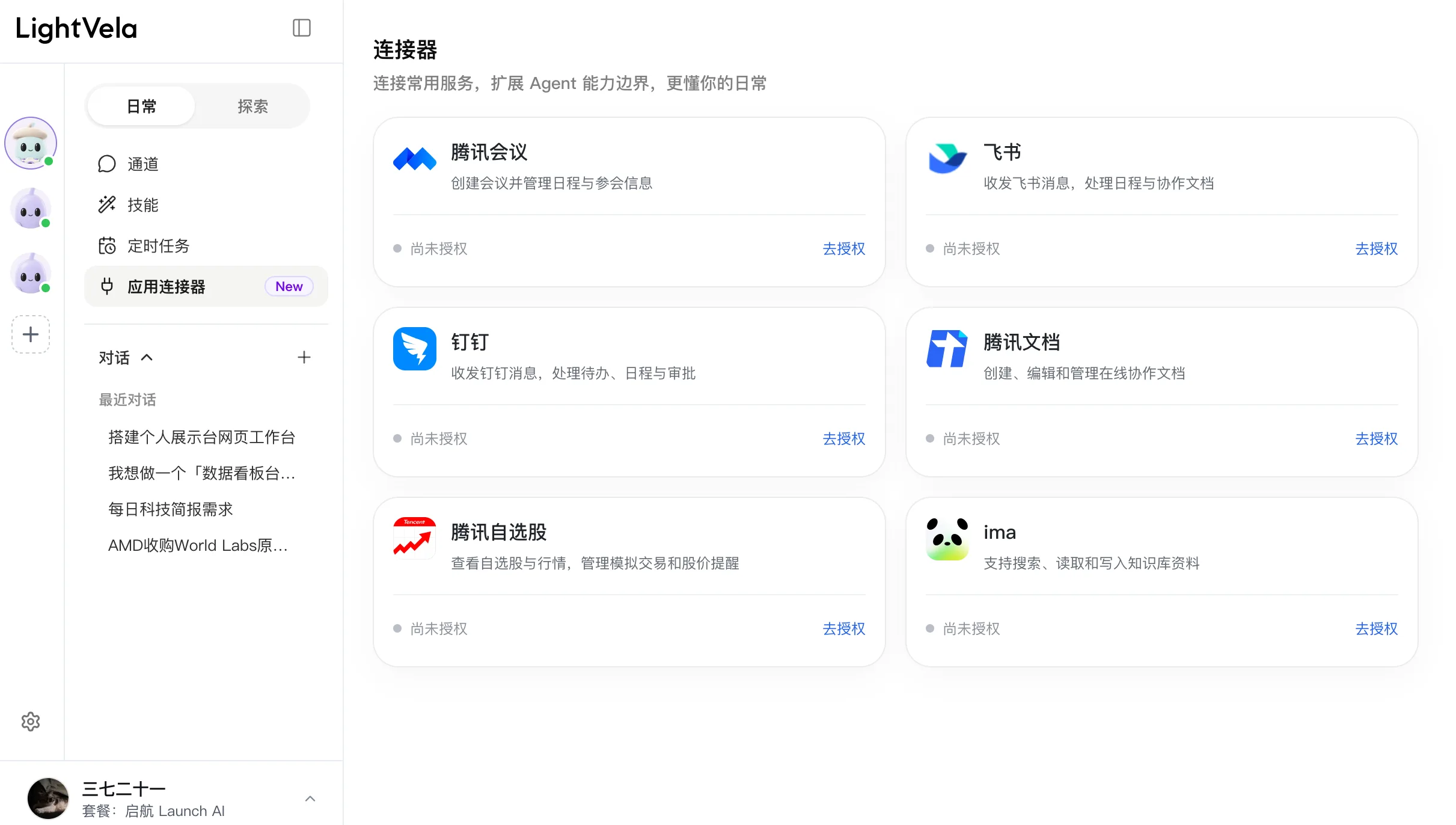
Back to the interface. In LightVela's design, various custom Bots are concentrated on the left side. You can customize an Agent Bot based on existing recommended templates—for example, I customized two sub-Bots, respectively responsible for industry research and fact-checking.
The conversation list follows the Bot, and the interface is divided into "Daily" and "Explore." Chat, skills, channels, scheduled tasks, and app connectors are placed in Daily; persona, persistent memory, achievements, as well as model, cloud computer, and other settings are placed in Explore.
This indeed avoids filling all options at once, but it also means that assigning work to the assistant and adjusting the assistant itself require switching back and forth between two sets of pages.
Another key point is "persona." If skills and connectors solve the methods and sources of information for doing things, persona and memory determine what kind of assistant LightVela is and how much it knows about you. In fact, this is also the key to a Personal Agent—not only the initial persona, but also memory correction during long-term use.
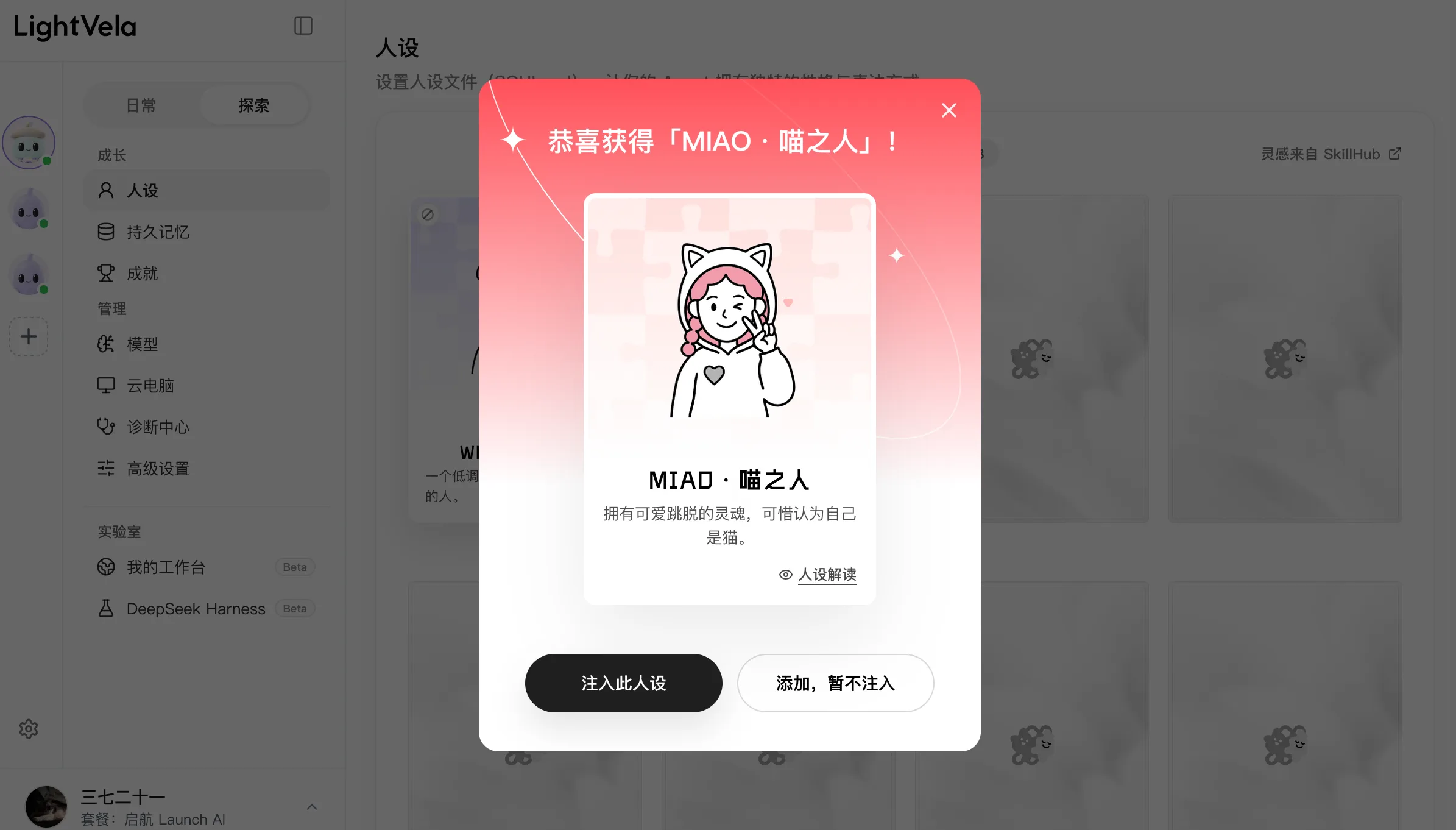
The persona page is the place in this product with the strongest sense of "nurturing." I clicked "Extract Persona," then started drawing cards, and got a "MIAO Meow Person." There are illustrations and personality interpretations, and you can continue to view expression style and action logic. This interaction is quite interesting. A set of character rules that originally required users to write themselves has been turned into cards that can be selected and collected. The process of choosing an assistant also adds a bit of fun in discovering personalities.
Of course, a more accurate approach is still to take a persona test, forming an initial Agent persona through answers to a series of questions.
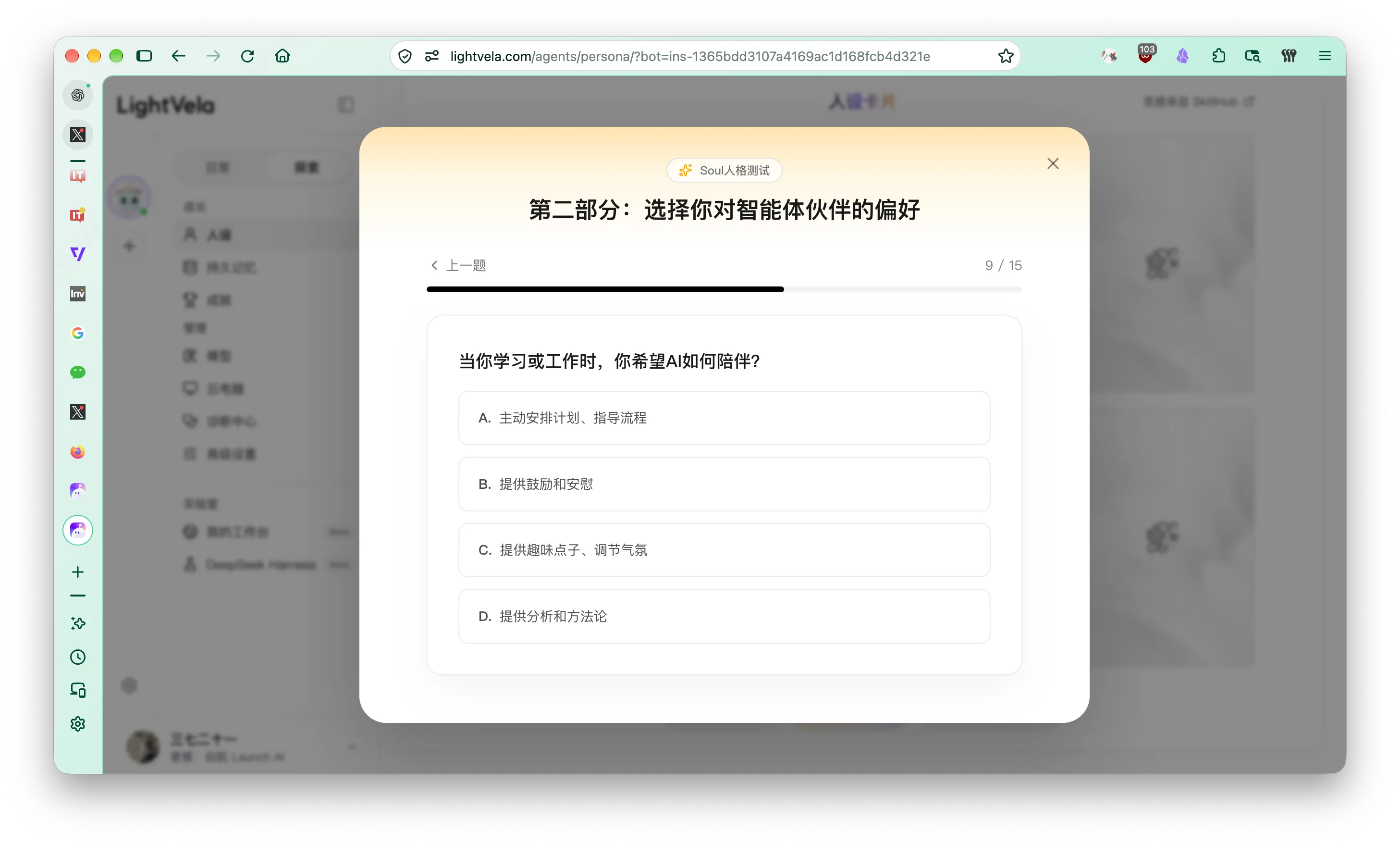
After understanding these features, it became easier for me to grasp LightVela's approach: first create an assistant, then gradually decide how the assistant works, what materials it accesses, and how it gets along with you. The question is, can ordinary users smoothly find the features they truly need in this process?
Next, it's time to let the assistant do some work.
Simpler Than Building Hermes Yourself, but How Are the Results?
The first task for LightVela was somewhat about letting AI research itself. I asked LightVela to check the official website's update log and documentation, organize the three changes—multiple Bots, cloud computer, and workbench—clearly state the launch time and usage boundaries, attach original sources, and finally deliver a briefing and a source table.
The task was not complicated, but it could both test whether the Agent would look up information and generate files, and make it convenient to return to the official original text to check whether the results were reliable.
The one responsible for this task was the industry researcher Bot I had just created. In the already activated account, keeping the "Auto" model option, without installing additional skills and without first connecting WeChat or Feishu, I could directly assign the work.
At least from the threshold for starting work, LightVela is indeed easier than deploying Hermes yourself. The page showed that the researcher Bot took 1 minute 18 seconds and returned the organized results of three updates, as well as the file paths for a Markdown briefing and a CSV source table.
Seeing a long string of server paths for the first time was indeed a bit jarring. Ordinary users want files—who cares which directory the Agent put the briefing in?
Fortunately, both files were delivered as clickable links. Clicking them opens a preview in the side panel, and they can also be downloaded directly—it's just that the interaction design is not intuitive enough.
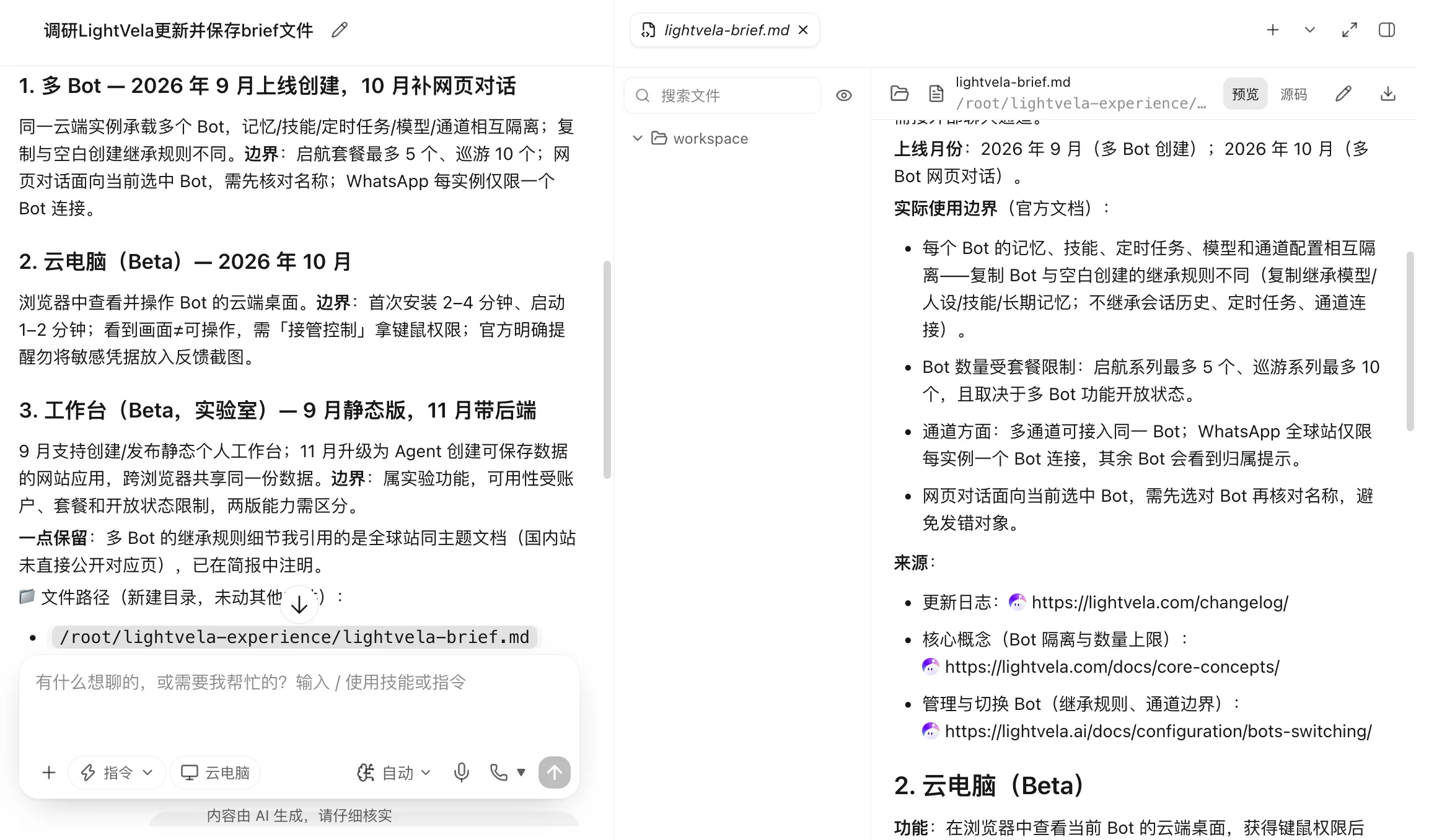
Of course, being able to open the files is only part of delivery; the key is also the quality of the results.
In practice, in the briefing, the researcher Bot cited the Bot management documentation from the international site, brought WhatsApp rules into the explanation for the domestic site, and also claimed that the domestic site had no corresponding documentation. In fact, the domestic site has a page on the same topic.
The problem is typical. The source did come from the official site, and the link looked correct, but it may not apply to domestic site users. If one simply sees "all verified from official website originals" and adopts it directly, errors will likewise enter the draft. This is also a step I still dare not skip today when using an Agent for research. Attaching sources is of course better than having none, but you still need to see whether the source really supports the sentence in front of you.
Giving the Agent a Computer Doesn't Necessarily Mean Things Get Done Well
Today, cloud computers have become a necessary design for Personal Agents, and LightVela officially added cloud computer support in its October upgrade. Now that AI has its own desktop environment, can it open web pages, operate software, and hand back results like a human?
The actual situation needs to be viewed separately. During this experience, I opened the cloud computer and also obtained keyboard and mouse control, and could enter the cloud environment where the Agent is located. But the official documentation's explicit description of this Beta feature is that users view and take over the cloud desktop. As for what operations the Agent itself can complete, that still depends on the actual tools and execution results.
So I assigned the researcher Bot a very simple browser task: open the official update log, find the November update, and send a screenshot to the current chat. No user takeover was required, and no additional software or skills were installed.
After waiting 1 minute 12 seconds, the screenshot was still not obtained.
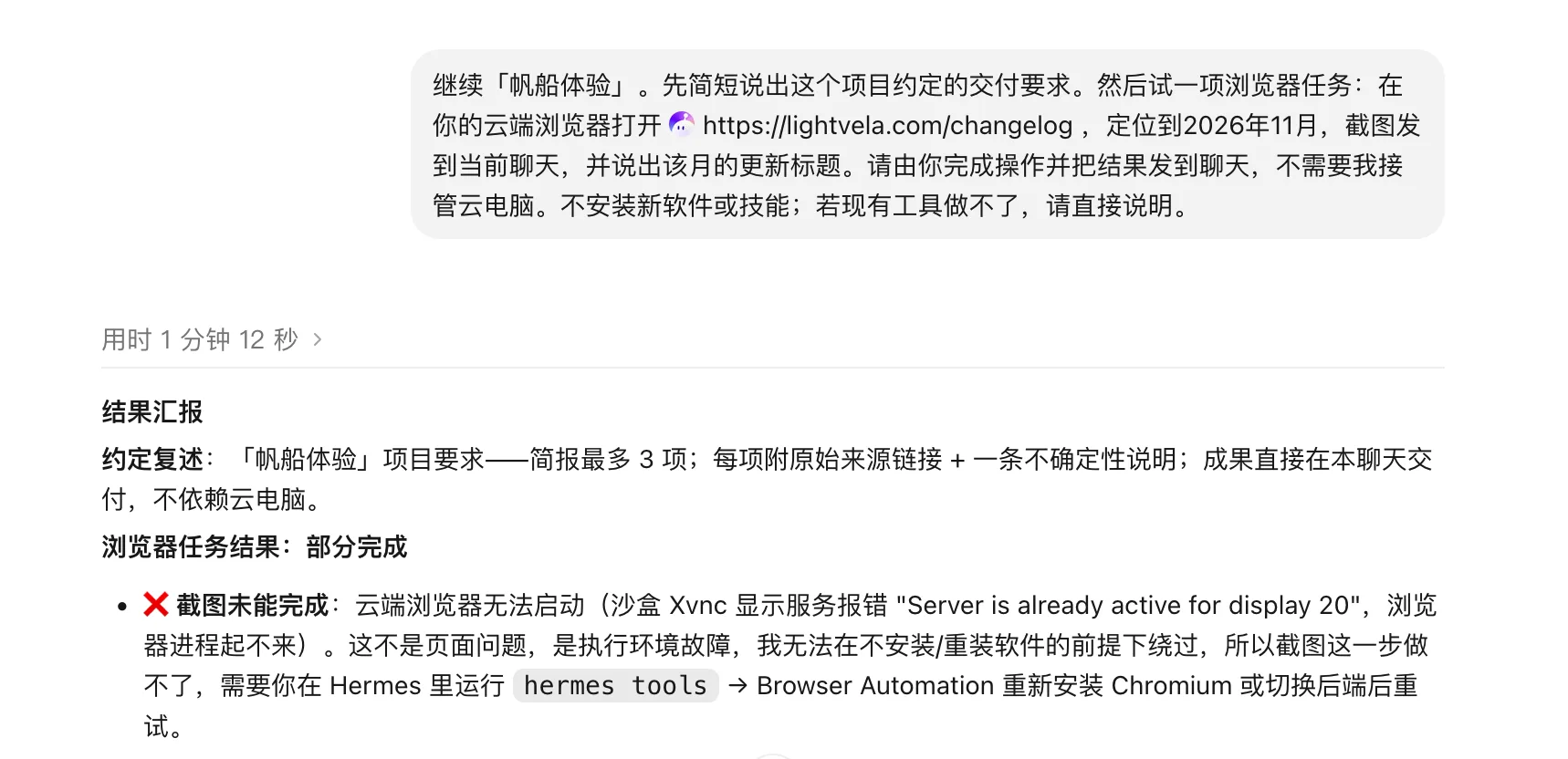
The Bot reported that the cloud browser encountered a display service conflict during startup, then switched to a web scraping tool and returned the November update title and description. But no matter what, the image I originally wanted was indeed not completed. In many cases, cloud hosting can indeed save people deployment work, but problems encountered during execution may still have to go back to the user.
Another feature that concerned me is "My Workbench Beta." LightVela actively lowers the usage threshold in its design and similarly prepares some quick-to-use templates, including a clean tool bench, data dashboard bench, operations activity bench, and personal showcase bench.
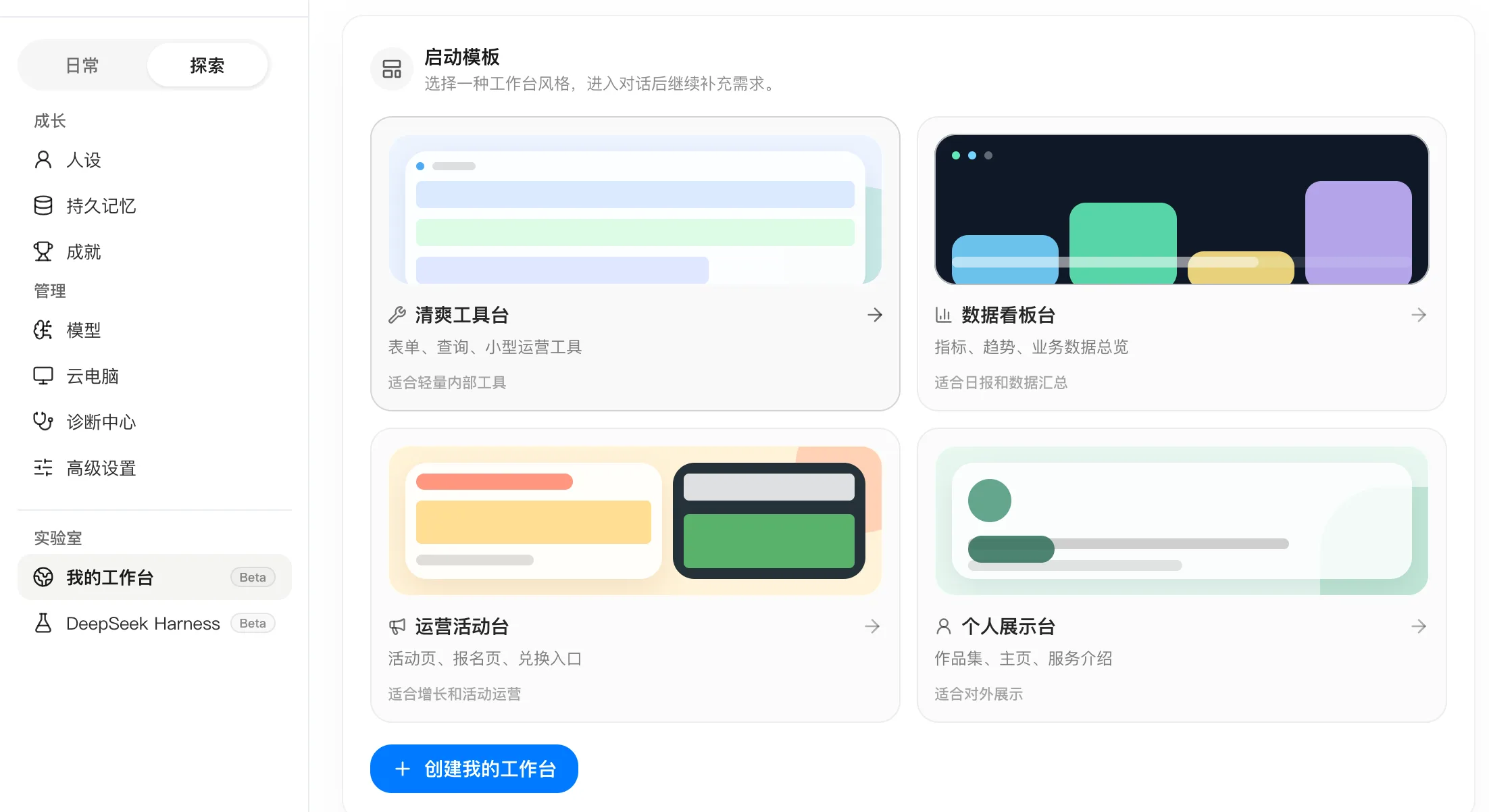
As the old saying goes, "Ideals are plump, reality is bony."
Take the "Data Dashboard Bench" as an example. After clicking it, it directly jumps to the main Bot to create a new conversation and first automatically sends a large template request containing technical stack requirements such as React, TypeScript, and Tailwind. The first attempt encountered an extremely long thinking process, after which the Bot asked for brief answers to some questions, including displayed data, sources, update frequency, etc., and then continued working.
The "Data Dashboard Bench" example may have involved some accidents, and it is actually not very related to my daily needs. By comparison, the personal showcase bench can become everyone's new resume in the AI era. As before, based on the template, the Bot asks about display audience, highlighted content, style preferences, and other questions. It took more than 17 minutes in total to complete the website development work, but the result still got stuck at the last step:
Website upload.
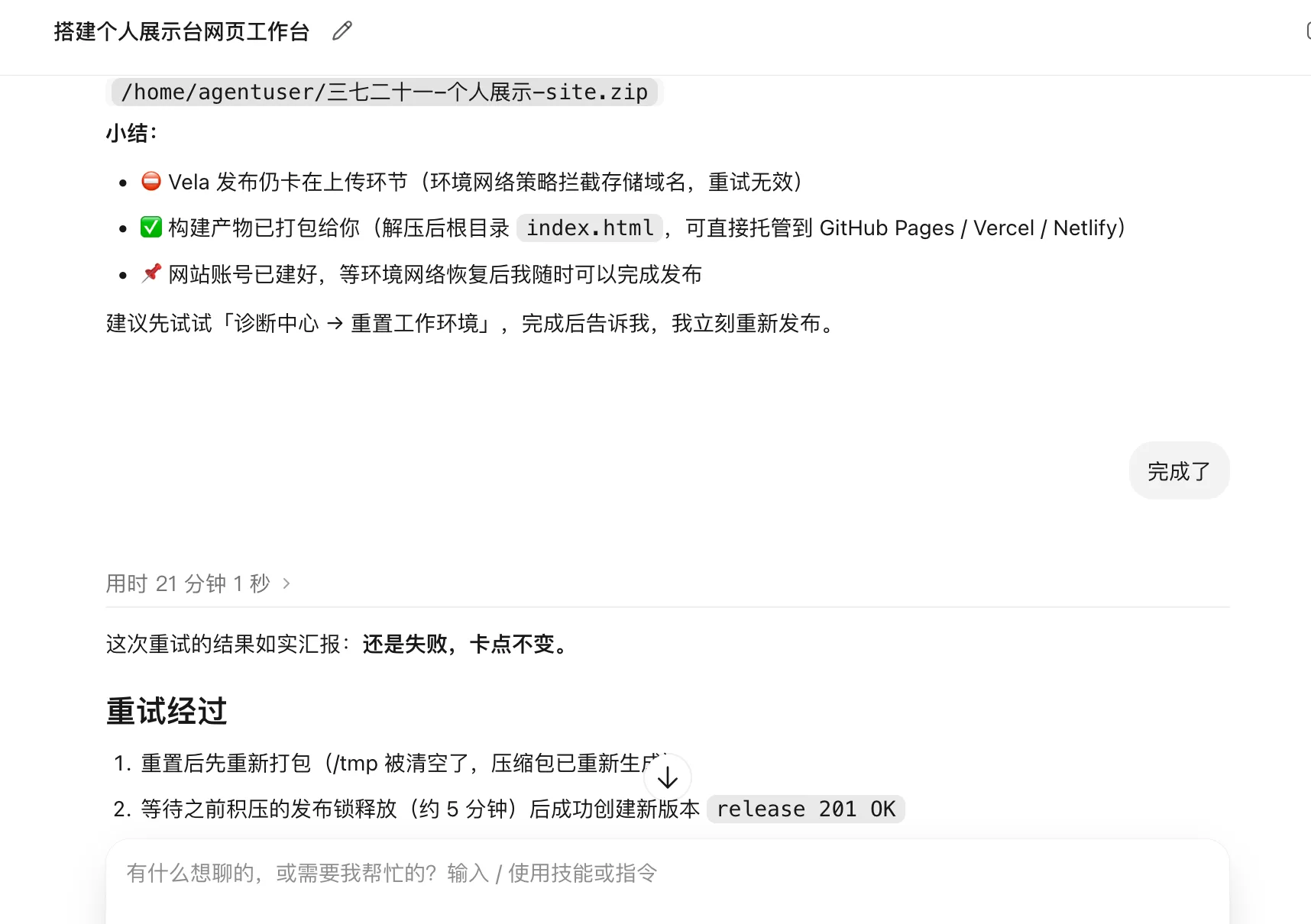
After I followed the AI's prompt and reset the working environment in LightVela's "Diagnostics Center," I tried again for 21 minutes, but it still failed. In fact, in "My Workbench," I could already see the personal showcase website with the status "Online," but visiting it in the actual test showed that the page did not exist.
Judging from the local preview results, the personal showcase website made by LightVela does not perform poorly in terms of design and editability—at least I was quite satisfied with it.
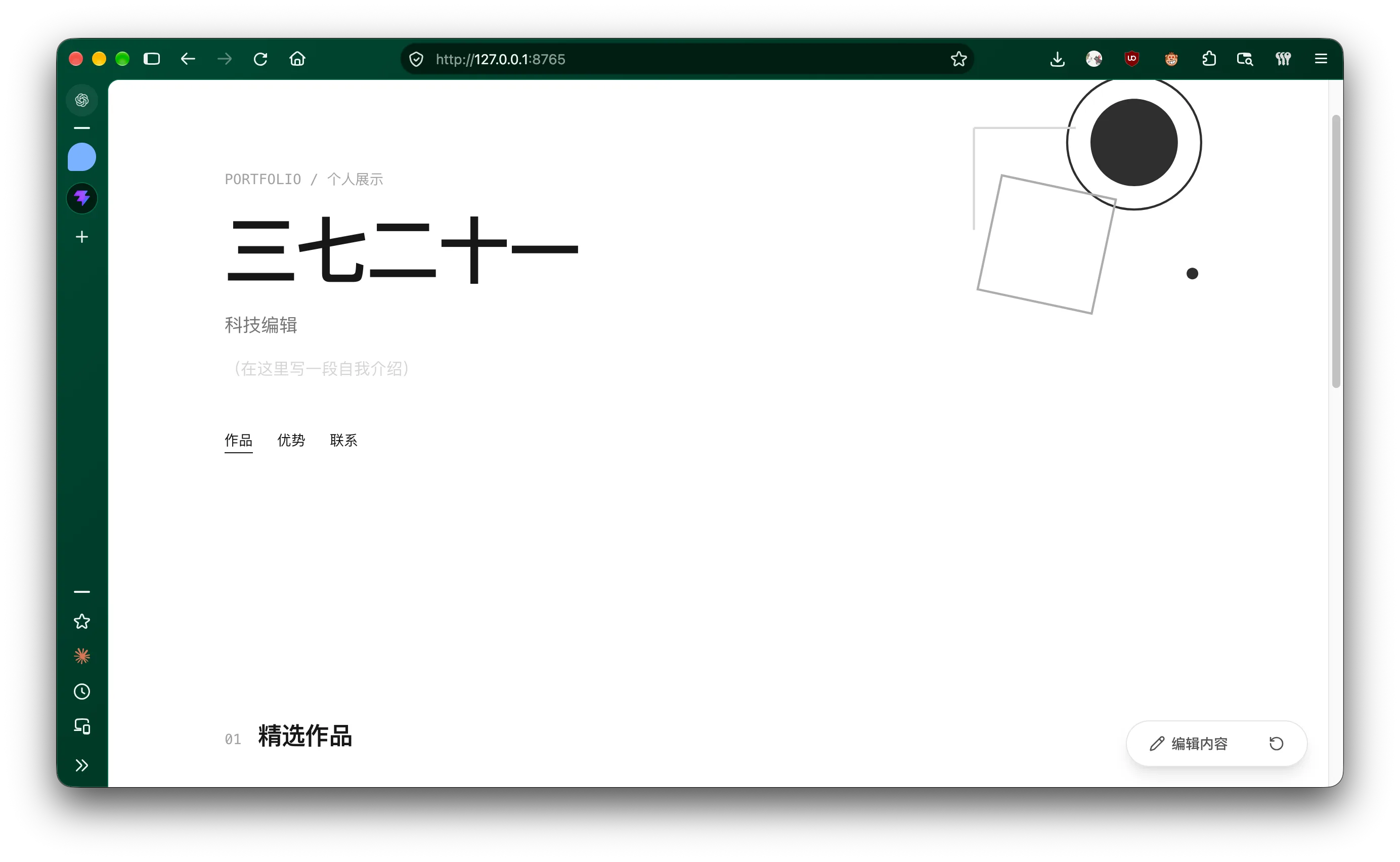
Image source: Leitech
Final Thoughts
LightVela leaves users with many choices—they can decide the assistant's responsibilities, model, skills, and way of working, while also using templates, images, and chat entry points to try to make these choices simple. But where the connection is not good enough is that users suddenly have to understand environment failures, technical requirements, and the relationships between different Bots.
Especially today, with office Agents represented by WorkBuddy and personal Agents represented by Muse already relatively mature in product design and experience, and with details increasingly refined, LightVela is really hard to satisfy people with. Ultimately, Agent products are first of all "products," and the standards for product experience have not essentially changed—they are still smooth, natural interaction and features and services that meet needs.
Memory and cloud environments are becoming capabilities that more Agents possess, and LightVela also needs to further explain how much convenience these capabilities combined can bring to daily work.
But if you want to use Hermes, are unwilling to maintain the server yourself, and still hope to retain room for configuration and expansion, LightVela has already provided a fairly direct entry point. As for users who just want to give one sentence and then wait to receive the results, LightVela's experience this time is indeed not enough for me to recommend it with confidence, whether or not it is a Personal Agent.
Source: Leitech
Images in this article are from: 123RF licensed image library Source: Leitech
-
![]()
SpaceX's Starship Was "Caught" — So Why Didn't the Stock Follow?
-
![]()
"Hua-series" Cars Score Big: HarmonyOS Jumps 139%, Arcfox Up 112%, Xiaomi Drops 11%
-
![]()
Billions in Losses: Xiaomi Auto's Sales Are "Winning Big," So Why Is the Business Bleeding?
-
A Robotaxi at 1.13 Yuan per Kilometer Is Reshaping the Livelihoods of Seven Million Ride-Hailing Drivers
-
Mercedes-Benz Freezes Investment in Germany While Expanding Production in China: Can Halving Costs Double Sales?
-
![]()
Tencent's Muse? Hands-On with the New LightVela: More Like a Personal Agent Than Ever, but Still Not Perfect
-
After the Jensen Huang Incident, Has AI Computing Power Construction Entered Garbage Time?
-
The AI Onslaught on Short Dramas: A Winter Without Obituaries