SpaceX's Starship Was "Caught" — So Why Didn't the Stock Follow?
 11/18 2026
 359
After the U.S. market close on November 13, Starship's 15th test flight delivered a scene straight out of science fiction: the ship flew in orbit for roughly 22.5 hours, circled the Earth 14 times, precisely deployed 26 next-generation Starlink satellites, and then landed steadily in the launch tower's "chopstick" robotic arms.
It marks the first time humanity has successfully caught a rocket second stage returning from orbit.
Unfortunately, the dual-capture goal set for this flight was only "half" achieved: the first-stage booster did not have enough fuel for the return trip, so flight control proactively abandoned the catch and switched to a splashdown in the Gulf of Mexico.
Previously, in the 3Q earnings review "SpaceX: From 'Rocket Guy' to 'Landlord' — Who Will Pay for Musk's New Trillion-Dollar Pie?", Dolphin Research noted: dual-stage capture will be SpaceX's biggest positive catalyst since its IPO.
The underlying logic: driving down costs with Starship is the prerequisite for fully unlocking the grand narratives of V3 constellation deployment and "space data centers." Once reuse proves out the TCO (total cost of ownership) model, the valuation centers of Starship and Starlink should be revised upward.
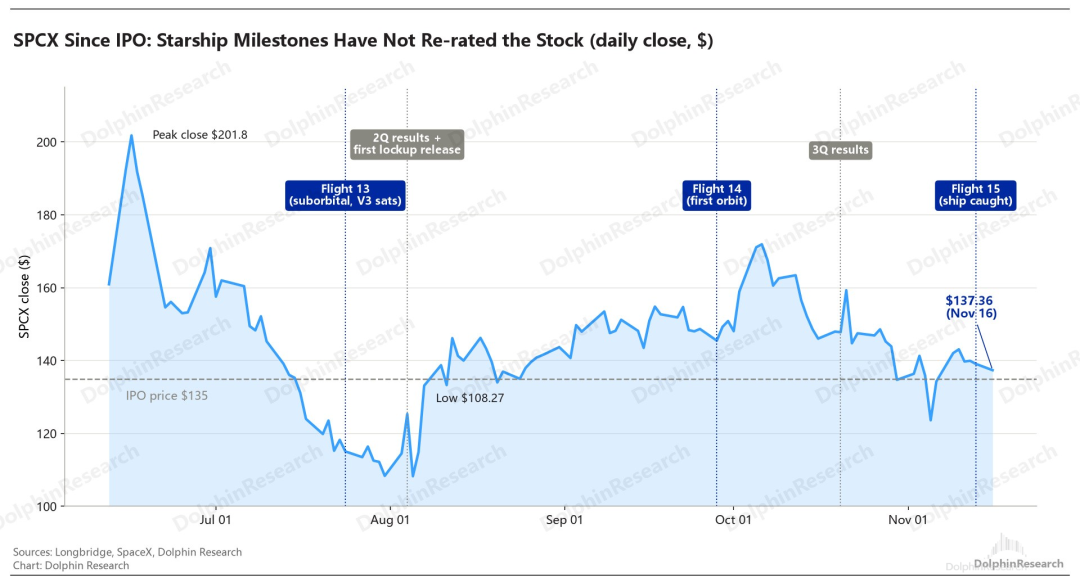
Yet the capital market's reaction was unusually cold. Although the stock rose as high as $141 in premarket trading on Monday (November 16), it quickly fell back alongside the broader tech selloff after the open and eventually closed down 1.3% at $137.36.
That price is only 1.7% above the $135 issue price and has pulled back nearly 16% from the mid-October high of about $163.
It made history technologically — so why was the stock price so unmoved? Where exactly is the expectation gap? Below, Dolphin Research addresses several questions in detail:
1) How did the 15th test flight actually perform?
2) Why is second-stage reusability so important?
3) Why didn't the stock price rise after the test flight?
4) What impact does this test flight have on SpaceX's valuation?
5) What should we watch next for SpaceX?
The following is a detailed analysis
I. How did the 15th test flight actually perform?
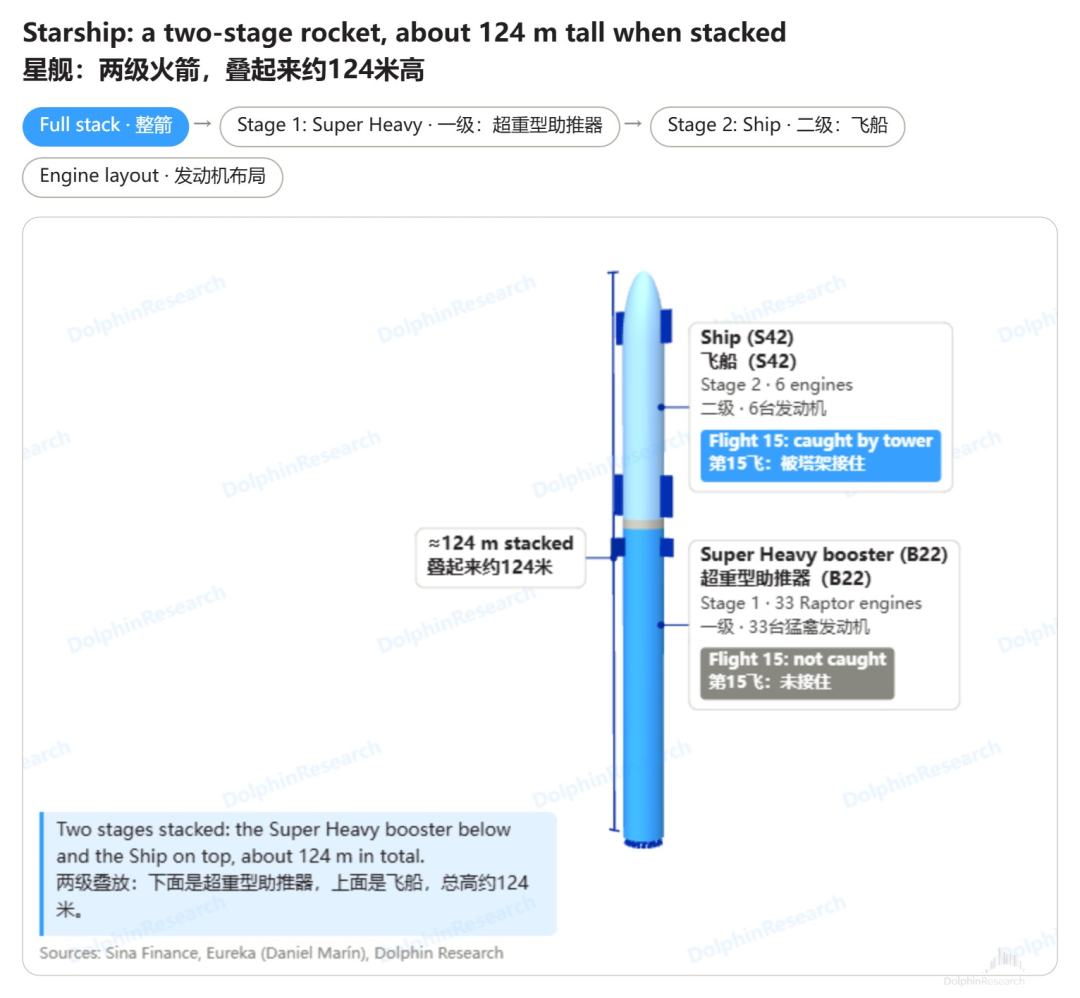
Starship is a two-stage rocket, with the two stages stacked about 124 meters tall:
a. First stage: the Super Heavy booster, equipped with 33 Raptor engines. It does not enter orbit after separation and flies back to the launch site about 6.5 minutes after liftoff. This is the one that was not caught this time (B22).
b. Second stage: the Ship, equipped with 6 engines (3 sea-level versions, 3 vacuum versions). It is responsible for entering orbit, deploying satellites, and then re-entering the atmosphere from orbit and returning. This is the one that was caught this time (S42).
The ship is much harder to catch than the booster: the booster never enters orbit throughout the flight, whereas the ship must first climb to an orbit of about 275 kilometers, then rush back into the atmosphere at about 26,000 kilometers per hour. The heat shield tiles must withstand temperatures of over a thousand degrees Celsius, and finally it must fly precisely into the robotic arms' "catch window." Musk had given only a 50-60% chance of catching both stages beforehand.
1. The ship: from "able to fly up" to "able to be brought back" in three months
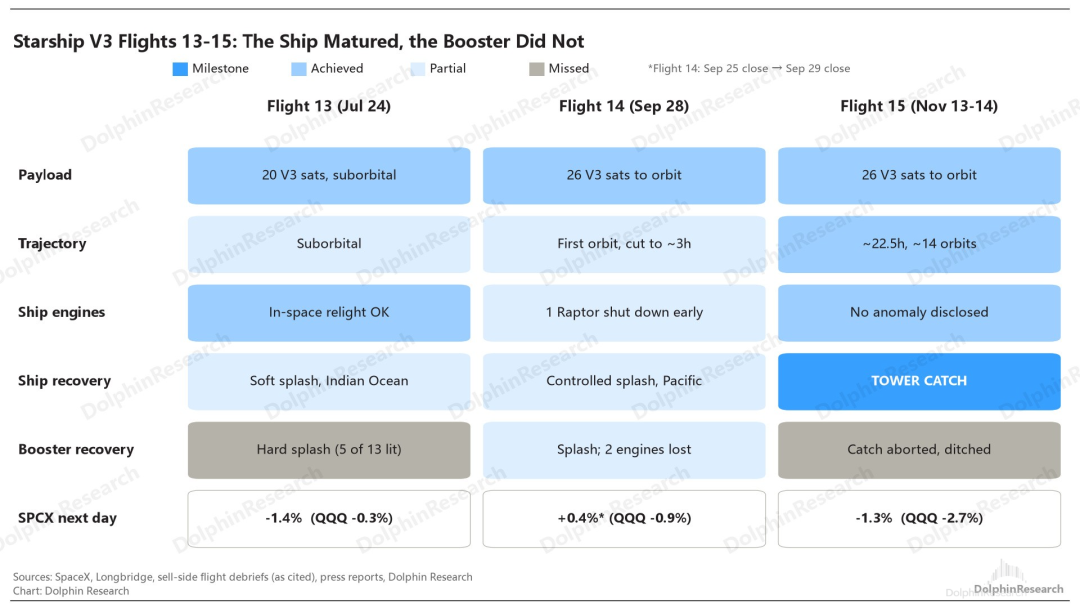
Compare the last three test flights: in July, the 13th flight was still a suborbital flight and splashed down in the Indian Ocean; in September, the 14th flight entered orbit for the first time, but because one engine shut down early, the originally planned 10-hour mission was shortened to about 3 hours; this time, after 22.5 hours in orbit and 14 orbits around the Earth, it returned precisely and was caught.
More importantly, the ship can be brought back to the workshop for disassembly and inspection. After examining the heat shield, Musk said it was in good condition and could fly again after a few weeks of refurbishment. He hopes the 16th flight will directly reuse recovered hardware.
Dolphin Research believes a more realistic path is to first remove high-value components such as engines and heat shield tiles and install them on the next ship; reaching "land, refuel, and fly again like an airplane" is still several iterations away.
2. The booster: the old problems of the new-generation engines still have not been fixed
The direct reason the booster was not caught was insufficient return fuel margin: flight control judged that it could not enter the capture window, so under the contingency plan it switched to a splashdown in the designated area of the Gulf of Mexico. Musk initially believed it was related to lower thrust from some engines; the final cause must wait for telemetry data. The short-term fix is to shut down earlier next time to leave more fuel for the return.
This is not an isolated case: since the V3 booster's first flight on the 12th test flight in May, engine issues have occurred in almost every recovery segment — on the 13th flight, only about one-third of the engines ignited for the landing burn, and on the 14th flight, 2 more were lost before splashdown.
External engineering analysis suggests that to reduce weight, V3 eliminated the heat shields and bulkheads between engines, so one problem can easily affect several nearby engines. In addition, ignition, timing, and software have also had issues, and what is needed is systematic reinforcement of the entire engine group; whether this time has the same cause still awaits official conclusions.
On the positive side, the protective mechanism of "abandon if something looks wrong" worked, and the highly valuable Launch Tower No. 2 was not damaged, so the next launch does not have to wait for tower repairs. Moreover, SpaceX had already caught and reflown two boosters many times on the previous-generation booster, so this is more a matter of debugging new-generation hardware than a question of "whether it can be done."
3. Payload: Starship has started doing "real work"
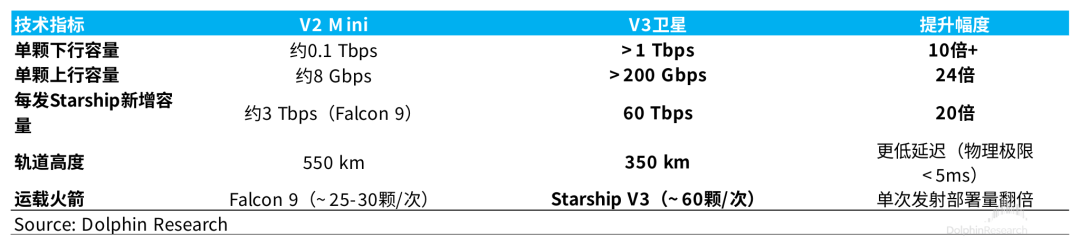
All 26 next-generation Starlink satellites came online. This generation of satellites weighs about 2 tons each and has downlink capacity exceeding 1 Tbps, about 10 times the previous generation, and only Starship can launch them; the capacity carried this time is roughly equivalent to 10 Falcon 9 launches, and with a full load of about 60 satellites it can reach more than 20 times that.
But management has said that users will clearly feel faster internet speeds only after hundreds of new satellites are in orbit, with the target set for the middle of next year. So far only 52 have been launched. At 26-60 per flight, about 5-15 more flights will be needed before mid-year. The faster payload capacity rises, the fewer flights are needed — and whether the cadence can keep up again comes back to "how soon after recovery can it fly again."
Dolphin Research gives this test flight an A-: all mainline objectives were completed, with the deduction for the booster. The 16th flight is planned before the end of the year, and booster capture is more like a "delay" than a "failure"; but if engines are still lost next time, reliability will escalate from a secondary issue to a primary one.
II. Why is second-stage reusability so important?
Falcon 9 recovered only the first stage and already pushed launch prices down to a fraction of competitors'. For Starship to drop another order of magnitude, the prerequisite is that both stages can be reused repeatedly — and the second stage is precisely the most expensive and hardest to recover, having basically been a one-time consumable in the past.
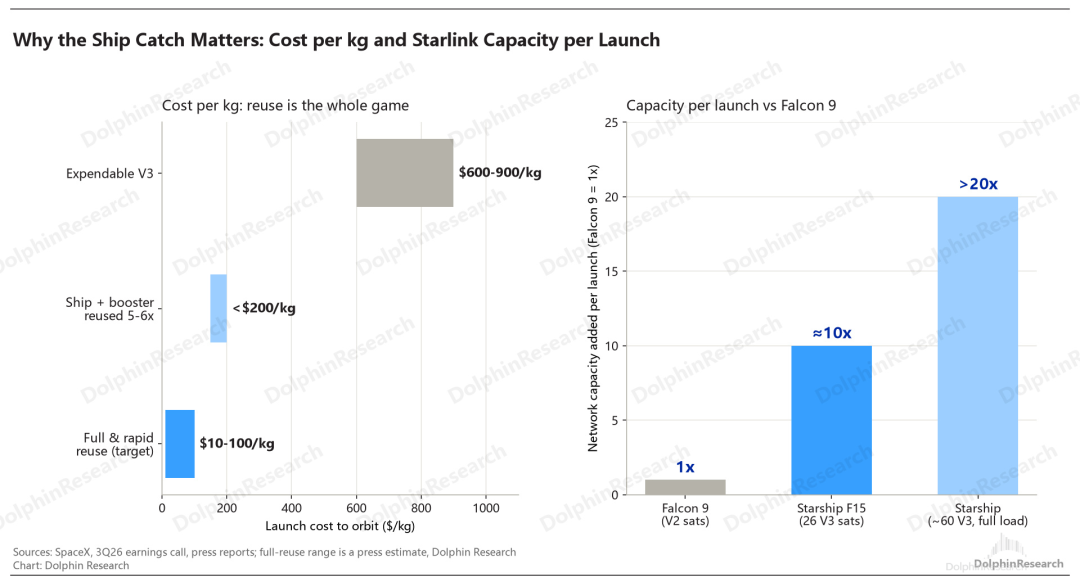
SpaceX's long-term goal is to reduce launch costs to below $200 per kilogram, more than 99% lower than the industry's historical average (about $18,500); Musk's farther-out vision is about $10 per kilogram, basically leaving only fuel costs.
How far is it from the goal?
Based on the Starship launch contract prices disclosed by U.S.-listed companies (about $90 million per flight), Dolphin Research estimates that a new-generation Starship without reuse costs about $600-900 per kilogram (payload 100-150 tons); referring to the historical relationship between cost reduction and reuse count, reusing each of the two stages 5-6 times would bring it below $200.
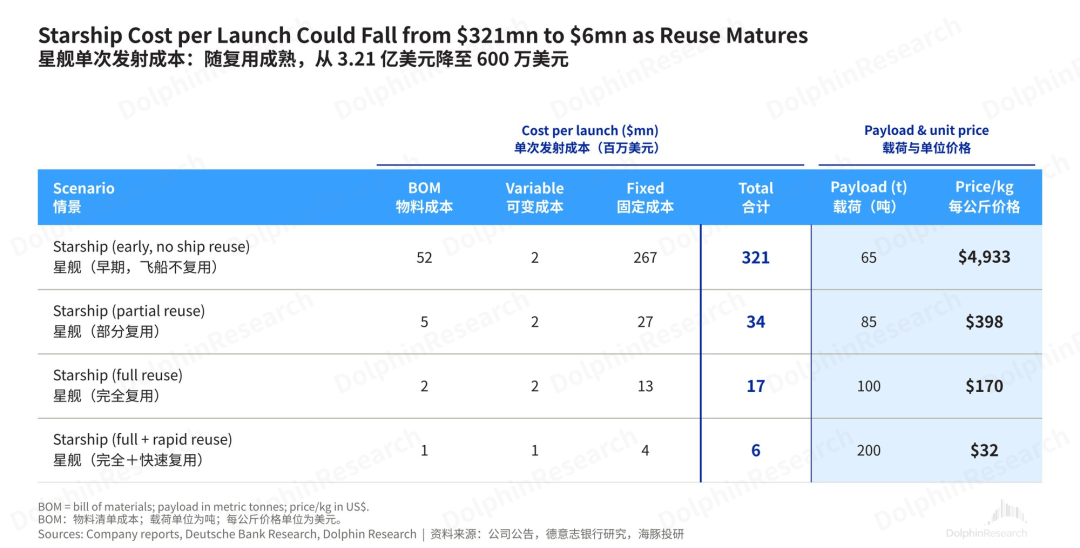
And according to DB's estimates, an early ship without reuse costs about $4,900/kg, partial reuse about $400 (around 2029), full reuse of both stages about $170 (around 2032), and with rapid turnaround and single-flight capacity raised to 200 tons, it could be as low as just over $30.
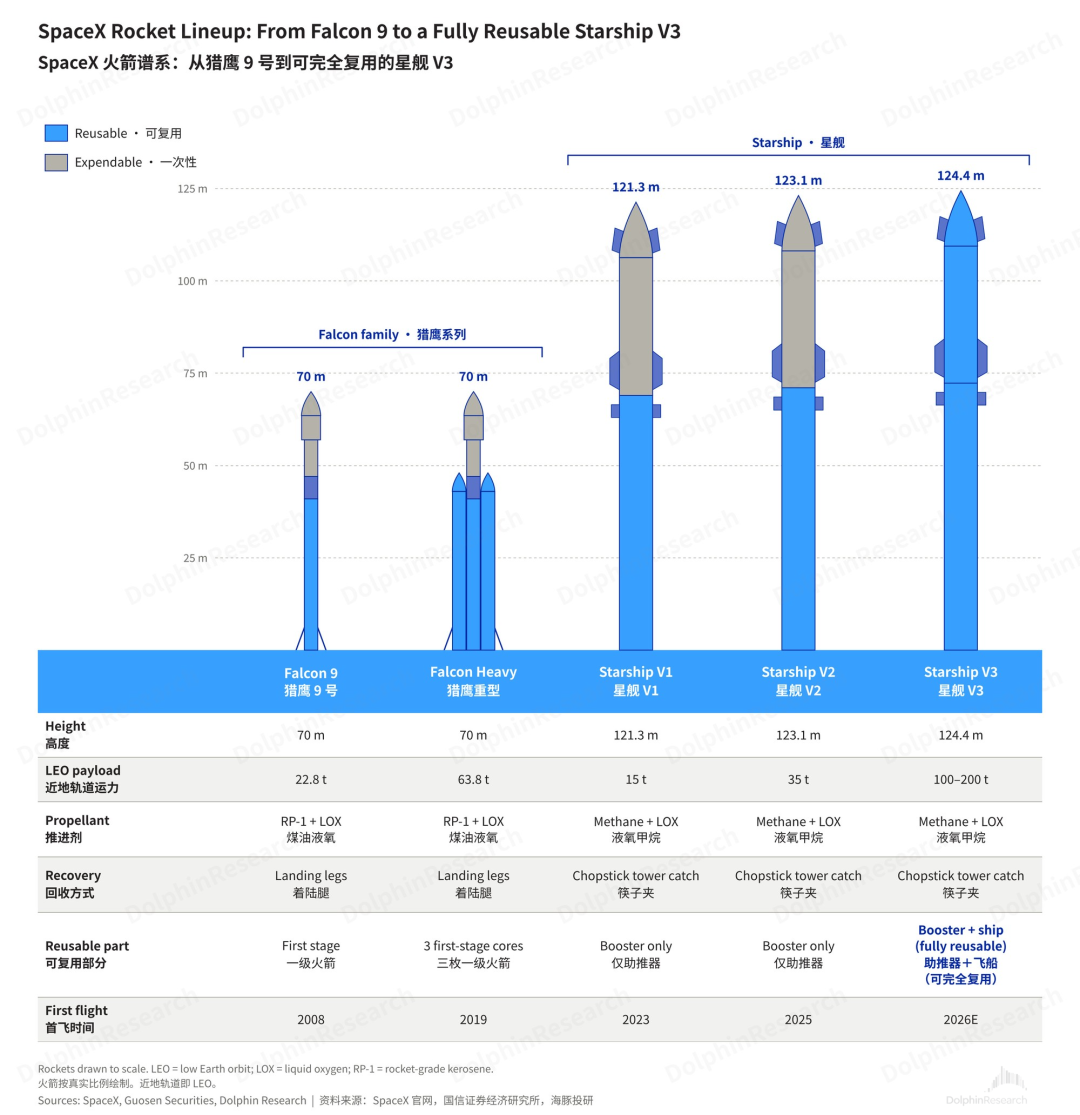
This cost curve matters because several of SpaceX's big stories rest on it:
(1) Starlink: cheaper and cheaper to launch
The manufacturing cost per Gbps of V3 satellites has already fallen by nearly 90% compared with the first generation, and the remaining major part is launch. If launch costs fall to $100-200 per kilogram, Starlink's unit bandwidth cost can compete with terrestrial fiber, and the market will no longer be limited to remote areas, oceans, and aviation.
(2) Space computing: $200/kg is the watershed
At present, the cost per kilowatt of space computing is about 3-5 times that of terrestrial data centers. Most estimates regard $200/kg as the break-even line for orbital data centers, and the cost after full Starship reuse lands right near or below this line. Of course, satellite manufacturing, heat dissipation, and lifespan costs must also come down in tandem.
(3) Launch business: Falcon 9 must "pass the baton"
According to reports, SpaceX is no longer accepting Falcon 9 orders after 2028, indicating the company is confident that Starship will take over; NASA's lunar landing contract (over $4 billion) and the first in-orbit propellant transfer demonstration in the first quarter of next year also depend on Starship's reliability.
But note that "catching" does not equal "reuse." What determines the economics is how long refurbishment takes and how many times one ship can fly. On Polymarket, the probability of "officially announcing full second-stage reusability before the end of the year" is only about 30%, while extending the deadline to the end of next year raises it to 72%, indicating that the market believes full reuse is likely to come, just later.
In terms of the competitive landscape, the gap is still widening:
a. Over the same weekend, United Launch Alliance's (ULA) Vulcan rocket experienced an anomaly while launching for Amazon's satellite internet constellation, and the satellites failed to enter orbit;
b. After Blue Origin's rocket explosion in May, the launch pad will not recover until early next year;
c. The first flight of Rocket Lab's medium reusable rocket "Neutron" has been delayed to 2027;
d. China's Long March 10 has achieved booster recovery, but it is still some distance from orbital-class second-stage recovery. In the short term, no second company can provide reusable capacity at the same level as Starship.
III. Why didn't the stock price rise after the test flight?
On the surface it fell, but SPCX now looks more like a highly volatile "AI infrastructure stock": using daily data since listing, Dolphin Research estimates its beta to the Nasdaq 100 at about 1.55-1.6, meaning that if the Nasdaq falls 1%, SPCX usually falls more than 1.5%.
On Monday, according to reports, Nvidia CEO Jensen Huang unexpectedly resigned, compounded by financing concerns over AI investment and policy uncertainty after the congressional turnover, Nvidia fell 4.1%, the semiconductor ETF fell 5.4%, and the Nasdaq 100 fell 2.7%.
Based on beta, SPCX "should have" fallen about 4.2% that day, but it actually fell only 1.3%. The extra roughly 2.9 percentage points (about $54 billion in market value) is the excess return brought by the test flight; on the same day it also outperformed other space stocks by 5-11 percentage points.
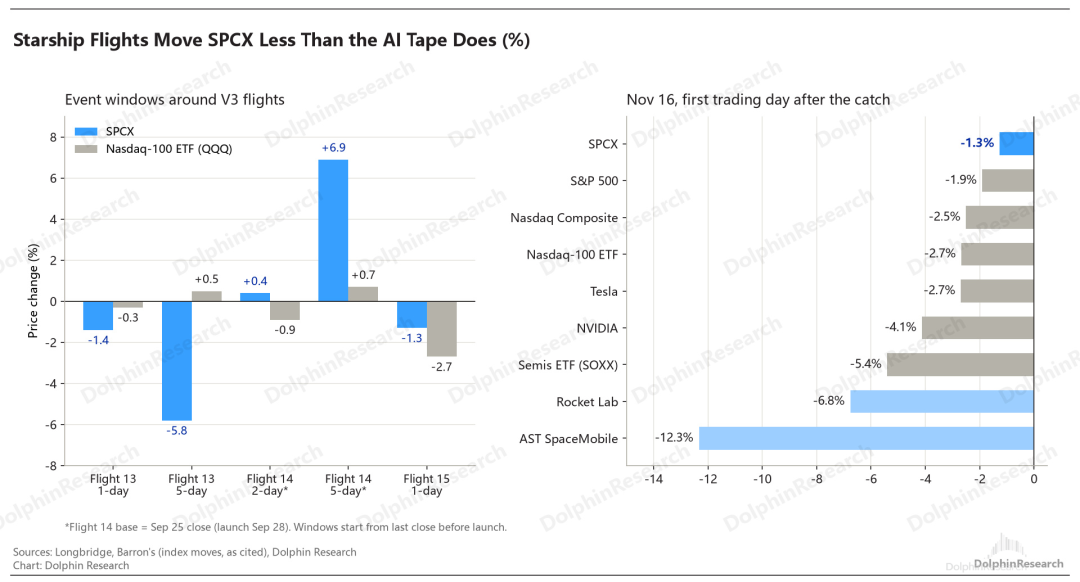
So why was the stock price reaction still limited? Dolphin Research believes there are three reasons:
1) The catalyst was only half realized, and it was within expectations: the "biggest catalyst since IPO" refers to catching both stages, while this time only the ship was caught, so the market naturally gave only half the reward.
Moreover, this was a pre-announced event. Beforehand, it was widely expected that at least one stage would abandon capture, and the result landed exactly in the neutral scenario, with part of the success expectation already priced into the stock.
2) "Catching" still does not equal "reuse": the market looks forward. If full reuse were already certain, it would not wait for the income statement to materialize before re-rating. But how soon the ship can be refurbished and fly again, and how many times it can fly, have not yet been verified. The probability of reuse has been raised, but it is still far from "certain," and the market will only assign a partial premium based on probability.
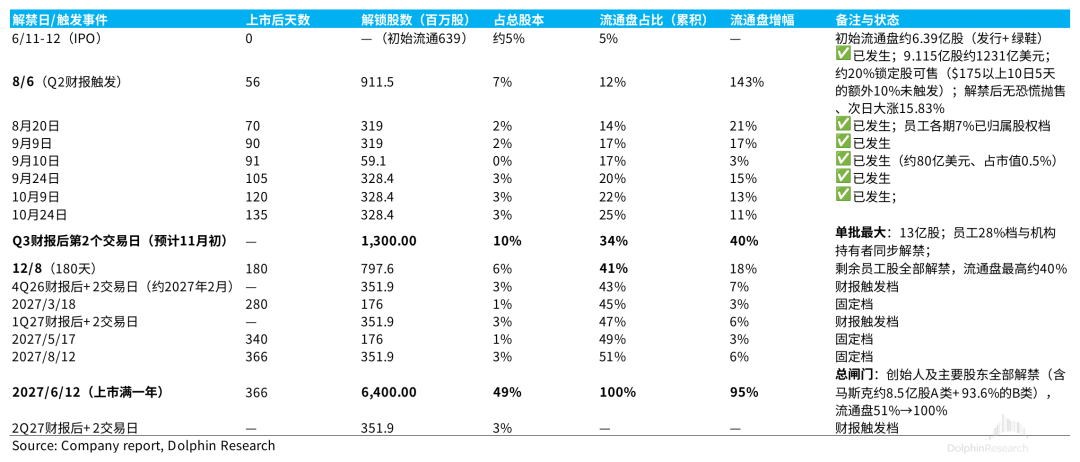
3) Share supply pressure in December capped the upside: at listing, only about 640 million shares were tradable, and by the end of the year this will expand to about 5.3 billion shares, about 40% of total share capital, with the unlocking of remaining employee shares on December 8 being the last batch.
On top of that, details of the 12/3 Tesla merger are yet to be disclosed (Polymarket puts the odds of completion before April next year at over 60%, though it still faces Texas regulatory review), and there is a sizable short position—so whenever good news drives the stock up, some people take the opportunity to sell.
4. What impact does this test flight have on SpaceX's valuation?
Dolphin values SpaceX using a sum-of-the-parts (SOTP) approach:
(1) AI compute rental: approximately $315 billion. This assumes 10GW of total compute in 2027, 60% rented externally, and about $35 billion in annualized revenue per GW—implying roughly $210 billion in annualized revenue by the end of the period, to which a 1.5x price-to-sales ratio is applied.
The multiple is not high because compute contracts are short-term and can be terminated early, making revenue less persistent than that of cloud vendors.
(2) Space + Starlink: approximately $900 billion, the largest component of the SOTP. Of this, Starlink accounts for about $520 billion and Starship about $380 billion; Starlink alone makes up roughly one-third.
This is the valuation under neutral assumptions (reusability gradually realized on schedule); if reusability is achieved faster, Starlink deployment costs will fall faster, and coverage scenarios and user numbers will also rise faster. Under an optimistic scenario, Starlink's valuation would be higher.
(3) AI applications: approximately $310 billion. Grok's annualized revenue is about $10 billion by year-end, and at a 25x price-to-sales ratio that works out to about $250 billion; Cursor is included at an acquisition price of $60 billion.
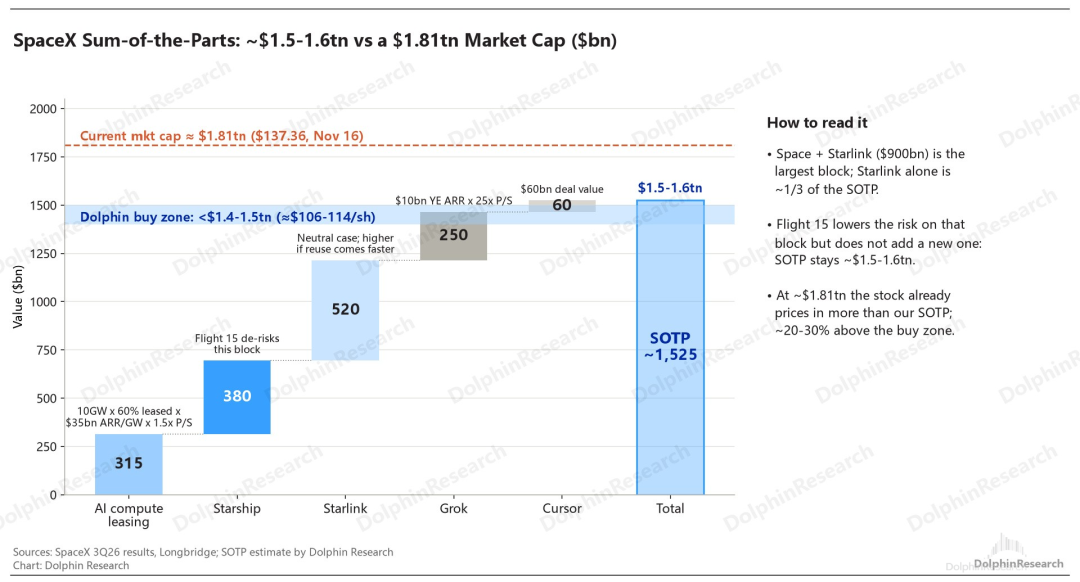
The successful recovery of the spacecraft this time shifts some probability from "pessimistic" toward "neutral and optimistic," so the weighted value naturally moves up—but Dolphin's neutral-case expectation remains unchanged.
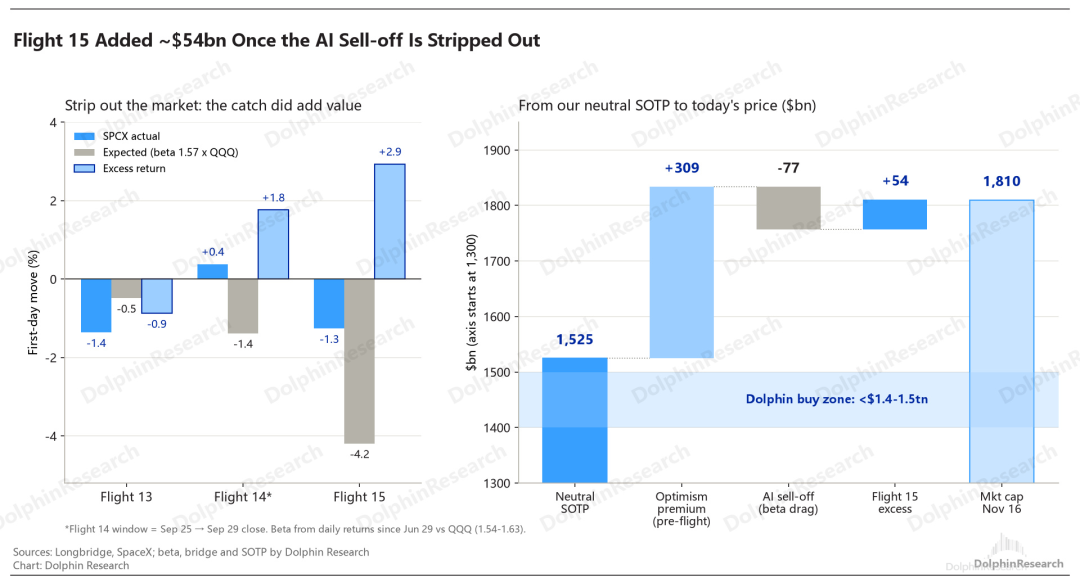
Before the test flight (11/13), the market cap was already about 20% above Dolphin's neutral estimate. This test flight makes that "optimistic premium" more defensible, but does not raise the neutral estimate itself.
However, a higher optimistic probability also means the stock price will be harder to push back down to that level, unless the lockup expiry or continued valuation compression in the AI sector drives prices down.
Also pay close attention to financing risk: cash and marketable securities stood at about $90 billion at the end of the third quarter, while fourth-quarter capex guidance alone is $35–40 billion.
Next year's newly added 10GW of compute, at $30–35 billion per GW, would require at least another $300 billion in investment, leaving a funding gap of more than $100 billion next year as well.
Management says operating cash flow is the priority, supplemented by bond issuance and industry-chain cooperation, while maintaining an investment-grade rating—and did not mention equity financing. But with such a large gap, if it is all funded by debt, maintaining an investment-grade rating will be very difficult. Dolphin believes equity financing is likely unavoidable and will cause share dilution.
5. What to watch next for SpaceX?
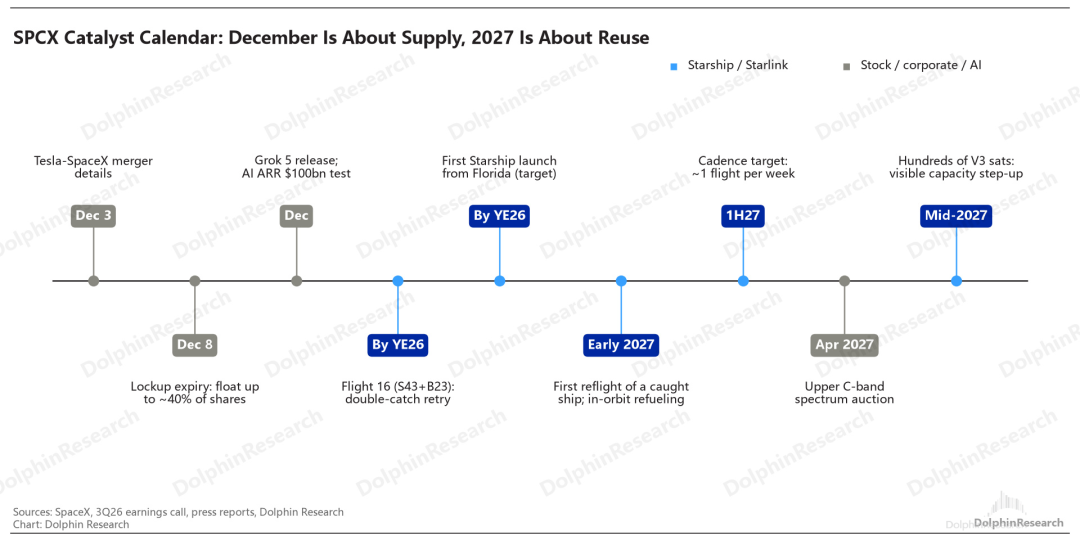
Short term (through mid-December): the stock price mainly depends on three things—sentiment in the AI sector, details of the Tesla merger announced on 12/3, and the final batch of lockup expirations on 12/8.
The role of this test flight is to make SPCX fall less in a sharp selloff; on its own, it is hard for it to push the stock price up. If there is concentrated selling around the lockup expiry, it could instead present a good opportunity.
Medium term (next 3–6 months): watch several "second-step" validations, each of which will adjust the probability of the optimistic scenario:
① The 16th test flight (before year-end): whether both stages can be caught, or even recovery hardware used; if the booster loses engines again, the optimistic probability should be revised down.
② The spacecraft's first reflight (early next year): whether refurbishment takes "a few weeks" or "several months" directly determines whether next year's goal of "one flight per week in the first half and two per week in the second half" can be met.
③ The first on-orbit propellant transfer demonstration (Q1 next year) and the first launch from Florida: for Starship to go to the Moon, it must first be refueled in space by "tanker" spacecraft. This is the most critical milestone in NASA's lunar contract; only if it is achieved can subsequent milestone-based revenue be recognized. The first Florida launch means Starship expands from a single base in Texas to multiple bases—a prerequisite for achieving "one flight per week" next year.
④ Whether AI business annualized revenue can reach $100 billion in December, Grok 5's performance, and whether newly signed compute contracts can "hold prices and have longer terms"—these are the main variables for SPCX's medium-term stock price.
But also note the risks: the speed from "catching once" to "routine rapid reuse" may be overestimated, and engine reliability must improve substantially to support one flight per week; if Starship's pace is slower than expected, it will delay Starlink expansion and the direct-to-cell timeline; if AI compute turns to oversupply, falling rental premiums will directly hit the core value thesis; in addition, there is dilution risk from large-scale financing.
- END -
// Reprint authorization
This article is original content by Dolphin Research. For reprints, authorization must be obtained.
// Disclaimer and general disclosure notice
This report is intended only for general comprehensive data use, aimed at general reading and data reference for users of Dolphin Research and its affiliates, and does not take into account the specific investment objectives, investment product preferences, risk tolerance, financial situation, and special needs of any person who receives this report. Investors who make investment decisions based on this report must consult an independent professional adviser before investing. Anyone who makes investment decisions based on the use of or reference to the content or information mentioned in this report must bear the risk themselves. Dolphin Research shall not be liable for any direct or indirect liability or loss that may arise from the use of the data contained in this report. The information and data contained in this report are based on publicly available materials and are for reference only. Dolphin Research strives for but does not guarantee the reliability, accuracy, and completeness of the relevant information and data.
The information mentioned or views expressed in this report shall not, in any jurisdiction, be treated or regarded as an offer to sell securities or an invitation to buy or sell securities, nor do they constitute advice, inquiry, or recommendation regarding the relevant securities or related financial instruments. The information, tools, and materials contained in this report are not intended or intended for distribution to citizens or residents of any jurisdiction where the distribution, publication, provision, or use of the relevant information, tools, and materials would conflict with applicable laws or regulations, or would cause Dolphin Research and/or its subsidiaries or affiliates to be subject to any registration or licensing requirements in that jurisdiction.
This report reflects only the personal views, opinions, and analytical methods of the relevant creators and does not represent the position of Dolphin Research and/or its affiliates.
This report is produced by Dolphin Research, and the copyright belongs solely to Dolphin Research. No institution or individual may, without the prior written consent of Dolphin Research, (i) produce, copy, reproduce, reprint, forward, or otherwise make any form of photocopy or reproduction in any way, and/or (ii) directly or indirectly redistribute or transfer it to other unauthorized persons. Dolphin Research reserves all related rights.
-
![]()
SpaceX's Starship Was "Caught" — So Why Didn't the Stock Follow?
-
![]()
"Hua-series" Cars Score Big: HarmonyOS Jumps 139%, Arcfox Up 112%, Xiaomi Drops 11%
-
![]()
Billions in Losses: Xiaomi Auto's Sales Are "Winning Big," So Why Is the Business Bleeding?
-
A Robotaxi at 1.13 Yuan per Kilometer Is Reshaping the Livelihoods of Seven Million Ride-Hailing Drivers
-
Mercedes-Benz Freezes Investment in Germany While Expanding Production in China: Can Halving Costs Double Sales?
-
![]()
Tencent's Muse? Hands-On with the New LightVela: More Like a Personal Agent Than Ever, but Still Not Perfect
-
After the Jensen Huang Incident, Has AI Computing Power Construction Entered Garbage Time?
-
The AI Onslaught on Short Dramas: A Winter Without Obituaries